Determining Rheological Extensional Strain Limits for Heated Polymeric Sheet Thermoforming
Extensional strain limits dictate wall thinning stability in sheet thermoforming, requiring strain hardening metrics to prevent ductile necking under rapid draw.


Swell

Extensional Kinematics in Polymer Sheet Stretching
Sheet thermoforming subjects a heated polymer slab to rapid planar and uniaxial or biaxial extensional deformation. Unlike shear rheology, where polymer chains slide past one another between moving boundaries, extensional flow stretches polymer chains along the direction of principal strain. High molecular weight chains disentangle or align depending on the applied strain rate and melt elasticity.
When a sheet expands into a mould cavity under pneumatic pressure or plug assist, local wall thickness drops exponentially with applied Hencky strain. Polymer melts lacking sufficient extensional strain hardening suffer localized necking, driving runaway thinning, corner blowout, and part rupture long before completing the draw.
Linear viscoelastic shear properties fail to predict sheet behavior during inflation and deep-draw forming. Standard melt flow index values measure low-shear capillary discharge, yet sheet deformation during thermoforming occurs at extensional strain rates between 0.1 and 15 reciprocal seconds. At these rates, transient extensional viscosity diverges from linear viscoelastic limits.
Strain hardening manifests as a steep upward deviation in transient extensional viscosity as cumulative Hencky strain builds, distributing applied stress across adjacent thicker sheet zones to stabilize the web against localized necking.
Melt strength governs wall thickness stability during rapid sheet inflation.
Melt strength indicates extensional resistance, measured as the peak force sustained by a molten filament prior to draw resonance or mechanical rupture. High melt strength delays excessive sheet sag inside heating ovens, preserving uniform thermal distribution across top and bottom sheet surfaces. Excessive melt elasticity causes springback when the formed sheet contacts cold tool steel, producing internal molded-in stress that manifests as warpage after ejection.
Lower molecular weight resins lack entanglements, yielding low melt strength and rapid extensional thinning that restricts maximum depth of draw.

Failure Modes under Extensional Strain
Polymer sheets exhibit distinct mechanical failure modes when localized extensional deformation exceeds physical limits. Linear polymers like standard polypropylene and unbranched polyethylene exhibit extensional thinning, where transient viscosity drops below linear viscoelastic bounds at high strain rates. Branched polymer architectures such as long-chain branched polypropylene or high-melt-strength polypropylene generate strong extensional strain hardening through persistent molecular entanglements.
Identifying the specific initiation point for strain failure guides thermoforming tool design and process parameter selection.
- Ductile Necking localized cross-sectional thinning occurs when local stress surpasses the extensional yield strength of the heated sheet, accelerating wall loss in unconstrained corners.
- Crazing Rupture rapid cavitation and micro-tearing develop along principal stress axes when amorphous polymers stretch below their glass transition temperature threshold under high strain rates.
- Draw Resonance periodic cross-sectional oscillations propagate across drawn sheet sections during continuous vacuum inline forming when extensional strain rates cross critical fluid dynamic thresholds.
- Brittle Filamentation premature chain scission occurs in highly oriented crystalline sheets, leading to catastrophic splitting along melt flow orientation lines during mechanical plug penetration.
Processing conditions that push regional sheet deformation past critical Hencky strain thresholds alter part mass distribution. Excess material accumulates near the clamp frame while deep features thin below structural engineering design limits. Controlling temperature uniformity across the sheet thickness reduces localized strain concentration, shifting high-deformation zones toward elastomeric drawing regimes.
| Deformation Mode | Kinematic Formula | Primary Process Zone | Thinning Rate Factor | Critical Failure Metric |
|---|---|---|---|---|
| Uniaxial Extension | Hencky Strain = ln(L / L0) | Plug contact ridges and edge radii | e^(-Hencky Strain) | Filament scission stress |
| Equal Biaxial Extension | Hencky Strain = ln(A / A0) / 2 | Bubble inflation dome center | e^(-2 Hencky Strain) | Ductile yield necking limit |
| Planar Extension | Hencky Strain = ln(W / W0) | Side walls of rectangular containers | e^(-Hencky Strain) | Transverse tear initiation |
Designing tool cavities without accounting for extensional viscosity divergence yields parts with inconsistent structural rib stiffening, localized thin spots, and scrap rates exceeding fifteen percent across production runs.


Rheometry

Extensional Viscometry Instrumentation and Methodology
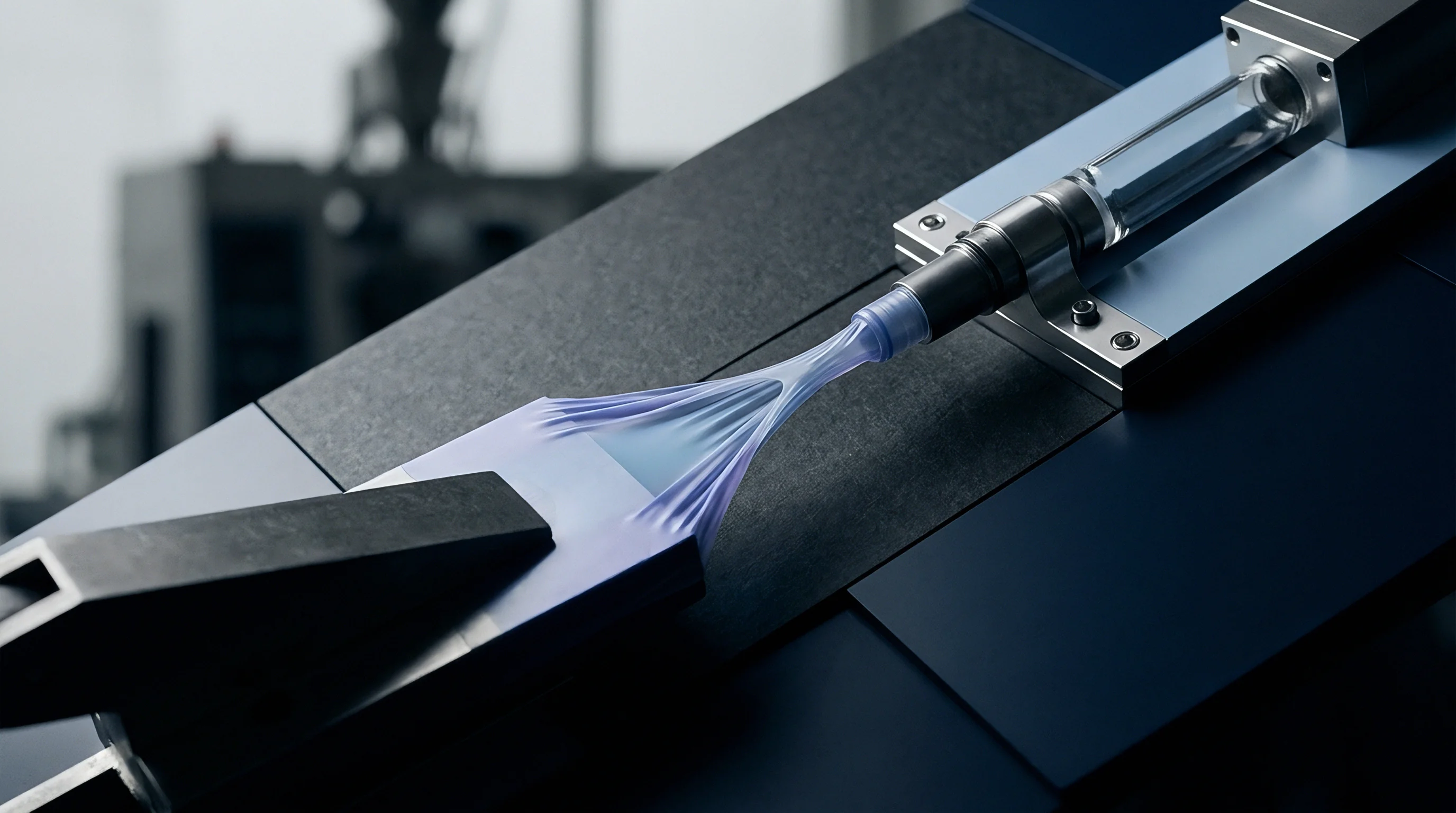
Accurate determination of extensional strain limits requires specialized rheological equipment designed to generate uniform extensional velocity fields at elevated temperatures. Rotary-drum extensional fixtures, such as the Sentmanat Extensional Rheometer, mount inside standard rotational rheometer environmental test chambers. Twin counter-rotating drums wind a rectangular polymer specimen cut directly from extruded sheet feedstock.
As drums rotate at constant angular velocities, the specimen undergoes controlled uniaxial extensional strain at defined strain rates. Precision torque transducers register force signatures, allowing direct calculation of transient extensional viscosity as a function of time and cumulative strain.
Capillary break-up extensional rheometers evaluate liquid-like or low-viscosity polymer melts by monitoring the rapid thinning of a liquid bridge after step strain displacement. For solid-state or high-viscosity sheet thermoforming, physical filaments undergo stretching until ductile rupture occurs. Optical high-speed video tracking measures mid-filament diameter decay, capturing non-linear extensional dynamics across strain rates ranging from 0.01 to 50 reciprocal seconds.
Thermal control must maintain specimen temperature within plus or minus 0.2 degrees Celsius to prevent thermal gradient artifacts from distorting local stress responses.
Test Parameter Matrix and Sample Preparation
Extensional test specimens cut from extruded sheet inherit directional molecular orientation from the extrusion process. Testing requires milling rectangular strips along both the machine direction and transverse direction to map anisotropy in strain hardening behavior. Mechanical cutting operations introduce edge notch defects that serve as stress risers, initiating premature tear failure during testing.
Fire-polishing or chemical smoothing of specimen edges removes physical stress concentrators, ensuring measured failure strain reflects intrinsic resin dynamics rather than surface flaw propagation.
Uniaxial extension dominates local corners. Selecting test strain rates matching real process kinetics remains necessary for precise process window determination. In commercial thermoforming presses, sheet deformation speed varies dynamically as pneumatic pressure pushes molten polymer into cavity contours.
Laboratory testing across multiple fixed strain rates produces master curves via time-temperature superposition principles, expanding usable rheological datasets across real process spectrums.
Selecting appropriate laboratory parameters depends on feedstock thickness, polymer morphology, and target forming temperatures.
- Specimen Thickness uniform sheet strips milled between 0.50 mm and 1.50 mm remove thermal gradients while matching production sheet cross-sections.
- Thermal Soaking Duration two minutes of ambient equalization inside the nitrogen-purged test chamber eliminates internal stresses without triggering thermal-oxidative polymer degradation.
- Strain Rate Range stepped strain sweeps covering 0.1, 1.0, and 10.0 reciprocal seconds span low-velocity plug pre-stretching and high-velocity vacuum snaps.
- Environmental Gas Atmosphere continuous dry nitrogen purge prevents molecular weight degradation and crosslinking reactions in oxidation-sensitive polymers like polyamide and polybutylene terephthalate.
ISO 20753 specimen preparation standards dictate edge polishing to eliminate physical micro-cracks before thermal testing.
Melt flow index ratios are frequently presented as proof of extensional performance on the assumption that melt-strength additives guarantee high draw ratios, even when transient extensional viscosity curves are omitted.

Window

Forming Window Mapping and Critical Strain Boundaries
The processing window for heated polymeric sheet thermoforming occupies a tight band bounded by thermal glass transition or melting points on the lower edge and thermal degradation or excess sag on the upper edge. Within this thermal window, extensional strain limits define the boundary between acceptable geometric replication and structural part failure. Plotting maximum sustainable Hencky strain against processing temperature produces the ultimate strain envelope for a given resin lot.
As sheet temperature increases, polymer entanglements slip more freely, reducing baseline extensional viscosity while simultaneously delaying brittle fracture.
Excessive heating drops melt strength below operational minimums, causing gravitational sag during oven transport. Sag stretches the upper surface of the sheet, introducing pre-orientation before mechanical drawing begins. Conversely, forming sheet stock near its lower thermal limit increases required inflation pressures and plug forces, driving peak extensional stresses past the material’s ductile yield limit.
Mapping local strain limits across a 20-degree forming window reveals optimal process setpoints that preserve wall thickness distribution without extending oven heating cycles.

Worked Example of Local Strain Calculation in Deep Draw Forming
Evaluating extensional strain limits requires translating part geometry into local strain metrics. Take a high-impact polystyrene sheet of initial thickness 1.80 mm stretched to an areal draw ratio of 3.20 under isothermal conditions at 155 degrees Celsius. Assume isotropic planar deformation across the unconstrained central dome of a cylindrical container cavity.
The areal draw ratio defines the final surface area divided by initial sheet area. For equal biaxial extension, the areal stretch ratio equals the square of the linear stretch ratio. Calculating linear stretch ratio yields 1.789.
The corresponding Hencky strain equals the natural logarithm of the linear stretch ratio, yielding 0.582. Using theoretical mass balance, final local wall thickness equals initial thickness multiplied by the negative exponential of twice the equal biaxial Hencky strain. Calculating local thickness gives 1.80 mm multiplied by e to the power of negative 1.164, resulting in a final dome wall thickness of 0.562 mm.
When part design demands a feature with a local areal draw ratio of 7.50, linear stretch ratio rises to 2.738, corresponding to an equal biaxial Hencky strain of 1.007. Required local wall thickness drops to 0.239 mm, representing an 86.7 percent reduction from initial stock thickness. If high-impact polystyrene exhibits a critical extensional strain limit of 0.95 Hencky strain at 155 degrees Celsius, this feature exceeds material limits, resulting in local necking or corner rupture during plug displacement.
Where Do Extensional Strain Limits Fail in Heavy Gauge Forming?
Heavy gauge sheet processing introduces severe cross-sectional thermal gradients. Outer sheet surfaces reach forming temperature while core layers remain near glass transition thresholds. When the plug assist engages the sheet, outer surfaces stretch past critical extensional strain limits, while the cooler core resists drawing, causing internal shear tearing and surface micro-crazing.
Reducing oven radiant heater intensity and extending soak times flattens internal thermal profiles, expanding effective extensional strain capacity.
- Mount thermocouple arrays directly inside sample sheet cores to establish accurate volumetric heat absorption rates across heating cycles.
- Heat sheet samples inside environmental chambers to target processing temperatures spanning 140 to 180 degrees Celsius at 5-degree increments.
- Apply Uniaxial high-strain rate pneumatic tension at 5.0 reciprocal seconds until physical specimen rupture occurs.
- Record critical force profiles using high-frequency load cells, identifying exact Hencky strain values where force slope transitions from positive to negative.
- Plot transient extensional viscosity against Hencky strain curves across all temperature steps to establish the non-linear strain-hardening coefficient.
- Define the safe operational boundary as eighty percent of the minimum Hencky strain at rupture across the full thermal window.
| Polymer Chemistry | Morphology | Forming Temp Window (°C) | Max Hencky Strain Limit | Strain Hardening Index |
|---|---|---|---|---|
| High-Impact Polystyrene (HIPS) | Amorphous Rubber-Modified | 145 – 165 | 1.25 | 1.15 |
| Polyamphiphilic Amorphous PETG | Amorphous Copolyester | 135 – 155 | 1.10 | 1.05 |
| High-Melt-Strength Polypropylene | Long-Chain Branched Semi-Crystalline | 155 – 170 | 2.10 | 2.85 |
| Standard Linear Polypropylene | Unbranched Semi-Crystalline | 160 – 168 | 0.75 | 0.80 |
| High-Density Polyethylene (HDPE) | Linear Semi-Crystalline | 140 – 155 | 0.90 | 0.95 |
| Polycarbonate (PC) | High-Tg Amorphous | 185 – 205 | 1.40 | 1.30 |
High strain hardening compensates for dynamic sheet heating variations across commercial production shifts.


Simulation

Constitutive Equations and Viscoelastic Modeling
Finite element analysis of thermoforming relies on constitutive equations that accurately capture large-strain, non-linear viscoelastic responses of heated sheets. Generalized Newtonian fluid models fail during deep-draw simulation because they ignore elastic strain memory and transient extensional strain hardening. Advanced integral models, such as the K-BKZ (Kaye-Bernstein-Kearsley-Zapas) and Wagner constitutive equations, incorporate damping functions that separate time-dependent relaxation spectra from strain-dependent non-linear properties.
Including strain hardening parameters derived from laboratory extensional rheometry enables simulation software to predict localized thinning, corner necking, and plug force requirements.
Molecular Stress Function models represent another advanced path, attributing extensional strain hardening to the stretch of polymer tube segments under deformation. When simulation packages use pure elastic Mooney-Rivlin or Ogden hyperelastic models, they simulate room-temperature rubber-like inflation rather than temperature-dependent, strain-rate-sensitive melt extensional flow. Hyperelastic assumptions consistently underestimate localized thinning at high draw speeds because they omit viscous relaxation and strain-rate-induced viscosity divergence.
Hyperelastic Mooney-Rivlin models underpredict localized corner thinning by up to thirty percent compared to integral K-BKZ viscoelastic models.
Mesh refinement isolates points of concentrated strain. Numerical instability often arises when local Hencky strain rates exceed convergence limits of explicit FEA solvers. Adaptive remeshing schemes update shell element sizes in zones where element distortion exceeds predefined aspect ratio thresholds, preserving accuracy as sheet thickness drops toward zero.
| Constitutive Model Class | Primary Inputs Required | Extensional Prediction Accuracy | Computational Cost Index | Typical FEA Application |
|---|---|---|---|---|
| Ogden Hyperelastic | Uniaxial & Biaxial Stress-Strain Curves | Poor (Lacks strain rate dependence) | 1.0 | Shallow draft tray forming |
| K-BKZ Integral Viscoelastic | Relaxation spectrum, Wagner damping parameters | Excellent (Predicts strain hardening) | 8.5 | Deep-draw complex enclosure tools |
| Molecular Stress Function (MSF) | Linear viscoelastic spectrum, molecular stretch factors | Superior (Captures chain entanglement dynamics) | 12.0 | High-speed inline thin-gauge forming |
| Power-Law Viscous | Zero-shear viscosity, power-law index | Unusable (Omits elasticity and extension) | 0.2 | Preliminary thermal heat transfer only |
How non-linear extensional parameters interact with dynamic tool surface friction coefficients across non-isothermal contacts remains an active challenge for finite element analysis validation.


Tooling

Plug Assist Kinematics and Local Strain Modification
Plug assist mechanisms alter sheet strain distribution by physically pushing heated polymer into tool cavities before pneumatic pressure engages. The geometric shape, material composition, thermal conductivity, and speed of the plug assist directly influence local extensional strain rates. Syntactic foam and aluminum-filled epoxy plugs provide low thermal conductivity, preventing premature surface freezing of the sheet during mechanical contact.
Cold metallic plugs freeze the contacting polymer surface, arresting further extensional deformation in that zone and forcing surrounding warm polymer sections to absorb all remaining draw strain.
Plug speed profiles dictate the local strain rate applied to the unconstrained sheet web. Rapid plug penetration applies extensional strain rates up to 10 reciprocal seconds, moving polymer deformation into strong strain-hardening regimes that distribute material evenly along sidewalls. Slow plug speeds allow molecular relaxation, causing polymer sections to stretch under low transient extensional viscosity and yielding severe base-corner thinning.
Matching plug displacement speed to material strain-hardening velocity maximizes minimum wall thickness in deep-draw geometries.
Adding draft to the tooling helps preserve corner thickness, while pre-blow air pressure creates an air cushion between the plug and sheet, reducing friction and pre-stretching the central web into an isotropic bubble prior to plug penetration.

Clamp Frame and Sheet Feedstock Requirements
Feedstock specifications dictate strict compliance requirements to withstand high extensional strain rates without edge slipping or premature tearing inside clamp frames.
- Sheet Thickness Consistency cross-web gauge variance must stay within plus or minus 2.5 percent of nominal sheet thickness to maintain uniform clamping pressure along frame perimeters.
- Transverse Strain Uniformity residual stress variation across extruded roll stock must remain under three percent to prevent asymmetric sheet bowing during radiant heating cycles.
- Recycle Blend Thresholds regrind contamination must not exceed fifteen percent by mass, with repeltized flake matching virgin resin molecular weight distributions within five percent.
- Pin-Chain Edge Allowance edge margins must sustain 350 Newtons of tensile clamping force per linear meter at forming temperature without mechanical tear-out.
Standard delivery agreements specify that feedstock lots exhibiting batch-to-batch melt flow index variations greater than eight percent grant the buyer full right of lot rejection without restocking penalties.


Audit

Receiving Inspection and Laboratory Verification Protocols
Protecting thermoforming operations from catastrophic line downtime requires rigorous incoming raw material audits. High-performance sheet contracts cannot rely on basic certificates of analysis reporting single-point melt flow values. Receiving protocols demand verifying transient extensional viscosity profiles on incoming resin lots using standardized Sentmanat or counter-rotating drum testing methods.
Establishing statistical process control bands around transient viscosity curves ensures that raw material suppliers do not alter resin branching ratios or molecular weight distributions without formal customer notification.
Resin blending variations, regrind incorporation, and thermal history during extrusion alter the extensional strain hardening exponent. Incoming roll stock testing involves thermal analytical methods, including differential scanning calorimetry to measure crystallinity variations and dynamic mechanical analysis to monitor storage modulus transitions. When receiving laboratories detect a drop in extensional strain hardening factors below historical control baselines, tool setters adjust plug speed profiles, oven heating zone ratios, and pre-blow air timing to preserve part quality until compliant material arrives.
Documenting extensional rheological metrics in material specifications establishes direct commercial leverage when supplier lots fail during production runs. Bridging the gap between laboratory melt rheology and press-side tool setup eliminates costly trial-and-error adjustments on the production floor.