Differential Scanning Calorimetry Metrology for Flake Oxidation Stability Verification
Differential scanning calorimetry metrology measures oxidation induction time to verify stabilizer retention in post-consumer recycled polymer flake.

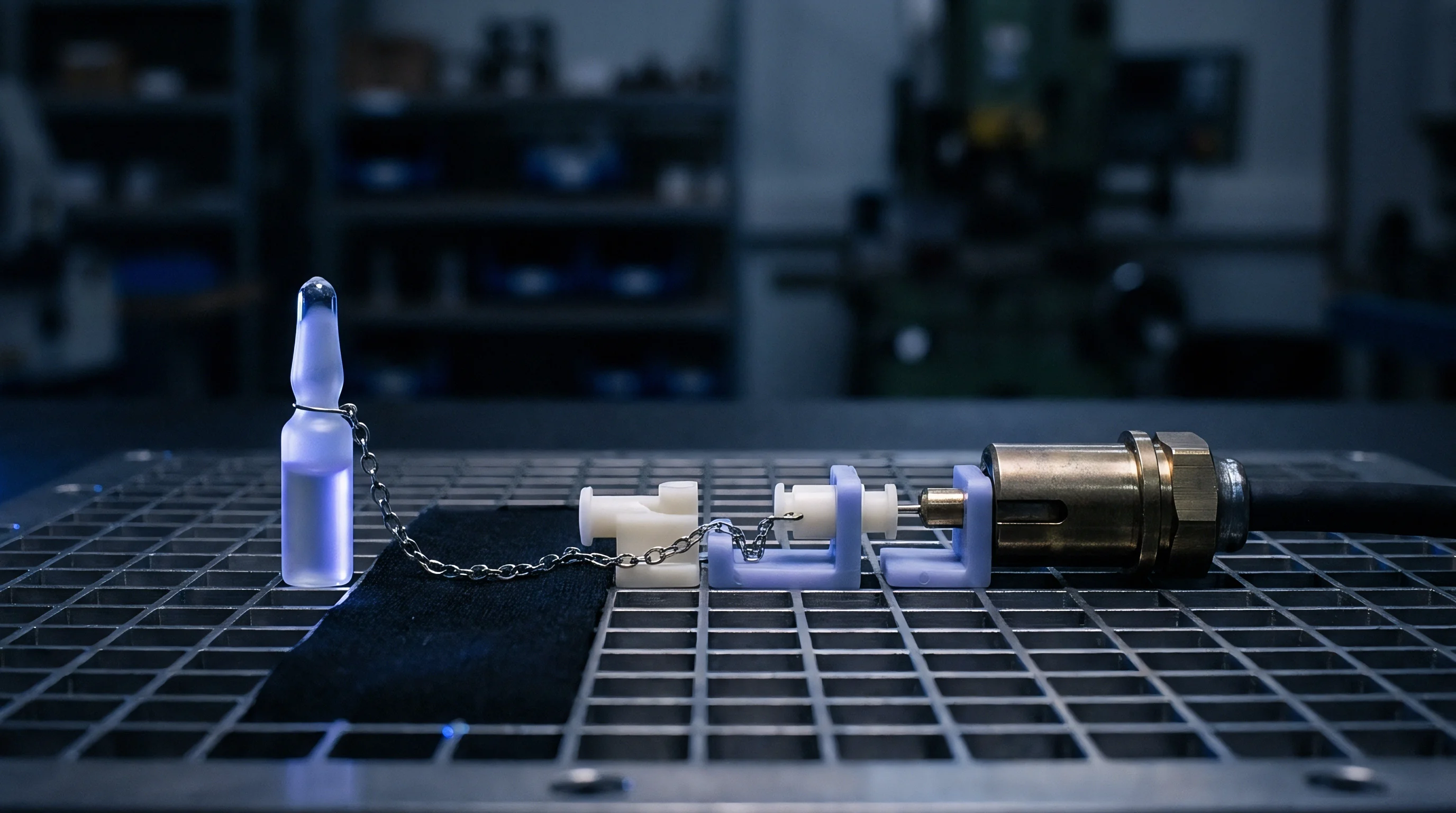
Pan
A five-milligram specimen of post-consumer high-density polyethylene flake placed inside a standard aluminum crucible exhibits immediate thermal lag when heat flow transitions from isothermal equilibrium to exothermic oxidation. The physical interface between the molten polymer mass and the crucible surface governs thermal conduction accuracy during Differential Scanning Calorimetry analysis. Flake specimens feature irregular surface topologies, trapped void volume, and variable wall thickness resulting from mechanical shredding.
When raw flakes drop into an open crucible without compression, air gaps insulate the specimen bottom, creating a thermal barrier that shifts measured oxidation induction times by several minutes. Achieving repeatable thermal contact demands uniform sample flatting or controlled micro-pelletizing prior to cell insertion.
Purge gas velocity inside the sample chamber sweeps volatile oxidation byproducts away from the polymer surface while maintaining constant ambient oxygen concentration. Standard open crucibles allow uninhibited gas flow across the specimen melt surface, but volatile degradation fragments escape rapidly and alter local reaction kinetics. Vented lids with micro-perforations standardize gas diffusion while preventing specimen splatter or thermal radiation loss.
The diameter of the lid hole alters mass transfer rates of organic peroxides generated during early-stage oxidative chain scission.
| Crucible Configuration | Thermal Conductance (W/m·K) | Purge Gas Interaction | Mass Drift Rate (mg/min) | OIT Variance (ISO 11357-6) |
|---|---|---|---|---|
| Standard Open Aluminum (40 µL) | 237 | Direct purge atmosphere exposure | 0.08 | ± 1.8 min |
| Vented Aluminum Lid (50 µL, 50 µm hole) | 237 | Controlled diffusion barrier | 0.01 | ± 0.4 min |
| Passivated Gold (40 µL) | 318 | Inert, zero catalytic surface activity | 0.01 | ± 0.3 min |
| Unpassivated Copper (40 µL) | 401 | Active catalytic oxidation acceleration | 0.14 | ± 3.2 min |
Crucible metallurgy introduces catalytic chemical reactions that alter baseline stability verification. Copper trace impurities inside low-grade aluminum pans accelerate hydroperoxide decomposition at temperatures above 180 °C, artificially shortening measured induction periods. High-purity aluminum crucibles containing less than ten parts per million copper eliminate surface catalysis.
Passivated gold crucibles provide an absolute chemical baseline when evaluating post-consumer polyolefin flakes contaminated with acidic wash-water residues or heavy metal pigments. Cold sampling tables catch surface moisture. Specimen pan choice dictates signal resolution during high-temperature thermal sweeps.
ASTM D3895 dictates an aluminum cell baseline shift tolerance below zero point two milliwatts across the isothermal test window.
Sample preparation procedures for heterogeneous flake lots determine testing repeatabilities across laboratory shifts. Laboratory technicians follow strict preparation guidelines to eliminate geometric artifacts from thermal curves:
- Specimen Flattening Flake particles are compressed at 120 °C under one megapascal pressure for ten seconds to form a smooth disc matching crucible base dimensions.
- Mass Calibration Analytical balances record specimen weights between four point eight and five point two milligrams to maintain constant sample thermal mass across runs.
- Lid Crimping Precision Mechanical crimping presses apply five hundred newtons of force to seal aluminum lids without distorting the flat crucible base.
- Volatile Venting Control Micro-hole punch tools produce a single fifty-micrometer orifice in the center of the crucible lid to standardize gas exchange kinetics.
Selecting improper crucible materials introduces uncalibrated catalytic reactions that artificially depress measured induction times by twenty percent.
Thermodynamics
Oxidation Induction Time testing under ISO 11357-6 requires strict thermal equilibrium before introducing reactive oxygen gas into the sample cell. The cell heats under an ultra-pure nitrogen purge at fifty milliliters per minute until reaching the target isothermal temperature, typically 200 °C for high-density polyethylene or 190 °C for polypropylene. Heating rates of twenty degrees Celsius per minute prevent thermal overshoot while minimizing premature thermal degradation during the ramp phase.
Once the cell reaches isothermal equilibrium, the temperature must stabilize within zero point zero five degrees Celsius for five minutes before gas switching occurs.
Switching the cell purge gas from nitrogen to oxygen triggers a transient baseline shift caused by differences in gas thermal conductivity. Nitrogen carries a thermal conductivity of thirty-one point two milliwatts per meter-kelvin at 200 °C, whereas oxygen carries thirty-eight point nine milliwatts per meter-kelvin. This conductivity step causes an artificial endothermic baseline deflection on the Differential Scanning Calorimetry heat flow trace.
Baseline drift correction algorithms filter out this gas-switch transient without obscuring the early exothermic onset of polymer oxidation.
Polypropylene flake tested at 200 °C under pure oxygen gas purge at 50 mL/min exhibits an oxidation induction threshold of 14.2 minutes when fully stabilized.
Calibrating cell temperatures under gas switching conditions prevents systematic kinetic measurement errors. Technicians execute a five-step calibration sequence prior to auditing high-volume flake shipments:
- Indium standards melt at 156.6 °C under a nitrogen purge of fifty milliliters per minute to verify cell temperature accuracy.
- Tin calibration standards confirm temperature linearity at 231.9 °C across the target operating range.
- Baseline runs without specimen crucibles establish system enthalpy drift metrics across sixty-minute hold times.
- Gas switching valves undergo timing verification to confirm oxygen arrival at the specimen surface within three seconds of command execution.
- Reference crucibles match specimen pan mass within zero point zero two milligrams to ensure balanced heat capacity across cell sensors.
Oxidation Onset Temperature metrology provides an alternative non-isothermal approach for evaluating highly degraded flake streams. Instead of holding the furnace at a constant temperature, the specimen heats continuously under pure oxygen at ten degrees Celsius per minute from 100 °C to 300 °C. The temperature at which the exothermic heat flow curve intersects the extrapolated baseline defines the oxidation onset threshold. Non-isothermal scanning eliminates the gas-switch baseline artifact, making it suitable for quick screening of post-consumer polyolefin flakes with unknown additive histories.
Pure nitrogen purges prevent early reactions. Sample mass choices change heat transfer.
Clean thermal signals during gas transition phases depend on maintaining steady purge rates across calibrated furnace zones.
Degradation
Flake samples recovered from post-consumer washing lines contain uneven distributions of hindered phenol primary antioxidants and secondary phosphite processing stabilizers. Primary antioxidants like Irganox 1010 scavenge free radicals generated during thermal stress, while secondary antioxidants like Irgafos 168 decompose hydroperoxides into non-reactive alcohols. When flake streams undergo repeated extrusion cycles during past service lives, these stabilizer packages undergo consumption kinetics.
Depletion of active phosphites leaves the polymer chain vulnerable to rapid oxidative chain scission during subsequent melt reprocessing.
Assessing thermal curves generated from heterogeneous flake blends reveals distinct kinetic behavior compared to virgin resin grades. A typical virgin high-density polyethylene compound carries an Oxidation Induction Time exceeding forty minutes at 200 °C. Post-consumer high-density polyethylene flake collected from mixed packaging bales often exhibits induction times between six and eighteen minutes under identical ISO 11357-6 conditions. The oxidation curve of degraded material shows a shallower exothermic slope, indicating diminished free-radical scavenging capacity and high polydispersity in local antioxidant concentrations.
| Flake Polymer Type | Primary Antioxidant Retention (%) | Secondary Phosphite Retention (%) | Mean OIT (min) | Exothermic Onset Slope (mW/min) |
|---|---|---|---|---|
| Post-Consumer rHDPE (Blow Moulding) | 42 | 18 | 12.4 | 0.85 |
| Post-Industrial rHDPE (Pipe Grade) | 85 | 72 | 38.1 | 2.10 |
| Post-Consumer rPP (Injection Grade) | 28 | 09 | 5.2 | 0.42 |
| Co-Mingled rHDPE / rPP (90:10 Blend) | 35 | 14 | 8.6 | 0.68 |
| Test conditions: 5.0 mg specimen mass, aluminum pan with 50 µm vented lid, 50 mL/min pure oxygen purge at 200 °C isothermal hold. | ||||
Quantifying antioxidant decay kinetics involves measuring the remaining induction period across multiple temperature points to calculate activation energies. An auditor takes a 40-tonne lot of post-consumer polyethylene flake with an unknown thermal history and evaluates specimen batches at 190 °C, 200 °C, and 210 °C. The measured oxidation induction times are 28.4 minutes, 12.4 minutes, and 5.1 minutes respectively. Plotting the natural logarithm of the reaction rate constant against the inverse of absolute temperature yields an Arrhenius relationship.
The calculated activation energy for oxidative degradation in this flake lot reaches ninety-six kilojoules per mole, revealing severe stabilizer depletion compared to virgin baseline values of one hundred and twenty-eight kilojoules per mole. Heat transfer drives kinetic reaction rates. Impurities accelerate thermal decomposition.
High residual catalyst levels in post-industrial flake consume secondary phosphite stabilizers faster than thermal exposure alone.
Co-mingled polyolefin impurities introduce secondary exothermic signals into Differential Scanning Calorimetry traces. Polypropylene flakes present as a ten percent contaminant inside a high-density polyethylene stream undergo oxidation at lower thermal thresholds. During an isothermal run at 200 °C, the polypropylene domain oxidizes first, generating an initial small exothermic peak at six minutes.
The main high-density polyethylene matrix oxidizes later, producing a secondary major exothermic peak at fourteen minutes. Analyzing these multi-peak profiles prevents misinterpreting early degradation signals as background noise.
Suppliers frequently attribute wide oxidation induction spread to ambient humidity variations during flake storage rather than masterbatch dosing errors.

Audit
Acceptance sampling across a twenty-tonne shipment of post-consumer flake requires ten discrete core samples drawn from opposing sides of five separate gaylord boxes. Individual flake fragments exhibit significant variance in wall thickness and stabilizer retention depending on their original container geometry. Combining discrete core samples into a composite specimen without proper homogenizing leads to high test scatter.
Laboratory procedures require grinding fifty grams of composite flake through a two-millimeter mesh sieve under liquid nitrogen cooling to generate a representative micro-pellet powder before weighing DSC test charges.
Discrepancies between international standard test methods complicate global trade specifications for recycled resins. ISO 11357-6 specifies an isothermal test environment using pure oxygen at fifty milliliters per minute with open or vented aluminum pans. ASTM D3895 uses identical gas purges but enforces specific open-pan geometries and baseline tangent fitting protocols.
ASTM D5885 employs a high-pressure Differential Scanning Calorimetry cell operated at 3.5 megapascal oxygen pressure at 150 °C, accelerating oxidation kinetics for highly stabilized polyolefins without risking thermal degradation of secondary additives during furnace heat-up.
| Standard Parameter | ISO 11357-6 | ASTM D3895 | ASTM D5885 |
|---|---|---|---|
| Isothermal Target Temperature | 190 °C or 200 °C | 200 °C | 150 °C |
| Purge Gas Pressure | Ambient (0.1 MPa) | Ambient (0.1 MPa) | High Pressure (3.5 MPa) |
| Purge Flow Rate | 50 ± 5 mL/min | 50 ± 5 mL/min | Static or 100 mL/min |
| Crucible Specification | Vented or Open Aluminum | Open Aluminum | Open Stainless Steel / Aluminum |
| Baseline Tangent Point | Offset from gas switch | First derivative peak onset | Inflection slope intercept |
Evaluating supplier Certificates of Analysis requires cross-checking quoted metrics against actual sample execution parameters. Compounders often report oxidation induction numbers measured on virgin base resin rather than final recycled flake blends. A buyer auditing an incoming lot verifies critical document entries to confirm compliance with processing specifications:
- Standard Alignment The document identifies whether testing followed ISO 11357-6 or ASTM D3895 parameters.
- Temperature Stating The certificate explicitly lists the isothermal test temperature used to generate induction values.
- Specimen Mass Recording Individual test weights appear on the report to confirm sample sizes stayed within the five-milligram mass target window.
- Purge Purity Sign-off Oxygen supply gas purity is certified at ninety-nine point nine nine percent or higher.
Calibration drifts corrupt critical threshold data. Unstabilized polymer degrades rapidly during processing.
ISO 11357-6 Clause 8.3 permits automatic baseline extrapolation only when tangent slope deviation stays within defined limits, forcing manual re-testing when thermal drift exceeds zero point zero five milliwatts.
Valuation
Commercial pricing for post-consumer polyolefin flake tracks the active antioxidant package remaining inside the recycled material. Flake lots exhibiting an Oxidation Induction Time under ten minutes at 200 °C command discounted market prices because they require immediate re-stabilization during compounding. Unstabilized recycled flake compounds cause melt fracture during profile extrusion and generate off-gassing defects in injection moulding cycles.
Compounding lines must re-introduce liquid or masterbatch antioxidants to restore thermal endurance to structural parts.
Calculating the landed cost of degraded recycled stock requires factoring in re-stabilization additive expenses alongside compounding yield losses. Assume a 40-tonne lot of post-consumer high-density polyethylene flake purchased at nine hundred Euros per tonne with a measured oxidation induction time of six minutes. To bring this material up to a minimum twenty-five minute induction threshold for pipe-grade application, the compounder doses zero point three percent by weight of a primary phenolic and secondary phosphite masterbatch blend.
The additive package costs fourteen Euros per kilogram, adding forty-two Euros per tonne in direct material expense. Compounding process heat further consumes five percent of the added stabilizer, requiring a two Euro per tonne dosing buffer. Landed costs reflect unhedged degradation risk.
Unstabilized recycled flake compounds cause melt fracture during profile extrusion and generate off-gassing defects in injection moulding cycles.
Scrap rates rise when induction drops. Degraded polyolefin flakes undergo chain scission in the extruder barrel, raising the melt flow rate from a nominal zero point eight grams per ten minutes up to one point six grams per ten minutes at 190 °C under two point one six kilogram load. This viscosity drop causes wall thickness variation in blow-moulded containers, producing structural rejects.
Purchasing unverified flake loads without Differential Scanning Calorimetry documentation exposes buyers to unexpected scrap costs that exceed initial raw material savings.
Whether real-time inline spectroscopic sensors can match differential scanning calorimetry in detecting micro-domain antioxidant depletion before compounding remains an open operational question.