Bulk Density and Moisture Inspection in Post-Consumer Flake
Post-consumer flake apparent density and moisture inspection requires standardized apparatus testing and Karl Fischer titration to prevent extrusion surging.


Geometry
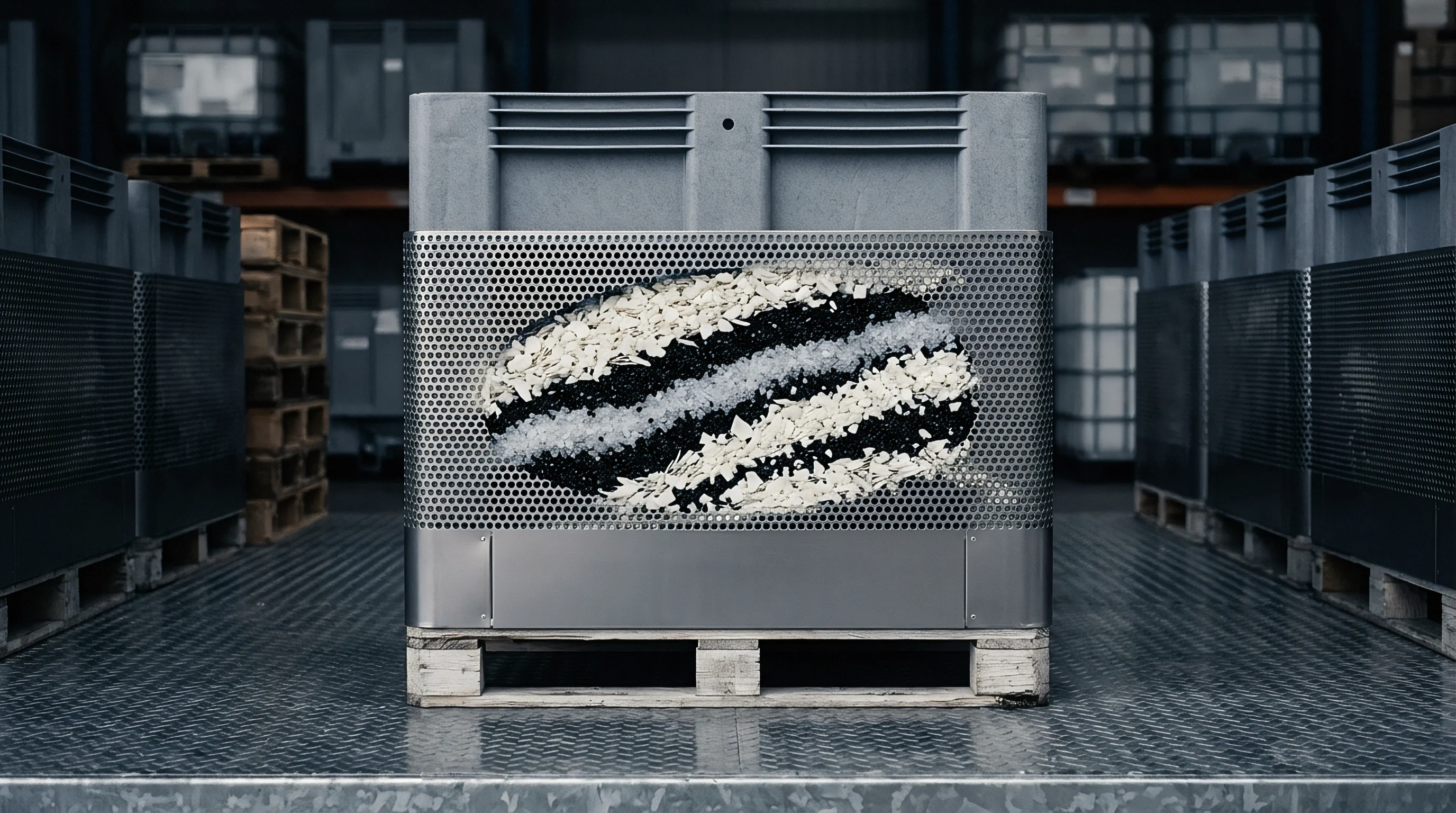
Post-consumer polyethylene terephthalate and high-density polyethylene incoming streams arrive at reprocessing plants with structural variability driven by container origin. Bottled water containers, milk jugs, detergent bottles, and thermoformed trays feature distinct wall thicknesses and orientation histories. Mechanical shredding converts these container walls into flat, curved, or twisted fragments.
These geometrical differences dictate how flakes pack together inside Gaylord boxes, siloses, and feeder hoppers. Thin wall fragments pack loosely.

Morphological Variance across Recycled Feedstocks
Baled bottles subjected to mechanical shredder blades produce planar fragments with irregular contour edges. Bottled water containers manufactured via stretch blow molding possess thin walls, typically ranging between 0.15 millimeters and 0.30 millimeters. Thermoformed PET sheet scrap exhibits higher stiffness and uniform thicknesses between 0.40 millimeters and 0.80 millimeters.
Detergent bottles made of high-density polyethylene yield thick, curved fragments that resist flat stacking. Thin wall fragments pack loosely. When packed into containers, flat fragments lie flush against adjacent surfaces, whereas curved fragments create interlocking architectures with open internal channels.
Particle size distribution further modifies spatial efficiency inside storage volumes. Mechanical granulation screens with 10-millimeter hole patterns produce a spectrum of particle sizes rather than uniform chips. A wide particle size distribution allows smaller fines to nest inside the void spaces formed between larger, rigid fragments.
Conversely, a narrow size distribution containing predominantly large, curved flakes maximizes inter-particle space, yielding lower mass per volumetric unit. Shredded film fragments compound this effect by folding into three-dimensional structures that trap atmospheric air within the bulk volume.
Post-consumer flake flakes flatly against bin walls, capturing air voids that drop apparent mass per unit volume.

Packing Mechanics in Non Uniform Shreds
Random spatial orientation during container filling leaves substantial inter-particle void spaces. Bulk density measures the total mass of loose polymer fragments divided by the total volume occupied, including structural air gaps. In un-compacted storage units, post-consumer PET flake achieves a packing fraction between 0.35 and 0.48 of solid polymer density.
Solid PET possesses a nominal density of 1.38 grams per cubic centimeter. The un-compacted bulk density of PET flake ranges from 0.28 to 0.45 grams per cubic centimeter. Tap density exceeds pour density.
Tap density testing demonstrates the extent of structural consolidation possible under physical vibration. Mechanical shocks overcome surface friction between overlapping flake edges, forcing fragments to slide, rotate, and settle into denser spatial arrangements. Fine particles migrate downward through the void network, filling lower interstices.
High-density polyethylene flake, with a solid density of 0.95 grams per cubic centimeter, exhibits an un-compacted bulk density between 0.22 and 0.34 grams per cubic centimeter. The ratio between tap density and pour density defines the Hausner Ratio, an indicator of flowability and consolidation tendency in hoppers.
| Polymer Type | Source Stream | Nominal Wall Thickness (mm) | Flake Size Mesh Pass (mm) | Apparent Density (g/cm³) | Tap Density (g/cm³) |
|---|---|---|---|---|---|
| rPET | Clear Beverage Bottles | 0.18 – 0.32 | 8.0 – 10.0 | 0.31 – 0.38 | 0.39 – 0.46 |
| rPET | Thermoformed Trays | 0.45 – 0.75 | 10.0 – 12.0 | 0.38 – 0.44 | 0.45 – 0.51 |
| rHDPE | Blow-Molded Milk Jugs | 0.40 – 0.90 | 8.0 – 10.0 | 0.24 – 0.30 | 0.30 – 0.36 |
| rHDPE | Injection-Molded Crates | 1.50 – 3.00 | 6.0 – 8.0 | 0.42 – 0.48 | 0.48 – 0.54 |
| rPP | Rigid Packaging Caps | 0.80 – 1.50 | 8.0 – 10.0 | 0.32 – 0.39 | 0.38 – 0.44 |
Flake aspect ratio directly controls wall drag within processing equipment. Flakes with high aspect ratios, where length and width exceed thickness by a factor of twenty or more, generate mechanical interlocking. Interlocking networks resist downward flow under gravity, creating stagnant zones in feed hoppers and storage silos.
Smooth, spherical pellets flow freely, whereas flat, high-aspect-ratio flakes form bridge structures across hopper discharge throats. Material reprocessors monitor flake geometry to forecast both container payload capacity and downstream feeding stability.
Flakes derived from thin-walled thermoforms pack with greater consistency than flakes cut from blow-molded bottles.

Scale
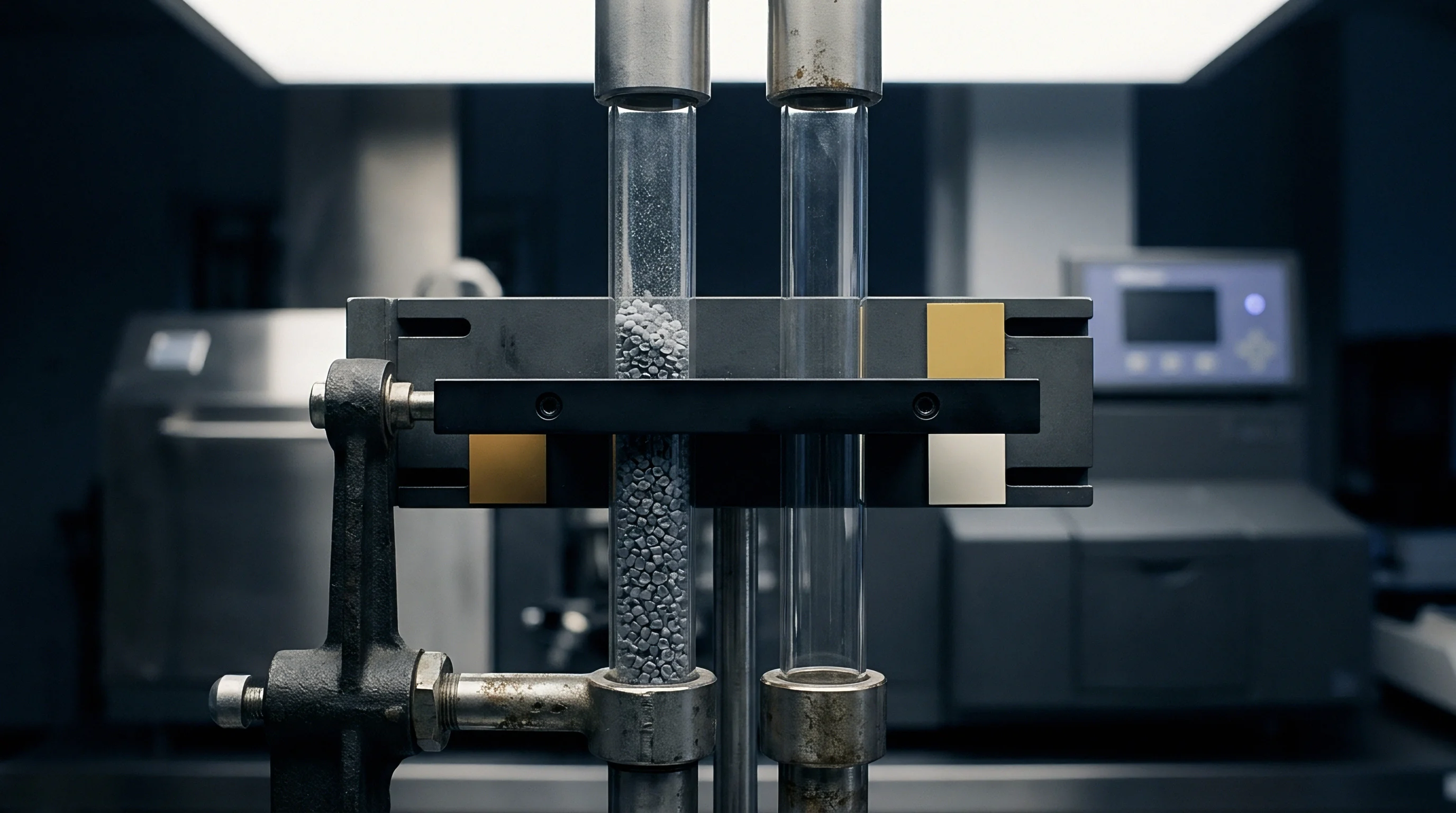
Volumetric measurement of recycled polymer fragments demands standardized apparatus designed to eliminate operator bias. Standard test methods establish precise geometric ratios between the pouring funnel and the receiving measure. Without controlled pouring heights and standardized orifice dimensions, apparent density figures vary significantly between laboratory technicians.
Accurate measurement establishes baseline data for freight logistics and extrusion throughput calculations.

Standardised Apparatus Calibration Procedures
Testing funnels specified under international benchmark methods utilize precise wall angles to maintain steady gravity flow. ISO 60 defines a standardized funnel geometry featuring a conical angle of 60 degrees and an exit orifice diameter of 33 millimeters. ASTM D1895 provides three distinct apparatus designs designated Method A, Method B, and Method C. Method A employs a small funnel orifice of 9.5 millimeters suited for fine powders and micro-pellets.
Method B utilizes a larger funnel with a 25.4 millimeter opening and a 400 milliliter cylindrical cup designed specifically for coarse regrind, large flakes, and irregular cut scraps.
Method selection governs measurement accuracy on post-consumer regrind. Coarse post-consumer PET flake fails to flow through the 9.5 millimeter orifice of ASTM D1895 Method A, causing immediate funnel bridging. Forcing material through a narrow orifice with a tamping rod alters particle packing and introduces measurement error.
Technicians utilize ASTM D1895 Method B or ISO 60 for regrind passing an 8-millimeter to 12-millimeter sieve screen. Method C accommodates coarse, fibrous, or interlocking materials using a special measuring cylinder and a weight-assisted compaction plunger, yielding compacted bulk density values.
Apparent density measurements using ASTM D1895 Method B require a 400 milliliter cylindrical cup to yield repeatable values on regrind larger than five millimeters.

Sampling Depth Errors in Gaylord Shipments
Vibration during truck transport forces smaller regrind particles toward the bottom of industrial storage boxes. Sampling only the top ten centimeters of a Gaylord container yields an artificially low apparent density figure because the upper layer consists primarily of large, low-density flakes. Core sampling probes, known as grain triers or compartmentalized sampling tubes, extract representative cross-sections from top to bottom.
Fines settle during transport. A representative sample requires extracting material from five distinct vertical locations across the box volume.
Static accumulation during dry ambient conditions disrupts apparent density measurements. Polymer fragments sliding across plastic funnels generate electro-static charges, causing flakes to repel one another and stick to container walls. Charged flakes pack inefficiently, creating artificial air voids inside the measuring cup and lowering the calculated apparent density by up to eight percent.
Static charge hinders gravity flow. Grounded metal funnels or anti-static spray treatment on apparatus walls eliminate electro-static repulsion during laboratory testing.
Incoming inspection procedures must account for structural traps that skew bulk measurements during container unloading.
- Surface Stratification occurs when mechanical agitation during transport drives large, low-density flakes to the container surface while dense fragments sink.
- Fines Migration concentrates small dust particles and micro-shreds at the lower discharge port, altering local density.
- Static Accumulation forces light flakes to cling to sampling tools, preventing natural packing inside the volumetric measuring cylinder.
- Funnel Bridging halts gravity flow during testing when large fragments jam the discharge orifice, requiring manual intervention that skews timing.
Disagreements over bulk density figures between reprocessors and compounders often trace back to using a small-orifice funnel meant for pellets instead of a wide-bore apparatus built for regrind.

Desiccation
Water trapped within or upon reclaimed polyolefins and polyesters directly alters processing stability. Moisture exists in two primary states within post-consumer flake lots: surface moisture adsorbed onto flake exteriors and bound moisture absorbed into the amorphous polymer matrix. Surface water originates from washing, rinsing, and ambient humidity exposure during storage.
Surface water drives up mass. Bound moisture occurs primarily in hygroscopic polymers such as PET and polyamide, where water molecules penetrate the intermolecular spaces between polymer chains.

Thermogravimetric Analysis versus Karl Fischer Titration
Heating scrap fragments in a moisture balance measures total mass loss, capturing both water vapor and volatile organic compounds. Standard Loss on Drying (LOD) balance testing heats a sample, typically 10 to 50 grams, at 105 to 160 degrees Celsius until mass loss ceases. On non-hygroscopic polyolefins like HDPE and PP, Loss on Drying accurately quantifies surface water.
On post-consumer PET, Loss on Drying often overestimates moisture content by volatilizing residual wash-line chemicals, low-molecular-weight oligomers, and residual spin finishes.
Karl Fischer titration isolates water molecules through quantitative chemical reaction. ISO 15512 Method B1 and ASTM D6869 utilize an evaporation oven coupled to a coulometric Karl Fischer titrator. The instrument heats the polymer flake sample in a sealed vial to 160–200 degrees Celsius under a stream of dry nitrogen gas.
The gas carries evolved moisture vapor into a titration cell where iodine reacts quantitatively with water molecules. Coulometric generation of iodine provides measurement precision down to 10 parts per million (0.001 percent), distinguishing surface water from internal absorbed moisture.
Purchasers rejecting loads above 0.05 percent moisture under ASTM D6869 prevent intrinsic viscosity drop during melt processing.

Hydrolytic Degradation Thresholds in Regrind PET
Polyethylene terephthalate chains cleave rapidly when exposed to heat above the glass transition point in the presence of water. During melt processing at 270 to 300 degrees Celsius, un-dried moisture drives ester bond hydrolysis. Hydrolysis cleaves polymer backbones rapidly.
Each water molecule breaks an ester linkage, yielding a carboxylic acid end group and a hydroxyl end group. Polymer chain scission reduces molecular weight, causing an immediate drop in intrinsic viscosity (IV). A drop in intrinsic viscosity from 0.80 deciliters per gram to 0.65 deciliters per gram reduces impact resistance and mechanical strength in final thermoformed or molded parts.
Polyolefins resist internal moisture absorption but suffer surface water retention inside irregular flake folds. While HDPE and PP do not undergo ester hydrolysis, excessive surface moisture converts to steam inside the extruder barrel. Water vapor creates internal voids.
Steam pockets cause melt pressure surges, vent flooding, surface splay on molded parts, and void formation in extruded sheet products. Un-dried polyolefin flake with moisture exceeding 0.20 percent by weight causes operational disruptions in unvented extruders.
| Inspection Method | Target Polymer | Detection Limit | Primary Measurement Target | Standard Reference | Processing Ceiling |
|---|---|---|---|---|---|
| Loss on Drying (LOD) Infrared | rHDPE / rPP | 0.01% (100 ppm) | Surface Adsorbed Water | ASTM D6980 | < 0.10% mass |
| Karl Fischer Coulometric Oven | rPET / rPA | 0.001% (10 ppm) | Bound Matrix Moisture | ISO 15512 Method B1 | < 0.005% mass |
| Karl Fischer Water Selective Sensor | rPET | 0.002% (20 ppm) | Evolved Water Vapor | ASTM D6869 | < 0.005% mass |
| Capacitance Microwave Sensor | rHDPE Bulk Stream | 0.10% (1000 ppm) | In-Line Bulk Water | Internal Factory Standard | < 0.20% mass |
Effective desiccation requires matching drying residence times to polymer diffusion rates. Dehumidifying hopper dryers must hold PET flake at dew points of minus 40 degrees Celsius or lower for 4 to 6 hours at 160 degrees Celsius to achieve moisture levels below 50 parts per million prior to extrusion.
Testing requirements must be explicitly agreed upon to establish valid incoming inspection procedures.
- Sample Sealing Standard mandates enclosing extracted flake immediately in moisture-impermeable aluminum-laminated bags to prevent ambient humidity adsorption.
- Temperature Profiling Rule defines the maximum allowable oven temperature during Karl Fischer heating to avoid thermal polymer degradation that releases reaction water.
- Reagent Calibration Requirement specifies daily standardization of Karl Fischer titrant using water standards to ensure accurate coulometric current calculation.
- Volatile Deduction Protocol requires subtracting known volatile content from Loss on Drying readings when measuring post-consumer polyolefins carrying trace oil or fragrance residues.
Allowing moisture inspection to rely on standard heat-balance drying on hygroscopic polyester flake results in intrinsic viscosity degradation during compounding.

Discrepancy
Extrusion feed throat behavior depends on consistent gravity flow from the overhead hopper into screw flights. Variable bulk density alters mass fill per screw revolution, destabilizing extruder operation. Volumetric augers move fixed volume.
When apparent density drops, less polymer mass enters the screw channels per turn, leading to reduced barrel pressure, melt temperature variation, and output fluctuations.

Why Do Volumetric Feeders Surge under Variable Flake Density?
Auger screws rotating at constant angular velocities displace fixed spatial volumes rather than constant material weights. Consider an extrusion process engineered for a nominal throughput of 500 kilograms per hour using post-consumer HDPE flake with an apparent density of 0.32 grams per cubic centimeter. If a incoming shipment carries an apparent density of 0.24 grams per cubic centimeter due to thinner bottle walls and coarse cutting, a volumetric feeder operating at fixed rotations per minute delivers only 375 kilograms per hour to the screw feed throat.
The 25 percent mass feed deficit Starves the extruder screw flights. Low density slows barrel output. Reduced barrel filling lowers mechanical shear generation, causing melt temperature to drop and backpressure at the breaker plate to decay.
Melt pressure instability causes wall thickness variations in extruded pipes and profiles. Gravimetric loss-in-weight feeders mitigate this discrepancy by continuously weighing the hopper mass and accelerating auger speed when bulk density drops. Accelerating auger speed has physical limits; if the volumetric capacity of the feed throat is exceeded, the feeder floods the hopper and starves the screw.

Throughput Penalties and Melt Volumetric Drift
Mass throughput variations degrade compounding economics. A compounding line running a 40-tonne lot of post-consumer PET flake illustrates the financial impact of density shifts. Assume a baseline processing rate of 1,000 kilograms per hour at a bulk density of 0.38 grams per cubic centimeter, requiring 40 operational hours.
If bulk density drops to 0.29 grams per cubic centimeter, volumetric feed limits reduce maximum throughput to 763 kilograms per hour. The 40-tonne job duration expands to 52.4 hours.
Operational extension adds 12.4 hours of compounding line labor, thermal energy consumption, and facility overhead. Assuming a fixed compounding cost of 250 USD per line hour, the bulk density reduction increases production costs by 3,100 USD for the lot, equivalent to 77.50 USD per tonne. Energy consumption per kilogram rises because barrel heating bands operate longer per unit mass output.
Wet regrind drops melt viscosity.
In-line quality control requires systematic verification of incoming bulk lots before loading reprocess silos.
- Extract core samples from five distinct depths across incoming Gaylord boxes using a compartmentalized sampling tube.
- Perform ISO 60 apparent density measurement using a wide-bore 400 milliliter cup apparatus.
- Run immediate loss-on-drying moisture testing at 105 degrees Celsius to determine surface water percentage.
- Compare measured values against raw material specification limits established in the supply contract.
- Issue conditional acceptance, price deduction, or material rejection documentation based on verified laboratory results.
A ten percent reduction in flake bulk density causes an equivalent reduction in volumetric extruder output unless screw speed adjusts dynamically.
What structural modifications inside feed hoppers permanently eliminate mechanical bridging when processing low-density post-consumer flake?


Contract
Commercial agreements for post-consumer regrind require quantitative specifications that protect compounders against uncompensated volumetric and water mass deficits. Reclaimed polymer transactions settle on delivered weight. Unbound water swells shipping weight.
Purchasing a 20-tonne shipment of rHDPE flake containing 1.5 percent surface moisture means paying resin prices for 300 kilograms of water. Specifications must set strict thresholds for apparent density, moisture content, fines concentration, and contamination limits.

Commercial Penalty Schedules for Sub Standard Shipments
Price adjustment structures tie landed cost directly to verified laboratory metrics measured upon container arrival. Standard procurement contracts establish a baseline moisture ceiling, typically 0.05 percent for rPET intended for direct processing and 0.50 percent for un-dried rHDPE wash-line output. Moisture content exceeding baseline levels triggers weight deductions.
The buyer recalculates net invoice mass by deducting the measured water mass fraction from the total billed net weight.
Density deductions address processing penalties caused by loose packing. If incoming rPET flake falls below the agreed minimum apparent density of 0.32 grams per cubic centimeter, the buyer incurs higher logistics costs per unit mass and reduced extrusion throughput. Supply agreements incorporate a sliding-scale penalty fee.
A drop in apparent density between 0.02 and 0.05 grams per cubic centimeter triggers a two to five percent price discount per tonne to offset extended compounding machine hours. Larger deviations grant the buyer full rejection rights at the seller’s expense.
| Quality Metric | Target Specification | Tolerance Limit | Measured Deviation | Commercial Penalty / Action |
|---|---|---|---|---|
| rPET Moisture Content | ≤ 0.05% mass | 0.05% – 0.10% | 0.08% mass | Weight deduction equal to excess water mass plus 150 USD drying surcharge per tonne |
| rPET Moisture Content | ≤ 0.05% mass | > 0.10% | 0.14% mass | Full lot rejection; supplier pays return freight and laboratory testing fees |
| rHDPE Apparent Density | ≥ 0.30 g/cm³ | 0.25 – 0.29 g/cm³ | 0.27 g/cm³ | 3% invoice price reduction per tonne to offset throughput loss |
| rHDPE Apparent Density | ≥ 0.30 g/cm³ | < 0.25 g/cm³ | 0.22 g/cm³ | Optional rejection or 8% invoice price reduction upon buyer agreement |
| Fine Particles (< 2mm) | ≤ 1.5% mass | 1.5% – 3.0% | 2.4% mass | 1.5% price reduction per tonne to account for melt filter screen blinding |
Certificate of Analysis Verification Benchmarks
Testing documentation provided by material reprocessors requires cross-validation against incoming lot retention samples. A supplier Certificate of Analysis (CoA) must report testing methods alongside numerical values. Moisture figures reported without test temperature, heating duration, and instrument type carry no commercial standing.
Specifications mandate ISO 15512 or ASTM D6869 for hygroscopic resins and ASTM D1895 Method B for apparent density measurements.
Retained samples preserve claim rights. Buyers extract and store twin 1-kilogram reference samples from every incoming container in vapor-sealed aluminum foil bags for thirty days. If downstream extrusion reveals hydrolytic degradation or feeder surging, retained samples undergo independent laboratory re-testing.
Discrepancies between supplier CoA metrics and buyer receiving tests settle through accredited third-party laboratory arbitration outlined in the master purchase contract.
Moisture deductions protect compounding margins.
Standard purchase terms stipulate that when incoming moisture content exceeds agreed thresholds, net billable weight adjusts according to the formula: Billable Weight equals Billed Net Weight multiplied by the factor one minus the difference between Measured Moisture Percentage and Contract Moisture Ceiling divided by one hundred.