Quantifying Trace Metal Contaminants in Post-Consumer Polyolefin Pellets
Quantifying trace metal contaminants in post-consumer polyolefins via microwave digestion and spectroscopic screening prevents pro-oxidant degradation and off-spec lots.


Ash
Post-consumer polyolefin streams carry variable elemental loads inherited from prior manufacturing and recovery cycles. High-density polyethylene and polypropylene recovered from packaging, bottle caps, agricultural film, and rigid containers retain chemical fingerprints from their initial compounding. Industrial synthesis leaves catalyst residues, while converted products absorb surface soils, printing inks, heavy metal colorants, and heat stabilizers.
During mechanical recycling, sorting, shedding, washing, and melt filtration remove macro-contaminants, yet sub-micron inorganic species pass through screen packs into the final pellet matrix. Quantifying these trace metals determines whether a recycled lot can undergo melt processing without thermal degradation or regulatory rejection.
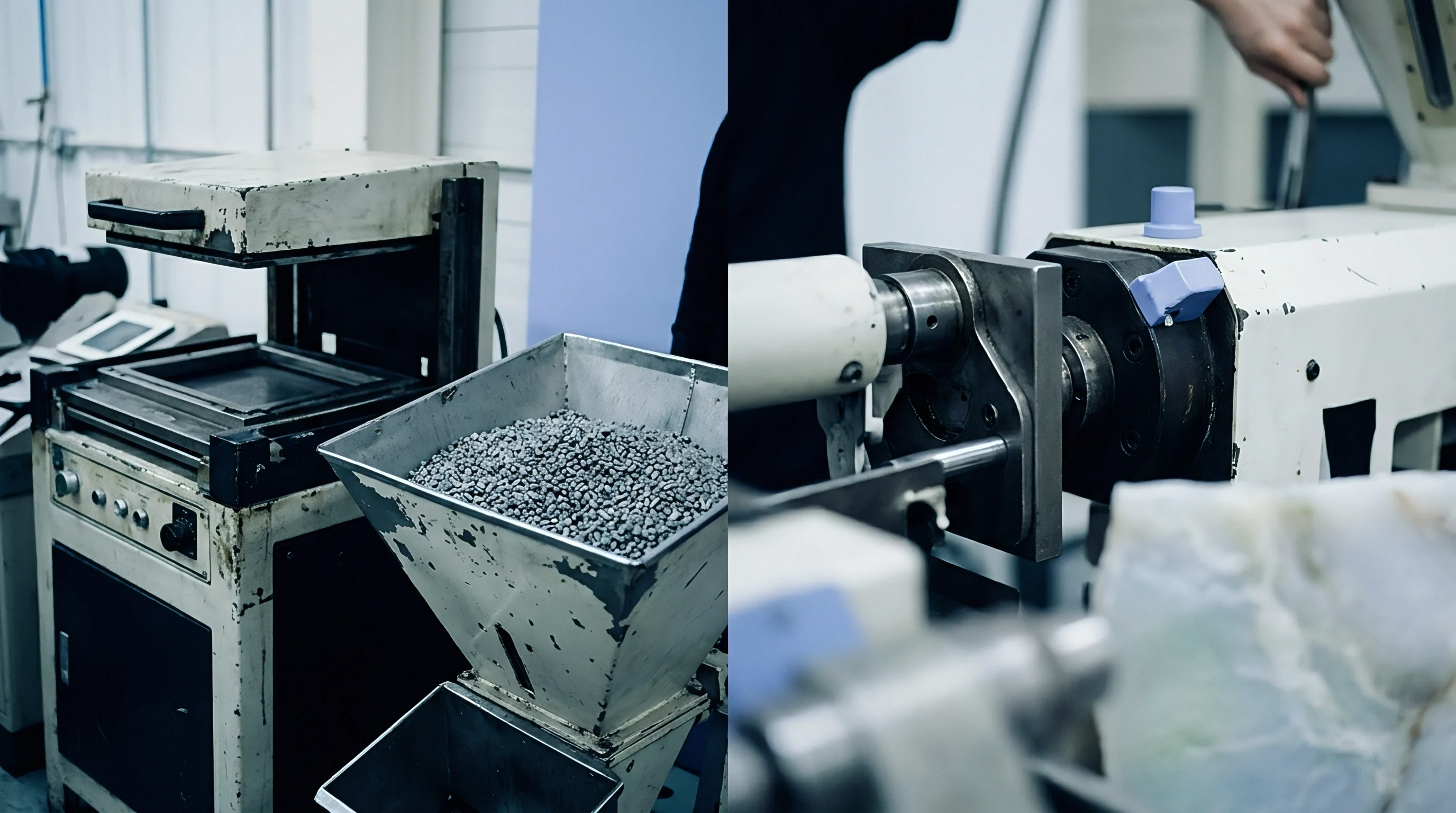
Origin Vectors in Post-Consumer Feedstocks
Mechanical recycling of high-density polyethylene and polypropylene merges distinct product histories into single pellet lots. The resulting melt pool contains an array of metals stemming from functional additives and environmental contamination. Trace elements in post-consumer polyolefins generally divide into three functional classes:
- Ziegler-Natta Catalyst Residues remain embedded in polyolefin matrices from primary gas-phase or slurry polymerization, depositing titanium, aluminum, magnesium, and silicon compounds.
- Colorant Pigments and Dyes introduce heavy metals including lead, cadmium, chromium, and iron through historic masterbatch formulations, rotomolding formulations, and printed surface inks.
- Organometallic Heat Stabilizers contribute zinc, barium, and calcium species originally added to prevent thermal cleavage during primary profile extrusion or blow molding.
- Wash Water Carryover deposits sodium, potassium, calcium, and iron salts onto flake surfaces during wet sink-float separation when wash water filtration cycles become saturated.
Ziegler-Natta catalyst systems generate non-volatile organometallic residues. Titanium tetrachloride reacted with triethylaluminum on magnesium chloride supports leaves residual titanium and aluminum in virgin polymer at concentrations between 5 and 50 parts per million. While virgin resins pass through deactivation steps to neutralize these active sites, post-consumer regrind undergoes repeated thermal processing.
Reheating reactivates these Lewis acid sites, triggering thermo-oxidative chain scission during secondary extrusion. Purity drives value.
Sorting efficiency at the wash line dictates the baseline concentration of transition metals in post-consumer polyolefin pellets.

Residual Catalysts and Pigment Systems
Titanium and aluminum compounds remain trapped inside polyolefin matrices following industrial polymerization. Phthalate plasticizers and donor molecules used in polypropylene catalyst synthesis also leave organic ester complexes bound to magnesium dichloride crystallites. When post-consumer rigid packaging contains white titanium dioxide pigments, total titanium concentrations escalate from 10 parts per million to over 5,000 parts per million.
Dispersed titanium dioxide particles operate differently than organometallic catalyst residues, yet total elemental analysis via energy-dispersive X-ray fluorescence captures both forms simultaneously.
Ziegler residues remain.
Inorganic pigments present severe contamination risks in mixed-color post-consumer streams. Historic bottle packaging and yellow pipe scrap contain lead chromate and cadmium sulfide colorants. Green agricultural films carry copper phthalocyanine structures.
Heat stabilizers in legacy polyvinyl chloride items, occasionally mis-sorted into polyolefin wash lines, add organotin and barium-zinc complexes. Chemical analysis of post-consumer pellet lots must isolate these functional classes to assess both degradation kinetics and toxicity compliance. Recyclers frequently explain elevated titanium levels as harmless mineral filler carryover rather than active catalyst residues.


Plasma
Spectroscopic determination of sub-part-per-million elemental concentrations demands complete matrix dissolution or calibrated excitation. Polyolefin pellets resist ambient acid attack due to their high molecular weight and non-polar paraffinic structure. Quantifying trace metals requires specialized digestion procedures to break down the carbon backbone, bringing insoluble metal oxides and organometallic complexes into aqueous solution.
Standard analytical suites employ Inductively Coupled Plasma Optical Emission Spectrometry, Inductively Coupled Plasma Mass Spectrometry, or X-ray Fluorescence spectrometry depending on required detection thresholds and sample throughput demands.

Microwave Acid Digestion Parameters
Closed-vessel microwave decomposition destroys the polyolefin matrix under high pressure and temperature. A representative 0.5-gram sample of post-consumer pellets is combined with concentrated nitric acid and hydrogen peroxide in fluoropolymer pressure vessels. For samples carrying high inorganic filler content, such as titanium dioxide or talc, the addition of hydrofluoric acid ensures complete fluorosilicic and fluorotitanic acid complexation.
The vessels undergo controlled heating up to 210 degrees Celsius at internal pressures reaching 35 bar, holding these conditions for 30 minutes to achieve complete digestion. Metals degrade chains.
Hot acids dissolve polymer.
Improper temperature ramps lead to incomplete organic destruction, yielding carbon-rich solutions that cause spectral interferences during atomic spectrometry. Residual organic carbon concentrations above 0.1 percent weight by volume alter nebulization efficiency and suppress ionization in plasma torches. Dilution with ultra-pure deionized water to a total dissolved solids level below 0.2 percent protects quartz spray chambers and torch injectors from salt deposition.
Hot acids demand careful handling during vessel vent procedures.
Microwave digestion of polyolefin pellets at 210 degrees Celsius in closed PTFE vessels yields full metal recoveries without volatile element loss.

Spectroscopic Quantification Methods
Inductively coupled torch systems convert dissolved polyolefin samples into gas-phase ions for emission or mass measurement. Argon flames ionize atoms. Inductively Coupled Plasma Optical Emission Spectrometry measures light emission at element-specific wavelengths, offering robust quantitative performance across a dynamic range from 0.1 to 1,000 milligrams per kilogram.
Inductively Coupled Plasma Mass Spectrometry extends detection limits down to parts per trillion for toxic heavy metals such as lead, cadmium, and arsenic, though high matrix salt content causes spectral overlap from polyatomic species.
| Analytical Method | Primary Target Elements | Limit of Detection | Sample Preparation | Destructive Status |
|---|---|---|---|---|
| ICP-OES (ISO 11885) | Ti, Al, Mg, Zn, Ca, Fe | 0.1 to 1.0 mg/kg | Microwave Acid Digestion | Destructive |
| ICP-MS (ISO 17294-2) | Pb, Cd, As, Hg, Sb | 0.001 to 0.05 mg/kg | Microwave Acid Digestion | Destructive |
| EDXRF (ASTM F2617) | Ti, Fe, Zn, Cu, Pb, Cd | 5.0 to 20.0 mg/kg | Direct Pellet Compression | Non-Destructive |
| WDXRF (ISO 14596) | Al, Si, P, S, Ca, Ti, Fe | 1.0 to 10.0 mg/kg | Fused Bead or Pellet Disc | Non-Destructive |
| Limits of detection depend on matrix matching, calibration range, and digestion dilution factors. | ||||
Matrices alter signals.
Energy-dispersive X-ray fluorescence provides rapid, non-destructive screening directly on compressed pellet disks. While X-ray methods eliminate acid digestion steps, their sensitivity remains limited by particle size distribution, surface roughness, and density variations across post-consumer lots. Matrix-matched calibration standards prepared with known concentrations of organometallic additives in virgin polyolefin matrices correct for X-ray absorption effects.
Adopting ISO 24085 Annex B requires acid digestion with hydrofluoric acid whenever total silicon and titanium exceed 100 milligrams per kilogram, overriding standard nitric acid digestions.


Catalysis
Transition metals function as active pro-oxidants when dispersed inside polyolefin matrices. Trace concentrations of multivalent ions alter oxidation kinetics during hot melt processing and long-term service exposure. Metals capable of undergoing single-electron redox transitions catalyze the decomposition of alkyl hydroperoxides into free radicals, accelerating polymer autoxidation chains.
Understanding the specific catalytic activity of each metal species allows compounders to adjust stabilizer packages before processing contaminated post-consumer lots.

Where Do Transition Metals Interfere with Polymer Stabilizers?
Hindered amine light stabilizers and primary phenolic antioxidants form complexes with multivalent transition ions. Phenolic antioxidants such as octadecyl 3,5-di-tert-butyl-4-hydroxyhydrocinnamate sacrifice themselves by donating hydrogen atoms to peroxy radicals. When iron or copper ions occupy the coordination sphere of these phenolic structures, the antioxidant molecule undergoes accelerated oxidation, converting into quinone color bodies.
This reaction depletes primary stabilizers long before parts undergo end-use exposure.
Phenols consume quickly.
Phosphite secondary antioxidants like tris(2,4-di-tert-butylphenyl) phosphite hydrolyze and oxidize rapidly in the presence of acidic Ziegler residues. Active titanium sites accelerate phosphite conversion into inactive phosphate species during twin-screw compounding. Phosphite depletion exposes the polyolefin backbone to unchecked radical scission, causing melt flow rate elevation in polypropylene and chain branching in high-density polyethylene.

Peroxide Decomposition and Autoxidation Cycles
Hydroperoxides formed during polymer processing react rapidly with trace iron or copper. The reaction follows Haber-Weiss and Fenton-type mechanisms where reduced transition metals react with hydroperoxides to form alkoxy radicals, while oxidized metal species generate peroxy radicals. This redox cycle recurs endlessly because the metal ion fluctuates between oxidation states without being consumed in the stoichiometric reaction.
Radicals attack backbone chains.
Copper exhibits the highest pro-oxidative catalytic activity among common contaminant metals. Concentrations as low as 1 milligram per kilogram of active copper reduce the Oxidative Induction Time of un-stabilized polypropylene by over 80 percent at 200 degrees Celsius. Titanium, chromium, and vanadium residues from legacy polymerization catalysts display lower specific activity per atom than copper, yet their typical concentrations in post-consumer pellets are significantly higher.
| Metal Species | Primary Source Vector | Oxidative Activity Index | OIT Reduction Rate | Degradation Mechanism |
|---|---|---|---|---|
| Copper (Cu+/Cu2+) | Wire scrap, pigments | 10.0 (Highest) | -85% at 2 mg/kg | Hydroperoxide homolysis |
| Iron (Fe2+/Fe3+) | Shredder wear, rust | 4.5 (Moderate) | -45% at 10 mg/kg | Fenton-type radical generation |
| Titanium (Ti3+/Ti4+) | Ziegler residue, TiO2 | 2.1 (Low to Moderate) | -20% at 50 mg/kg | Lewis acid scission, UV activity |
| Zinc (Zn2+) | Heat stabilizers, rubber | 0.3 (Negligible) | -5% at 100 mg/kg | Deactivator complexation |
Copper accelerates oxidation.
Stabilizer formulation strategies for high-metal post-consumer lots mandate metal deactivators. Hydrazide and oxamide derivatives bind multivalent metal ions into stable, non-catalytic chelate rings. Deactivators prevent transition metal ions from participating in single-electron transfer reactions with hydroperoxides.
Incorporating 0.2 percent weight concentration of a metal deactivator restores oxidative stability to post-consumer polyolefins carrying elevated iron and copper loads. Ignoring trace transition metal contamination in post-consumer polyolefins causes premature stress cracking and catastrophic brittle failure of molded parts in field service.


Screen
Incoming inspection of post-consumer pellet lots relies on layered testing to balance speed against precision. Recyclers and compounders handle large volumes where high elemental variance occurs between gaylord boxes and bulk silos. Relying exclusively on off-site wet chemical digestion creates operational bottlenecks.
Rapid screening techniques at the receiving dock separate compliant lots from contaminated material before pneumatic transfer into storage silos occurs.

Pressure Filter Testing and Melt Homogeneity
Extrusion through fine wire mesh measures the physical and inorganic contaminant load of post-consumer melt. Standardized by DIN EN 13900-5, the Filter Pressure Value test passes a melted polyolefin sample through a defined screen pack, typically 14 or 25 microns, at a constant volume flow rate using a gear pump. Inorganic particles, including titanium dioxide agglomerates, aluminum flakes, and un-melted cross-linked gels, clog the mesh openings, driving a pressure rise upstream of the filter pack.
Screen packs plug fast.
Pressure spikes signal contamination.
Calculating the Filter Pressure Value provides an immediate physical proxy for total solid contaminant loading. Expressed in bar per gram of polymer extruded, a low pressure value below 1.5 bar per gram indicates high melt purity suitable for fine fiber spinning or thin film extrusion. Values exceeding 10.0 bar per gram flag severe inorganic contamination, signaling high concentrations of pigment agglomerates, glass fibers, or metallic debris that will disrupt molding operations.

Statistical Sampling Protocols for Silo Acceptance
Heterogeneity across 20-tonne polymer shipments demands multi-point core sampling before silo unloading. Incremental samples taken from top, middle, and bottom discharge ports of a bulk tanker yield a composite sample representing true lot distribution. Following ISO 11648-2 principles for particulate materials ensures that sample size and grab counts overcome spatial segregation effects typical of recycled pellet blends.
- Insert a multi-zone sampling lance vertically into four distinct access points across the top hatch of the bulk transport container.
- Rotate the lance sleeve to open collection chambers, trapping primary increments at defined depths between 0.5 and 2.0 meters.
- Consolidate primary increments into a clean stainless steel mixing vessel to form a 5-kilogram primary composite sample.
- Pass the primary composite through a rotary riffle sample splitter to extract a representative 500-gram analytical sub-sample.
- Compress 50 grams of the sub-sample into flat discs at 180 degrees Celsius under 10 MPa pressure for direct X-ray screening.
Sampling demands discipline.
Rapid gatekeeping relies on energy-dispersive X-ray fluorescence analysis of these pressed discs. Operating hand-held or benchtop instruments yields total titanium, iron, zinc, and copper concentrations within five minutes. Establishing quantitative threshold limits prevents off-spec shipments from entering production storage facilities.
- Titanium Concentration Ceiling set at 100 milligrams per kilogram for film grades prevents melt draw-down instability and gel formation.
- Total Transition Metals capped at 50 milligrams per kilogram maintains oxidative induction time specifications without over-dosing expensive stabilizer packages.
- Heavy Metal Limits specified below 80 milligrams per kilogram total combined lead, cadmium, mercury, and hexavalent chromium ensures packaging Directive compliance.
- Filter Pressure Limit held below 3.0 bar per gram prevents nozzle clogging during high-speed hot runner injection molding runs.
A dark yellow color shift during melt compounding indicates active antioxidant depletion by transition metals long before mechanical drop tests show embrittlement.


Settlement
Commercial contracts for post-consumer polyolefin pellets anchor pricing to elemental purity thresholds. High metal content degrades mechanical integrity, accelerates thermal decay, and restricts end-use applications, reducing market valuation. Buyers specify upper concentration boundaries for both toxic heavy metals regulated by law and process-disrupting transition metals.
Lot pricing reflects the processing cost required to clean, dilute, or stabilize contaminated material to meet performance specifications.

Heavy Metal Regulatory Compliance Limits
European Directives and food-contact regulations set strict maximum concentration limits for toxic metals. EU RoHS Directive 2011/65/EU restricts lead, mercury, cadmium, and hexavalent chromium in electrical equipment, establishing threshold limits of 100 milligrams per kilogram for cadmium and 1,000 milligrams per kilogram for lead and mercury. EU Packaging Directive 94/62/EC enforces a combined threshold of 100 milligrams per kilogram for lead, cadmium, mercury, and hexavalent chromium in packaging materials.
Regulators penalize heavy metals.
Food-contact approval under FDA 21 CFR 177 and EU Regulation 10/2011 prohibits post-consumer polyolefins containing heavy metals capable of migrating into foodstuffs. Compliance verification requires total digestion testing alongside migration testing into food simulants. Shipments failing these threshold limits cannot enter target supply chains, forcing recyclers to divert non-compliant lots into low-value structural applications like plastic lumber or highway barriers.
Packaging materials must not exceed a cumulative concentration of 100 milligrams per kilogram of lead, cadmium, mercury, and hexavalent chromium combined.

Price Discount Formulas and Contamination Rebates
Pellet lots exceeding negotiated transition metal specifications trigger financial adjustments or rejection. Contracts define baseline pricing for standard post-consumer grades, establishing automatic price deductions when analytical certificates report elevated titanium, iron, or zinc levels. Deductions offset the compounder cost of adding metal deactivator additives or performing secondary melt filtration passes.
| Contaminant Element | Specification Baseline | Tolerance Threshold | Commercial Penalty Formula | Action Threshold |
|---|---|---|---|---|
| Titanium (Ti) | Under 50 mg/kg | 50 to 200 mg/kg | $15 per tonne per 10 mg/kg over baseline | Rejection above 200 mg/kg |
| Iron (Fe) | Under 15 mg/kg | 15 to 50 mg/kg | $20 per tonne per 5 mg/kg over baseline | Rejection above 50 mg/kg |
| Copper (Cu) | Under 2 mg/kg | 2 to 10 mg/kg | $50 per tonne per 1 mg/kg over baseline | Rejection above 10 mg/kg |
| Total Heavy Metals | Under 50 mg/kg | 50 to 100 mg/kg | $30 per tonne per 10 mg/kg over baseline | Rejection above 100 mg/kg |
Off-spec lots face discounts.
Contracts enforce purity limits.
Sourcing engineers calculate landed costs by combining base pellet purchase price, duty fees, freight costs, and additive modification expenses. When high iron concentrations require adding 0.3 percent metal deactivator at $18 per kilogram, processing costs rise by $54 per tonne. If the pellet supplier pays no rebate to cover additive costs, purchasing off-spec post-consumer resin becomes economically unviable compared to prime virgin grades.
It remains uncertain whether emerging chemical recycling processes will reach lower total transition metal levels than advanced mechanical wash lines without driving pellet processing costs beyond virgin resin parity.