Flow Rate Ratio Analysis for Bimodal High Density Polyethylene Resin Qualification
Flow rate ratio analysis of high-load over standard melt index isolates bimodal resin molecular distribution shifts to prevent extrusion failures before silo unloading.
Die
Incoming inspection tables reject bimodal high density polyethylene lots when the high-load melt flow rate splits from the standard weight prediction. A resin showing an acceptable melt mass-flow rate of 0.25 grams per 10 minutes under 2.16 kilograms at 190 degrees Celsius can still destroy continuous production. That same pellet batch may yield an extrusion head pressure spike of forty bar within six minutes of line start.
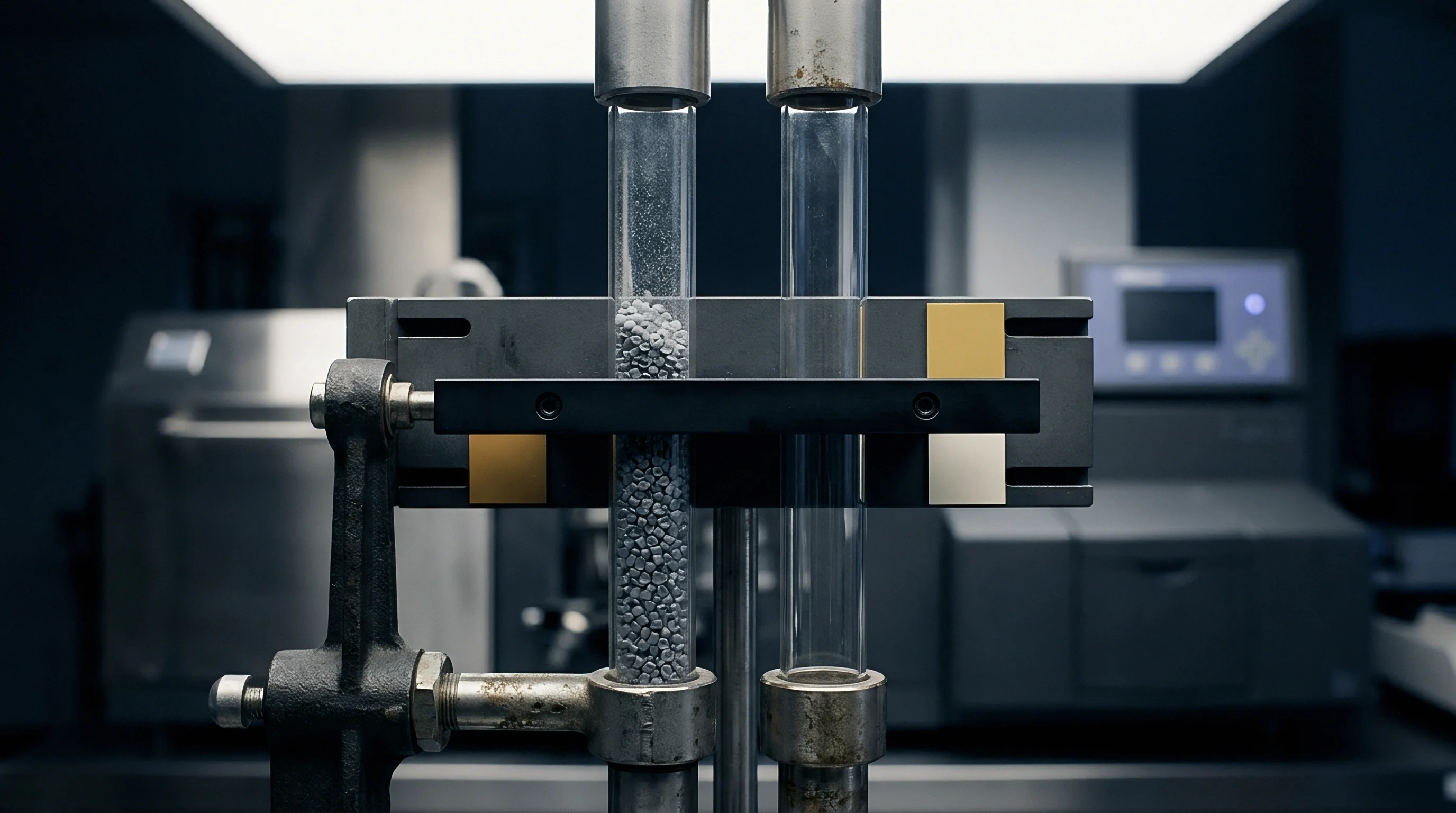
The laboratory capillary die reveals what single-point melt testing conceals. High molecular weight polymer chains remain entangled under low gravitational shear stress. Elevated loads uncoil those long backbones, forcing them through the tungsten carbide orifice at accelerated rates.
Measuring the mass discharge across two distinct load conditions produces the flow rate ratio. That mathematical quotient serves as the primary inline proxy for molecular weight distribution breadth and reactor split consistency.
Standard qualification procedures rely on ISO 1133-1 Method A and ASTM D1238 Procedure A or B. Technicians pack seven grams of vacuum-dried pellets into the heated cylinder barrel, preheating the polymer charge for exactly 420 seconds at 190 degrees Celsius. The test runs first under a nominal dead-weight piston load of 2.16 kilograms to capture standard flow, termed index 2.16. Operators run a secondary charge from the same incoming sample box under a 21.6 kilogram weight, recording the high-load melt flow index, designated index 21.6.
Dividing the high-load result by the standard-load result yields the flow rate ratio 21.6 over 2.16. Certain pipe converters specify a 5.0 kilogram reference condition instead, deriving the ratio from index 21.6 divided by index 5.
A flow rate ratio of 105 measured at 190 degrees Celsius under 21.6 kilograms against 2.16 kilograms defines the target window for dual-reactor blow molding copolymer lots.
Die geometry dictates test precision during qualification runs. Both ISO 1133 and ASTM D1238 specify an internal bore diameter of 2.095 millimeters and an axial length of 8.000 millimeters. A tooling tolerance wear limit of 0.005 millimeters alters the calculated extrusion velocity by four percent.
Sourcing teams checking imported PE-100 or blow-molding grades track these mechanical dimensions on every test certificate.
| Test Condition Code | Piston Load (kg) | Nominal Shear Stress (kPa) | Primary Molecular Response | Targeted Processing Defect |
|---|---|---|---|---|
| ASTM D1238 Condition E | 2.16 | 19.6 | Low molecular weight matrix flow | Extrusion surge and sag |
| ISO 1133 Condition T | 5.00 | 45.4 | Mid-weight chain disentanglement | Haul-off speed mismatches |
| ASTM D1238 Condition F | 21.60 | 196.0 | High molecular weight chain alignment | Melt fracture and head pressure |
| Ratio Calculation 21.6/5 | Relative | Differential | Reactor block balance | Environmental stress cracking |
| Ratio Calculation 21.6/2.16 | Relative | Differential | Polydispersity index span | Parison instability and pinch flash |
Commercial contracts specify the numerical bounds for the calculated quotient. A railcar carrying bimodal blow-molding resin with a nominal 21.6 over 2.16 ratio target of 110 presents severe processing resistance when the laboratory measurement drops below 88. Narrow ratios indicate an under-represented low molecular weight fraction or incomplete reactor block synthesis.
The converter observes immediate barrel motor current escalation and melt fracture at the tooling lip. Sourcing dossiers record the flow rate ratio on every lot release document to protect processing margins.

Modality
Dual-reactor synthesis plants manufacture bimodal high density polyethylene by running two polymerization reactors in series. The first reactor uses high hydrogen concentrations to yield a low molecular weight homopolymer block with chain lengths terminating near 20,000 grams per mole. The second cascade reactor strips hydrogen and injects 1-butene or 1-hexene comonomer, generating a high molecular weight copolymer fraction exceeding 450,000 grams per mole.
This structural split gives bimodal resin its dual character. The short chains lubricate the melt during extrusion. The long chains incorporate the comonomer branches, creating tie molecules that span the amorphous regions between crystalline lamellae.
Analytical laboratories use gel permeation chromatography to measure molecular weight distribution directly. High-temperature trichlorobenzene chromatography takes eight hours per sample run, demanding columns heated to 160 degrees Celsius. Flow rate ratio testing requires twenty minutes on a standardized extrusion plastometer.
The rheological ratio responds directly to the polydispersity index, defined as weight-average molecular weight divided by number-average molecular weight. Shifts in the second reactor comonomer incorporation rate alter the high-load flow index without perturbing the low-load baseline.
Processors observe distinct material trade-offs when resin modality drifts away from design targets:
- Melt fracture threshold shifts toward lower shear rates when the high molecular weight tail increases beyond specification bounds, causing surface roughness on continuous profile surfaces.
- Environmental stress crack resistance drops by decades of hours under ASTM D1693 Condition B when the tie molecule population falls below critical limits.
- Parison sag velocity accelerates during large-part blow molding operations if the high-load melt flow index rises past 8.5 grams per 10 minutes.
- Die swell enlargement forces frequent tooling recalibrations when the elastic recovery of the high molecular weight fraction exceeds target tolerances.
Single-reactor Ziegler-Natta or chromium-catalyzed resins produce unimodal distributions. Their flow rate ratios under 21.6 over 2.16 loading settle between 25 and 45. Bimodal cascade resins routinely demonstrate ratios between 80 and 150.
A resin buyer encountering an alleged bimodal lot with an index ratio below 65 looks directly at reactor transition scrap blended into prime product. Plant managers explain that reactor temperature fluctuations altered the chain-transfer kinetics during the final hours of the campaign.

Shear
Melted polyethylene exhibits pseudoplastic shear-thinning behavior inside processing screws and tooling channels. At resting state or under low shear stress, random thermal coil conformations cause polymer chains to remain tangled. Applying mechanical stress disentangles and aligns these macromolecules parallel to the stream vector.
Viscosity drops by multiple orders of magnitude as shear rate climbs. Bimodal architecture steepens this viscosity reduction curve compared to linear unimodal grades. The low molecular weight fraction acts as an internal solvent, lowering the apparent viscosity precisely where wall shear rates peak.
Standard plastometer testing operates at low wall shear rates. Under a 2.16 kilogram load, the shear rate inside the standard capillary orifice hovers near 5 reciprocal seconds. Applying a 21.6 kilogram mass accelerates the piston, driving the shear rate toward 150 reciprocal seconds.
Industrial single-screw extruders run die lips at shear rates between 500 and 3,000 reciprocal seconds. The flow rate ratio captures the slope of the power-law viscosity curve across that initial thirty-fold shear escalation. A steep slope signals lower head pressure and reduced energy draw at commercial production speeds.
Apparent shear viscosity declines along a power-law exponent proportional to the ratio of high-load to low-load melt flow values.
Evaluating incoming railcars demands a repeatable, sequentially executed lab procedure. Technicians follow a four-stage qualification sequence to confirm shear stability:
- Dry incoming resin samples under desiccated air at 80 degrees Celsius for 120 minutes to eliminate surface condensation.
- Pack exactly 7.2 grams of pellets into the plastometer barrel in three distinct compressions to prevent air entrapment.
- Execute the 2.16 kilogram benchmark test per ISO 1133-1 Procedure A, timing the optical piston travel across a 25.4 millimeter stroke.
- Clean the barrel with brass patches, reload immediately with identical resin mass, apply the 21.6 kilogram weight, and record high-load displacement rate.
Extrusion lines drift when lots carry identical standard melt indices alongside divergent flow rate ratios. Take a factory converting 40 metric tons of PE-100 pipe resin daily. Nominal resin specifications state a standard index of 0.23 grams per 10 minutes at 190 degrees Celsius under 5.0 kilograms.
The supplier ships two consecutive lots with matching 0.23 values. Lot Alpha presents an index 21.6 of 6.9, yielding a ratio of 30. Lot Beta arrives with an index 21.6 of 9.2, generating a ratio of 40.
Extruding Lot Alpha drives barrel melt temperatures up by 14 degrees Celsius due to shear heating. The downstream vacuum calibration bath fails to cool the thick pipe wall fast enough, producing internal lumen ovality and pulling the pipe out of dimensional tolerance.
| Resin Grade Designation | Standard Melt Index (g/10 min) | High-Load Melt Index (g/10 min) | Flow Rate Ratio (21.6/5.0) | ESCR PENT Hours (ASTM F1473) | Die Head Pressure (bar) |
|---|---|---|---|---|---|
| Pipe PE-100 Grade A | 0.22 (at 5.0 kg) | 6.4 | 29.1 | >10,000 | 245 |
| Pipe PE-100 Grade B | 0.24 (at 5.0 kg) | 9.1 | 37.9 | 6,200 | 210 |
| Blow Molding HIC-1 | 0.35 (at 2.16 kg) | 31.5 | 90.0 | 1,800 | 185 |
| Blow Molding HIC-2 | 0.15 (at 2.16 kg) | 21.0 | 140.0 | 3,500 | 195 |
| Film Grade Bimodal | 0.08 (at 2.16 kg) | 10.4 | 130.0 | >5,000 | 280 |
| Data measured at 190 degrees Celsius; head pressure recorded on a 90mm smooth-bore extruder at 45 rpm. | |||||
Rheological divergence translates directly into financial exposure on converter ledger sheets. A container of pipe resin showing an out-of-spec flow rate ratio cannot run at rated line speeds without inducing surface melt fracture. Dialing down screw speed by fifteen percent to avoid sharkskin defect costs four thousand dollars per operating shift in lost machine output.
Sourcing contracts place immediate rejection authority on ratio deviation limits. Buying agents specify ratio boundaries on raw material purchasing orders.
Thermal stability during the plastometer test run affects the recorded shear response. Polyethylene held at 190 degrees Celsius for longer than eight minutes without adequate phenolic antioxidants undergoes cross-linking or chain scission. Secondary cross-linking ties long branches together, reducing the high-load flow rate and compressing the calculated ratio artificially.
A testing protocol accounts for thermal dwell time to isolate true polymer morphology from thermal degradation artifacts. The buyer confirms stabilization packages on the resin technical datasheet before disputing test findings.
Accepting resin lots on standard melt flow data alone leads to mold cavity underfills, excessive part weight variation, and catastrophic stress cracking failures in field service.

Stress
Mechanical longevity in bimodal high density polyethylene parts depends on tie molecule density. Under prolonged tensile loads in the presence of detergents or hydrostatic pressure, polyethylenes fail via slow crack growth. The mechanism operates without macroscopic yield.
Microscopic fibrils within the craze zone stretch and detach from crystalline fold surfaces. High molecular weight chains spanning these crystalline lamellae resist disentanglement. They transfer load across the amorphous boundary, arresting craze progression.
The flow rate ratio provides an indirect window into this long-term crack resistance performance.
Resin lots exhibiting flow rate ratios below 85 in blow molding grades yield inconsistent slow crack growth performance under detergent exposure.
Direct verification of slow crack growth resistance demands lengthy testing protocols. The Pennsylvania Notch Test per ASTM F1473 runs for thousands of hours at 80 degrees Celsius under an engineering stress of 2.4 megapascals. The Full Notch Creep Test per ISO 16770 requires hundreds of hours inside an aqueous surfactant bath.
Converters cannot hold incoming silos open for four months awaiting creep test completion. Sourcing teams use the flow rate ratio as an immediate go-no-go gateway test. When the high-load melt flow index drops relative to the base index, the high molecular weight copolymer fraction has shrunk.
A smaller copolymer block reduces the tie molecule population, increasing field failure probability.
Evaluating resin compliance involves specific laboratory pass criteria:
- High-load flow boundary stays within plus or minus eight percent of the baseline qualification certificate.
- Calculated flow rate ratio remains within twelve percent of the designated master resin qualification file.
- Cylinder test dwell time remains under ten minutes to prevent thermal stabilizer depletion during measurement.
- Extrudate strand appearance shows no visual sharkskin or helical distortion under the 21.6 kilogram test stroke.
Uncertainty exists in the precise correlation between high-load flow ratios and long-term creep curves across different catalyst families. Metallocene-catalyzed bimodal resins produce narrower molecular weight splits while achieving equal tie molecule effectiveness through superior short-chain branch distribution. Sourcing engineers handle this ambiguity by refusing cross-catalyst ratio comparisons.
A Ziegler-Natta resin baseline cannot validate a metallocene resin delivery. The buyer qualifies each catalyst family against its own specific ratio envelope.
How do subtle reactor variations undermine these test limits? A dual-reactor plant running slurry cascade loops may experience comonomer dosing fluctuations of three percent. That small dosing error shifts tie molecule distribution without changing the standard 2.16 kilogram melt flow number.
Standard certificates of analysis miss the variation entirely. The high-load ratio captures the shift, registering a depressed value. What remains unresolved across the compounding sector is whether inline rheological die transducers can replace bench plastometers without introducing unacceptable calibration drift during continuous operations.

Intake
Incoming inspection procedures govern whether resin bags enter processing silos or return to the freight terminal. Sourcing specialists write exact testing requirements into resin supply agreements. A complete specification line names the polymer designation, target density per ISO 1183, standard melt index, high-load melt index, and acceptable flow rate ratio band.
The clause requires third-party or internal laboratory testing of three composite samples per 25-ton shipping container. Material stays in quarantine status until lab sign-off occurs.
The economics of resin qualification connect technical precision directly to operating cash flow. Prime virgin bimodal pipe grades trade at twelve hundred dollars per metric ton on contract settlements. Secondary or off-spec extrusion lots trade at a three-hundred-dollar discount.
Compounders occasionally dilute virgin prime lots with near-prime railcar heels to widen margins. A single-point melt flow test misses this adulteration if the blending balances low and high fractions arbitrarily. The flow rate ratio exposes the dilution through changes in shear sensitivity.
The buyer avoids paying prime prices for degraded blends.
Specification contracts resolve disputes by referencing ISO 1133-1 Condition G testing protocols. The purchase agreement stipulates that any railcar delivering a calculated flow rate ratio deviating beyond ten percent from the approved technical datasheet incurs automatic return freight at the supplier expense alongside full invoice cancellation.