Arbitrating Unabsorbed Overhead Machine Losses from Undetected Hydrolytic Polymer Chain Scission in Automated Cells
Arbitrating unabsorbed machine overhead losses from hydrolytic chain scission requires inline viscosity tracking, moisture logs, and clear quality contract addendums.

Scission
Automated injection molding and extrusion cells running engineering thermoplastics operate under strict thermal and mechanical cycle limits. Condensation polymers including polybutylene terephthalate, polyamide 66, and polycarbonate undergo rapid hydrolytic chain cleavage when exposed to trace moisture at elevated melt temperatures. Water molecules present in raw resin pellets act as nucleophiles, attacking carbonyl groups along the polymer backbone during plasticization inside the injection barrel.
The reaction breaks high molecular weight chains into shorter fragments, lowering the average degree of polymerization within seconds. Melt pressure sensors inside the barrel record low resistance as viscosity drops, while automated cell end-of-arm tooling continues to package parts that meet external dimensional tolerances.
Automated visual inspection stations and dimensional gauging stations fail to register this internal structural collapse. Part geometry, surface finish, and weight remain within drawing callouts despite severe reductions in number-average molecular weight. Polymer chains cleaved by water molecules retain short-range spatial order as they freeze inside cold mold cavities.
Tensile strength and impact resistance deteriorate silently. The parts leave the automated cell and enter sub-assembly queues, carrying microscopic molecular defects that lead to catastrophic brittle fracture when subjected to mechanical loading during end-use service.
ISO 1043 polymer designation agreements in raw material contracts fix commercial liability for non-conforming molecular weight degradation directly upon the resin compounder.
Downstream testing often uncovers hydrolytic degradation days after processing. Production runs generated across multiple shifts are declared non-conforming, forcing total scrap write-offs. Machine time expended on the automated cell cannot be recovered or re-allocated to other jobs.
Fixed overhead costs including press depreciation, floor space allocation, cell automation capital recovery, and auxiliary equipment energy baseline continue to accrue during production delays. The financial loss expands beyond destroyed resin pellets to include unabsorbed plant overhead costs generated during cell operation.
Controversies arise during commercial cost recovery when determining whether chain degradation resulted from wet resin delivered by the compounder or inadequate desiccant drying by the molder. Compounders state raw pellets met intrinsic viscosity specifications at the packaging dock. Molders present dryer dew point trend logs showing low dew point levels during processing.
The technical arbitration hinges on analytical measurements that isolate incoming pellet moisture from cell processing conditions. Processors who fail to isolate these rheological markers absorb complete machine downtime overheads.
Viscosity
Melt Flow Index Shift under Degradation
Rheological evaluation provides direct empirical proof of molecular weight reduction in processed parts. Melt flow rate measurement serves as an immediate indicator of polymer chain length changes. High molecular weight polymers exhibit high melt resistance, resulting in low volumetric flow numbers through a standardized orifice under fixed temperature and load conditions.
When hydrolytic chain cleavage occurs, reduced molecular chain entanglements allow faster fluid displacement through the test barrel. Comparing raw pellet melt flow rates with regrind or part sample melt flow rates quantifies the extent of polymer degradation occurring inside the processing cell.
Capillary rheometry demonstrates how shear viscosity drops across varying shear rates when water cleaves condensation polymers. At high injection speeds typical of automated thin-wall molding, degraded polymers display pronounced shear thinning alongside low overall zero-shear viscosity. Lower viscosity alters cavity filling dynamics, shifting the transition from velocity-controlled filling to pressure-controlled packing.
The automated injection press compensates by reducing peak hydraulic pressure, obscuring the physical degradation occurring within the melt stream.

What Rheological Testing Establishes Degradation Boundaries?
Analytical techniques isolate polymer backbone cleavage from thermal oxidation or mechanical shear damage. Solvent-based viscosity testing measures intrinsic viscosity by dissolving polymer samples in selective solvent mixtures at controlled temperatures. Intrinsic viscosity correlates directly to weight-average molecular weight through the Mark-Houwink equation.
Gas chromatography and titration methods quantify terminal functional groups created during bond cleavage. Gel permeation chromatography determines the complete molecular weight distribution, exposing shifts in polydispersity caused by hydrolytic degradation.
- Intrinsic Viscosity Loss measured in phenol and 1,2-dichlorobenzene at 25 °C drops by more than fifteen percent relative to pristine pellet certificates of analysis when hydrolytic cleavage occurs.
- Melt Volume-Flow Rate Jumps under ISO 1133 conditions at 250 °C with a 2.16 kg weight exceed twenty-five percent above baseline incoming values.
- Carboxyl End-Group Concentration increases proportionally with hydrolyzed ester or amide linkages, verified through potentiometric titration according to ISO 13737 methods.
- Polydispersity Index Expansion captured through gel permeation chromatography reveals a distinct bimodal shift toward lower molecular weight fractions.
Quantifying these rheological changes provides the technical evidence required for commercial claims. Compounders frequently claim that elevated melt flow measurements result from excessive screw speed, high back pressure, or prolonged residence times inside the injection cylinder rather than excess moisture inside raw pellets.
| Polymer Grade | Test Standard | Dry Pellets (Moisture < 0.02%) | Moist Pellets (Moisture = 0.08%) | Degraded Pellets (Moisture > 0.15%) |
|---|---|---|---|---|
| PBT Unfilled (ISO 20028) | MVR 250 °C / 2.16 kg (cm³/10 min) | 18.5 | 29.2 | 54.0 |
| PBT 30% Glass Fiber | Notched Izod 23 °C (kJ/m²) | 9.2 | 6.8 | 4.1 |
| PA66 Unfilled (ISO 16396) | Solution Viscosity Number (mL/g) | 145.0 | 122.0 | 91.0 |
| Polycarbonate Optical Grade | Tensile Stress at Yield (MPa) | 64.0 | 62.5 | 48.0 |
| Data recorded under laboratory conditions; solution viscosity measured in 96% sulfuric acid per ISO 307. | ||||
ISO 1133 testing at 280 °C under a 2.16 kg load reveals a three-fold increase in melt volume rate when moisture content exceeds 0.02 percent by weight.
Resin suppliers attribute observed viscosity spikes to molder regrind incorporation or improper thermal settings in the heating zones.

Clamp
Automated cells rely on cavity pressure profiles to govern valve gate sequencing, hold pressure transfer, and robotic parts removal. Hydrolyzed resin fills mold cavities faster under constant injection velocity due to reduced fluid drag. Pressure transducers located at the mold gate detect rapid pressure rise, triggering early transition to pack and hold phases.
The cell logic interprets this fast pressure transmission as standard mold filling performance. The clamp unit holds the mold plates closed under full tonnage, oblivious to the fact that reduced polymer chain entanglements are creating brittle parts with altered shrinkage vectors.
Automated vision systems inspect ejector pin marks, part perimeter flash, and runner separation. Optical sensors confirm physical presence and dimensional boundaries, transmitting positive compliance signals to the main cell controller. Downstream robotic handling systems stack parts into shipping crates while internal residual stresses and shortened polymer chains compromise structural integrity.
Part warpage appears later as molded components undergo ambient cooling and stress relaxation in storage warehouses.
| Automated Cell Subsystem | Measured Metric | Baseline Operating Signal | Degraded Resin Signal | Downstream Structural Impact |
|---|---|---|---|---|
| Hydraulic/Electric Injection Unit | Peak Cavity Filling Pressure | 85 MPa | 62 MPa | Flash formation, internal voiding, sink marks |
| Melt Pressure Transducer | Time to V/P Switchover | 1.45 seconds | 1.12 seconds | Incomplete packing, high volumetric shrinkage |
| Robot End-of-Arm Tooling | Part Extraction Force | 120 N | 82 N | Ejector pin push-through, micro-fracturing |
| In-Cell Optical Vision Station | Boundary Dimension Check | Pass (±0.05 mm) | Pass (±0.05 mm) | Hidden impact strength loss up to sixty percent |
Parts ejected from automated molds with degraded molecular structure show zero immediate visual defects.

Variance
Calculating unabsorbed overhead losses during production runs compromised by undetected chain cleavage demands detailed financial tracking of fixed facility costs. Modern automated cells carry high hourly machine burden rates derived from capital equipment depreciation, automated cell integration financing, dedicated chillers, hopper dryers, robotic end-effectors, and allocated floor space costs. When a 72-hour automated production run yields scrap due to undetected wet resin processing, the financial loss contains direct material scrap costs alongside unabsorbed machine overhead allocations.
Consider an automated manufacturing cell operating a 500-tonne electric injection molding press dedicated to automotive connector housing production using 30% glass-fiber reinforced PBT. The cell runs at an hourly machine burden rate of $145.00, excluding direct labor and raw resin costs. Capital depreciation accounts for $65.00 per hour, facility space and baseline energy consume $35.00 per hour, and auxiliary automated handling units absorb $45.00 per hour.
Raw PBT compound costs $4.20 per kilogram, and the cell consumes 35 kilograms of resin per hour, producing 1,200 parts every 60 minutes.
During a weekend run, a lot of pre-compounded PBT containing 0.12% internal moisture enters the hopper dryer. The automated cell runs continuously for 48 hours without cell fault shutdowns, producing 57,600 connector housings. Subsequent mechanical testing via ISO 179 notched Izod impact shows catastrophic embrittlement, dropping impact resistance from 9.0 kJ/m² to 3.2 kJ/m².
The entire batch is rejected. Calculating the total unabsorbed overhead machine loss involves isolating fixed facility burden from direct variable costs:
- Direct machine overhead rate determination multiplying $145.00 per hour by 48 operating hours yields $6,960.00 in unabsorbed machine burden.
- Auxiliary drying and automated inspection equipment allocation adds $18.50 per hour across 48 hours, contributing $888.00 in non-recoverable auxiliary burden.
- Facility space and fixed plant utility absorption calculated at $12.00 per hour generates $576.00 in unabsorbed factory space overhead.
- Direct material write-off adding 1,680 kilograms of processed resin at $4.20 per kilogram totals $7,056.00 in scrap material loss.
- Regrind processing and environmental disposal expenses add $0.40 per kilogram across 1,680 kilograms, totaling $672.00.
Total financial damages reach $16,152.00 for the single 48-hour run. Unabsorbed fixed machine overheads ($8,424.00) exceed the raw resin material loss ($7,056.00). In commercial arbitration, resin suppliers often offer to replace the 1,680 kilograms of resin, refusing to cover the $8,424.00 in lost machine overhead capacity.
The processing plant lost 48 hours of press capacity that cannot be resold, leaving fixed machine costs unabsorbed on the general ledger.
Polymer melt viscosity changes measured at the nozzle provide an immediate indication of moisture-induced structural decay before mechanical testing occurs.
Allocating machine burden recovery requires documenting that press time was completely lost to non-conforming goods production.
Arbitration
Evidentiary Requirements for Overhead Loss Recovery
Commercial arbitration proceedings governing unabsorbed machine overhead claims require strict chains of evidence connecting raw resin conditions to cell downtime losses. Arbitrators reject claims based on simple part failure reports. The processing firm must present incoming pellet moisture certification, automated cell processing logs, dryer dew point recorder charts, and definitive analytical chemistry proving hydrolytic chain scission occurred.
Dryer performance logs constitute the primary line of defense against compounder counter-claims. Resin suppliers routinely argue that molder desiccant dryers suffered regeneration failure, dew point spike, or airflow restriction, introducing moisture inside the barrel. Continuous dew point sensors mounted at the dryer hopper inlet providing certified negative 40 °C logs disprove processor negligence claims.
Moisture measurements taken from sealed incoming bags using Karl Fischer coulometric titration (ASTM D6980) at the receiving dock establish baseline material non-conformance prior to cell processing.
Commercial Allocation of Machine Downstream Burdens
Supply contracts determine whether unabsorbed overhead machine losses are recoverable or excluded as consequential damages. Standard resin purchasing agreements contain liability limits restricting damages to resin replacement or credit memo issuance for raw material value. High-precision molders protect against unabsorbed overhead exposure by negotiating custom quality addendums that include machine burden recovery clauses.
| Dispute Origin Factor | Primary Technical Evidence | Compounder Financial Liability | Processor Financial Liability |
|---|---|---|---|
| Incoming Resin Out-of-Spec Moisture (>0.05%) | Karl Fischer Titration at Sealed Bag Opening | 100% Material Cost + 100% Unabsorbed Overhead | 0% Liability Allocation |
| Inadequate Cell Desiccant Dryer Operation | Hopper Inlet Dew Point Log > -20 °C | 0% Liability Allocation | 100% Material + Overhead Absorption |
| Excessive Barrel Residence Time (>10 min) | Automated Injection Cell Cycle Log Trends | 0% Liability Allocation | 100% Material + Overhead Absorption |
| Additive-Induced Hydrolysis (Acidic Pigment) | Extractable Chemistry & End-Group Titration | 100% Material + 50% Negotiated Overhead | 50% Negotiated Machine Overhead |
Contractual risk distribution depends on explicit document wording regarding manufacturing downtime indemnity.
- Incoming Quality Records including sealed bag retain samples tested via Karl Fischer titration establish initial water content upon delivery.
- Automated Cell Process Histories documenting injection pressure, cushion position, barrel temperatures, and cycle times verify stable processing conditions.
- Desiccant Dryer Dew Point Analytics continuous chart records proving dew point maintenance below negative 40 °C eliminate molder drying fault claims.
- Analytical Chain Scission Evidence intrinsic viscosity and end-group titration reports matching processed parts directly to molecular degradation mechanisms.
Standard purchase order terms containing broad liability waivers force molders to absorb machine overhead losses unless specific quality addendums override general terms. Standard ISO 9001 receiving records combined with automated cell sensor logs provide the technical foundation required to enforce customized machine loss recovery clauses during legal proceedings.
Specific contract terms stipulating that resin suppliers indemnify molders for direct machine burden costs incurred when processing non-conforming raw materials alter commercial recovery outcomes entirely.
Remedy
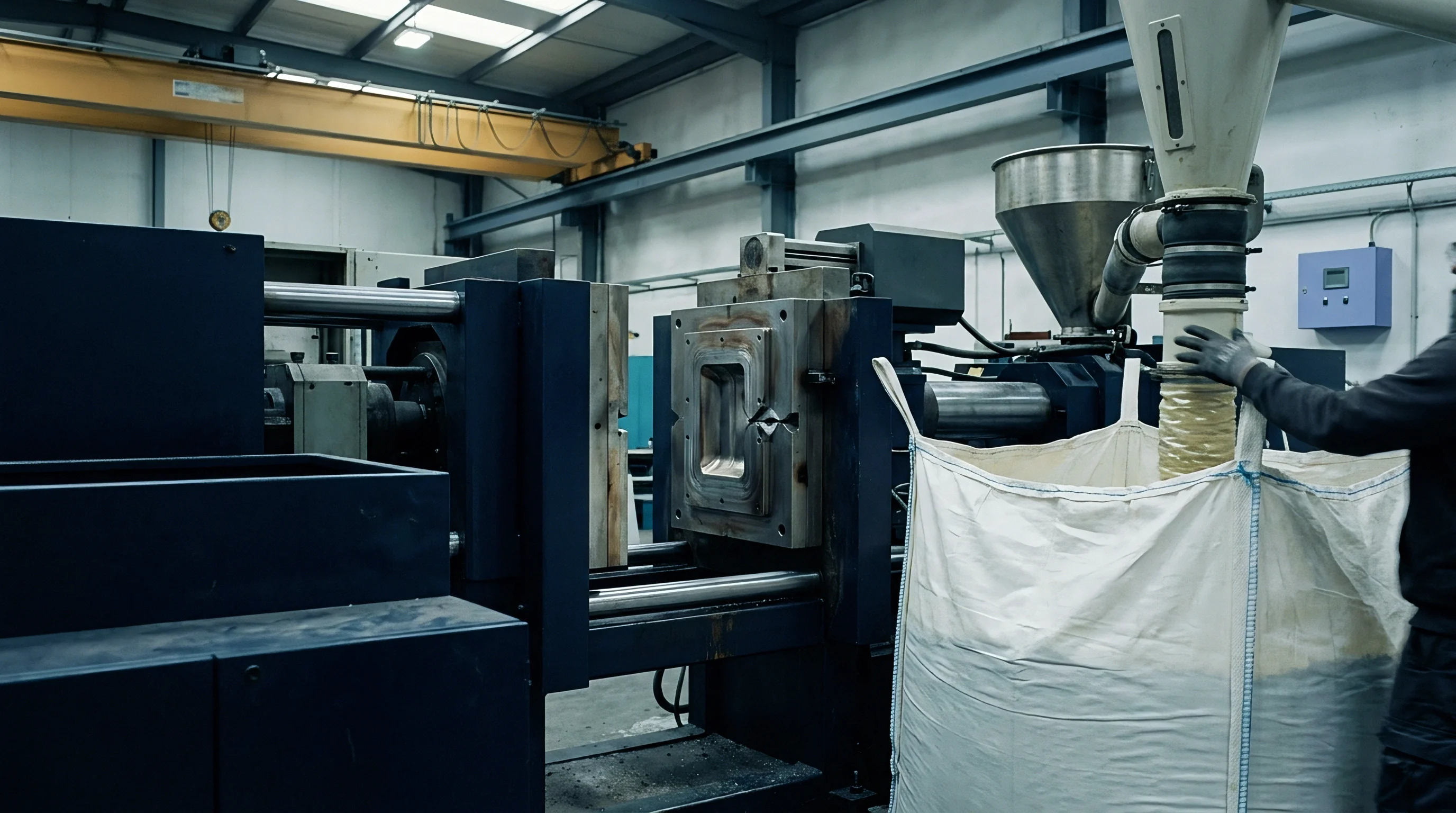
Preventing unabsorbed machine overhead losses requires implementing inline detection systems directly within the automated processing cell. Closed-loop cavity pressure transducers combined with real-time melt viscosity monitoring algorithms detect sudden drops in flow resistance during the injection stroke. When viscosity falls below predetermined statistical process control limits, the automated cell controller initiates a machine stop, holding further processing and alerting cell technicians before hours of unabsorbed overhead loss accumulate.
Automated hopper sampling stations equipped with high-speed moisture analyzers sample incoming resin prior to barrel entry. Coupling real-time moisture verification with cell interlocking logic prevents degraded or improperly dried pellets from entering the plasticizing screw. Advanced cell automation software tracks machine burden metrics in real time, calculating exact unabsorbed overhead costs during line stoppages to generate immediate commercial documentation for vendor claims.
Establishing clear technical baseline standards within procurement contracts fixes liability before material enters the plant. Defining clear intrinsic viscosity drop limits, melt flow rate shift thresholds, and standardized Karl Fischer receiving protocols ensures both compounder and molder operate under identical verification parameters. Structured quality agreements protect machine capacity value, turning complex hydrolytic chain scission disputes into straightforward contractual settlements.
Does the integration of inline capillary rheometers at the injection nozzle justify capital expense by eliminating unabsorbed overhead losses from silent hydrolytic polymer chain scission?