Analytical Differentiation of Extrusion Melt Hydrolysis from Environmental Hydrolytic Degradation in Polyamides
Melt hydrolysis cuts polyamide chains uniformly with stoichiometric end-group parity; environmental attack causes sharp surface oxidation gradients.
Specimen
Carboxyl Titration against End Group Balance
Analytical differentiation between processing-induced thermal hydrolysis and ambient environmental embrittlement in aliphatic polyamides rests on end-group stoichiometry and spatial gradient distribution. An unvented extruder barrel at 275 degrees Celsius containing polyamide 66 resin above the critical moisture limit of 0.20 percent by weight drives rapid chain scission through the reverse polycondensation reaction. The melt cleaves amide linkages uniformly throughout the molten stream, producing one stoichiometric carboxylic acid end group and one primary amine end group per cleaved bond.
This stoichiometric parity defines melt processing failure. The ratio of amine end groups to carboxyl end groups remains identical to the incoming virgin resin baseline, even as number-average molecular weight collapses from 18,000 g/mol to under 11,000 g/mol.
Environmental weathering operates under divergent kinetic and thermodynamic boundaries. Solid-state exposure to moisture, atmospheric oxygen, and operating temperatures below the polymer melting point generates severe degradation gradients between the part surface and the core. Photo-oxidation and thermal auto-oxidation initiate radical cascades along the aliphatic segments adjacent to nitrogen atoms.
Subsequent hydrogen abstraction and peroxide decomposition cleave the amide backbone while oxidizing amine terminals into carbonyl, imine, and nitroso derivatives. Carboxylic acid end groups accumulate unchecked at the exposed boundary layer. Amine end groups systematically diminish through secondary oxidation pathways.
The stoichiometric equivalence of amine and carboxyl end groups distinguishes melt-phase chain cleavage from oxidative service embrittlement.
Potentiometric titration provides absolute quantification of these species. Dissolving a 2.00 g specimen in 50 mL of benzyl alcohol at 180 degrees Celsius under dry nitrogen blanket preserves the native chain integrity for titration against 0.05 N potassium hydroxide in methanol to quantify carboxyl terminals. A duplicate specimen dissolved in an 85:15 volume ratio of phenol to methanol titrates against 0.05 N perchloric acid to determine amine terminal concentration.
The results isolate the failure mechanism cleanly.
Processing scrap or poorly dried virgin chips exhibit equivalent upward translation in both end-group titers across the entire part geometry. Environmental failure displays an asymmetrical carboxyl excess exceeding 45 milliequivalents per kilogram alongside a severe depletion of amines within the initial 150 micrometers of the molded surface. Core material from the same failed component retains its virgin end-group ratio and baseline molecular weight distribution.
The practical consequence of misdiagnosing these mechanisms is immediate financial loss through unrecoverable tooling disputes and misdirected warranty chargebacks.


Gradient

Microtome Profiling and Molecular Weight Mapping
Spatial localization of macromolecular cleavage resolves whether molecular degradation preceded mould filling or accumulated during deployment. Rotational cryo-microtomy slices serial sections of 20 micrometer thickness parallel to the weathered surface down to the part interior. Each layer undergoes gel permeation chromatography, also termed size exclusion chromatography, using 1,1,1,3,3,3-hexafluoroisopropanol containing 0.05 M potassium trifluoroacetate at 40 degrees Celsius to suppress polyelectrolyte effects.
Melt-phase degradation inside an injection unit or compounding extruder yields a flat molecular weight profile across the wall thickness. Because molten polyamide mixes under severe shear within the screw flights, moisture-induced chain scission takes place homogeneously throughout the bulk fluid before passing through the gate. Number-average molecular weight and weight-average molecular weight extracted from the skin layer match the values obtained from the exact centre of the part wall within standard instrument precision of plus or minus 3 percent.
Service exposure creates a parabolic degradation curve dictated by the Fickian diffusion rate of water and oxygen into the semicrystalline matrix. At ambient outdoor operating temperatures, oxygen diffusion coefficients in polyamide 6 run between 10 to the power of negative 9 and 10 to the power of negative 11 square centimeters per second. The oxidation rate at the surface outpaces oxygen replenishment into the interior, restricting deep oxidative scission to the immediate outer layer.
| Depth from Surface | Melt Hydrolysis Mn | Melt Hydrolysis Mw/Mn | Service Hydrolysis Mn | Service Hydrolysis Mw/Mn |
|---|---|---|---|---|
| 0 to 40 micrometers | 10,800 g/mol | 2.05 | 6,200 g/mol | 3.85 |
| 40 to 120 micrometers | 10,900 g/mol | 2.04 | 9,400 g/mol | 2.90 |
| 120 to 240 micrometers | 10,750 g/mol | 2.06 | 13,600 g/mol | 2.35 |
| 240 to 500 micrometers | 10,850 g/mol | 2.05 | 16,900 g/mol | 2.10 |
| 500 to 1500 micrometers | 10,800 g/mol | 2.05 | 17,800 g/mol | 2.02 |
| Size exclusion chromatography conducted in hexafluoroisopropanol against polymethyl methacrylate standards on 3.2 mm plaques. | ||||
The polydispersity index differentiates the underlying degradation physics. Melt hydrolysis preserves the theoretical Most Probable Distribution dictated by Flory statistics, maintaining an Mw-to-Mn ratio between 1.95 and 2.10. Solid-state hydrolytic and oxidative degradation generates polydispersity values exceeding 3.5 near the surface.
Radical branching, localized scission of amorphous tie molecules, and incomplete diffusion-limited chain cleavage broaden the molecular distribution unevenly.
A supplier facing warranty claims will often point to environmental water absorption as the sole source of part brittleness, attributing structural embrittlement entirely to outdoor moisture cycling.
Crystallite
Differential Scanning Calorimetry and Chemi-Crystallization
Solid-state chain scission promotes restructuring of the crystalline phase, leaving permanent physical markers in the polymer morphology. In an ambient or sub-glass-transition service failure, hydrolytic and oxidative cleavage acts selectively upon the tangled, constrained polymer chains trapped within amorphous domains. Freed from mechanical entanglements, these shortened chains gain sufficient translational mobility to rearrange themselves into secondary crystalline lamellae.
This reorganization occurs well below the primary processing temperature, driving an increase in total volumetric crystallinity alongside the formation of a distinct low-temperature endotherm.
Extrusion melt hydrolysis acts without this phase restructuring. Because chain scission occurs above the thermodynamic melting temperature of 260 degrees Celsius for polyamide 66, the severed molecules remain completely disordered and thoroughly mixed within the isotropic melt. When the molten resin rapidly cools against the cold metal tool walls, the depressed average molecular weight slightly accelerates overall crystallization kinetics, yet it yields a single, standard crystalline endotherm upon subsequent differential scanning calorimetry thermal analysis.
- First heating run evaluation exposes the true processing and service history of the molded part without thermal erasure.
- Secondary melting peak detection indicates low-temperature chemi-crystallization driven by long-term environmental chain scission in the amorphous regions.
- Enthalpy integration measurements conducted under ISO 11357-3 identify whether the overall crystalline mass balance has shifted abnormally beyond the typical 35 to 40 percent baseline for molded parts.
- Cooling cycle crystallization behavior from the melt reveals whether molecular scission is permanent and bulk-distributed, showing a marked upward shift in peak crystallization temperature due to reduced chain entanglement.
Cooling cycle kinetics yield critical verification data. Shorter polymer chains produced by unvented extruder degradation demonstrate enhanced reptation rates and lowered melt viscosity. These degraded fragments nucleate and crystallize at temperatures between 5 and 12 degrees Celsius higher than virgin resin pellets when cooled at a standard rate of 10 Kelvin per minute.
Environmental degradation restricted to a microscopic surface skin leaves the bulk crystallization temperature of the whole part core completely unaffected.
ISO 11357-3 heat of fusion analysis detects solid-state chemi-crystallization through an anomalous secondary melting endotherm absent in melt-sheared polymer.
The morphology of the core versus the skin locks in the physical timeline of the part failure. Melt degradation shows low total enthalpy of fusion with high nucleation temperatures throughout the cross-section. Environmental degradation exhibits high surface enthalpy of fusion, prominent secondary peak shoulders between 200 and 220 degrees Celsius, and unmodified core crystallization behavior.
Overlooking this morphological divergence leads engineering teams to scrap functional tooling when raw material degradation was the true root cause.
Vent
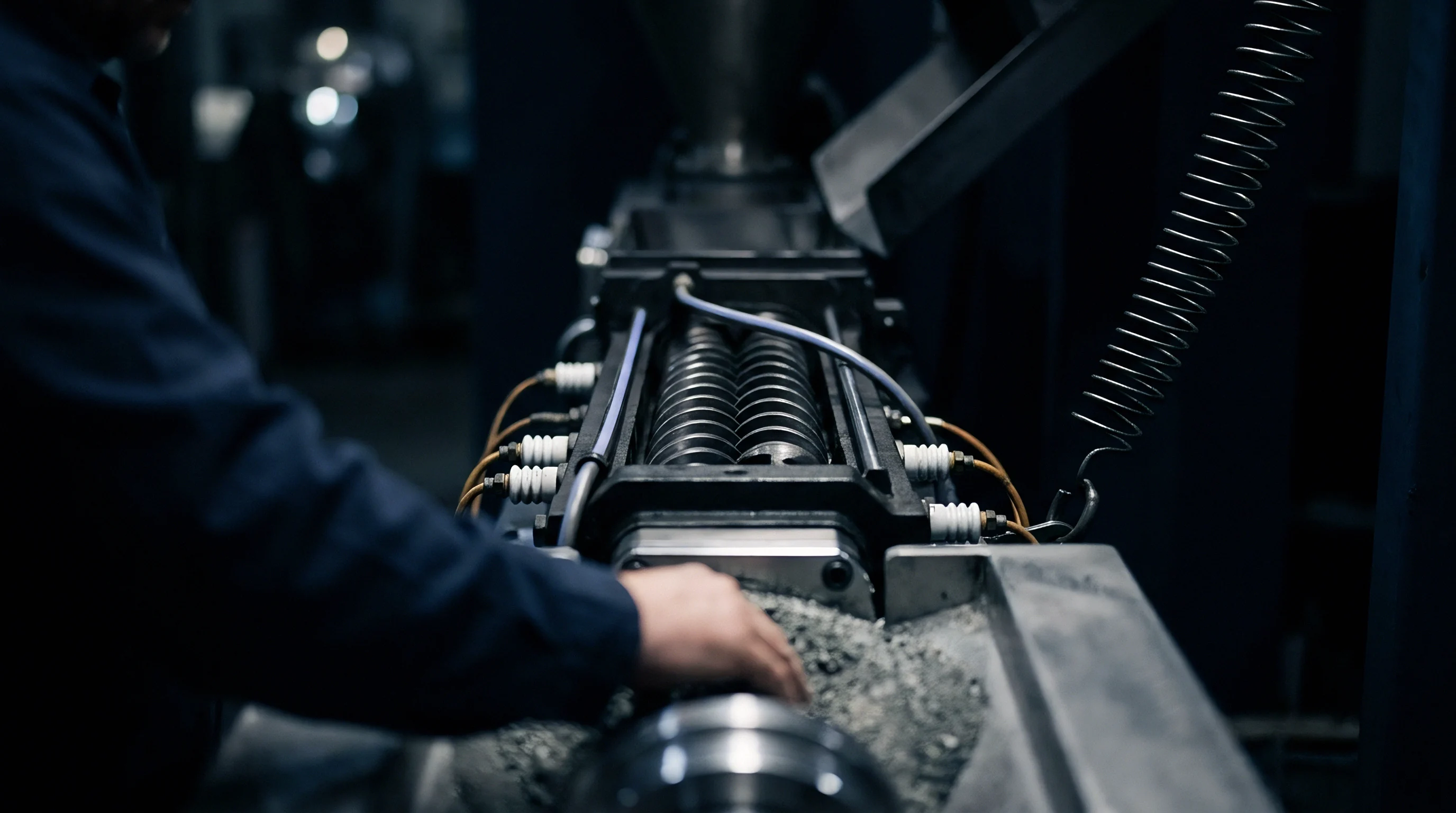
Barrel Residence Time and Volatilization Chemistry
Water drives degradation kinetics inside the extruder through temperature, vapor pressure, and time. Polyamide 66 chips absorb atmospheric moisture rapidly up to an equilibrium saturation of 2.5 to 8.5 percent depending on relative humidity. If incoming feed passes into an extruder barrel carrying moisture above the critical threshold of 0.15 percent without deep vacuum extraction, the high temperature of the melt zones triggers rapid hydrolytic depolymerization.
At 285 degrees Celsius, water vapor pressure exceeds 6.8 MPa inside a closed screw channel.
Vacuum vents positioned along the plasticizing cylinder extract moisture only after the pellets transition to a continuous melt film. If the initial melting zone lacks adequate devolatilization capacity or if the vacuum falls below 0.08 MPa absolute pressure, the rate of water consumption by amide bond cleavage outpaces steam extraction. The forward reaction rate constant for amide hydrolysis at 280 degrees Celsius is approximately 0.15 kilograms per mole-minute, causing measurable loss of chain length within 30 seconds of barrel residence time.
Volatile organic byproducts provide analytical evidence of thermal history. High-temperature melt hydrolysis generates distinctive volatile fragments absent during low-temperature ambient weathering. In polyamide 66, hydrolytic cleavage at high thermal regimes initiates secondary cyclization and pyrolytic decomposition of the hexamethylenediamine and adipic acid repeating units.
Gas chromatography coupled with mass spectrometry utilizing thermal desorption at 250 degrees Celsius detects trace cyclic monomers, cyclopentanone, and aliphatic nitriles that form exclusively during melt processing excursions.
Vacuum levels below 0.08 MPa absolute pressure inside the barrel vent zone allow steam-driven chain cleavage to outpace moisture removal.
Volatiles generated during outdoor environmental degradation follow photochemical and ambient autoxidative pathways. Headspace analysis of environmentally damaged parts shows no cyclopentanone or adipic anhydride signatures. It detects lower-molecular-weight aldehydes, formamides, formic acid, and trace valeramide generated through photo-cleavage and radical peroxy-decomposition under atmospheric conditions.
| Marker Compound | Melt Hydrolysis Marker | Environmental Marker | Analytical Method | Detection Limit |
|---|---|---|---|---|
| Cyclopentanone | Present at high concentrations | Absent | Headspace GC-MS at 200 C | 0.5 ppm |
| Cyclic PA66 Oligomers | Elevated above virgin baseline | Equal to virgin baseline | Soxhlet extraction HPLC-MS | 10 ppm |
| Formic Acid | Absent | Present on exposed surfaces | Ion chromatography | 1.0 ppm |
| Aliphatic Nitriles | Detected above 270 C processing | Absent | Pyrolysis GC-MS at 300 C | 2.0 ppm |
| Hydroperoxides | Negligible | Strong accumulation in skin | Iodometric titration | 0.2 meq/kg |
The distribution of volatile markers settles disputes over component history with quantitative precision. Melt hydrolysis embeds thermal cleavage fragments within the core of the component wall. Environmental exposure confines volatile oxidation markers entirely to the outer exposure surfaces.
Contract manufacturing agreements frequently fail to specify allowable thermal desorption volatile thresholds, leaving buyers unprotected against resin thermal abuse.

Spectroscopy

Attenuated Total Reflectance and Carbonyl Indices
Fourier transform infrared spectroscopy operating in attenuated total reflectance mode reveals spatial degradation gradients across the specimen surface. A germanium crystal provides a shallow penetration depth of approximately 0.65 micrometers at 1700 inverse centimeters, isolating the chemical state of the immediate boundary layer. Zinc selenide or diamond crystals penetrate between 1.5 and 2.2 micrometers, providing depth-resolved comparison across the exterior surface.
The carbonyl region spanning 1600 to 1800 inverse centimeters tracks the divergent chemical pathways. In virgin polyamide 66, the Amide I absorption band centers at 1633 inverse centimeters, representing the stretching vibration of the peptide carbonyl group involved in trans-conformation hydrogen bonding. The Amide II band centers at 1535 inverse centimeters, corresponding to C-N stretching combined with N-H in-plane bending modes.
Melt hydrolysis maintains the exact baseline spectral shape across this region. Because chain cleavage occurs stoichiometrically without secondary oxidation, the relative intensity ratio of the Amide I band to the Amide II band remains static at 1.15 to 1.20 throughout the material. New absorption bands do not appear between 1710 and 1780 inverse centimeters because simple hydrolytic cleavage of the amide bond yields standard carboxyl and amine terminals that merge directly into the native matrix absorption bands.
Environmental weathering distorts the carbonyl spectrum. Photochemical and autoxidative mechanisms create an array of overlapping oxidation species that appear as a broad absorption envelope extending from 1690 to 1760 inverse centimeters. This envelope comprises distinct chemical species:
- Imide carbonyl groups absorbing at 1738 and 1695 inverse centimeters, formed by secondary oxidation of the methylene group adjacent to the amide nitrogen.
- Carboxylic acid dimers producing a broad band centered at 1712 inverse centimeters, accumulating as terminal photo-cleavage products in amorphous domains.
- Aliphatic ester impurities generating a sharp shoulder at 1725 inverse centimeters from competitive radical recombination pathways.
- Carbamate and urea derivatives creating distinct absorption modifications in the Amide II region between 1510 and 1550 inverse centimeters.
The Carbonyl Index quantifies this progression. Calculated as the ratio of the integrated absorbance of the oxidation carbonyl envelope between 1700 and 1780 inverse centimeters against the internal reference methylene scissoring vibration at 1463 inverse centimeters, the index measures oxidative degradation severity. Virgin polyamides and melt-hydrolyzed components show a Carbonyl Index below 0.05 across all sampling points.
Environmental exposure drives the Carbonyl Index above 0.85 within the top 50 micrometers of material, while deeper slices return to baseline values below 0.05.
Surface analysis must account for processing lubricants and visual colorants. Migrated zinc stearate, ethylene bis-stearamide mold release agents, and fatty acid slip packages produce carbonyl absorption peaks between 1700 and 1740 inverse centimeters that mimic oxidation bands. A 30-minute Soxhlet wash in boiling hexane clears these processing additives from the surface prior to spectroscopic scanning, preventing false-positive environmental degradation readings.
The presence of intact Amide I and Amide II profiles without imide shoulders establishes that structural failure originated inside the molding barrel.
Rheology
Zero-Shear Viscosity and Melt Flow Verification
Rheological assessment provides definitive evaluation of macromolecular integrity. A rotational rheometer fitted with parallel-plate geometry of 25 mm diameter measures small-amplitude oscillatory shear properties across angular frequencies from 0.1 to 500 radians per second. Polyamide samples undergo vacuum drying at 80 degrees Celsius for 24 hours to a moisture content below 0.01 percent by weight before testing under a dry nitrogen purge at 275 degrees Celsius.
Zero-shear viscosity correlates directly to weight-average molecular weight through the classical power law relationship where viscosity is proportional to molecular weight raised to the 3.4 power above the critical entanglement limit. A virgin high-viscosity injection grade with an Mw of 32,000 g/mol exhibits a zero-shear viscosity plateau near 850 Pascal-seconds at 275 degrees Celsius. Extrusion melt hydrolysis flattens this response entirely.
A part molded from wet resin suffers random chain scission across the entire melt volume, collapsing its zero-shear viscosity to 110 Pascal-seconds or lower. The dynamic frequency sweep shows Newtonian fluid behavior across a wide frequency range, accompanied by a suppressed storage modulus and the loss of shear-thinning behavior at low shear rates. This loss of elasticity occurs uniformly whether the test specimen is cut from the part core, gate area, or extreme flow perimeter.
Environmental failure presents a different rheological profile. Parts degraded in outdoor field service retain high bulk viscosity. When the fragile surface layer is microtomed away, core specimens exhibit the full rheological response of undamaged virgin resin.
Parallel-plate testing on unsectioned parts shows a minor secondary relaxation phase at high angular frequencies, reflecting the low-molecular-weight surface fraction, while the bulk zero-shear plateau remains above 700 Pascal-seconds.
Standard Melt Flow Rate testing under ISO 1133 confirms this behavior on the production floor. Degraded melt-processed material tests out of specification across all samples:
| Material State | Moisture Content | MVR 275 C / 5.0 kg | Viscosity Number | Tensile Strain at Break |
|---|---|---|---|---|
| Virgin PA66 Pellets | 0.04 weight percent | 45 cc/10 min | 145 mL/g | 45 percent |
| Shed-Stored Wet Pellets | 0.35 weight percent | 45 cc/10 min | 144 mL/g | 44 percent |
| Molded Dry (Proper Melt) | 0.03 weight percent | 48 cc/10 min | 142 mL/g | 42 percent |
| Molded Wet (Melt Scission) | 0.32 weight percent | 185 cc/10 min | 88 mL/g | 8 percent |
| Service Degraded (3 yr) | 1.85 weight percent | 52 cc/10 min | 138 mL/g | 6 percent |
The ISO 307 solution viscosity test using 96 percent sulfuric acid or formic acid eliminates moisture plasticization artifacts from the mechanical equation. Testing reveals an unrecoverable reduction in the Viscosity Number for the melt-hydrolyzed lot, dropping from 145 down to 88 mL/g. Service-degraded components, once cleaned of the weathered surface layer, retain Viscosity Numbers above 135 mL/g, verifying that the core bulk remained structurally sound throughout service exposure.
Commercial acceptance clauses governed by ISO 1133 must stipulate maximum incoming moisture limits and fixed barrel residence times to remain legally defensible when structural failures emerge.
Arbitration

Assigning Liability in Brittle Structural Fractures
When injection-molded polyamide components shatter prematurely in the field, buyers and compounders enter high-stakes liability disputes. Suppliers routinely assert that environmental embrittlement, customer chemical exposure, or improper maintenance caused the mechanical failure. The buyer asserts that the processor introduced unvented scrap, ran wet resin, or allowed excessive thermal residence times during molding.
Systematic analytical arbitration follows a sequential failure analysis protocol.
First, technicians measure bulk solution viscosity per ISO 307 alongside Karl Fischer coulometric moisture titration per ISO 15512. If the bulk viscosity number matches the resin manufacturer certificate of analysis, processing-induced bulk melt hydrolysis is disproven. High bulk viscosity confirms the resin entered the mold with its macromolecular structure intact, confining the root cause to design stress, impact overloading, or severe surface-initiated environmental embrittlement.
Second, micro-FTIR mapping across a polished cross-section locates degradation markers. The presence of carbonyl absorption bands between 1710 and 1745 inverse centimeters isolated within a 100-micrometer perimeter confirms outdoor weathering, ultraviolet exposure, or oxidative service damage. If these oxidation bands are missing yet the component displays brittle cracking and low impact strength, technicians execute gel permeation chromatography and end-group titration on the bulk material.
Third, end-group quantification establishes the definitive commercial proof. If titration reveals matched, stoichiometric increases in both amine and carboxyl end groups, combined with a uniform molecular weight collapse throughout the part thickness, melt hydrolysis is proven. This signature proves that the processor molded wet pellets or subjected the material to hydrolytic decomposition in an unvented barrel, nullifying claims of environmental weathering.
A rigorous incoming inspection requirement incorporating moisture testing and melt volume-flow rate verification upon delivery prevents defective components from entering the supply chain, resolving warranty disputes before products reach the field.