Analytical Additive Isolation in Small Polymer Assembly Components
Micro-scale polymer additive isolation requires microtomed extraction and high-resolution chromatography to verify declarations and prevent border seizures.
Shard
Analytical characterization of miniature injection-molded components faces an immediate physical obstacle in gross sample mass. Micro-fluidic check valves, dental dispenser gears, electrical connector clips, and pharmaceutical plunger seals regularly weigh between 2 and 40 milligrams per individual unit. At this scale, gathering the standard 1.0 to 5.0 grams of material stipulated by bulk polymer extraction norms requires sacrificing hundreds of discrete parts from a single production lot.
Sourcing teams confronting compliance audits under European Union food contact rules or medical device material characterization guidelines discover that pooling across multiple press cavities introduces silent composition variances that mask out-of-specification formulation shifts.
Micro-components present acute mass boundaries. A single 12-milligram polyoxymethylene pinion gear contains roughly 12 to 60 micrograms of total phenolic antioxidant package when loaded at nominal 0.10 to 0.50 weight percent. Cryogenic milling of such tiny volumes results in catastrophic loss via chamber wall adhesion.
Laboratory technicians turn instead to precision surgical microtoming, shaving controlled cross-sections of 20 to 50 micrometers thickness directly from functional faces to expose the core morphology while avoiding frictional thermal degradation of heat-sensitive phosphite process stabilizers.
Soxhlet reflux across 72 hours at 65 degrees Celsius in hexane recovers 94 percent of free slip additives from sliced 15-milligram polyolefin gaskets.
Surface segregation skews analytical recovery when sample preparation fails to distinguish the outer boundary from the inner core. Lubricants, antistatic agents, and mold release compounds accumulate preferentially at the component boundary during cooling, creating concentration gradients where the exterior 5 micrometers carries four times the additive density found at the geometric center. Extracting whole intact miniature components strips this skin layer cleanly, producing an analytical artifact that misrepresents the bulk masterbatch incorporation rate.
- Rotary diamond micro-saws slice fragile crystalline engineering resins into reproducible 100-micrometer wafers without thermal smearing.
- Cryogenic blade fragmentation pulverizes elastomeric seals below glass transition temperatures while preventing room-temperature elastic rebound loss.
- Ultrasonic biopsy punches extract 0.5-millimeter diameter cylindrical cores from localized stress points without blade lubricant contamination.
Additive migration spikes at corners. When mechanical prep work generates excessive localized frictional heating, secondary antioxidants like tris(2,4-di-tert-butylphenyl)phosphite oxidize instantly to phosphate analogs inside the sample vial prior to instrumental separation. Sourcing engineers evaluating third-party laboratory reports for regulatory declarations find their component lots rejected for degraded stabilizer content because clumsy mechanical subdivision burned the additive before the solvent touched the matrix.
Elution
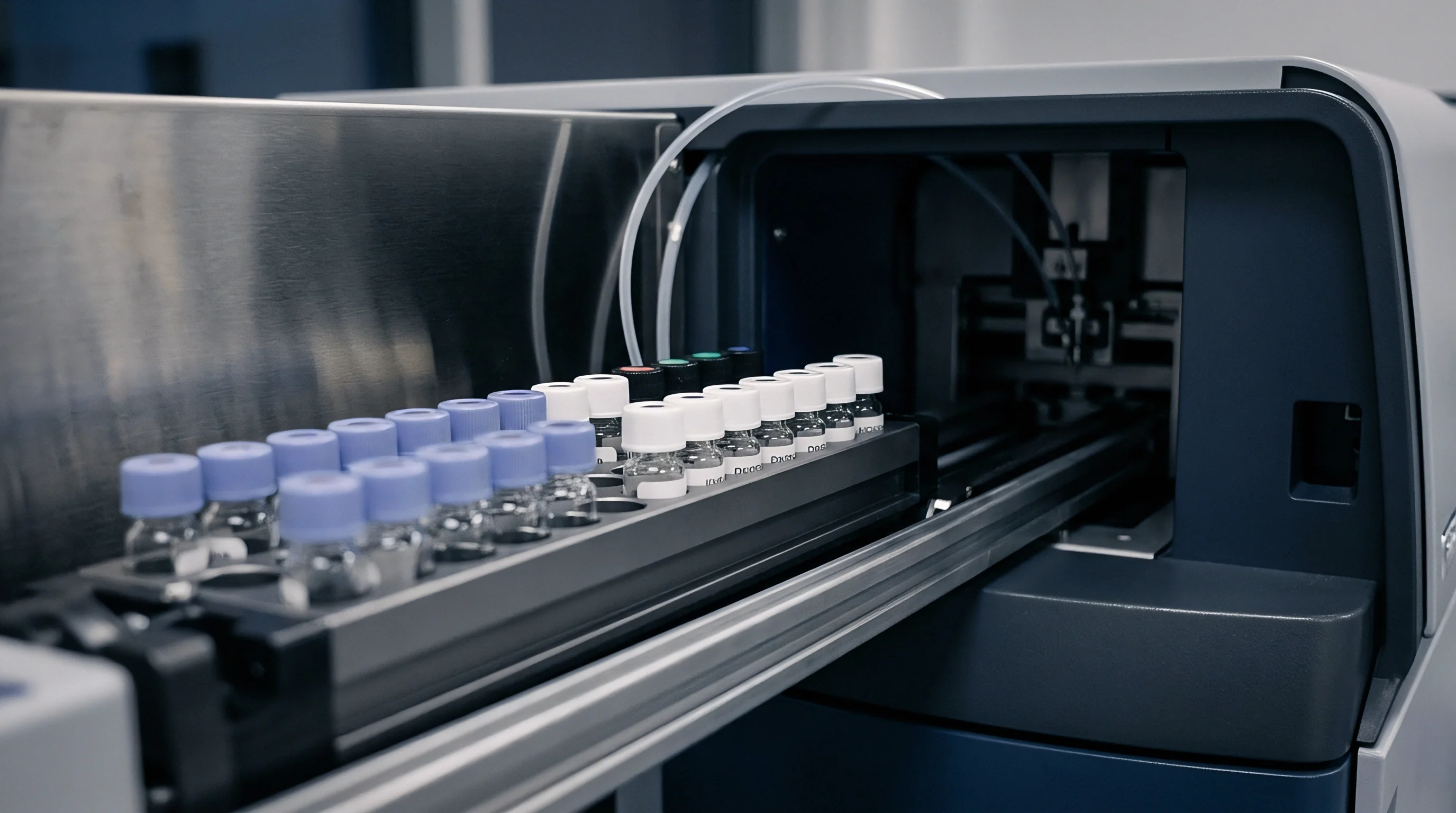
Separating stabilized polymer chains from low-molecular-weight process aids in micro-samples relies on fine thermodynamic balances between solvent swelling and complete backbone dissolution. For crystalline miniature components formed from polyamides, polybutylene terephthalate, or polyacetal, traditional liquid-solid leaching leaves up to 40 percent of hindered amine light stabilizers trapped inside crystalline lamellae. Pressurized liquid extraction operating at 100 to 140 degrees Celsius under 10 to 15 megapascals forces organic solvents into the amorphous interstitial spaces without melting the primary polymer backbone.
High pressures speed polymer dissolution. Dissolution-reprecipitation workflows operate as the primary alternative for stubborn polyolefin and fluoropolymer micro-assemblies. The technician dissolves a 20-milligram fluorosilicone valve duckbill in minimal boiling toluene or tetrahydrofuran, followed by dropwise addition of high-purity methanol cooled to negative 15 degrees Celsius.
The high-molecular-weight polymer collapses into a flocculent solid, leaving target plasticizers, processing aids, and slip chemistries suspended in the liquid supernatant.
Gelatinous polymer precipitates trap target stabilizers when anti-solvent addition occurs above room temperature.
Target compounds degrade under heat. Thermal desorption coupled directly to gas chromatography eliminates solvent handling altogether for volatile and semi-volatile additives in micro-components. Direct thermal extraction cells heat a single 5-milligram molded clip from 50 to 300 degrees Celsius inside a pure helium sweep stream, transferring evolved erucamide, glycerol monostearate, and low-end phthalate plasticizers onto a cryo-trap maintained at negative 40 degrees Celsius prior to column injection.
| Matrix Resin | Target Additive Class | Solvent System | Temperature and Time | Mean Recovery Yield |
|---|---|---|---|---|
| Polyamide 66 (18 mg clip) | Hindered Phenol (Irganox 1098) | Methanol / Formic Acid (9:1) | 120 °C at 10 MPa, 20 min | 96.2 percent |
| Polyacetal (8 mg gear) | Benzotriazole UV Absorber | Dichloromethane | 40 °C at 0.1 MPa, 180 min | 88.4 percent |
| PBT (32 mg connector) | Organophosphate Flame Retardant | Tetrahydrofuran / Acetonitrile | 80 °C at 12 MPa, 35 min | 98.1 percent |
| Polypropylene (5 mg valve) | Erucamide Slip Agent | Cyclohexane / Isopropanol (1:1) | 70 °C at 0.1 MPa, 90 min | 93.7 percent |
Supercritical fluid extraction using carbon dioxide modified with 5 to 10 volume percent ethanol provides another precise route for delicate biomedical components. Carbon dioxide reaches supercritical density above 31.1 degrees Celsius and 7.38 megapascals, diffusing through miniature elastomeric diaphragms with gas-like transport rates while dissolving lipophilic additives with liquid-like solvency. Modifying the fluid modifier percentage allows selective recovery of surface slip agents during initial passes, followed by core plasticizer isolation during subsequent higher-pressure cycles.
- Matrix swelling opens interstitial pathways in the micro-component via exposure to moderately polar organic liquids below glass transition temperatures.
- Thermal diffusion drives low-molecular-weight process chemicals outward from swollen polymer matrices into the circulating solvent phase.
- Polymer phase separation deposits high-mass polymer chains onto inert glass frit filters via controlled anti-solvent cooling.
- Centrifugal clarification isolates sub-micron colloidal polymer fibrils from clean extract supernatants at 14,000 gravities for twelve minutes.
- Nitrogen concentration evaporates excess solvent volume down to 200 microliters under ambient temperature to avoid volatile loss.
Selecting the anti-solvent requires matching the polarity index to the target additive family rather than the polymer matrix. When a laboratory chemist matches anti-solvent polarity to the base polymer, target plasticizers co-precipitate into the collapsing matrix and disappear from downstream quantification.
Partition
Chromatographic separation of additive isolates extracted from sub-50 milligram parts confronts extreme analyte concentration disparity. Slip additives and external lubricants exist at thousands of parts per million, whereas catalyst residues, degradation byproducts, and non-intentionally added substances linger below ten parts per million within the same micro-vial. High-performance liquid chromatography coupled to electrospray ionization high-resolution quadrupole time-of-flight mass spectrometry resolves these complex mixtures across wide dynamic ranges without requiring preliminary chemical derivatization.
Which Chromatographic Sequence Separates Co-Migrating Plasticizers?
Reversed-phase octadecylsilane stationary phases running water-acetonitrile gradients containing 0.1 percent formic acid resolve common polyolefin processing aids within a single 25-minute run. When plasticizers share isobaric masses, secondary gas chromatography with tandem mass spectrometry operating under electron ionization at 70 electronvolts provides fragmentation fingerprints that distinguish linear phthalates from branched adipate and sebacate alternatives.
Triple quadrupoles confirm trace masses down to sub-picogram injection levels.
Matrix suppression conceals target analytes. In electrospray liquid chromatography, residual low-molecular-weight polymer oligomers co-eluting with additives rob ionization charge from target molecules, dropping calculated concentrations by 50 to 80 percent below true values. Analysts counter this suppression by running standard addition curves directly inside extracted component fractions, confirming that baseline response slopes match matrix-free calibration curves within five percent relative standard deviation.
| Analyte Compound | Compound Role | Separation Mode | Ionization / Detector | Quantification Limit |
|---|---|---|---|---|
| Irganox 1010 | Primary Antioxidant | C18 Reverse Phase LC | ESI Negative, m/z 1175.78 | 0.05 mg/kg |
| Tinuvin 770 | HALS Photostabilizer | C8 Reverse Phase LC | ESI Positive, m/z 481.40 | 0.10 mg/kg |
| Bis(2-ethylhexyl) phthalate | Matrix Plasticizer | DB-5MS Capillary GC | EI Tandem MS, m/z 149, 167 | 0.01 mg/kg |
| Erucamide | Internal Slip Aid | C18 Reverse Phase LC | ESI Positive, m/z 338.34 | 0.20 mg/kg |
| Trisnonylphenyl phosphite | Secondary Stabilizer | DB-1 Capillary GC | EI Single Quad, m/z 317, 688 | 0.50 mg/kg |
| Method parameters derived from liquid volume concentrations scaled to 10-milligram nominal initial specimen dry weight. | ||||
Clean solvent blanks prevent false positives. Airborne laboratory dust, plastic syringe filters, and automated pipette tips contribute plasticizers and slip agents to micro-vials, where total background contamination can exceed the mass of additive harvested from a 5-milligram molded gear. Running procedural solvent blanks alongside every five injection-molded test specimens protects compliance filings from phantom phthalate detections introduced by contaminated sample vessels.
Whether non-targeted high-resolution mass spectrometers can unambiguously distinguish recycled-content process residues from primary virgin polymerization additives across sub-milligram assembly components remains an open scientific question.
Dispute
Commercial conflict over small component compliance arises almost exclusively from the gap between raw resin supplier technical datasheets and the finished state of the molded part. Raw polymer manufacturers supply generic material declarations certifying that an unpigmented, virgin pellet formulation complies with European Union food contact limits under Regulation EU 10/2011 or United States FDA 21 CFR 177.1520. Molders downstream combine these certified natural granules with uncharacterized universal color masterbatches, process regrind from previous production runs, and mold-release sprays applied directly to cavity pins.
Where Do Dossier Declarations Diverge from Formulations?
Declarations of conformity frequently list raw base polymers while omitting secondary additive systems introduced during assembly part fabrication. Tier-two molders operating multi-cavity hot runner molds regularly dose mold release waxes and external slip chemistry at the press hopper without informing the purchasing entity, attempting to resolve pin drag or surface cosmetic flow defects. Sourcing audits reveal that up to 30 percent of non-compliant additive findings originate from unapproved processing aids introduced by toolmakers rather than the specified resin compound.
- Unlisted process aids entered the melt stream via uncertified universal carrier masterbatches carrying undisclosed ester waxes.
- Cavity release compounds sprayed manually onto tooling faces contaminated initial shot cycles with silicone oils and fluoro-surfactants.
- Regrind degradation products introduced oxidized hydroperoxides and fragmented oligomers that shifted migration profiles outside permitted specific limits.
- Cross-contamination residues remained inside processing screws from preceding production campaigns utilizing restricted heavy-metal colorants.
Blank chromatograms expose external contamination. Sourcing contracts that lack strict chemical disclosure clauses leave importers legally defenseless when customs laboratories detect unlisted additives. A molder confronting an analytical failure will assert that the formulation matched the purchase order because the base resin batch carried a factory certificate, deflecting blame toward testing laboratory sensitivity.
Tariff
Border inspections treat missing or inaccurate chemical dossiers for small assembly parts as customs classification misdeclarations and consumer safety violations. Customs agents seizing consignments of consumer coffee machines, medical fluid meters, or aerosol valves extract functional components directly from assembled assemblies, subjecting tiny polymer check valves and gaskets to total digestion and migration screening. When an importer classifies an assembly as compliant plastic hardware under Chapter 39 or medical apparatus under Chapter 90, failure to substantiate additive compliance results in immediate customs detention and recalculation of duty liability under punitive non-conforming goods categories.
Port authorities retain suspicious consignments. In the European Union, market surveillance authorities logging entries into the Safety Gate rapid alert system identify restricted phthalates like DEHP and DBP exceeding the 0.1 weight percent limit set under REACH Annex XVII in small components like power cord grommets, internal fluid tube clips, and casing feet. The importer of record bears sole statutory liability for inventory destruction charges, harbor demurrage, and administrative fines that reach up to 50,000 euros per non-compliant lot.
A supply contract stipulating full material disclosure across all bill-of-materials tiers shifts re-testing and quarantine storage fees to the fabricator upon customs refusal.
Commercial disputes trace back to sampling. The economic consequence of analytical additive isolation becomes severe when finished sub-assemblies face batch rejection due to a two-milligram silicone o-ring containing prohibited organotin heat stabilizers. Sourcing managers calculating risk budgets find that qualifying a five-cavity micro-molding tool across three distinct production batches costs roughly 4,500 euros in combined extraction and high-resolution mass spectrometry work, compared to millions of euros in commercial exposure from whole-vessel port rejections.
| Component Weight Class | Typical Assembly Role | Dominant Regulatory Exposure | Verification Testing Cost | Non-Compliance Consequence |
|---|---|---|---|---|
| Sub-5 mg micro-part | Fluidic check valves, pipettes | EU 10/2011 Specific Migration Limits | 1,800 to 2,500 EUR per lot | Import seizure, food contact ban |
| 5 to 50 mg small part | Gears, casing clips, seals | REACH Annex XVII, SVHC notification | 1,200 to 1,900 EUR per lot | Market withdrawal, administrative fines |
| 50 to 250 mg sub-part | Housings, wire guides, levers | RoHS Directive, packaging waste limits | 800 to 1,400 EUR per lot | Tariff reclassification, shipment destruction |
Incomplete declarations void customs clearances. Sourcing departments managing complex bill-of-materials supply chains preserve commercial margins by binding component suppliers to contractual verification warranties that mandate batch-level additive isolation certificates before tooling release. Supply contracts incorporating clause 4.2 of EN 10204 inspection certificate structures require primary laboratory chromatography reports for every resin and masterbatch lot, transferring demurrage expenses and re-testing costs directly to the molder when port inspections uncover unlisted additive compounds.