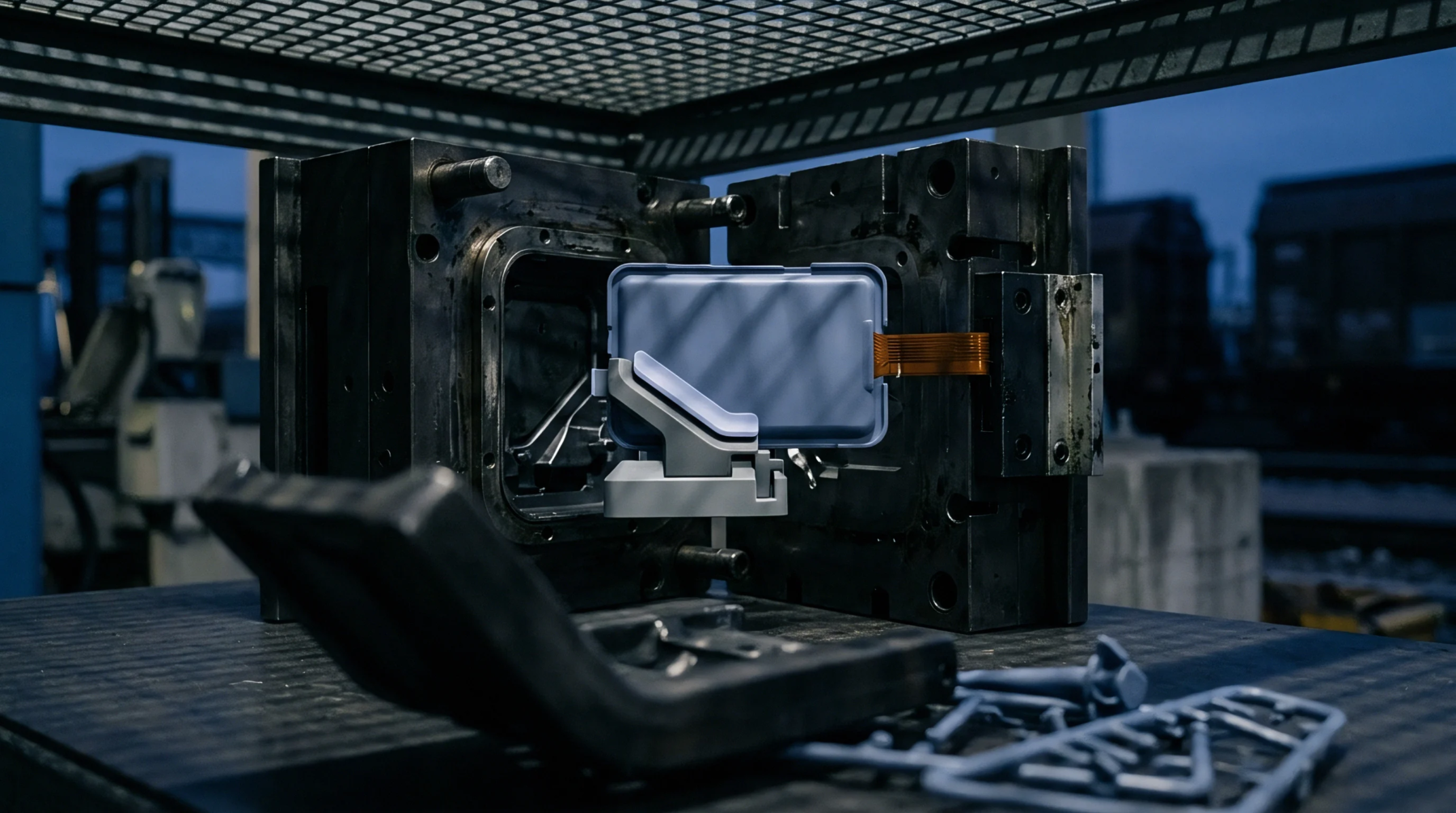
Meaning
Precision-machined contact interface where the stationary and moving halves of an injection mold seal together under press clamp force bounds the shape of the part and prevents plastic melt from escaping. Termed the parting line shutoff, this ground, matched perimeter seals the boundary of each cavity and defines the precise line where cosmetic witness seams form on the finished plastic component. It governs flash containment and mold venting up to the dimensional edge of the part perimeter, where the steel profile transitions outward into clearance relief pockets.
Sealing Mechanics
High clamping tonnage compresses the steel faces of the sealing land together with tremendous localized contact pressure. In a proper parting line shutoff, the actual matching contact band runs only fifteen to twenty-five millimeters wide around the cavities, with the rest of the plate ground down by roughly 0.5 millimeters to form clearance relief. Relieving the non-sealing plate area concentrates the total clamp force directly onto the shutoff perimeter, preventing internal melt pressure from prying the steel open.
When closing forces balance evenly across the contact lands, polymer melt is stopped cold while air exhausts freely.
Venting Interface
Microscopic channels ground directly into the contact land let displaced air and volatilized processing gases escape into atmospheric vents during rapid injection. The parting line shutoff incorporates shallow vent depths tailored strictly to resin viscosity, typically between 0.01 and 0.04 millimeters. Vents machined too deep allow plastic melt to enter the gap, resulting in razor-sharp perimeter flash that damages components and injures human operators.
Vents cut too shallow trap air ahead of the advancing melt front, producing black diesel-burn spots and weak, unknitted weld seams.
Tooling Damage
Misaligned mold plates, debris contamination, and excessive machine clamp force will crush the shutoff lands beyond their yield point. A crushed parting line shutoff permanently closes micro-vents and causes localized steel depression, resulting in persistent flash that cannot be dialed out through process adjustments alone. Repairing crushed shutoff lands demands extensive micro-welding, laser cladding, hand stoning, or re-machining the entire cavity insert.
Regular cleaning with soft brass tools prevents hard resin flakes from being stamped into the precision shutoff faces during fast automated cycling.