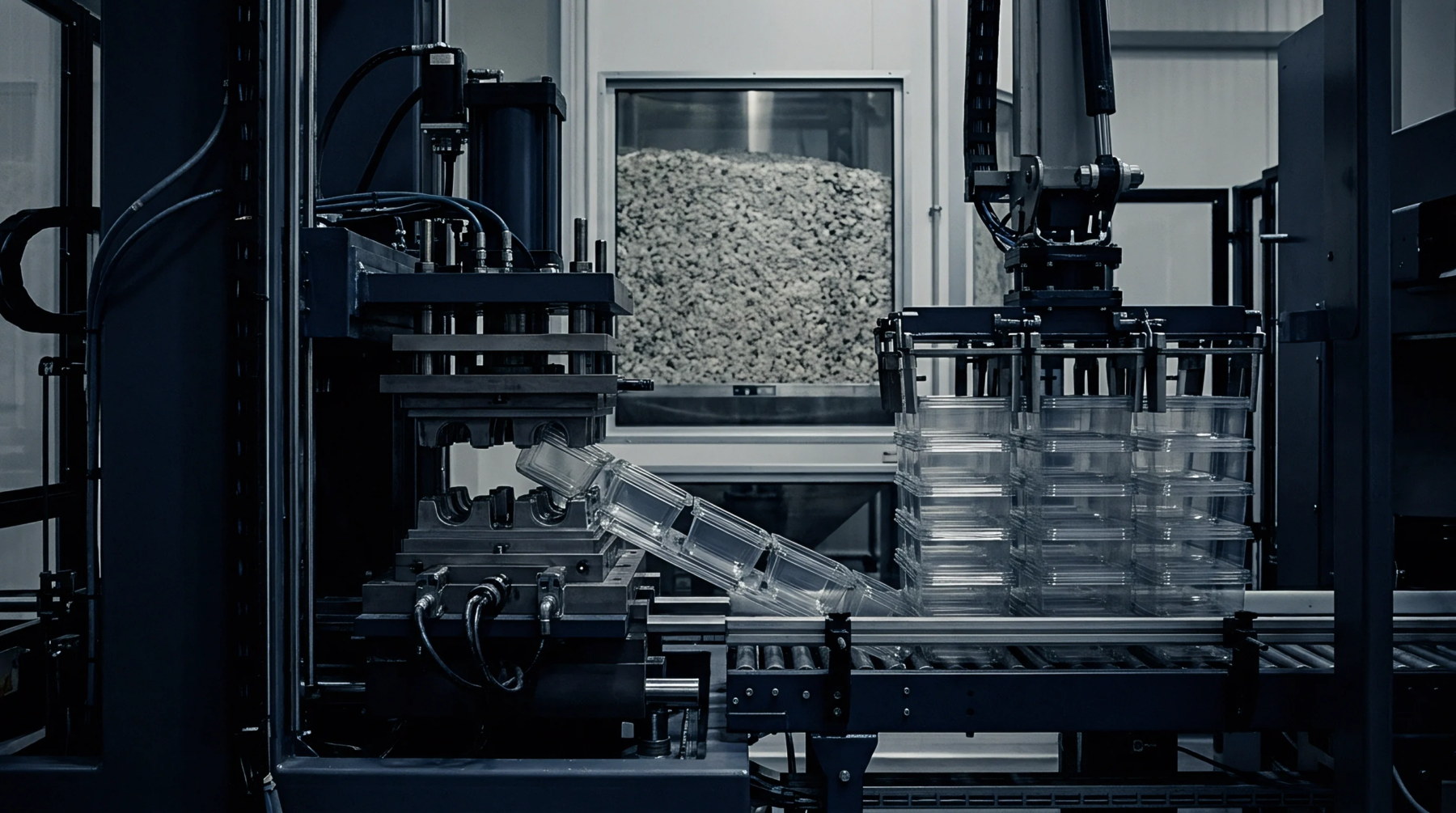
Thermoforming against Injection for Volumes below Fifty Thousand Units
Thermoforming delivers lower total landed cost below fifteen thousand units by saving upfront tooling capital, beyond which injection piece price efficiency dominates.
Polymeric materials with a disordered molecular arrangement lack a defined melting point and instead undergo a gradual softening as temperatures rise through a glass transition range. Molecular chains in an amorphous polymer exist in a random, entangled state similar to a mass of yarn, which prevents the formation of organized crystalline lattices during the cooling phase of the injection moulding process. Because there is no lattice to break, the energy required to transition from a solid to a melt is spread across a wider temperature window compared to semi crystalline alternatives.
This lack of order means that the polymer does not have a single, sharp melting point but instead softens gradually as heat is applied. The internal structure remains essentially the same in the solid and liquid states, which contributes to the predictable flow characteristics observed during high pressure injection.
Transitioning through the glass transition temperature marks the shift from a rigid, glassy state to a rubbery one, which determines the upper service limit for the final part. In an amorphous polymer, the absence of a sharp melt point means the material remains viscous over a large range, allowing for a broader processing window in some applications. Such gradual changes allow for better control over flow during complex thin wall moulding where sudden solidification would result in short shots or poor surface finish.
Moulders often find that these materials are easier to process because they do not require the precise temperature control needed to manage crystal formation. The cooling curve is linear, which simplifies the calculation of cycle times and allows for more consistent production across different machines. Viscosity remains higher than that of semi crystalline resins, requiring more injection pressure to fill the same cavity volume.
A processor must balance this pressure against the risk of creating internal stress.
Low and isotropic shrinkage values make these resins ideal for precision components that require tight tolerances across multiple axes. An amorphous polymer typically shrinks between zero point four and zero point seven percent, with the value being nearly identical in both the flow and transverse directions. This uniformity reduces the risk of warpage and internal stresses that often plague other materials during the cooling stage in the tool.
High transparency is a common characteristic because the disordered structure does not scatter light, making these polymers suitable for optical components. Manufacturers must ensure that the melt is fully dried before processing to avoid moisture bubbles that could compromise this clarity.
Resistance to solvents is generally lower in these materials because the open molecular structure allows chemicals to penetrate and swell the polymer matrix. An amorphous polymer is susceptible to environmental stress cracking when exposed to certain oils or cleaning agents while under load. This limitation defines the boundary for its use in automotive under hood components or industrial fluid handling.
Selecting the right grade involves weighing the need for clarity and precision against the chemical environment of the application. Despite these limits, the ease of moulding and dimensional accuracy keep these materials at the center of consumer electronics and medical device production.
Thermoforming delivers lower total landed cost below fifteen thousand units by saving upfront tooling capital, beyond which injection piece price efficiency dominates.
Expertise is a utility, not a secret. sentiention™ publishes its working knowledge as open reference: intelligence layer covering the materials it sources, the markets it enters, and the reference that serves both.