Resolving Inter-Laboratory Fundamental Parameter Matrix Divergence in High-Density Masterbatch Refractory XRF Assays
Standardizing borate fusion preparation and matching FP mass attenuation coefficient libraries resolves inter-laboratory masterbatch XRF divergence.


Beam
X-ray fluorescence assays of refractory inorganic masterbatches often differ between testing facilities, even on identical hardware. At loadings of 60 to 70 weight percent titanium dioxide, antimony trioxide, or barium sulfate in a polyolefin carrier, sample density drives severe matrix absorption. Primary tube radiation passes through the hydrocarbon matrix and hits dense refractory oxide particles, making fluorescence excitation non-linear across concentration ranges.
Fundamental parameter software is expected to handle these density shifts automatically through mathematical corrections. Yet slight differences in excitation geometry, background subtraction algorithms, or sample surface topography lead to systematic concentration splits between benches.
Polyolefin carriers like linear low-density polyethylene or polypropylene form a matrix fraction that spectrometers cannot directly measure. Neither carbon nor hydrogen emits characteristic fluorescence lines above the light-element detection threshold of wavelength or energy dispersive systems. The fundamental parameter engine has to model this dark matrix using theoretical calculations or backscatter intensity ratios.
Because the matrix absorbs secondary photons, an incorrectly modeled dark matrix ratio shifts calculated heavy metal percentages between labs even when raw spectral peak counts match within one percent relative error.

Photon Scattering and Attenuation Physics
Primary radiation entering a dense polyolefin compound decays in proportion to matrix density. In light hydrocarbon matrices, Rayleigh coherent scattering and Compton incoherent scattering dominate the background spectrum. Incoming X-ray photons are absorbed by refractory inorganic additives at specific absorption edge energies; high concentrations of titanium dioxide in a polyethylene carrier raise the average mass attenuation coefficient by orders of magnitude over unfilled resin.
Incident X-rays excite titanium atoms near the surface, but excitation at deeper layers is choked off by intervening oxide particles. For titanium K-alpha emission at 4.51 kiloelectronvolts, effective sampling depth is under 50 micrometers in a 70 weight percent masterbatch pellet. By contrast, higher energy emissions like antimony K-alpha at 26.36 kiloelectronvolts escape from depths beyond 12 millimeters in the same polymer volume, creating a severe spatial sampling bias between element families.
| Element / Refractory Oxide | Analyte Emission Line | Line Energy (keV) | Mass Attenuation Coefficient (cm²/g) | Infinite Thickness Depth in 70% Compound (mm) |
|---|---|---|---|---|
| Titanium Dioxide (TiO2) | Ti K-alpha | 4.51 | 145.2 | 0.048 |
| Antimony Trioxide (Sb2O3) | Sb K-alpha | 26.36 | 7.82 | 14.200 |
| Barium Sulfate (BaSO4) | Ba K-alpha | 32.19 | 5.64 | 18.500 |
| Zirconium Dioxide (ZrO2) | Zr K-alpha | 15.77 | 18.40 | 4.100 |
| Zinc Oxide (ZnO) | Zn K-alpha | 8.64 | 48.10 | 0.720 |
Secondary Fluorescence in High-Density Refractory Matrices
Heavy elements like barium and antimony absorb characteristic radiation emitted by adjacent lighter oxides. In a multi-component flame-retardant masterbatch containing antimony trioxide and zinc oxide, secondary enhancement occurs: photons emitted by zinc atoms secondarily excite antimony atoms before escaping the specimen. Standard fundamental parameter engines apply the Sherman equation to account for this secondary excitation within matrix layers.
Discrepancies arise when software packages use different numerical integration limits for secondary absorption depth. If Laboratory A applies a two-layer excitation model while Laboratory B uses an infinite-layer approximation, calculated antimony loadings differ by up to 2.3 weight percent on identical spectral inputs. This gap widens when sample thickness falls below the infinite thickness threshold for high-energy K-lines.
- Photoelectric Absorption Dominance occurs when low-energy primary photons hit heavy refractory nuclei, stripping inner-shell electrons and suppressing background scatter.
- Compton Incoherent Backscattering increases across regions dominated by the hydrocarbon carrier, producing broad spectral humps that distort low-concentration trace element integration.
- Primary Particle Shadowing emerges when inorganic agglomerates exceed 10 micrometers in diameter, masking interior atoms from incident excitation rays.
- Absorption Edge Step Discontinuity alters the background continuum slope sharply near high-Z elemental threshold energies, confusing automated baseline fitting routines.
Titanium dioxide concentrations in linear low-density polyethylene measured by direct pellet excitation exhibit an inter-laboratory bias of up to 4.8 weight percent at a nominal 70 weight percent loading.
Failing to reconcile excitation physics across software platforms leads to false rejections during incoming resin verification, forcing compounders to absorb unnecessary scrap costs.
Specimen
Analytical errors in masterbatch testing often start inside the sample cup before spectral acquisition even begins. High-density masterbatches arrive as extruded pellets, hot-pressed plaques, or fine powders. Raw pellets vary in geometry, surface curvature, and filler distribution.
Scanning whole pellets in an XRF sample cup leaves substantial air voids between particles, while excitation photons reflect off curved pellet walls and distort the scatter-to-peak ratio at the detector.
Pellet-to-pellet heterogeneity further drives inter-laboratory divergence. Compounding extrusion can leave masterbatch let-down streams with micro-scale phase separation or pigment agglomeration. When an operator loads 15 grams of unground pellets into a cup, the instrument measures only the thin outer layer facing the film window.
Variations in cut length or surface skin formation skew results immediately.

Sample Preparation Mechanics and Grain Boundaries
Uneven inorganic particle distribution creates micro-absorption pathways within plastic pellets. Primary X-rays pass through a polyolefin matrix with minimal attenuation until hitting a dense inorganic cluster. If refractory oxide particles agglomerate into 20-micrometer clusters rather than dispersing evenly at 0.5 micrometers, effective absorption of characteristic fluorescence increases.
In this way, particle size distribution shifts XRF signal intensity regardless of true elemental concentration.
Direct pellet measurement runs into severe grain-size effects defined by the Berry and Claisse equations. Light elements like titanium yield reduced fluorescence intensity in large-particle regimes because of self-absorption within individual particles. High-energy elements like antimony are far less sensitive to particle size, generating an artificial shift in calculated element ratios.
Grinding pellets under liquid nitrogen homogenizes particle sizes below 45 micrometers, eliminating surface orientation errors.
| Preparation Method | Inter-Laboratory Bias Range (%) | Within-Lab Repeatability RSD (%) | Particle Size Sensitivity | Preparation Time per Sample (min) |
|---|---|---|---|---|
| Direct Pellet Counting | 3.50 to 6.20 | 4.10 | Extreme Sensitivity | 1.5 |
| Cryogenic Grinding & Pressed Powder Disk | 1.20 to 2.40 | 1.15 | Moderate Sensitivity | 18.0 |
| Hot-Pressed Polymeric Film (190°C, 10 MPa) | 0.80 to 1.50 | 0.85 | Low Sensitivity | 12.0 |
| High-Temperature Borate Glass Fusion (1050°C) | 0.15 to 0.40 | 0.22 | Zero Sensitivity | 45.0 |

Borate Flux Fusion versus Hot Pressing
Converting polymeric masterbatch samples into homogeneous glass discs removes particle size distortion. High-temperature fusion burns off the hydrocarbon binder, leaving the inorganic refractory residue. These remaining oxides dissolve completely in a molten lithium tetraborate and lithium metaborate flux mixture, yielding a glass bead with an optically flat, fully homogeneous surface.
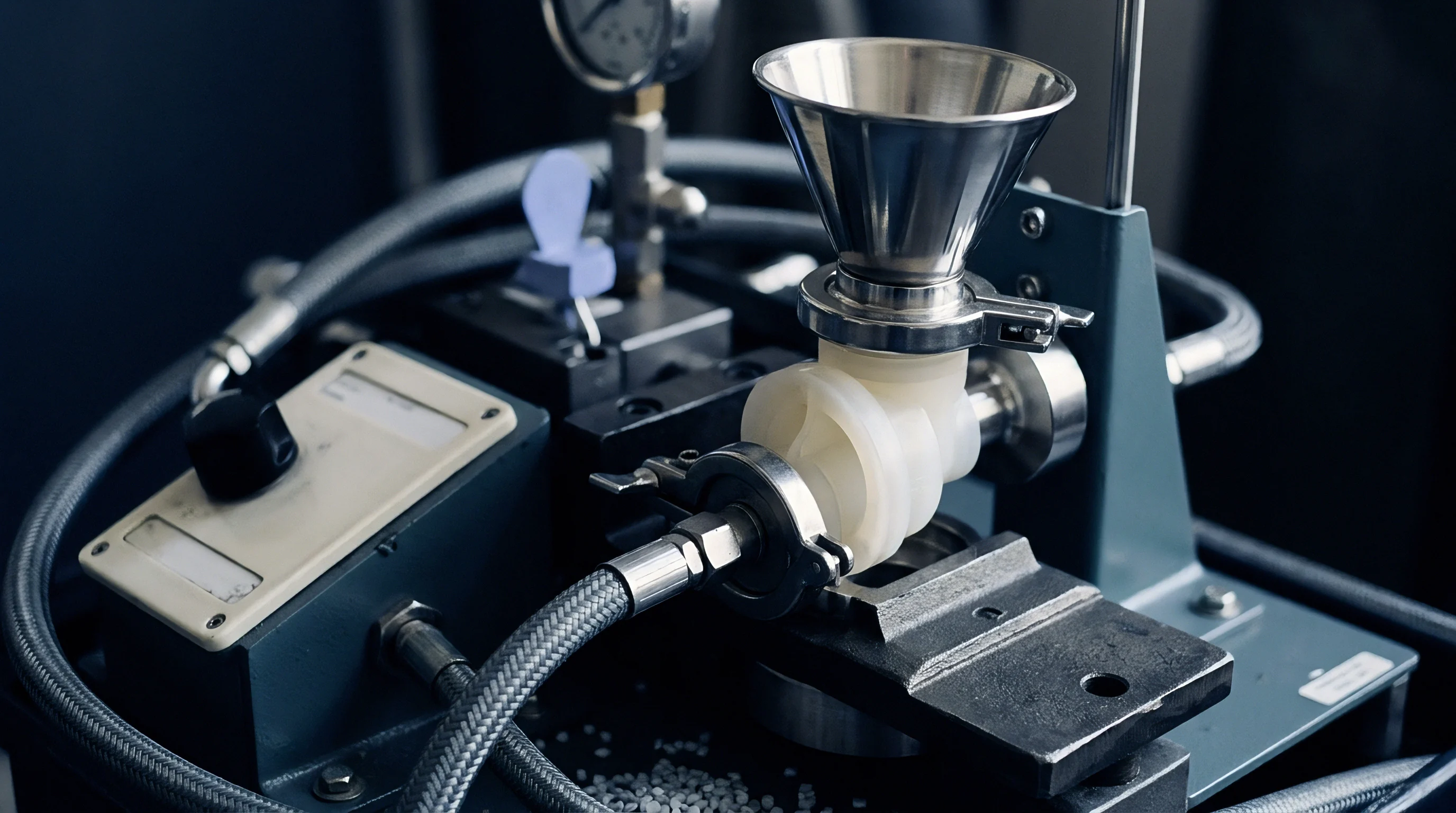
Hot pressing offers a semi-destructive alternative for polyolefin masterbatches. Pellets are compression-molded at 190°C under 10 megapascals of hydraulic pressure between smooth steel plates coated with fluoropolymer release film. The finished plaque eliminates air voids and standardizes the distance to the X-ray window, though it does not alter primary inorganic particle sizes, leaving micro-absorption effects intact within the matrix.
- Weigh 1.0000 gram of masterbatch pellets into a platinum-gold crucible containing 0.5000 grams of pure organic binder or oxidizer compound.
- Heat the crucible in a muffle furnace under an oxygen purge at 650°C for 30 minutes to burn off the hydrocarbon carrier polymer cleanly without volatilizing trace metal halides.
- Add 9.0000 grams of pre-fused lithium tetraborate metaborate flux mixture (66:34 ratio) along with 0.1000 grams of lithium bromide release agent to the cooled residue.
- Fuse the mixture inside an automated electric fusion apparatus at 1050°C for 15 minutes with continuous rocking agitation to dissolve refractory oxides into the liquid flux.
- Pour the molten melt automatically into a preheated platinum mold and cool under a controlled air stream to form a stress-free clear glass disc suitable for precision XRF analysis.
Direct pellet scanning can match fusion accuracy when calibrated against internal standards, but spatial particle segregation across production lots invalidates single-point calibration models.

Mass
Fundamental parameter routines rely on theoretical cross-section tables to model photon transmission. Mass attenuation coefficients represent the fractional loss of X-ray intensity per unit area density traversed. Models sum the product of element weight fractions and their mass attenuation coefficients to calculate total matrix absorption, using attenuation values drawn from theoretical calculations or photo-absorption reference libraries.
Discrepancies arise when instrument software relies on different cross-section libraries ~ such as NIST XCOM, Heinrich tables, or the McMaster compilation. While mass attenuation coefficients for iron or nickel agree within one percent across these databases, values for heavy refractory elements in light hydrocarbon matrices differ by up to 5 percent near low-energy absorption edges.

Mass Attenuation Coefficient Library Discrepancies
Calculated concentrations vary depending on whether software references NIST XCOM or Heinrich tables. Mass attenuation coefficients define how strongly a material absorbs X-rays at a given wavelength per unit density. In high-density titanium masterbatches, minor deviations in the attenuation coefficient used for carbon or oxygen alter the calculated balance of the unmeasured dark matrix.
When an FP algorithm computes titanium concentrations in linear low-density polyethylene using XCOM values, the mass attenuation coefficient of carbon at 4.51 kiloelectronvolts is evaluated at 22.4 square centimeters per gram. Under Heinrich tables, that same coefficient is 21.6 square centimeters per gram. This 3.7 percent shift in dark matrix absorption leads the algorithm to miscalculate the titanium dioxide mass fraction needed to balance net peak intensity.
Cross-section libraries derived from disparate theoretical physics tables introduce systematic mathematical drift into fundamental parameter matrix algorithms.

Infinite Thickness Thresholds in Light Hydrocarbon Carriers
Characteristic X-rays emitted deep within a pellet matrix must escape without being fully absorbed by surrounding resin. Infinite thickness is the critical depth beyond which additional material produces no increase in detected fluorescence. Sample thickness must equal or exceed this threshold for standard fundamental parameter calculations to hold.
In low-density polyethylene matrices containing heavy elements, infinite thickness varies dramatically across the energy spectrum. Light element emissions like titanium K-alpha reach infinite thickness within a fraction of a millimeter, whereas high-energy emissions like antimony K-alpha penetrate deep into the polymer, requiring over 14 millimeters to achieve full signal saturation. Analyzing a 3-millimeter hot-pressed plaque thus yields accurate results for titanium while introducing severe negative mass errors for antimony from incomplete beam saturation.
- XCOM Library Selection applies modern theoretical photo-ionization cross-sections suitable for high-energy K-shell and L-shell transition modeling.
- Heinrich Library Selection relies on classic empirical attenuation data that fits mid-range transition metals well but overestimates light-element absorption in organic binders.
- McMaster Library Selection incorporates legacy measurement tables that exhibit known interpolation anomalies near heavy element L-edge absorption thresholds.
- FPM Custom Hybrid Tables utilize proprietary vendor modifications designed to optimize specific tube anode target lines at the expense of cross-platform portability.
Standardizing attenuation libraries across testing laboratories eliminates software-induced analytical bias without altering physical sample preparation.


Variance
Software models convert detected X-ray counts into elemental mass fractions through non-linear iteration. The fundamental parameter algorithm starts with an initial estimate of sample composition, calculates expected theoretical X-ray intensity, and compares it to measured counts. Elemental weight fractions are adjusted iteratively until calculated intensities match measured values within a set convergence limit.
Convergence stability breaks down when analyzing high-density refractory masterbatches because of the contrast between heavy inorganic phases and the light organic carrier. Solvers struggle when uncalculated light element fractions exceed 30 weight percent. If the iteration algorithm encounters multiple local minima in the absorption equations, different software engines settle on divergent concentrations from the exact same spectral data.

Fundamental Parameter Model Assumptions and Iterative Convergence
Iterative calculation loops adjust assumed matrix composition until theoretical fluorescence matches observed intensity. Algorithms rely on numerical minimization techniques like Gauss-Newton or Levenberg-Marquardt solvers to optimize element ratios. High-density masterbatches force these solvers toward non-linear boundaries where small shifts in intensity translate into large changes in calculated composition.
Mathematical instability occurs when matrix elements have overlapping emission energies or absorption edges. In a masterbatch containing titanium dioxide and barium sulfate, the titanium K-alpha peak at 4.51 kiloelectronvolts overlaps the barium L-alpha peak at 4.47 kiloelectronvolts. If peak deconvolution assigns excess intensity to barium, the FP iteration engine compensates by underestimating titanium dioxide, creating divergence between labs using different peak-fitting routines.
| Model Assumption Mode | Assumed Matrix Stoichiometry | Calculated TiO2 Content (wt%) | Calculated Matrix Content (wt%) | Relative Bias from Nominal (%) |
|---|---|---|---|---|
| Fixed Hydrocarbon Carrier | CH2 (Polyethylene) | 70.12 | 29.88 | +0.17 |
| Oxygen-Enriched Carrier | C10H20O2 (Oxidized Polyolefin) | 68.45 | 31.55 | -2.21 |
| Pure Carbon Dark Matrix | C (Elemental Carbon) | 72.30 | 27.70 | +3.28 |
| Unconstrained Balance Mode | Variable Light Elements | 66.10 | 33.90 | -5.57 |

Uncalculated Matrix Composition in Polymer Carrier Resins
Polyolefin binders consist of carbon and hydrogen atoms that emit no detectable fluorescence photons. Fundamental parameter programs account for these unmeasured light elements by assuming a dark matrix stoichiometry ~ often modeling the balance as pure CH2, fixing the organic carbon-to-hydrogen ratio, or calculating the dark matrix by difference from 100 weight percent.
Assumed stoichiometry directly affects calculated mass attenuation coefficients. Standard polyethylene has a carbon-to-hydrogen ratio of 1:2. If polar waxes, fatty acid amide slip agents, or degraded recycled polymers are present, oxygen enters the matrix.
Oxygen has a significantly higher mass attenuation coefficient than carbon at low energies. Standard fundamental parameter models assuming a pure CH2 carrier underestimate matrix absorption in oxidized resins, overestimating titanium loadings by up to 2.2 weight percent.
Standard laboratory contracts governing masterbatch acceptance specify borate glass fusion as the referee sample preparation method for refractory oxide quantification.
Which mathematical criteria should an incoming inspection lab use to set convergence limits in FP software when analyzing unknown high-density masterbatch lots?

Algorithm
Spectral processing engines resolve overlapping emission lines using mathematical deconvolution. Modern X-ray spectrometers capture thousands of energy channels, mapping photon counts against pulse height distributions. In multi-element refractory formulations, peak overlaps are frequent: barium L-series lines overlap titanium K-series lines, and antimony L-lines overlap sulfur K-lines from barium sulfate fillers.
Resolving these interferences requires accurate filtering before peak intensities enter fundamental parameter calculation loops.
Software divergence often comes down to how instrument manufacturers handle peak deconvolution and background modeling. Some algorithms use empirical peak shape profiles recorded from pure standards; others fit Gaussian or pseudo-Voigt functions directly to raw spectral data. When peak overlaps occur alongside high background scattering, slight variations in background subtraction alter calculated net peak intensities by several percent.

Instrument Geometry and Peak Overlay Algorithms
Physical alignment between the anode tube, sample surface, and detector window dictates background scattering profiles. Energy dispersive spectrometers use direct tube excitation or secondary targets, altering the spectral profile of primary rays striking the masterbatch sample. Wavelength dispersive systems use analyzing crystals to isolate wavelengths physically, avoiding the pulse pile-up artifacts inherent to energy dispersive detectors.
Comparing quantitative data across wavelength dispersive and energy dispersive XRF platforms introduces algorithm divergence. Wavelength dispersive XRF offers high spectral resolution, separating barium L-alpha from titanium K-alpha cleanly. Energy dispersive systems must resolve these overlapping peaks mathematically.
If an energy dispersive fundamental parameter model uses an incorrect peak width calibration curve, it misallocates counts between barium and titanium, creating systematic bias against wavelength dispersive results.

Detector Response Function Calibration Protocols
Silicon drift detectors undergo minor resolution shifts under high count rates. High-density masterbatches generate substantial photon flux, driving detector dead-time above 30 percent if primary beam attenuators are omitted. High dead-time causes pulse pile-up, where two low-energy photons strike the detector simultaneously and register as a single high-energy event.
Pulse pile-up distorts spectra by creating artificial sum peaks and depleting low-energy counts. Sum peaks for titanium K-alpha photons appear at 9.02 kiloelectronvolts, directly overlapping zinc K-alpha channels. Automated algorithms try to correct pile-up using mathematical detector models, but discrepancies between actual pile-up rates and software corrections introduce count-rate-dependent errors during long analytical runs.
- Empirical Peak Deconvolution utilizes stored reference spectra from pure mono-elemental targets to subtract spectral interferences channel by channel.
- Gaussian Mathematical Fitting models individual spectral lines as theoretical distribution curves, adjusting peak height and half-width to fit complex overlapping regions.
- Polynomial Background Subtraction fits a high-order mathematical curve beneath spectral peaks to isolate net fluorescence counts from matrix Compton scatter.
- Iterative Strip Processing removes known line interferences sequentially starting from high-energy un-overlapped peaks down to complex low-energy clusters.
Under ISO 17025 accreditation guidelines, test laboratories must declare the specific mass attenuation library, dark matrix model, and peak deconvolution algorithm used in fundamental parameter reports to ensure legal comparability of commercial masterbatch assays.

Reconciliation
Aligning test results between counterparties requires a shared analytical framework. When a masterbatch buyer and supplier report conflicting titanium dioxide figures for the same railcar shipment, commercial settlements stall. Resolving these disputes requires systematically separating sample preparation errors from software calculation bias, ensuring both parties evaluate identical physical specimens under matching fundamental parameter settings.
Inter-laboratory reconciliation begins with standardized sample preparation. Relying on direct pellet scans for high-density refractory compounds leads to persistent analytical discrepancies. Moving both buyer and supplier laboratories to fused borate glass discs eliminates physical heterogeneity, particle size scattering, and surface orientation variables from the measurement entirely.
Inter-Laboratory Round-Robin Dossier Requirements
Technical dossiers exchanged during grade disputes should include raw channel intensities alongside final percentage figures. Comparing raw net peak counts per second per milliampere reveals whether divergence stems from physical sample differences or software models. If raw count rates match within 0.5 percent while calculated weight fractions differ by 3 percent, the discrepancy rests entirely within fundamental parameter software settings.
Reconciling algorithm settings requires enforcing unified modeling constraints across software platforms. Testing facilities must align mass attenuation libraries by adopting standard NIST XCOM tables in their FP setups and fix dark matrix calculations to identical stoichiometry, defining unmeasured polyolefin carriers as standard CH2 units. Matching energy calibration bounds and peak integration windows eliminates software-induced calculation drift.
Uncalculated dark matrix assumptions in polyolefin carrier resins shift calculated heavy metal concentrations without altering measured spectral peak areas.

Contractual Tolerance Limits and Commercial Arbitration
Masterbatch purchasing agreements set measurement offsets based on verified referee protocols. Contracts specifying high-density inorganic loadings should establish a two-tier tolerance threshold. The first tier governs routine quality control using hot-pressed plaques, allowing a 1.5 weight percent variance band for minor matrix variations.
The second tier defines the referee protocol for arbitration, mandating borate glass bead preparation combined with aligned cross-section calculations.
When an arbitration sample undergoes referee testing, the fused bead assay serves as the binding metric for lot acceptance. Standardizing referee sample mass to 10.000 grams of flux mixture guarantees that infinite thickness conditions are met for all elements up to 30 kiloelectronvolts emission energy while eliminating grain boundary effects. Aligning attenuation libraries ensures both facilities process raw X-ray emission counts into identical mass fraction values, settling lot disputes decisively.
- Exchange raw un-processed spectral data files containing channel counts and live acquisition times between participating testing facilities.
- Verify instrument energy calibration using a pure copper reference disk to ensure peak positions align within 0.005 kiloelectronvolts across detectors.
- Re-process raw spectral files through a single shared fundamental parameter software setup using fixed NIST XCOM mass attenuation tables.
- Compare calculated concentrations against certified standard reference materials prepared under identical borate glass fusion conditions.
- Draft a joint inter-laboratory reconciliation certificate declaring the verified refractory oxide loading to finalize commercial lot settlement.
Because background subtraction shifts low-energy counts, implementing shared calibration protocols realigns inter-laboratory bias limits, bringing high-density masterbatch analytical variance within commercial contractual acceptance windows.