Quantifying Moisture Limits in Recycled Polyester Compounding
Controlling rPET compounding moisture below 50 ppm prevents hydrolytic chain scission, preserving intrinsic viscosity and mechanical performance in final parts.


Flake
Sorption Kinetics in Recycled Polyester Streams
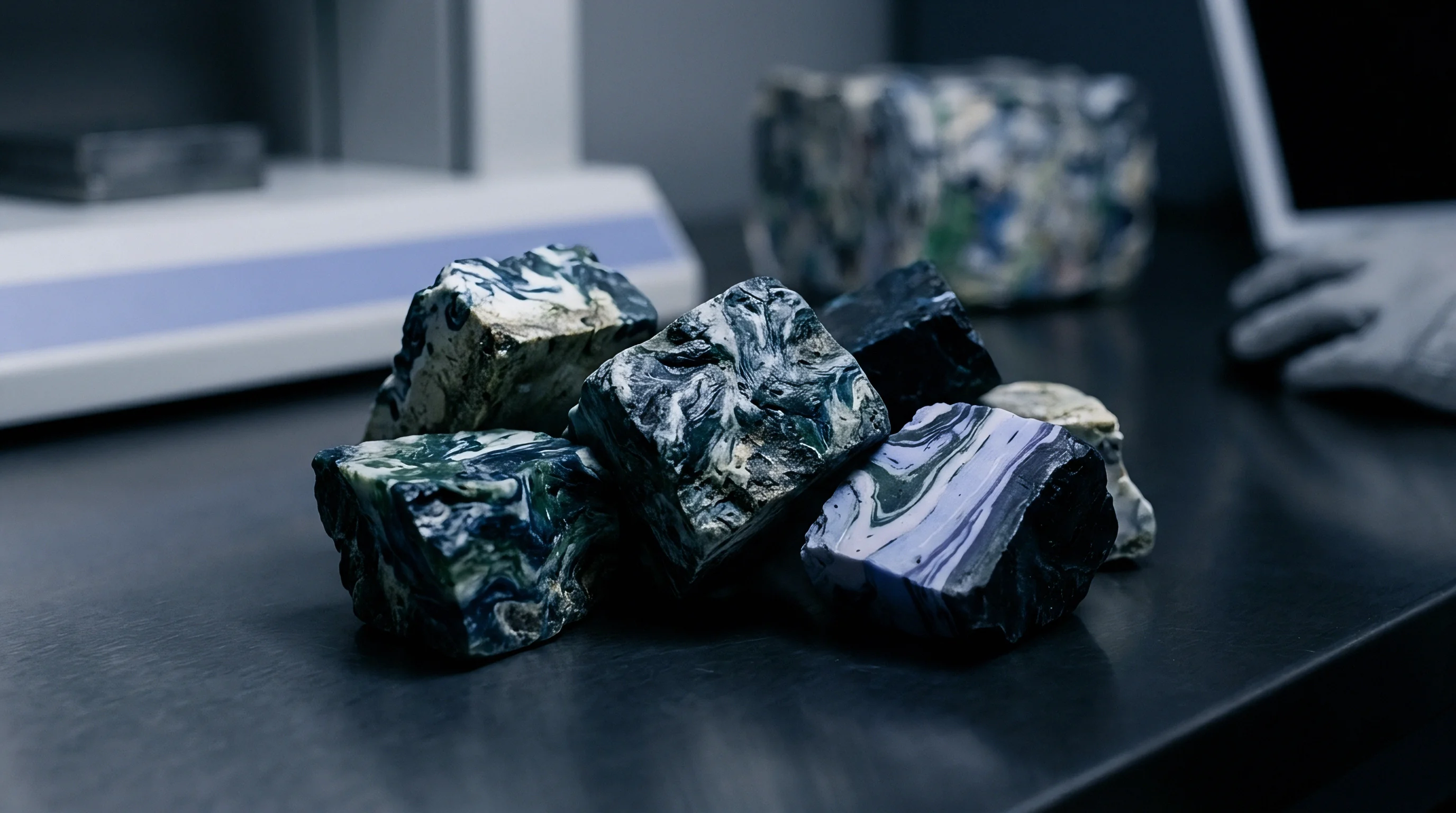
Post-consumer polyethylene terephthalate regrind carries two distinct water fractions into the extrusion compounding line. Surface water adheres mechanically to flake faces after washing and float-sink separation. Absorbed water resides deep within the amorphous regions of the polymer matrix, trapped between folded ester chains during rapid quenching in previous conversion cycles.
Surface moisture adsorbed onto residual washing surfactants acts immediately upon entry into the feed throat of an extruder. Clean flake exhibits surface moisture levels around 0.10 percent by weight after centrifugal drying. Contaminated flake carrying residual sugar syrup, detergent residues, or organic labels retains surface water levels approaching 1.0 percent.
Water destroys ester links.
Moisture trapped within amorphous polymer domains initiates thermal cleavage before the melt phase reaches full homogenization.
Unwashed post-industrial skeletons present a different moisture profile than washed post-consumer flake. Post-industrial trim typically lacks surface contamination, holding only ambient absorbed moisture determined by warehouse relative humidity. The diffusion rate of ambient moisture into solid polyester flake follows Fickian behavior, reaching saturation at approximately 0.40 percent relative water content under ambient tropical storage conditions.
| Grade Designation | Source Matrix | Internal Water Fraction (ppm) | Surface Water Fraction (ppm) | Initial Carboxyl Content (mmol/kg) |
|---|---|---|---|---|
| Clear Bottle Flake | Post-Consumer Beverage Containers | 350 to 500 | 1,000 to 3,000 | 28 to 35 |
| Colored Flake Blend | Mixed Post-Consumer Thermoforms | 450 to 650 | 2,500 to 6,000 | 38 to 48 |
| Industrial Skeleton Regrind | Post-Industrial Biaxially Oriented Film | 200 to 300 | 100 to 300 | 18 to 24 |
| Pelletized Recyclate (Un-dried) | Reprocessed Mechanical Repellet | 300 to 450 | 200 to 500 | 32 to 42 |
Carboxyl end-group concentration serves as an indicator of prior hydrolytic damage in recycled raw materials. Elevated carboxyl levels accelerate autocatalytic chain degradation during subsequent melting, creating a feedback loop where initial moisture induces rapid viscosity drop even if processing moisture levels remain low. Reclaim merchants frequently report that high vacuum devolatilization at the extruder mid-barrel eliminates the necessity of pre-drying incoming flake shipments.

Desiccation
Pre-Conditioning Requirements for Amorphous and Semi-Crystalline Recyclate
Removing bound water from recycled polyester requires heat, dry air volume, and adequate hold time. Amorphous regrind softens at 78 degrees Celsius, the glass transition temperature of polyethylene terephthalate. Heating un-crystallized material directly to drying temperatures between 160 degrees Celsius and 180 degrees Celsius causes particle agglomeration and bridging inside the hopper inlet.
Wet resin jams hoppers.
Crystallization in an agitated vessel at 140 degrees Celsius precedes final drying. The agitation breaks surface agglomerates as polymer chain segments realign into ordered spherulitic structures, raising the heat deflection point above 200 degrees Celsius and permitting high-temperature desiccation without clumping. Clean flake yields stability.
- Transfer washed flake into a continuously agitated crystallizer unit operating at 140 degrees Celsius for forty minutes.
- Pass the crystallized stream into a twin-tower desiccant hopper supplied with air at a dew point below minus forty degrees Celsius.
- Maintain a volumetric air-to-polymer mass flow ratio exceeding 2.5 cubic meters per kilogram of resin throughput.
- Measure the discharge pellet temperature to verify core heating reaches 170 degrees Celsius before throat entry.
Desiccant dry-air systems extract internal absorbed water by maintaining a steep vapor pressure differential between the core of the flake and the surrounding gas stream. Air dew point controls this vapor gradient. Operating a hopper with a dew point of minus twenty degrees Celsius leaves equilibrium moisture levels near 150 parts per million, which remains too high for engineering compounding.
Lowering the dew point to minus forty degrees Celsius drops equilibrium core moisture below fifty parts per million, safeguarding the molecular chain during twin-screw melting. Dryer hoppers mandate care. Dry air flow volume matters less than maintaining a dew point below the freeze point of water vapor at the dryer exhaust.


Assay
Analytical Methods for Sub-100 Ppm Moisture Verification
Laboratory determination of trace moisture content in recycled polyesters demands isolation from atmospheric ambient humidity. Standard moisture balances relying on weight loss during heating introduce significant errors when testing recycled flakes. Measure surface moisture first.
Sealed oven coulometric Karl Fischer testing at 180 degrees Celsius isolates water vapor from organic volatiles to achieve a measurement precision of five parts per million.

Is Karl Fischer Titration Required for Pellet Verification?
Standard infrared moisture balances fail to differentiate between water and volatile organic compounds present in post-consumer materials. Residual wash surfactants, residual monomers, and printing ink solvents evaporate during thermal testing, generating false elevated moisture readings. Coulometry isolates water vapor using an inert carrier gas stream passed through a temperature-controlled heating chamber into an anode titration cell.
Volatiles corrupt loss tests. Coulometry isolates water. Reagent purity matters most.
| Analytical Method | Standard Reference | Detection Floor (ppm) | Test Duration (min) | Interference Vulnerability |
|---|---|---|---|---|
| Coulometric Karl Fischer (Oven) | ISO 15512 Method B | 5 | 12 to 18 | Negligible (Gas Separation) |
| Volumetric Karl Fischer | ASTM D6869 | 50 | 8 to 12 | Moderate (Direct Dissolution) |
| Loss-on-Drying (Infrared) | ASTM D6980 | 150 | 5 to 10 | Severe (Volatiles / Additives) |
| Sensor Evaporation Method | ISO 15512 Method C | 20 | 10 to 15 | Low (Selective Water Sensor) |
Receiving inspection procedures rely on clear decision criteria to determine when low-cost rapid tests suffice and when coulometric accuracy is required for commercial settlement.
- Material Volatile Profile evaluate whether incoming regrind contains residual wash surfactants or volatile organic compounds that distort loss-on-drying mass loss measurements.
- Target Moisture Limit select coulometric Karl Fischer titration when downstream processing demands water levels below fifty parts per million.
- Sample Handling Speed deploy rapid loss-on-drying balances only for high-moisture pre-check screening at the dryer throat.
- Calibration Frequency check reagent water equivalent standards daily when operating Karl Fischer titration equipment on high-volume production lines.
Standard procurement contracts specifying ISO 15512 Method B compliance penalize shipments exceeding fifty parts per million moisture by imposing a two percent invoice deduction per hundred parts per million overage.

Viscosity

Hydrolytic Cleavage Kinetics during Melt Extrusion
Degradation of polyester chains proceeds rapidly through ester link hydrolysis when melt processing temperatures exceed two hundred sixty degrees Celsius. Heat accelerates hydrolysis. Every molecule of water reacting with the molten polymer chain cleaves an ester bond, producing one terminal carboxyl group and one terminal hydroxyl group while cutting chain length.
High moisture drops pressure.
ISO 527 tensile testing demonstrates that an intrinsic viscosity drop from 0.80 to 0.65 dL/g reduces ultimate tensile elongation at break by over forty percent.
Quantifying Intrinsic Viscosity Loss in Twin-Screw Extrusion
Calculating molecular weight reduction requires establishing the kinetic rate constant of hydrolytic cleavage at processing temperatures. Consider a compounding line processing recycled flake with an initial intrinsic viscosity of 0.80 deciliters per gram, corresponding to a number-average molecular mass of approximately 32,000 grams per mole. Processing at 280 degrees Celsius under a residence time of forty-five seconds yields a predictable intrinsic viscosity loss based on incoming moisture concentration.
When the feed moisture content stands at 0.05 percent (500 parts per million), the water-to-ester mole ratio drives rapid hydrolysis. The final intrinsic viscosity drops to 0.62 deciliters per gram, representing a 22.5 percent loss in chain length. Lowering incoming moisture to 0.005 percent (50 parts per million) limits hydrolytic cleavage, restricting final intrinsic viscosity loss to 0.78 deciliters per gram under identical thermal and residence conditions.
Dry flakes preserve viscosity.
Extruder screw design alters the degradation rate. A high-shear kneading block configuration elevates localized melt temperatures by 15 to 20 degrees Celsius above the barrel setpoint, doubling the rate of ester cleavage in the presence of un-extracted water. Vacuum devolatilization zones operating at 10 millibar absolute pressure extract surface moisture within the first three residence stages, yet bound moisture remaining inside un-melted core domains reacts before reaching the vacuum vent.
Multi-stage degassing extruders mitigate surface moisture, but fail to prevent hydrolytic scission occurring inside early melting zones when pre-drying is omitted.
Thermal stability additives suppress thermo-oxidative degradation, but exert zero inhibition against hydrolytic cleavage. Phosphite stabilizers prevent radical-induced chain scission without altering ester hydrolysis reaction rates. Managing water content prior to barrel entry remains the sole physical mechanism for preserving intrinsic viscosity during mechanical recycling compounding operations.
- Impact Resistance Loss reduced molecular weight shifts brittle-to-ductile transition temperatures upward, resulting in part failure under cold drop testing.
- Melt Pressure Fluctuation declining melt viscosity lowers die head pressure, destabilizing strand pelletizing operations and causing pellet size variance.
- Carboxyl Group Accumulation elevated terminal carboxylic acid concentrations accelerate autocatalytic hydrolytic degradation during subsequent molding cycles.
- Color Index Shift thermally cleaved chain ends undergo secondary oxidation, causing yellowing quantified by increased Hunter b color coordinates.
The precise threshold where carboxyl end-group accumulation begins to overpower thermal stabilizer packages in post-consumer clear bottle flake remains a subject of active research across compounding halls.

Yield
Economics of Deep Drying versus Chemical Chain Extension
Material specifications for technical compounding balance pre-drying capital expenditure against additive chemical chain extension costs. Chain extenders such as pyromellitic dianhydride or multi-functional epoxy acrylic oligomers react with hydroxyl and carboxyl end-groups during melt residence. This chemical coupling reconnects broken polymer chains, restoring intrinsic viscosity without requiring sub-50 ppm pre-drying moisture levels.
Chain extenders raise costs.
| Processing Strategy | Pre-Drying Target (ppm) | Energy Cost (EUR/Tonne) | Additive Cost (EUR/Tonne) | Final IV Retention (%) |
|---|---|---|---|---|
| Desiccant Drying Only | < 50 | 42.50 | 0.00 | 97.5 |
| Atmospheric Venting + Chain Extender | 1,500 | 8.00 | 65.00 | 95.0 |
| High Vacuum Devolatilization (Multi-Vent) | 250 | 18.50 | 12.00 | 96.8 |
| Combined Vacuum + Chain Extender | 250 | 18.50 | 38.00 | 102.5 |
Foil liners block moisture. Quality management systems rely on clear procurement specifications to protect incoming supply chains from humidity degradation during maritime shipping.
- Maximum Moisture Threshold set explicit incoming water limits at one hundred parts per million for pre-dried flake delivered in vapor-barrier Gaylord boxes.
- Intrinsic Viscosity Floor specify a minimum post-compounding intrinsic viscosity of zero point seven two deciliters per gram under ASTM D4603 test conditions.
- Contamination Rejection Limit establish rejection criteria for PVC contamination above fifty parts per million to prevent acid-catalyzed hydrolytic degradation during drying.
- Delivery Container Integrity require aluminum foil liner bags with sealed vacuum valves to prevent moisture absorption during multi-day transit.
Moisture limit failures during compounding increase scrap rates at the injection molding machine, inflating final part unit cost through unrecoverable regrind degradation.