Quantifying Interfacial Adhesion Failure and Phase Separation in Immiscible Recycled Polyolefin Blends
Quantifying interfacial adhesion in recycled polyolefins requires measuring essential work of fracture and domain size to set compatibilizer dosage.


Thermodynamics
High-density polyethylene and polypropylene remain immiscible across practical melt-processing temperatures due to low mixing entropy and positive enthalpy of mixing. This enthalpy scales with the Flory-Huggins interaction parameter, which generally ranges between 0.015 and 0.045 for polyolefin combinations from 190 °C to 230 °C. Because long polymer chains contribute negligible combinatorial entropy, the Gibbs free energy of mixing stays positive across all composition ratios. Consequently, phase separation happens quickly while molten, producing discrete minority-component domains dispersed throughout the majority matrix.
In mechanical compounding of recycled polyolefin streams, post-consumer packaging flakes introduce high-density polyethylene, linear low-density polyethylene, and polypropylene homopolymers or random copolymers into one melt stream. Phase morphology develops according to the concentration ratio, melt viscosity ratio, and interfacial tension between components. Below a minority volume fraction of 0.30, the dispersed phase forms spherical droplets.
As the minority fraction approaches equal volume with the matrix, domain coalescence produces co-continuous structures that degrade impact toughness.
Phase Separation Kinetics in Molten Polymer Pairs
Processing post-consumer polyolefin waste streams blends linear low-density polyethylene, high-density polyethylene, and isotactic polypropylene. Spinodal decomposition drives phase separation whenever the melt enters the unstable region within the binodal curve. In the metastable region, nucleation and growth take over, generating spherical droplets that expand with melt temperature and hold time.
In uncompatibilized high-density polyethylene and polypropylene blends, droplet diameters increase from 1.5 micrometers right after exiting a twin-screw extruder to over 12 micrometers after two minutes of quiescent annealing at 200 °C.
Coalescence kinetics in the dispersed phase follow the Lifshitz-Slyozov-Wagner model adapted for viscoelastic matrices. Driven by interfacial tension between high-density polyethylene and polypropylene, domain coarsening minimizes interfacial free energy as capillary pressure gradients feed larger droplets at the expense of smaller ones. Melt elasticity in high molecular weight fractions resists droplet deformation during compounding, whereas lower molecular weight contaminants coalesce rapidly because lower matrix viscosity presents less resistance.
Interfacial tension between high-density polyethylene and isotactic polypropylene measures 4.8 mN/m at 190 °C under zero-shear conditions.
Interfacial Tension and Viscoelastic Dynamics
How dispersed droplets deform under shear depends on the viscosity ratio ~ the melt viscosity of the dispersed phase divided by that of the matrix at a given shear rate. Droplets break up inside the extruder barrel once the Capillary number passes the critical threshold given by the Grace curve. At a viscosity ratio of 1.0, this critical Capillary number reaches its minimum near 0.4, allowing moderate shear stresses to break droplets down into sub-micron domains.
Extreme mismatches in viscosity ratios cause macro-phase separation during injection molding or sheet extrusion. When the viscosity ratio exceeds 3.8, shear stresses in the screw channels fail to break up dispersed droplets, forcing large polymer inclusions through the die land. Conversely, when the viscosity ratio falls below 0.1, the matrix phase transfers shear stress inefficiently, creating elongated threads that break down into uneven droplet arrays upon entering the mold cavity, reflecting how melt flow rates reshape phase morphology.
| Polymer Binary Pair | Temperature (°C) | Interfacial Tension (mN/m) | Flory-Huggins Parameter | Critical Domain Diameter (µm) |
|---|---|---|---|---|
| HDPE / iPP Homopolymer | 190 | 4.8 | 0.038 | 2.4 |
| HDPE / iPP Homopolymer | 230 | 3.9 | 0.031 | 1.8 |
| LLDPE / iPP Random Copolymer | 190 | 3.2 | 0.024 | 1.5 |
| LLDPE / iPP Random Copolymer | 230 | 2.5 | 0.019 | 1.1 |
| LDPE / HDPE Binary Pair | 190 | 0.9 | 0.007 | 0.4 |
Whether long-chain branching in post-consumer low-density polyolefins suppresses domain coalescence at elevated melt temperatures remains an open empirical question.

Notch
Evaluating toughness in multi-phase resin systems requires test geometries that isolate interfacial adhesive failure from bulk matrix deformation. Standard tensile testing under ISO 527 misses phase boundary weaknesses because necking hides localized micro-voids around immiscible inclusions. Notched impact and fracture mechanics testing, by contrast, expose the sharp drop in energy dissipation caused by poor adhesion between polyethylene and polypropylene phases.
Interfacial failure shows up as delamination along phase boundaries under rapid impact loading. As an uncompatibilized blend absorbs impact energy, stress accumulates at the poles of polypropylene droplets embedded in the polyethylene matrix. Without chemical bonding or chain entanglement across the interface, cracks travel around domain boundaries rather than through polymer chains, leaving clean debonding surfaces under electron microscopy.

Essential Work of Fracture Analysis
Linear elastic fracture mechanics breaks down when applied to ductile polyolefin matrices that experience extensive plastic yielding ahead of a crack tip. The essential work of fracture approach in ISO 13586 separates total fracture energy into essential work inside the process zone and non-essential work in the surrounding plastic zone. Testing double-edge notched tension specimens over different ligament lengths gives a linear plot whose y-intercept defines the specific essential work of fracture.
Specific essential work values directly reflect interfacial bond strength in post-consumer polyolefin compounds. Uncompatibilized recycled high-density polyethylene with 15 percent polypropylene yields values below 12 kJ/m², whereas compatibilizing the interface elevates essential work above 38 kJ/m² ~ approaching virgin resin levels. Strong interfacial adhesion forces the crack tip to cut through polymer chains rather than debonding along phase boundaries, turning brittle interfacial failure into ductile matrix yielding.
Compliance with ISO 13586 requires notch tip radii below 10 micrometers to prevent artificial elevation of essential work of fracture values.
Fracture Morphology and Interfacial Failure
Electron microscopy shows void formation around uncompatibilized rubbery domains. Under tensile load, stress concentrations at the droplet poles reach 2.5 times the applied stress. Debonding starts at the droplet equator once local normal stress exceeds interfacial adhesive strength, and the resulting micro-voids coalesce rapidly under continued strain to form macroscopic cracks before the matrix can yield.
Quantifying interfacial adhesion failure relies on identifying distinct mechanical signatures across standardized test methods. Compounders and quality control laboratories monitor specific physical metrics to identify delamination risks in recycled lots.
- Interfacial Debonding Stress measured through acoustic emission tracking during tensile elongation reveals initial interface rupture prior to macroscopic material yield.
- Notched Izod Energy Decay recorded across temperature sweeps between minus 40 °C and plus 23 °C identifies ductile-to-brittle transition temperatures driven by domain debonding.
- Crack Tip Opening Displacement calculated from high-speed video recording during essential work testing quantifies plastic zone resistance ahead of propagating crack fronts.
- Delamination Surface Fraction calculated via microscopic image analysis of fractured surfaces quantifies the area ratio of debonded domain sockets relative to ductile matrix fibrils.
Evaluating fracture toughness in post-consumer high-density polyethylene containing 12 percent polypropylene homopolymer yields an essential work of fracture of 14.2 kJ/m² at 23 °C under ISO 13586 parameters established in 2021. This value depends on sharp notch tip radii produced by fresh razor blades; blade dulling that increases notch tip radius to 25 micrometers inflates measured essential work to 21.8 kJ/m², falsely masking interfacial weakness.
| Blend Composition | Compatibilizer Type | Notched Izod Impact (kJ/m²) | Essential Work of Fracture (kJ/m²) | Interfacial Shear Strength (MPa) |
|---|---|---|---|---|
| 80% HDPE / 20% iPP | None | 4.2 | 11.8 | 3.1 |
| 80% HDPE / 20% iPP | 5% SEBS | 18.5 | 32.4 | 12.4 |
| 80% HDPE / 20% iPP | 5% PE-b-iPP Diblock | 24.1 | 41.2 | 18.6 |
| 80% HDPE / 20% iPP | 3% PE-g-MAH / 2% EVA | 12.8 | 26.5 | 8.9 |
| 70% LLDPE / 30% iPP | None | 6.8 | 14.5 | 4.2 |
Standard procurement contracts adhering to ISO 179-1/1eA define notch tip radii tolerances of 0.25 plus or minus 0.05 millimeters to ensure consistent stress concentration across testing batches.


Compatibilization
Thermodynamic compatibility between non-polar polymer phases improves with the addition of amphiphilic diblock or triblock molecules. During thermal compounding, synthetic block copolymers containing crystallizable polyethylene and isotactic polypropylene segments migrate to the interface. The polyethylene block co-crystallizes with the polyethylene matrix while the polypropylene block anchors into the dispersed polypropylene domain.
This molecular bridging creates physical entanglements that lower interfacial tension and suppress domain coalescence during processing.
Interfacial modification changes both domain morphology and viscoelastic response. Effective compatibilizing agents drop interfacial tension from above 4.5 mN/m to below 0.8 mN/m. This lower tension reduces equilibrium droplet diameters under shear, yielding fine domain distributions under 500 nanometers that prevent local stress concentrations and premature debonding under load.

Block Copolymer Architecture and Phase Boundary Anchoring
Saturated diblock structures with high molecular weights locate at phase boundaries during compounding. Styrene-ethylene-butylene-styrene triblock copolymers and olefin block copolymers serve as common non-reactive interfacial agents for post-consumer polyolefin streams. Elastomeric midblocks absorb impact energy at the interface, while crystalline endblocks anchor into matrix chains.
Block copolymer selection depends on matching segment lengths with matrix molecular weight distributions to maximize chain entanglement densities.
Chemical cracking of heavy petroleum fractions yields ethylene and propylene monomers whose catalytic polymerization defines short-chain branching distributions, establishing the exact entropic penalty paid during phase separation in downstream recycled compounds. When molecular block lengths fall below the critical entanglement molecular weight, compatibilizing molecules pull out of domain interfaces under mechanical stress rather than transferring load across the phase boundary.
Saturated block copolymers locate preferentially at phase boundaries when midblock segment lengths match matrix chain entanglement densities.
Could Reactive Extrusion Eliminate Domain Coalescence in PCR Blends?
Grafting maleic anhydride onto polypropylene backbones creates functional sites that react with amine-terminated polyolefins during high-shear compounding. Functionalized polyolefins undergo covalent coupling across phase boundaries, forming graft copolymers in situ during extrusion. Reactive extrusion processing eliminates the need for pre-synthesized block copolymers by creating custom amphiphilic structures directly at the molten interface.
Grafting efficiency depends on screw residence time, melt temperature, and organic peroxide initiator concentration.
Formulating effective compatibilization packages for mixed post-consumer streams requires evaluating additive performance across structural parameters.
- Block Length Symmetry dictates whether the compatibilizer distributes evenly between matrix and domain phases or forms micellar aggregates inside the continuous phase.
- Functional Group Density determines the degree of covalent cross-linking across interfaces during reactive processing, balancing impact recovery against melt flow reduction.
- Thermal Stability Window limits processing temperatures to prevent thermal degradation of functional grafting sites during twin-screw compounding.
- Viscosity Match Factor governs how rapidly block copolymers diffuse through high-viscosity polymer melts to reach phase boundaries before extrudate cooling.
Estimating compatibilizer diffusion kinetics across high-viscosity matrix interfaces involves uncertainty due to overlapping relaxation spectra in dynamic mechanical measurements. While common assumptions hold that adding 3.5 percent by weight of generic olefin block copolymer achieves complete coverage across post-consumer high-density polyethylene lots containing 5 to 15 percent polypropylene, buyers manage this risk by requiring lot-specific melt rheology sweeps from 0.01 to 100 radians per second to confirm elastic modulus elevations in the low-frequency terminal regime.
Block copolymer compatibilizers function effectively when the molecular weight of each block exceeds the entanglement molecular weight of the corresponding matrix polymer.

Shear
Barrel temperature profiles and screw rotation rates govern domain morphology in the extrudate. Compounding twin-screw extruders rely on intense dispersive mixing in initial melting zones, followed by controlled distributive mixing to position additives along domain boundaries. Excess shear energy degrades high molecular weight polymer chains through thermal-mechanical scission, shifting melt flow rates unpredictably, while insufficient shear leaves large undispersed polymer contaminants that create structural defects in molded parts.
Droplet coalescence accelerates as molten polyolefins move through low-shear die channels or sit in hot runner systems. In high-speed injection molding, shear rates at mold gates reach 10,000 to 50,000 reciprocal seconds, stretching dispersed domains into fine threads. Rapid mold cooling freezes these elongated fibrils in place, creating anisotropic mechanical properties that risk delamination.
Slower cooling, by contrast, gives stretched threads time to break down into spherical droplet chains via Rayleigh-Taylor capillary instabilities.

Viscosity Ratios and Droplet Breakup Mechanics
Dynamic frequency sweeps conducted between 0.01 and 100 radians per second reveal elastic relaxation mechanisms associated with dispersed droplets. Polymer melt rheology provides direct analytical insight into interfacial tension and phase separation without requiring destructive cross-sectioning. Applying the Palierne viscoelastic emulsion model to complex shear modulus curves allows precise calculation of interfacial tension and volume-average droplet radii in immiscible polyolefin compounds.
Melt elasticity increases in compatibilized compounds due to stress storage by interfacial block copolymers. A Cole-Cole plot of imaginary versus real viscosity displays a characteristic secondary arc at low frequencies when droplets are effectively compatibilized. Uncompatibilized blends show simple single-arc behavior, signaling weak interfacial stress transfer and rapid droplet relaxation.

Verification Procedures for Incoming Pellet Shipments
Receiving managers who unload bulk containers test material consistency using differential scanning calorimetry and multi-load melt flow index measurements. Sampling incoming lots requires systematic verification to prevent contaminated or uncompatibilized resin from entering manufacturing silos.
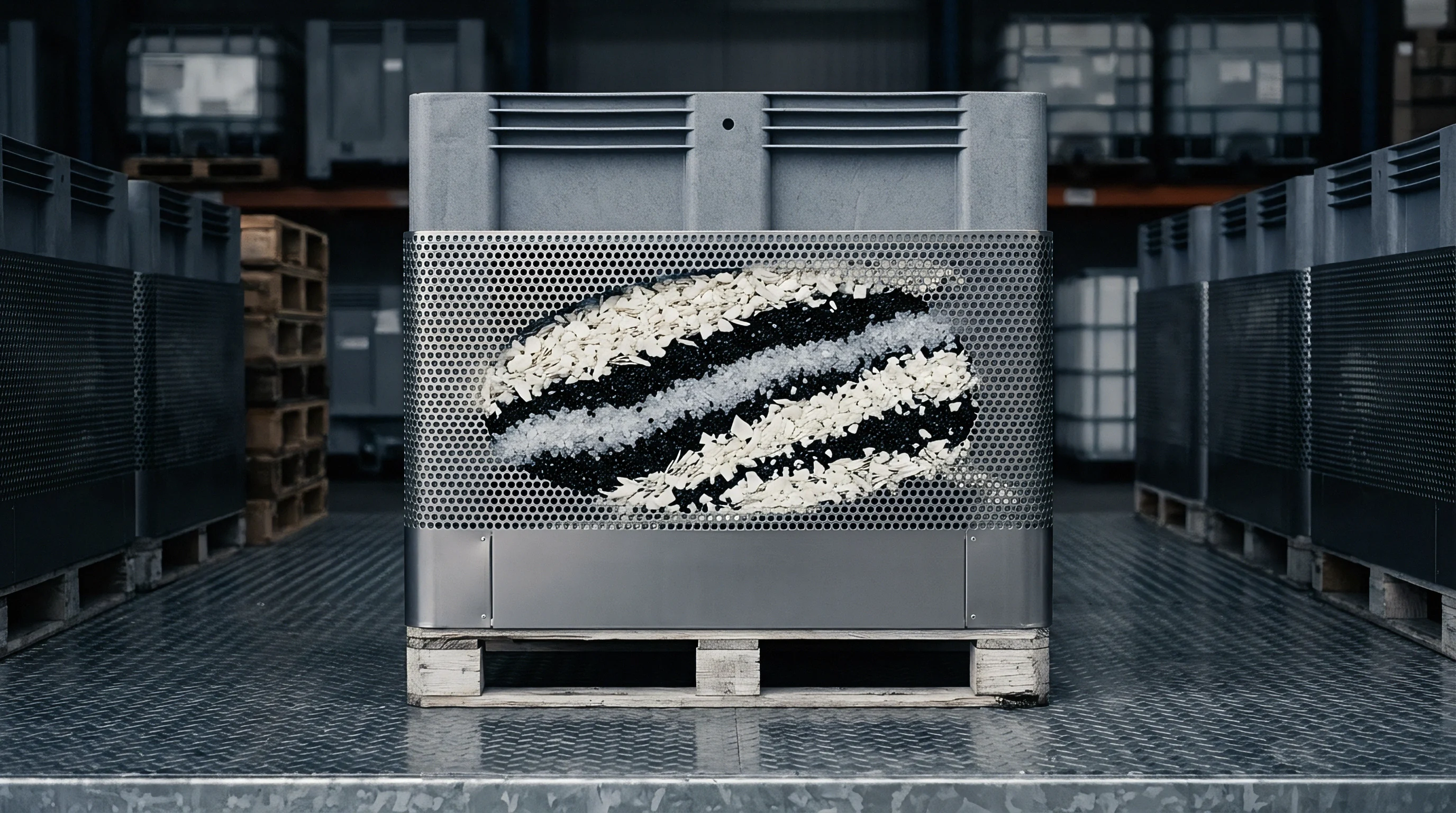
- Draw five representative core samples from top, middle, and bottom sections of every bulk gaylord or railcar compartment using a slotted grain sampler.
- Seal drawn samples immediately in moisture-barrier bags labeled with lot numbers, shipment dates, and silo destination codes.
- Run differential scanning calorimetry heat-cool-heat cycles from 30 °C to 200 °C at 10 °C per minute to quantify polypropylene contamination down to 0.5 percent by peak area integration.
- Measure melt flow rates at 190 °C under standard 2.16 kg load and elevated 21.6 kg load according to ISO 1133 to calculate high-load melt flow ratios.
- Perform capillary rheology shear sweeps from 10 to 5,000 reciprocal seconds to identify melt viscosity mismatches across processing shear windows.
- Inject mold standardized ISO test bars and inspect cross-sections under polarized light microscopy to verify dispersed domain diameters remain below 2.0 micrometers.
Coalescence rates in uncompatibilized melt streams double during quiescent holding times inside hot runner systems.
High melt flow differences between post-consumer fractions do not automatically homogenize during high-speed injection molding.

Discount
Financial liabilities from phase-separated resin batches stem from higher scrap rates, tool wear, and field failures. Although post-consumer polyolefin regrind trades 350 USD to 750 USD per metric tonne below virgin market settlements, uncompatibilized blends that fail along phase boundaries during molding quickly erase those savings with rejection rates above 15 percent.
Adding compatibilizing agents increases compounding costs, requiring direct comparison against finished part margins. Block copolymer additives cost between 3.20 USD and 5.80 USD per kilogram, adding 96 USD to 174 USD per metric tonne at typical 3 percent let-down ratios. Sourcing managers weigh this additive expense against performance gains and reduced scrap.

Landed Cost Impact of Compatibilizer Additive Packages
Specialized block copolymers add 0.15 USD to 0.45 USD per kilogram to raw material expenses. However, effective compatibilization allows higher loading of lower-cost post-consumer polypropylene flake in high-density polyethylene matrixes, reducing overall formulation costs and lowering landed costs per good part.
| Formulation Strategy | Resin Cost (USD/Tonne) | Additive Cost (USD/Tonne) | Molding Scrap Rate (%) | Landed Cost per 1,000 Good Parts (USD) |
|---|---|---|---|---|
| Virgin HDPE Homopolymer | 1,420 | 0 | 1.2 | 143.70 |
| 80/20 PCR HDPE/PP Uncompatibilized | 850 | 0 | 18.5 | 104.30 |
| 80/20 PCR HDPE/PP + 3% SEBS | 850 | 126 | 2.8 | 100.40 |
| 80/20 PCR HDPE/PP + 2% PE-b-iPP | 850 | 104 | 1.5 | 96.80 |
| 60/40 PCR HDPE/PP + 4% Reactive Graft | 780 | 148 | 3.2 | 95.90 |

Commercial Specification Clauses for Material Acceptance
Procurement contracts for post-consumer polyolefins establish strict caps on polypropylene contamination in high-density polyethylene streams, requiring analytical proof of compliance before releasing payment. Technical specifications set explicit thresholds for notched Izod impact strength, essential work of fracture, and maximum domain size measured by SEM analysis.
Contractual agreements define clear financial recourse when incoming resin lots fail phase separation criteria upon arrival. Rejection clauses specify that if polypropylene domain sizes exceed 3.0 micrometers or essential work values fall below 25 kJ/m², the seller absorbs all freight charges, sampling fees, and silo decontamination expenses.
Skipping interfacial analysis on raw post-consumer lots leads directly to unbudgeted sorting costs, tool damage, and complete batch rejections at the customer molding facility.