Dynamic Mechanical Analysis Gel Content Determination Recycled Polypropylene Compound Quality Verification Standards
Dynamic mechanical analysis quantifies cross-linked gel content in recycled polypropylene compounds by measuring high-temperature storage modulus plateaus.


Crosslinks
Contaminants in recycled polypropylene stream feeds originate from residual cross-linked polyethylenes, degraded rubber phase domains, and thermal-oxidative degradation during compounding. High-shear extruders run at temperatures between 210 °C and 240 °C induce radical cleavage in polypropylene backbones, leading primarily to chain scission and melt flow elevation. Thermoplastic packaging scrap contains trace volumes of cross-linkable low-density polyethylene, organosilane-grafted copolymers, or peroxide-initiated cross-linked residues from multi-layer film structures.
These polyolefin contaminants fail to melt during standard processing cycles, forming gel domains ranging from 10 to 500 micrometers in diameter.
Heterogeneous scrap fractions introduce additional gel mechanisms through vulcanized elastomer inclusions. Automotive shredder residue and post-consumer appliance housings contain ethylene-propylene-diene monomer (EPDM) or ethylene-propylene rubber (EPR) phase modifiers. While dispersed elastomer particles improve ambient notched Izod impact strength in virgin homopolymer grades, cross-linked rubber particles act as insoluble gel centers when reprocessed into recycled polypropylene compounds.
Standard capillary melt flow rate testing under ISO 1133 condition M (230 °C, 2.16 kg) fails to quantify these elastic domains because small gel particles shear through standard 2.095 mm orifices without registering a measurable drop in mass flow rate.
Shear flow across standard orifice dies masks the physical presence of micro-gels through transient particle deformation.
Quantifying gel fractions requires isolating structural network formation from simple high-molecular-weight entanglements. Linear polypropylene chains exhibit physical entanglements that untangle under elevated temperatures and slow shear conditions. Hydrocarbon networks linked by covalent bonds preserve structural rigidity past the melting point of the crystalline matrix.
Distinguishing these two states dictates whether a compound can be processed through fine filtration screens or thin-wall packaging tooling.
- Peroxide Degradation Products generated during prior processing cycles form micro-gels through secondary cross-linking reactions in contaminated polyethylene fractions.
- Organosilane Residues from moisture-cured polyolefin packaging layers remain insoluble at standard polypropylene compounding temperatures above 160 °C.
- Vulcanized Rubber Particles from automotive scrap streams create elastomeric inclusions that resist thermal dissipation during twin-screw extrusion.
- Thermal-Oxidative Degradation Gels form when local temperature spikes inside the extruder barrel yield highly oxidized, insoluble polyolefin aggregates.
Reclaiming high-purity recycled polypropylene demands precise identification of gel morphology prior to conversion. Standard melt pressure volume tests often mask cross-linked gel fractions behind temporary viscosity shifts. Compounders frequently explain batch-to-batch extrusion pressure spikes as minor variations in filler dispersion rather than cross-linked gel contamination.


Modulus
Viscoelastic Profiling beyond the Melting Point
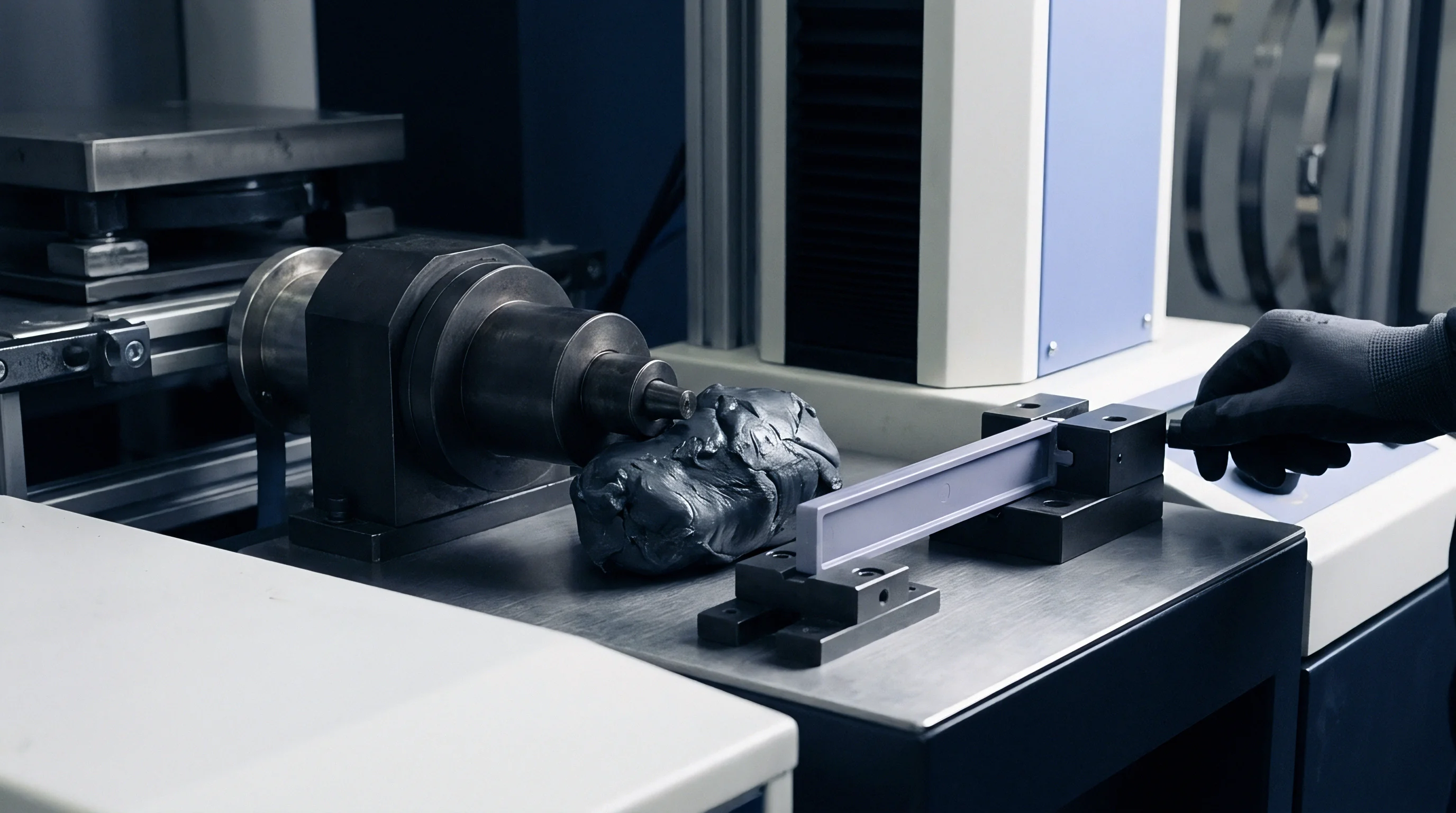
Dynamic Mechanical Analysis measures the viscoelastic response of a polymer compound by applying a sinusoidal strain across a defined thermal sweep. The instrument records the storage modulus representing elastic energy storage, the loss modulus representing viscous energy dissipation, and the loss factor tan delta calculated as the ratio of loss modulus to storage modulus. Solid isotactic polypropylene exhibits a sharp drop in storage modulus across its glass transition temperature near 0 °C, followed by a steady decline until reaching complete structural yield at the crystalline melting temperature between 160 °C and 168 °C.
Linear polyolefin compounds experience rapid modulus collapse above their melting point, where storage modulus values drop below measurable thresholds. Recycled polypropylene compounds containing cross-linked gel networks display a distinct equilibrium plateau in storage modulus above 170 °C. This rubbery plateau occurs because covalent cross-links prevent macromolecular chain sliding under low-frequency oscillation. The magnitude of the high-temperature storage modulus correlates directly with gel volume fraction and cross-link density within the compound matrix.
Dynamic mechanical testing at 180 °C under a 1 Hz oscillation frequency isolates the elastic storage modulus of gel networks without interference from un-crosslinked polypropylene crystals.
Calculating the cross-link density of isolated gel fractions utilizes classical affine network elasticity models. Equation calculations relate the equilibrium storage modulus in the molten state to the average molecular weight between cross-links according to the relation where storage modulus equals polymer density multiplied by the universal gas constant, absolute temperature, and the reciprocal of molecular weight between cross-links. A 40-tonne lot of recycled polypropylene compound displaying a molten storage modulus of 12 kilopascals at 180 °C indicates an active cross-linked gel fraction of approximately 1.8 weight percent, assuming a reference network density of 850 kilograms per cubic meter.
Higher modulus readings indicate denser chemical cross-linking that resists mechanical dispersion during moulding.
Applying temperature sweeps from -50 °C to 200 °C at a constant heating rate of 3 °C per minute reveals structural relaxation modes. The glass transition temperature peak of the polypropylene matrix appears in the tan delta curve near 0 °C, while secondary peaks below -40 °C indicate the presence of impact-modifying polyethylene or EPDM rubber phases. The height and area of the high-temperature storage modulus plateau remain the primary metrics for cross-linked gel content quantification.
What structural mechanisms cause low-density gel fractions to exhibit transient storage modulus spikes near 175 °C during rapid heating sweeps?


Sieve

Solvent Extraction Protocols and High Temperature Filtration
Standard gravimetric measurement of gel content in polyolefins relies on solvent extraction techniques defined under ISO 10147 and ASTM D2765. The test protocol requires refluxing a weighed polymer sample in boiling xylene at 138 °C for 12 to 24 hours using a Soxhlet extraction apparatus. Soluble polypropylene and un-crosslinked polyethylene dissolve into the solvent phase, leaving insoluble gel fractions contained inside a stainless steel wire cloth pouch.
The extracted residue is dried under vacuum at 140 °C until reaching constant mass, yielding the gel percentage by gravimetric weight calculation.
Solvent extraction presents several operational limitations when applied to post-consumer recycled polypropylene compounds. Boiling xylene dissolves un-crosslinked elastomeric rubber modifiers such as EPDM, underestimating total gel inclusions that act as physical defects during processing. Thermal degradation during extended reflux cycles can induce additional chain scission or cross-linking if antioxidant packages within the recycled feedstock are depleted.
High-temperature dynamic mechanical analysis avoids solvent handling while providing real-time measurements of gel elasticity within 45 minutes.
- Dry the granular compound sample at 80 °C under vacuum for 4 hours to eliminate absorbed moisture.
- Enclose a 1.000 gram specimen in a pre-weighed 120-mesh stainless steel wire cloth pouch.
- Reflux the pouch in 300 milliliters of xylene containing 1.0 weight percent antioxidant for 16 hours.
- Transfer the pouch to fresh xylene at 130 °C for 1 hour to wash away residual dissolved polymer.
- Dry the extracted pouch in a vacuum oven at 140 °C for 12 hours under absolute pressure below 10 kilopascals.
- Calculate the gel fraction as the mass ratio of dry insoluble residue to initial specimen weight.
Extrudate melt pressure filter testing according to ASTM D6265 offers a physical alternative to solvent extraction. A melt pump feeds molten compound through a standardized screen pack assembly containing 325-mesh wire cloth at 230 °C. The rate of pressure buildup across the screen pack correlates with insoluble gel concentration and particulate contamination levels. The table below compares the diagnostic capabilities of extraction, rheological, and filtration methods for quality verification.
| Test Method | Standard Designation | Primary Measurement Metric | Sample Size | Testing Duration |
|---|---|---|---|---|
| Soxhlet Solvent Extraction | ASTM D2765 / ISO 10147 | Gravimetric Insoluble Mass % | 1.0 g to 2.0 g | 16 to 24 hours |
| Dynamic Mechanical Analysis | ASTM E1640 / ISO 6721-10 | Molten Storage Modulus (G’) | 0.5 g to 1.0 g | 45 to 60 minutes |
| Extrudate Melt Pressure Index | ASTM D6265 | Pressure Rise Rate (bar/kg) | 5.0 kg to 25.0 kg | 30 to 60 minutes |
| High-Temperature SEC-MALS | ISO 16014-4 | Molecular Weight Distribution | 0.05 g | 3 to 5 hours |
Purchasing specifications incorporating ISO 6721-10 require suppliers to certify that molten storage modulus values above 175 °C do not exceed agreed thresholds, shifting compliance proof from long solvent extractions to high-speed rheological audits.

Oscillation

Small-Amplitude Oscillatory Shear Spectrum Analysis
Small-Amplitude Oscillatory Shear (SAOS) testing characterizes the linear viscoelastic region of recycled polypropylene compounds using parallel-plate rheometer geometries. Standard measurements place a 25 mm diameter disc between polished plates maintained at 190 °C under nitrogen purge to prevent thermal oxidation. Applying an angular frequency sweep from 0.01 to 100 radians per second at a constant strain amplitude of 1 percent generates frequency-dependent curves for storage modulus and loss modulus.
Linear polyolefins display terminal liquid behavior at low frequencies, characterized by a storage modulus proportional to frequency squared and a loss modulus proportional to frequency.
Gel networks modify low-frequency terminal behavior by introducing frequency-independent modulus plateaus. As oscillation frequency approaches zero, un-crosslinked polypropylene chains relax fully, causing storage modulus values to plunge. Cross-linked polyolefin gels retain structural elasticity, causing storage modulus curves to flatten into a horizontal plateau at low angular frequencies.
The van Gurp-Palmen plot, which maps phase angle delta against complex modulus magnitude, provides direct visual confirmation of gel networks when phase angle values drop below 45 degrees at low complex modulus values.

Can Dynamic Mechanical Analysis Differentiate Polyethylene Crosslinks from Rubber Modifiers?
Discriminating between cross-linked polyethylene contamination and added elastomer phase modifiers relies on temperature-dependent relaxation spectra. Un-vulcanized EPDM rubber modifiers exhibit complete terminal flow at elevated temperatures above 200 °C, leading to continuous drop-offs in storage modulus during low-frequency sweeps. Cross-linked polyethylene gels maintain non-zero storage modulus plateaus up to 230 °C, confirming the presence of covalent network bonds rather than physical elastomer domain entanglements.
Cole-Cole plots mapping imaginary viscosity against real viscosity show circular arcs for homogeneous polymer melts. Recycled polypropylene compounds containing cross-linked micro-gels diverge from parabolic arcs at high real viscosity values, exhibiting upturns that indicate structural non-homogeneity. The table below outlines rheological indicators used to classify contaminants in post-consumer polypropylene compounds.
| Contaminant Type | Low-Frequency G’ Slope | van Gurp-Palmen Minimum Phase Angle | Cole-Cole Plot Deviation |
|---|---|---|---|
| Homopolymer Polypropylene | Approaches 2.0 | Approaches 90 degrees | Smooth Parabolic Arc |
| EPDM Rubber Modifier | 0.8 to 1.2 | 45 to 60 degrees | Slight Low-Frequency Tail |
| Cross-linked PE Micro-gels | Approaches 0.0 | Below 30 degrees | Distinct High-Viscosity Upturn |
| Oxidized Thermal Gels | 0.2 to 0.4 | 30 to 45 degrees | Linear Asymmetric Distortion |
- Terminal Modulus Slope values approaching zero during low-frequency angular sweeps indicate insoluble network structures within the polymer matrix.
- Phase Angle Suppression below 40 degrees at low oscillation frequencies confirms elastic dominate over viscous flow mechanisms in molten states.
- Relaxation Time Spectra broadening across long relaxation times reveals slow structural rearrangements caused by cross-linked gel inclusions.
- Complex Viscosity Divergence at shear rates below 0.1 radians per second signals yield stress behavior induced by particulate gel networks.
Low-frequency storage modulus plateaus above 180 °C provide unambiguous evidence of cross-linked gel structures without requiring chemical dissolution steps.


Sampling

Quality Verification and Silo Qualification
Incoming inspection procedures for recycled polypropylene compounds require structured sampling protocols to ensure analytical data represents entire shipments. Post-consumer scrap lots exhibit significant batch-to-batch variation due to changing municipal feedstock sources. Sampling single bags provides inadequate quality assurance for 20-tonne silo deliveries.
Implementing ISO 2859-1 level II sampling plans secures representative composite specimens across multi-bag octabins or bulk transport tankers.
Specimen preparation for dynamic mechanical analysis demands strict thermal control to prevent artificial gel formation or polymer degradation. Samples extracted from incoming pellets are compression-moulded into 1.0 mm thick discs at 190 °C under 5 MPa pressure for exactly 3 minutes, followed by rapid cooling at 15 °C per minute to fix crystalline morphology. Extended exposure to moulding temperatures above 200 °C during sample preparation risks thermal scission of polypropylene chains or premature cross-linking of residual peroxide species, distorting measured modulus values.
Representative composite sampling across three depth levels of a bulk container prevents localized gel concentrations from corrupting compound acceptance decisions.
Establishing acceptance thresholds balances processability requirements against feedstock costs. High-grade injection moulding applications tolerate total gel fractions below 0.2 weight percent, whereas pipe extrusion and thick-walled moulding compounds tolerate gel content up to 1.0 weight percent. Quality verification dossiers record storage modulus values at 0.01 rad/s frequency and 190 °C alongside conventional melt flow rate and notched Izod impact data.
The table below lists compound limits tailored to specific processing technologies.
| Application Class | Maximum Gel Content (wt%) | Allowable G’ at 0.01 rad/s (190 °C) | Melt Pressure Rise Threshold |
|---|---|---|---|
| Thin-Wall Injection Moulding | Below 0.10 % | Below 150 Pa | Below 2.0 bar/kg |
| Blow Moulding Containers | Below 0.25 % | Below 400 Pa | Below 5.0 bar/kg |
| Automotive Exterior Parts | Below 0.50 % | Below 1,000 Pa | Below 10.0 bar/kg |
| Thick Profile Extrusion | Below 1.20 % | Below 2,500 Pa | Below 25.0 bar/kg |
- Composite Pellets Collection across top, middle, and bottom sections of every third octabin ensures representative batch evaluation.
- Thermal History Control during press moulding keeps sample preparation temperatures below 190 °C to preserve native cross-link structures.
- Strain Sweep Validation performed prior to frequency sweeps verifies testing occurs strictly within the linear viscoelastic strain range.
- Dual-Run Verification mandates testing two independent discs per lot, requiring storage modulus results to agree within a 5 percent margin.
Uncorrected gel contamination in incoming resin lots causes melt filtration screen blinding, injection mould pinhole defects, and premature impact fracture in finished products.

Acceptance
Translating dynamic mechanical test results into commercial purchase contracts establishes quantitative parameters for lot rejection and price adjustments. Standard polyolefin purchasing agreements specify melt flow rate, density, and ash content, but frequently omit gel content tolerances. Including explicit storage modulus thresholds measured under ISO 6721-10 at 190 °C protects converters against unprocessable recycled compounds.
Contracts define a baseline storage modulus limit, above which compounding lots incur financial penalties or face complete rejection.
Commercial compounding agreements balance feedstock costs against processing risks. A recycled polypropylene compound quoted at 1,250 Euros per tonne with a maximum gel limit of 0.2 weight percent provides reliable performance for automotive interior trim production. When incoming inspection identifies gel contents between 0.2 and 0.5 weight percent based on elevated elastic modulus plateaus, automated contractual price deductions of 80 Euros per tonne offset additional downtime for filter screen cleaning.
Gel content exceeding 0.5 weight percent triggers lot rejection, returning the shipment to the compounder at supplier expense.
Commercial quality verification protocols rely on repeatable analytical standards that establish objective material properties. Dynamic mechanical analysis provides rapid, solvent-free quantification of gel content, bridging the gap between molecular network characterization and factory-floor processing realities. Integrating rheological criteria into procurement specifications secures consistent compound performance across post-consumer recycling supply chains.