Non-Targeted Screening Analysis for Recycled Packaging Contaminant Identification
Non-targeted screening using HRMS quantifies unknown migrants in recycled plastic packaging to satisfy food contact compliance and prevent tax penalty liabilities.


Melt
Post-consumer resin streams carry variable chemical burdens from prior contact, cleaning steps, and thermal degradation. Isolating volatile and semi-volatile compounds from post-consumer polyolefins and polyethylene terephthalate demands target extraction techniques that preserve trace migrants while stripping matrix interference. Gas chromatography coupled to high-resolution mass spectrometry relies on clean vapor profiles, whereas liquid chromatography addresses non-volatile oligomers and additives.
Dynamic headspace, micro-furnace thermal desorption, and microwave-assisted solvent extraction represent the primary routes for isolating non-intentionally added substances prior to chromatographic dispersion.
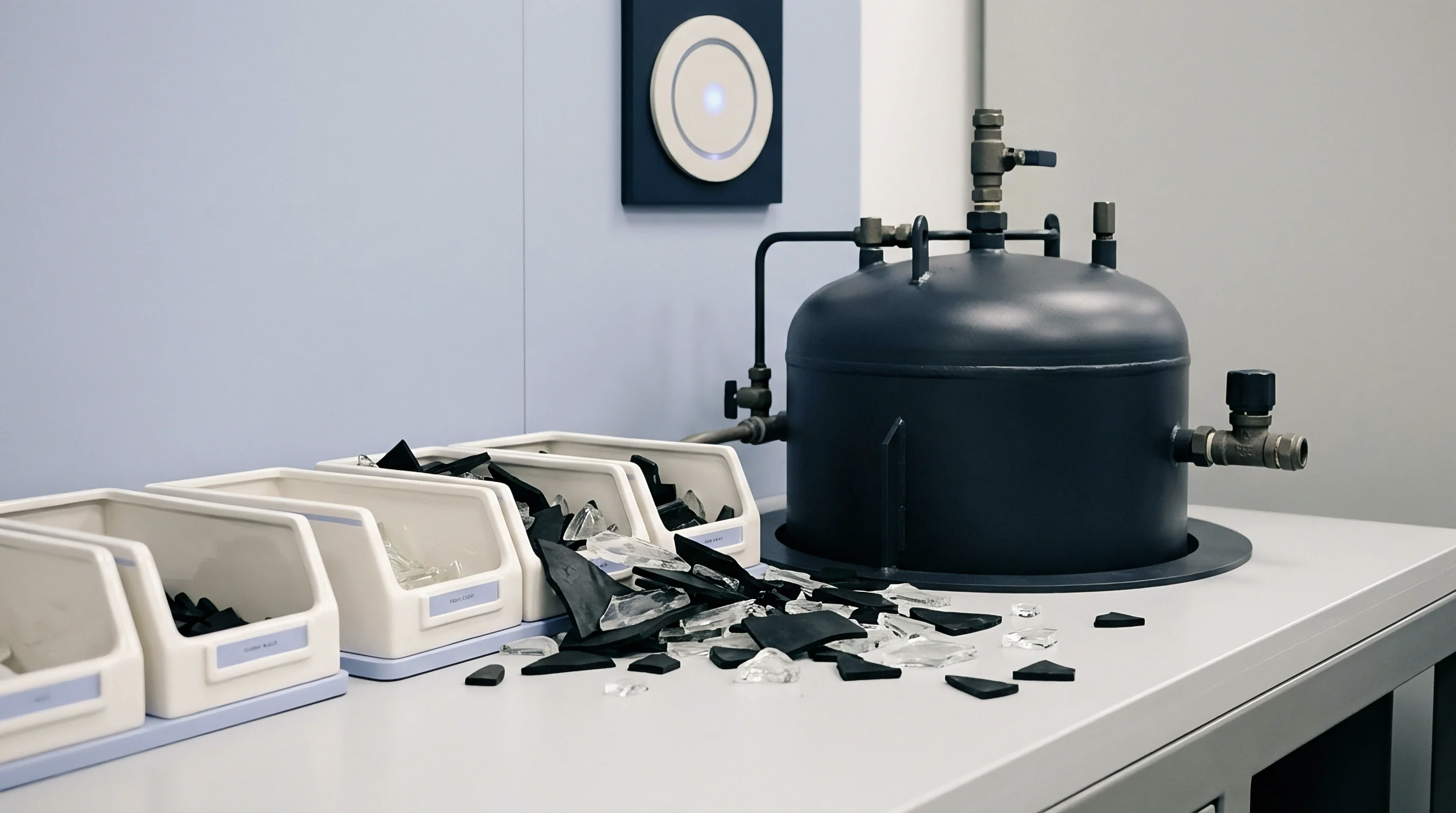
Extraction Strategies for Volatile Contaminants
Direct thermal desorption releases low molecular weight species from ground pellets without matrix solubilization. Heating resin granules between one hundred and one hundred eighty degrees Celsius drives volatile organic compounds into an inert carrier gas stream for cryo-trapping. Recycling loops concentrate residual substances.
Higher temperatures risk in situ thermal degradation of hindered phenol antioxidants, generating synthetic artifacts like 2,6-di-tert-butyl-p-benzoquinone. Dynamic headspace sweep-and-trap configurations handle larger sample masses up to five grams, lowering analytical detection thresholds to sub-parts-per-billion levels in the solid resin phase.
- Cryogenically mill five grams of post-consumer pellet stock under liquid nitrogen to achieve a particle size under five hundred micrometers.
- Weigh two hundred milligrams of milled polymer powder directly into a twenty-milliliter glass headspace vial and seal with a PTFE-lined silicone septum.
- Thermostat the vial at one hundred twenty degrees Celsius for forty-five minutes under continuous helium purging at fifty milliliters per minute.
- Trap purged volatiles on a Tenax TA adsorbent tube maintained at twenty degrees Celsius during the thermo-desorption cycle.
- Desorb the collection trap at two hundred eighty degrees Celsius directly onto the gas chromatography capillary column inlet using splitless injection.
Volatiles escape during high heating. Sample surface area controls desorption kinetics during thermal recovery phases. Coarse pellets trap internal migrants, returning artificially suppressed concentration numbers unless liquid nitrogen grinding precedes heating.

Solvent Selection and Matrix Swelling
Liquid extraction dissolves or swells the packaging resin to liberate semi-volatile and non-volatile migrants. Polar solvents swell polymer networks. Dichloromethane dissolves polyolefins at elevated temperatures but yields excessive matrix background during chromatographic separation.
Isopropanol and ethanol mixtures offer controlled swelling of high-density polyethylene, yielding cleaner extracts suitable for electrospray ionization. Polyethylene terephthalate requires dissolution in hexafluoroisopropanol or trifluoroacetic acid followed by solvent precipitation using acetonitrile to drop out high molecular weight oligomers.
Analytical detection limits for unknown migrants in recycled plastics depend directly on the sample surface-to-volume ratio during thermal extraction.
Microwave-assisted extraction accelerates solvent diffusion into the liquid phase while maintaining tight temperature limits. Extracting three grams of polyolefin flake with twenty milliliters of dichloromethane at seventy degrees Celsius for thirty minutes recovers high molecular weight degradation products, including oxidized Irgafos 168 fragments and fatty acid amides. Non-polar matrices hold target compounds.
Clean-up steps using solid-phase extraction cartridges remove bulk polymer wax, protecting sensitive high-resolution mass spectrometer source optics from premature fouling during long sequence runs. Which thermal desorption temperature range prevents polymer backbone cleavage while recovering legacy migrants across variable post-consumer streams?


Library
High-resolution mass spectrometry provides exact mass determinations for unidentified chromatographic peaks. Flight time and electrostatic trap instruments deliver mass accuracy within five parts per million, permitting the calculation of unambiguous empirical chemical formulas. Database searching matches measured isotopic patterns and collision-induced dissociation fragments against standardized compound spectra.
Spectral matching alone remains insufficient for full non-intentionally added substance characterization without confirmation against reference standard retention times.

Mass Accuracy and Elemental Composition
Accurate mass measurements constrain potential molecular formulas for unknown signals. High mass accuracy narrows possibilities. An accurate mass of m/z 219.1743 measured under positive electrospray ionization corresponds to protonated dibutyl phthalate with a mass error of 0.8 parts per million.
Quadrupole time-of-flight instruments maintain resolving power above thirty thousand full width at half maximum, resolving isobaric species that overlap on nominal mass benchtop detectors. Orbitrap analyzers yield resolution power. Ultra-high resolution exceeding one hundred thousand separates nitrogen-containing contaminants from hydrocarbon matrix peaks at identical nominal masses.
| Parameter | GC-QTOF | LC-QTOF | LC-Orbitrap |
|---|---|---|---|
| Ionization Source | Electron Ionization / Chemical Ionization | Electrospray Ionization (+/-) | Atmospheric Pressure Chemical Ionization |
| Mass Accuracy Range | 1.0 to 3.0 ppm | 0.8 to 2.0 ppm | 0.2 to 1.0 ppm |
| Resolving Power (FWHM) | 30,000 at m/z 272 | 40,000 at m/z 400 | 120,000 at m/z 200 |
| Dynamic Range | 104 | 105 | 106 |
| Primary Target Classes | Volatile NIAS, Solvents, Monomers | Polar Oligomers, Photoinitiators | Non-ionic Surfactants, Degradation Products |
| Data acquired under standard EN 13130 verification guidelines using certified surrogate calibration mixtures. | |||

Deconvolution in Complex Matrices
Co-eluting polymer additives generate overlapping mass spectra that defeat simple spectral matching algorithms. Mathematical deconvolution extracts clean compound spectra by grouping ion chromatograms that share precise retention time profiles and peak shapes. Unmatched spectra remain unclassified compounds.
Commercial and open-source spectral repositories contain thousands of plastic additives, printing ink components, adhesives, and known degradation products. Unmatched signals demand manual interpretation of tandem mass spectrometry fragmentation trees, tracking radical losses and ring cleavages to reconstruct parent molecular architectures.
Retention index matching adds a second physical dimension to gas chromatography spectral matching. Calculating Kovats retention indices using n-alkane series reduces false-positive identification rates by sixty percent compared to spectral matching alone.


Surrogate
Determining exact quantitative concentrations for non-targeted compounds presents analytical challenges because authentic reference standards do not exist for unidentified molecules. Laboratories assign semi-quantitative values by comparing the signal response of an unknown peak against the response of an added internal standard. Ionization efficiency varies across chemical structures by up to two orders of magnitude in liquid chromatography electrospray sources.
Quantitative reporting without structure-specific correction factors introduces substantial systematic error into risk evaluation files.

Response Factor Variability across Ionization Modes
Electron ionization in gas chromatography demonstrates relatively constant response factors across non-polar hydrophobic molecules. Response factors vary across detectors. Flame ionization detection yields mass-proportional responses for hydrocarbons, making it a reliable reference for semi-quantification of volatile polyolefin migrants.
Ion suppression alters peak areas. Electrospray ionization response depends on proton affinity, molecular surface area, and solution phase concentration, causing a tenfold variance in detector response between structural analogs.
- Ion Suppression Effects matrix co-elutriates reduce analyte ionization yield in liquid chromatography mass spectrometry.
- Structural Response Disparity surrogate calibration curves understate oxygenated degradation products while overstating simple alkyl aromatics.
- Evaporative Blowdown Loss volatility differences during sample concentration steps purge low molecular weight targets before injection.
- Adsorption on Glassware polar migrants adhere to sample preparation surfaces, diminishing final analytical recovery values.

Quantification Error Boundaries
Assessing health risk requires establishing maximum potential concentrations for identified migrants. Surrogate standards introduce systematic error. Applying a universal surrogate like toluene-d8 for gas chromatography or benzophenone-d5 for liquid chromatography creates an uncertainty band spanning twenty to five hundred percent of the true concentration value.
Applying conservative relative response factors prevents underestimating migrant concentrations during preliminary safety screening.
A specific migration limit of 0.01 milligrams per kilogram in simulant A requires an analytical screening detection threshold below 2.0 micrograms per kilogram in resin extracts.
Screening detection limits must sit below target toxicological thresholds to ensure safety compliance. When relative response factors vary wildly, analytical reports must state the specific surrogate compound assigned to each target zone alongside the calculated recovery confidence limits. Miscalculating migrant concentration by an order of magnitude leads directly to false compliance declarations, exposing brand owners to mandatory market withdrawals and customs seizures.


Tier
Evaluating unidentified or semi-quantified compounds relies on the Threshold of Toxicological Concern framework to establish safe intake levels based on chemical structure. Human exposure limits range from 1800 micrograms per person per day for low-toxicity substances down to 0.15 micrograms per person per day for potential DNA-reactive mutagens. Classifying an unknown migrant into a toxicological priority group requires identifying functional groups that signal genotoxic potential or organ toxicity.

Can Structural Isomers Bypass Standard Toxicity Screening?
Isomeric configurations dramatically alter biological activity and toxicological potency. Ortho-substituted phthalate esters display reproductive toxicity, whereas para-substituted terephthalates exhibit lower systemic toxicological concern. High-resolution mass spectrometry alone often cannot distinguish structural isomers sharing identical exact masses.
Chromatographic retention time alignment and ion mobility mass spectrometry separate stereoisomers and positional isomers, preventing incorrect hazard classification.
| Cramer Structural Class | Human Exposure Threshold | Max Food Migration Level | Required Analytical Sensitivity |
|---|---|---|---|
| Cramer Class I (Low) | 1800 µg/person/day | 3.0 mg/kg food | 100 ppb in extract |
| Cramer Class II (Intermediate) | 540 µg/person/day | 0.9 mg/kg food | 30 ppb in extract |
| Cramer Class III (High) | 90 µg/person/day | 0.15 mg/kg food | 5 ppb in extract |
| Genotoxic / Carcinogenic Alert | 0.15 µg/person/day | 0.0025 mg/kg food | 0.1 ppb in extract |

Cramer Classification in NIAS Evaluation
Assigning Cramer classes to semi-quantified non-intentionally added substances dictates the required analytical threshold sensitivity. Cramer Class III demands rigor. Structural alerts like aromatic amines, epoxides, hydrazine derivatives, and nitroso groups automatically place unknown compounds into the highest hazard tier, demanding verification down to ten parts per billion in food simulants.
Unidentified chromatographic peaks exceeding the genotoxic threshold of 0.15 micrograms per person per day must be treated as potential mutagens until structural elucidation proves otherwise.
- Alert Identification screening software flags reactive functional groups within candidate chemical structures automatically.
- Exposure Calculation daily intake models assume one kilogram of food contacts six square decimeters of packaging material daily.
- Tier Assignment compounds lacking explicit toxicity data default to Cramer Class III restrictions.
- Genotoxicity Testing Ames micro-plate assays confirm or refute mutagenic predictions derived from structural alerts.
Structural alerts signal potential mutagenicity. Converting screening data into toxicological clearance requires explicit agreement on worst-case consumption assumptions. PCR suppliers often state that non-targeted screening reports confirm safety down to ten parts per billion without providing the underlying response factor correction factors used to reach that conclusion.


Chain
Regulatory approval for post-consumer recycled plastics in food contact applications requires transparent traceability from feedstocks through decontamination processes to converter operations. In the European Union, Regulation 2022/1616 governs recycled plastic materials, requiring decontamination technologies to demonstrate contaminant reduction efficiencies through rigorous challenge testing. A non-targeted screening report forms a core pillar of the compliance dossier, proving that real-world recycling operations consistently achieve target clearance performance across variable raw input batches.

Challenge Test Data versus Lot Verification
Challenge tests evaluate decontamination machinery using intentional surrogate spikes like toluene, chlorobenzene, phenylcyclohexane, and benzophenone at high concentrations. Surrogate clearance factors established during technology authorization set baseline processing parameters like temperature, residence time, and vacuum pressure. Batch variation ruins standard clearance.
Commercial post-consumer input streams contain unpredictable industrial contaminants, cosmetic fragrances, and ink photoinitiators not covered in standard challenge test surrogates.
Supply agreements for post-consumer food contact resin specify batch-level non-targeted screening certificates covering volatile organic loads under standard EN 13130 testing.
Routine lot qualification relies on non-targeted screening to verify that operating parameters successfully clear non-standard impurities. Continuous screening of finished resin lots identifies emerging contaminants before material enters converting lines, closing the gap between static authorization credentials and dynamic feedstock reality.

Declaration of Conformity Dossier Deficits
Declarations of conformity frequently list compliance with main polymer regulations while omitting specific non-intentionally added substance evaluations. Declaration gaps expose raw buyers. A declaration claiming compliance with Regulation 10/2011 remains incomplete if supporting documentation lacks non-targeted screening evidence covering oligomer migration and degradation products.
Downstream converters assume legal liability for finished article safety when converting post-consumer resin into packaging containers.
- Decontamination Verification Reports documented surrogate removal percentages verified across pilot and full-scale runs.
- Input Feedstock Specifications quantified limits on non-food post-consumer plastic fraction in input bales.
- Batch Screening Data gas chromatography and liquid chromatography profiles for every fifty-tonne production lot.
- Toxicological Exposure Assessments expert evaluations for all detected non-intentionally added substances exceeding target screening limits.
Purchasing agreements must include explicit requirements for non-targeted screening documentation across every delivered resin shipment. Clause 8.2 of standard supply contracts assigns financial liability for converted batch scrap directly to the resin producer if non-targeted screening surfaces unlisted mutagenic substances above ten parts per billion upon destination customs inspection.

Levy
Commercial exposure linked to recycled content compliance extends beyond material replacement costs into national packaging tax penalties and customs entry refusals. The UK Plastic Packaging Tax charges £217.85 per tonne on finished packaging components containing less than thirty percent recycled plastic by mass, verified through rigorous technical audit trails. The European Union national plastics levy charges member states eight hundred euros per tonne on non-recycled plastic packaging waste, driving regional legislative mandates for higher recycled content incorporation across consumer brands.

Financial Exposure from Impurity Penalties
Incorporate contaminated post-consumer resin into food packaging and face immediate market recall costs, legal defense expenses, and brand erosion. Customs holds generate daily fees. Border inspection authorities sample imported finished packaging for non-compliant migrants, holding entire freight shipments in port storage pending analytical verification.
Failing non-targeted screening limits for restricted substances like primary aromatic amines or phthalates triggers immediate Rapid Alert System for Food and Feed notifications across European ports.
| Cost Component | Financial Metric / Base Rate | Risk Trigger | Commercial Impact |
|---|---|---|---|
| UK Plastic Packaging Tax | £217.85 per metric tonne | Failure to prove >30% PCR content | Direct tax assessment on full shipment mass |
| EU Plastics Levy Exposure | €800.00 per metric tonne | Rejection of PCR batch due to NIAS | Reclassification of material as virgin waste |
| Port Demurrage and Holding | €150.00 to €450.00 per day | Customs holding for GC-MS testing | Compounding storage charges at destination port |
| Batch Recall and Destruction | 100% of landed cargo value + fees | Detection of mutagenic NIAS >10 ppb | Total forfeiture of product value and disposal cost |

Landed Cost Calculation for Recycled Resin
Calculating landed cost for recycled polymer requires balancing raw material price discounts against compliance verification costs. A ten percent price discount on post-consumer polyethylene terephthalate disappears quickly if comprehensive high-resolution mass spectrometry screening costs three thousand euros per batch. Sourcing strategies balance analytical verification frequency against feedstock supplier reliability, establishing skip-batch testing protocols for long-term certified processing partners.
Quantifying total compliance cost ensures that incorporating recycled resin maintains net profit margins across global manufacturing footprints. Sourcing decisions balance regulatory compliance, analytical verification fees, and raw resin pricing against market access requirements.