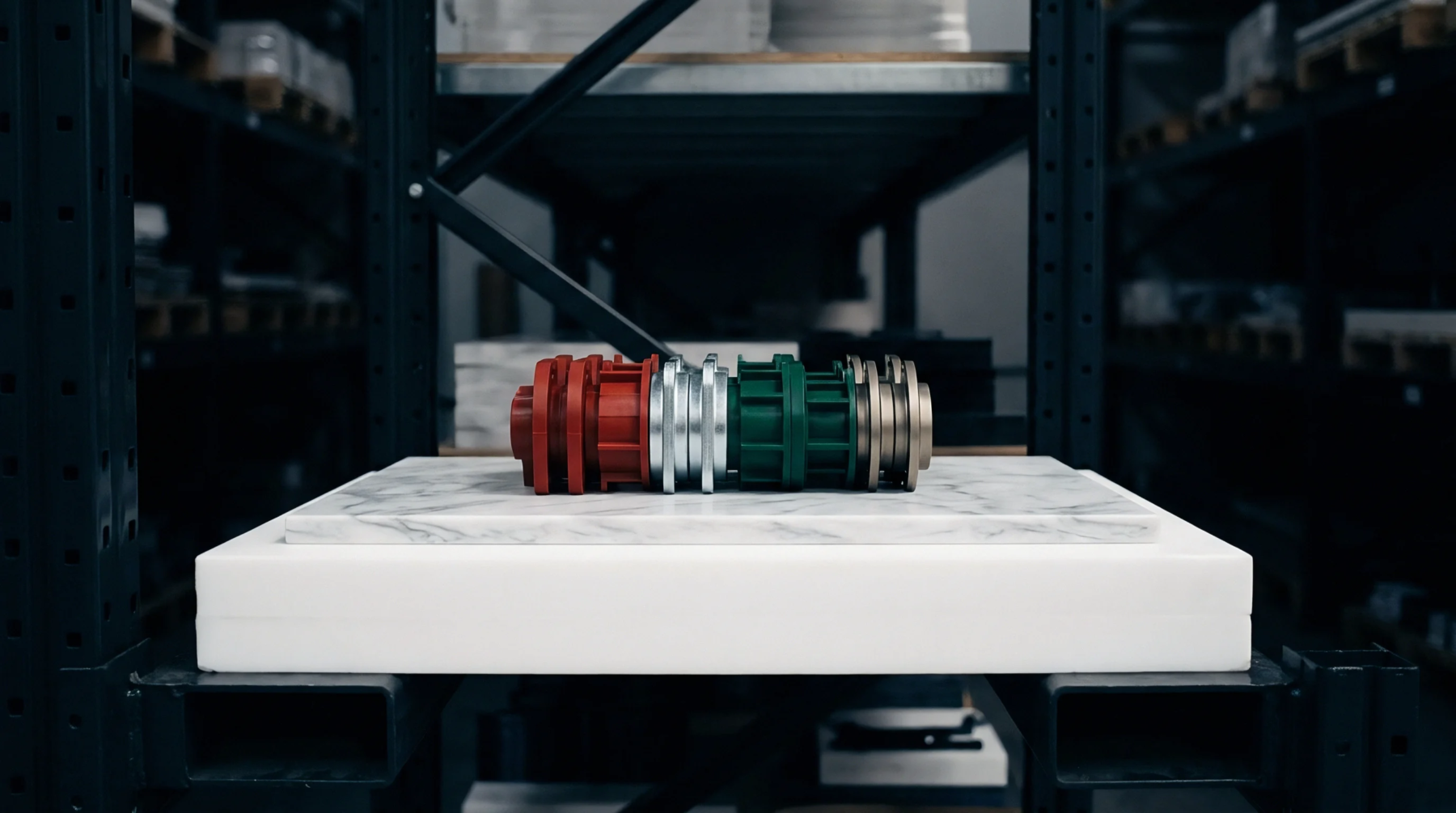
Electroformed Copper Inserts for Millimeter-Wave Tool Steel Tooling Assemblies
Electroformed copper inserts enable sub-30nm surface roughness and 35% faster cycle times in mmWave tooling when thermal expansion gaps are engineered.
Automotive sensing frequency bands require specialized polymer enclosures that maintain signal transparency while shielding internal electronics from environmental moisture and physical impact. An automotive 77 GHz radar sensor housing functions as a dielectric window where transmission efficiency depends directly on the relative permittivity and loss tangent of the resin. At this operational frequency of roughly seventy-seven gigahertz, electromagnetic wavelengths inside typical thermoplastics compress to less than two millimeters.
Wall thickness uniformity across the radome aperture must stay within tight decimal tolerances because phase distortion corrupts target angle detection. Polybutylene terephthalate, polycarbonate blends, and cyclo-olefin polymers are selected for low dissipation factors and minimal moisture uptake. The boundary of this application ends where conductive shielding covers the back of the module, shifting engineering constraints from microwave transmissivity to electromagnetic attenuation.
Dielectric transmission through a radome front plate requires uniform wall thickness down to fractions of a millimeter. When moulding enclosures for 77 GHz radar systems, deviations in wall thickness or localized density gradients from uneven cooling alter the electromagnetic phase front. Toolmakers calibrate the cavity thickness to match half-wavelength multiples in the target resin, balancing nominal transmission against structural rigidity.
Material suppliers specify dielectric constant values measured under dry conditions, yet real-world atmospheric exposure introduces absorbed moisture that raises signal attenuation. Regrind additions amplify this problem by introducing inconsistent molecular weights and degraded crystalline morphology that disperse the beam. Part specifications define strict limits on gate vestige height and parting line steps across the active sensing aperture to prevent refraction errors.
Moisture absorption alters the dielectric properties of common engineering thermoplastics during continuous road service. Unfilled polybutylene terephthalate retains a dielectric constant near three point one with a dissipation factor below zero point zero zero two across broad thermal cycles. Adding glass fibre reinforcement improves housing stiffness and dimensional stability around metal mounting brackets, yet random fibre orientation induces localized anisotropy in dielectric properties.
Hydrophobic grades prevent signal degradation in wet climates where surface water film accumulation attenuates the beam.
Volumetric shrinkage variation during the pack and hold stages induces differential sink marks that distort sensor calibration. Injection speeds must avoid shear-induced material degradation while maintaining rapid cavity filling before the thin aperture walls freeze. Tool cooling circuits require turbulent water flow to prevent thermal gradients across the core and cavity inserts.
Any drift in barrel temperature or holding pressure translates into phase distortion across the produced lot. Scrap rates escalate when process monitoring systems fail to detect slight variations in mould closure force or cavity pressure. Continuous cavity pressure feedback ensures that internal stress remains balanced across every operational shift.
Electroformed copper inserts enable sub-30nm surface roughness and 35% faster cycle times in mmWave tooling when thermal expansion gaps are engineered.
Expertise is a utility, not a secret. sentiention™ publishes its working knowledge as open reference: intelligence layer covering the materials it sources, the markets it enters, and the reference that serves both.