European Food Contact Polymer Migration Limit Determination
European food contact compliance requires validating overall and specific migration limits using designated simulants, geometric ratios, and traceable dossiers.

Bench
Analytical verification of plastic articles intended for contact with food inside the European Union operates under Commission Regulation (EU) 10/2011. Testing laboratories expose finished articles to prescribed liquid media under standardized thermal exposures to establish the mass transfer of synthetic constituents into alimentary matrices. The overall migration limit restricts inert transfer to 10 milligrams of total non-volatile migrant per square decimetre of food contact surface area, designated as 10 mg/dm², or 60 milligrams per kilogram of simulant in cases involving infant formulations or packaging volumes under 500 millilitres.
Specific migration limits govern individual toxicologically evaluated substances, ranging from 0.01 mg/kg for unlisted substances behind functional barriers to 30 mg/kg for plasticizers such as bis(2-ethylhexyl) adipate.
Execution of migration testing requires selecting food simulants that duplicate the chemical extraction properties of target food categories. Simulant A represents ethanol 10 percent by volume for aqueous commodities. Simulant B provides acetic acid 3 percent by weight for foodstuffs maintaining a pH below 4.5.
Simulant C introduces ethanol 20 percent for alcoholic products up to that concentration. Simulant D1 applies ethanol 50 percent for oil-in-water emulsions and higher alcohol volumes. Simulant D2 assigns rectified olive oil, or technical substitutes like vegetable oil triglycerides, isooctane, and 95 percent aqueous ethanol, to lipophilic environments carrying free surface fats.
Simulant E utilizes poly(2,6-diphenyl-p-phenylene oxide), known commercially as Tenax, to examine dry food contact with high sorption affinity.
A measured migration value lacks regulatory standing unless accompanied by its assigned simulant, test duration, exposure temperature, and the surface area to volume ratio applied during contact.
Time and temperature contact parameters replicate the most severe foreseeable commercial conditions of processing and shelf storage. Standard conditions designated as OM2 specify ten days at 40 degrees Celsius, covering any long-term storage at ambient or chilled temperatures, including hot-fill operations up to 70 degrees Celsius or heating up to 100 degrees Celsius for 15 minutes. High-heat applications invoke OM5, prescribing two hours at 100 degrees Celsius or reflux conditions, representing contact up to 121 degrees Celsius during thermal sterilization.
The analytical chemist measures gravimetric residues following total solvent evaporation for overall migration, while employing gas chromatography-mass spectrometry or liquid chromatography-triple quadrupole mass spectrometry to quantify target specific migrants against their reference calibration standards.
Importers encounter severe customs disruptions when test reports substitute generic chemical extractions for designated food simulants. National border inspectorships across member states reject declarations grounded in unqualified solvent extraction protocols, holding commercial shipments at ports of entry while re-testing is commissioned at authorized reference laboratories.


Partition
Mass transfer kinetics govern the progression of polymer additives, catalytic fragments, and low-molecular-weight oligomers from the bulk packaging wall across the phase interface. Diffusion inside the solid polymer matrix dictates migrant movement according to Fickian mechanics, where the diffusion coefficient depends on migrant molar mass, molecular cross-sectional volume, polymer glass transition temperature, and matrix morphology. Crystalline domains in semi-crystalline resins such as high-density polyethylene and isotactic polypropylene restrict molecular passage, forcing migrant diffusion through amorphous channels.
In glassy polymers like polyethylene terephthalate, low chain mobility limits diffusion rates at room temperature, while flexible polyolefin matrices allow rapid interstitial diffusion of plasticizers, slip additives like erucamide, and primary antioxidants such as octadecyl 3-(3,5-di-tert-butyl-4-hydroxyphenyl)propionate.
Thermodynamic partitioning between the polymer matrix and the food simulant defines migrant equilibrium concentration. The partition coefficient determines whether an additive remains trapped within the polymer bulk or concentrates into lipophilic simulants. High partition values toward fatty simulants cause pronounced migration spikes of hydrophobic slip compounds and ultraviolet stabilizers into vegetable oil or isooctane.
Sorption of the food simulant into the polymer alters these mechanics. Non-polar solvents cause polyolefin swelling, lowering the local glass transition temperature and accelerating internal diffusion constants by several orders of magnitude during prolonged exposure periods.

Modelling Transport Dynamics
Predictive migration estimation applies mathematically verified diffusion models recognized under European Union validation protocols. Piringer approach equations utilize relative molecular mass and polymer-specific parameters to calculate conservative upper limits for migrant transfer, bypassing bench contact trials when estimated figures fall safely below regulatory cut-offs.
Calculation of specific migration through numerical integration models uses the standardized formula:
M = C0 p dp Ap
The variable M represents migrant mass transferred per surface area, C0 defines initial substance concentration in the polymer, p denotes polymer density, dp indicates package thickness, Ap corresponds to contact surface area, D represents the diffusion coefficient, and t is contact duration. The European Union accepts recognized diffusion calculation models as screening tools to demonstrate compliance, provided the mathematical assumptions overestimate migration relative to physical test results.
| Polymer Matrix | Reference migrant | Molecular Mass (Da) | Diffusion Coefficient at 40°C (cm²/s) | Simulant D2 Partition (Kp/s) | OM2 Measured Migration (mg/kg) |
|---|---|---|---|---|---|
| Low-Density Polyethylene | Butylated hydroxytoluene | 220.35 | 2.4 x 10^-9 | 0.08 | 4.2 |
| High-Density Polyethylene | Irganox 1076 | 530.86 | 6.1 x 10^-11 | 0.15 | 1.8 |
| Polypropylene Homopolymer | Erucamide | 337.58 | 4.8 x 10^-10 | 0.04 | 5.6 |
| Polyethylene Terephthalate | Antimony trioxide | 291.52 | 1.2 x 10^-15 | 12.50 | 0.02 |
| Polystyrene | Styrene monomer | 104.15 | 8.5 x 10^-12 | 0.32 | 0.14 |
| Data measured under standard condition OM2 (10 days at 40 degrees Celsius) utilizing verified liquid chromatography-mass spectrometry detection methods. | |||||
Discrepancies arise when measuring migrants with high chemical affinity for aqueous matrices compared to lipophilic fatty food simulants. Hydrophilic components migrate rapidly into Simulant B while remaining completely stable under Simulant D2 conditions. Analytical laboratories evaluate matrix integrity to confirm whether acidic hydrolysis generates secondary decomposition products during the test cycle.
Plastic component suppliers often explain elevated laboratory migration figures as an unavoidable consequence of excessive solvent swelling rather than true product non-compliance.

Screening
Non-intentionally added substances, designated as NIAS, constitute an analytical challenge in food contact compliance. These compounds encompass reaction by-products, thermal breakdown variants, oligomeric fractions, and raw material impurities that do not appear on commercial masterbatch formulation sheets. Article 19 of Regulation (EU) 10/2011 assigns responsibility for risk assessment of these unlisted components directly to downstream operators placing the packaging into service.
Unknown compounds require separation and identification down to toxicologically relevant thresholds before an article enters production lines.
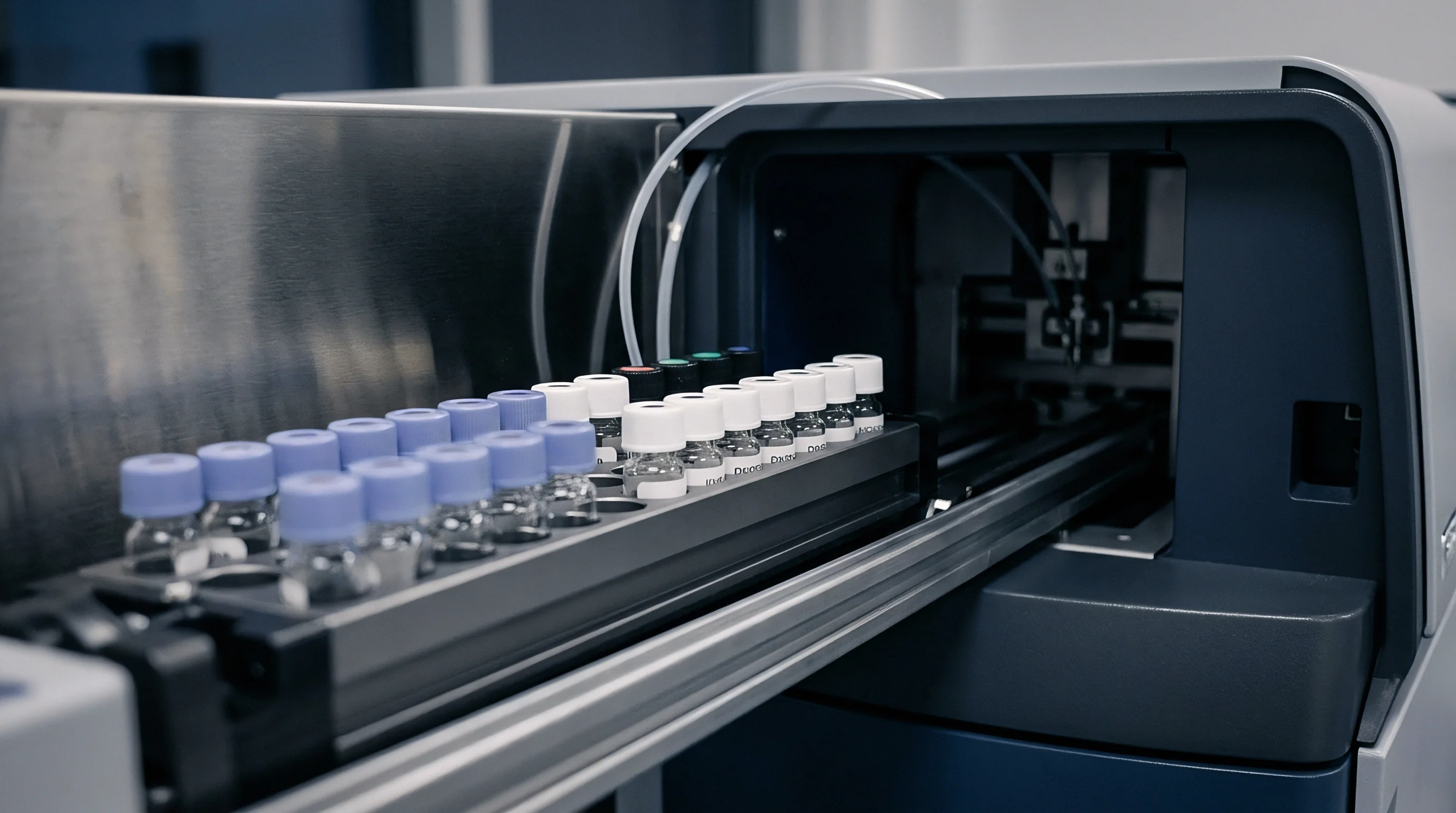
Gas chromatography paired with high-resolution time-of-flight mass spectrometry screens volatile and semi-volatile migrants, while ultra-high-performance liquid chromatography coupled to electrospray ionization quadrupole time-of-flight mass spectrometry profiles non-volatile species. Unknown chromatographic peaks undergo structural elucidation through accurate mass fragmentation patterns, isotopic abundance ratios, and comparison against spectral databases. Detected compounds lacking specific toxicology files are evaluated under the Threshold of Toxicological Concern concept.
Substances falling under Cramer Class I permit an exposure threshold of 1800 micrograms per person per day, Class II permits 540 micrograms, and Class III permits 90 micrograms. Compounds containing genotoxic alerts such as structural diazo, nitroso, or epoxide groups operate under an absolute safety threshold of 0.15 micrograms per person per day, equivalent to a specific migration concentration of 0.00001 mg/kg.
A chromatography report confirming the absence of target substances guarantees compliance only within the stated limits of analytical quantification.

Identification Sequences for Unlisted Substances
Screening workflows require systematic fractionation to prevent complex chemical noise from obscuring dangerous degradation traces. Evaluation of non-target chemical components follows a defined sequence across test batches.
- Solvent Extraction Profiling isolates volatile components using low-temperature dichloromethane head-space collection to avoid thermal artifact generation.
- High-Resolution Mass Deconvolution separates co-eluting chemical entities based on accurate mass retention measurements within a 5 parts per million tolerance window.
- Cramer Classification Assignment maps identified molecular formulas against chemical structural libraries to establish preliminary toxicological exposure boundaries.
- Toxicological Exposure Evaluation converts chromatographic concentration estimates into daily dietary intakes based on standardized consumption assumptions.
Analytical quantification limits heavily influence screening conclusions. Screening runs operating with high limits of detection often fail to register genotoxic degradation fragments present at low levels. Laboratories verify baseline noise levels before asserting the absence of unlisted contaminants.
Future guidelines may mandate universal quantitative thresholds for cyclic polyolefin oligomers currently migrating into lipid food phases without established individual safety limits.


Clamp
Physical execution of migration tests requires secure clamping of materials within specialized migration cells to isolate the active food-contact face. Double-sided exposure yields incorrect analytical data whenever an exterior layer carries functional coatings, printing inks, or surface lubricants never formulated for dietary contact. Single-sided migration cells, constructed from electropolished stainless steel and fluoropolymer sealing gaskets, clamp the test specimen under uniform mechanical tension.
The fluid reservoir exposes a certified surface area, typically one or two square decimetres, directly to the selected simulant while isolating the exterior face entirely from chemical leaching.
Torque applied to cell fasteners dictates gasket integrity and edge leakage rates. Insufficient clamping pressure allows volatile simulants like isooctane to escape at elevated temperatures, concentrating non-volatile migrants and artificially inflating measured specific migration values. Excessive torque deforms the plastic substrate, crushing the polymeric barrier, creating microscopic surface fractures, and exposing internal layers containing masterbatch carrier resins or internal processing aids.

Are Single-Sided Migration Cells Mandatory for Multilayer Structures?
Total immersion of multilayer structures in liquid simulants invalidates test results. Cut edges expose the internal polymer core, tie layers, barrier adhesives, and structural supports directly to the extraction solvent. In co-extruded films containing ethylene vinyl alcohol copolymers or modified polyurethane adhesives, cross-sectional contact causes solvent wicking, swelling the polar barrier core and leaching adhesive components that remain sealed during normal use.
Single-sided cell clamping is required to ensure that extraction occurs through the inner sealing layer.
For rigid containers, bottles, and thermoformed tubs, real-article contact testing provides a direct alternative to cell clamping. The technician fills the container to its operational fill volume with pre-heated simulant, securing an inert glass or fluoropolymer plate over the opening to halt evaporation. This configuration measures migration under real surface-to-volume conditions, removing mathematical extrapolation errors inherent to flat-sheet test cells.
Repeated-use articles, including kitchen utensils, processing equipment, and conveyor belting, follow distinct analytical rules. Article 21 of Regulation (EU) 10/2011 states that repeated-use articles undergo migration testing across three successive exposures using fresh simulant for each cycle. Compliance hinges on the analytical result recorded in the third test cycle.
Migration levels must not rise from the first to the third exposure, because an increasing trend indicates progressive polymer matrix breakdown or active surface degradation.
A supplier contract clause specifying testing under single-sided cell parameters protects the converter from liability disputes arising from cut-edge solvent wicking.


Ratio
Converting bench migration figures into statutory compliance ratings requires evaluating geometric packaging proportions. Specific migration results expressed as milligrams of migrant per kilogram of food simulant assume a conventional cubic package geometry holding one kilogram of food packed within a contact area of six square decimetres, establishing a reference surface-to-volume ratio of 6 dm²/kg. Real commercial packaging rarely matches this baseline profile.
Small containers, single-serve blister packs, and elongated narrow tubes present much higher surface-to-volume ratios, concentrating identical chemical migration across a reduced volume of food.
Article 17 of Regulation (EU) 10/2011 governs the application of surface-to-volume conversion calculations. For containers with holding capacities below 500 millilitres or exceeding 10 litres, migration figures must be established on the basis of the actual contact surface area to the actual volume of food enclosed. Testing small articles without applying this geometric correction yields inaccurate results, passing packages that fail real-world concentration limits once packed on automated filling lines.
Worked Evaluation for Single-Serve Packaging
Consider an injection-moulded polypropylene sauce cup with an operational volume of 30 millilitres and an internal contact area of 0.45 square decimetres. The packaging contains 0.05 percent by weight of an antioxidant possessing a specific migration limit of 0.3 mg/kg. Laboratory bench testing conducted in a flat migration cell exposes 1.0 dm² of material to 100 millilitres of Simulant D1 for ten days at 40 degrees Celsius, yielding an analytical extraction of 0.035 mg/dm².
Direct application of the conventional European 6 dm²/kg conversion factor calculates an apparent migration level:
Migration (standard) = 0.035 mg/dm² 6 dm²/kg = 0.21 mg/kg
This calculated value rests below the 0.3 mg/kg statutory restriction, indicating a passing result. Applying the true geometric ratio of the production container changes the compliance status completely:
Surface-to-volume ratio = 0.45 dm² / 0.030 kg = 15.0 dm²/kg
Migration (actual) = 0.035 mg/dm² 15.0 dm²/kg = 0.525 mg/kg
The actual migration level exceeds the specific migration limit by 75 percent, turning a seemingly compliant flat-sheet test result into a regulatory violation when filled with product. Failure to account for high surface-to-volume ratios in small packaging formats exposes commercial brands to regulatory penalties and product recalls.
| Container Format | Volume (L) | Surface Area (dm²) | Real Ratio (dm²/kg) | Bench Result (mg/dm²) | Real Migration (mg/kg) | Regulatory Action |
|---|---|---|---|---|---|---|
| Single-serve condiment cup | 0.025 | 0.42 | 16.8 | 0.04 | 0.67 | Exceeds 0.6 mg/kg SML |
| Yogurt cup | 0.125 | 1.25 | 10.0 | 0.04 | 0.40 | Complies with 0.6 mg/kg SML |
| Standard soup tub | 0.500 | 3.50 | 7.0 | 0.04 | 0.28 | Complies with 0.6 mg/kg SML |
| Catering oil jug | 5.000 | 18.00 | 3.6 | 0.04 | 0.14 | Complies with 0.6 mg/kg SML |
| Bulk storage vessel | 25.000 | 55.00 | 2.2 | 0.04 | 0.09 | Complies with 0.6 mg/kg SML |
The Fat Consumption Reduction Factor offers relief for lipophilic migrants dissolving into fatty products. Regulation (EU) 10/2011 Annex III Table 2 permits dividing measured migration in Simulant D2 by a correction factor between 2 and 5 for specific high-fat foods, reflecting real human dietary consumption limits. The analytical chemist verifies whether the migrant is authorized for fat consumption correction before applying reduction factors to borderline test results.
When packaging geometry changes on a production line, the compliance calculation changes with it.


Trace
Paperwork compliance rests on the Declaration of Conformity issued along the supply chain. Article 16 of Regulation (EC) 1935/2004, detailed through Annex IV of Regulation (EU) 10/2011, requires operators to issue written statements confirming that plastic materials, intermediates, and finished articles comply with relevant food contact rules. This declaration functions as a legal assertion that the manufacturing operations adhere to Good Manufacturing Practice under Regulation (EC) 2023/2006, supported by verifiable analytical dossiers held ready for official inspection.
A Declaration of Conformity must clearly state what it covers and identify any elements excluded from testing. Declarations provided by masterbatch producers often cover only the base additive, omitting carrier resin impurities or degradation by-products formed during downstream extrusion. Converters who issue finished product declarations based on raw material certificates without verifying additive interactions create serious compliance gaps.
A Declaration of Conformity that omits the identity of dual-use additives or restricted specific migration limits shifts legal liability onto downstream operators.

Critical Conformity Dossier Elements
Enforcement inspectors audit supporting documentation to confirm that written declarations match actual resin chemistries and process conditions.
- Identity of Dual-Use Additives includes authorized food ingredients and enzymes present in the packaging that migrate into foodstuffs without breaching European food additive limits.
- Adequate Information on Restricted Substances details identity markers, chemical abstracts numbers, and defined specific migration limits for authorized components.
- Functional Barrier Declarations confirm that non-authorized substances behind an impermeable barrier do not undergo analytical detection above 0.01 mg/kg.
- Manufacturing Batch Traceability Records link specific production lots to representative laboratory migration test reports and material bills of lading.
Audit discoveries of invalid declarations trigger commercial and legal consequences across European distribution chains. When national enforcement authorities discover non-compliant articles, withdrawal notices publish through the Rapid Alert System for Food and Feed, forcing retail recalls, customs impoundments, and financial penalties across cross-border trade networks.
Contract terms requiring suppliers to maintain and present complete analytical testing dossiers on demand prevent costly customs disputes when border authorities request documentary proof.