Visual Screening Methods for Thermoplastic Pellet Quality
Visual pellet screening combines sieve sizing with optical inspection to catch geometric anomalies and thermal char before resin reaches the extruder hopper.


Geometry
Pellet size distribution directly governs feeding stability in single-screw and twin-screw extruders. Standard commercial pellets produced via underwater, strand, or water-ring pelletization exhibit distinct target geometries ranging from spherical to cylindrical cuts. Physical dimensions typically span two to four millimeters in length and diameter.
Variations outside these parameters disrupt mass transfer rates from feed hoppers into screw channels.
Strand-cut processing frequently generates non-uniform length profiles when knife cutter speeds drift relative to strand extrusion velocity. Long pellets, commonly referred to as tails or stringers, exceed six millimeters in length. Oversized cuts bridge feed throats, while delicate filaments known as angel hair tangle inside pneumatic conveying lines.
Defects alter bulk density. Underwater pelletization reduces tail formation but produces lens-shaped or doublet pellets when strand cooling water temperatures drop below freezing points of specific polymer grades.
Mechanical sieving per ISO 3310-1 isolates dimensional fractions across calibrated woven wire mesh screens. Precision measurement quantifies length-to-diameter aspect ratios. Standard virgin polyolefins maintain aspect ratios between 0.8 and 1.2.
Ratios above 1.5 indicate knife wear or cutter blade misalignment during hot-face pelletizing. Fine particles measuring under 500 microns arise from brittle strand fracturing or mechanical attrition during railcar unloading operations.
Recycled thermoplastic compounds present wider dimensional spreads than virgin streams. Post-industrial regrind pellets often retain irregular facets and variable cut lengths caused by unsteady melt pressure at die plates. Stringers cause feed throat bridging.
Screening schedules for reprocessed resin measure both maximum pellet dimensions and fine particle concentrations per kilogram sample.
A pellet length deviation exceeding two millimeters over nominal dimensions alters hopper bulk density by four percent under steady feed pressure.
Bulk density shifts directly modify volumetric feed throat intake. When variable pellet lengths fill screw flights unevenly, solid conveying zones experience bulk density variations that produce downstream pressure oscillations at the die face. A feed stream containing a broad spread of pellet dimensions produces pressure fluctuations before any thermal gradient forms in the barrel.

Optics
Discoloration and embedded particulate contaminants reveal oxidative history during previous thermal processing. Visual defect characterization categorizes optical anomalies by color, transparency, spatial location within the pellet body, and light-scattering behavior under illuminated inspection screens.
Thermal char and carbonized polymer fragments form inside dead zones of compounding barrels, screen changers, and adapter pipes. These black specks range from 50 to 500 microns in size. Char particles clog nozzle tips.
Discolored streaks signal localized antioxidant depletion during high-shear melt processing. Yellowness Index testing via ASTM E313 quantifies overall thermal exposure, comparing specimen reflectances against standard white tile references.
Cross-contamination introduces foreign polymer species or mismatched color masterbatch pellets into clean virgin lots. Opaque black pellets within translucent natural polyethylene signals unwashed material hoppers during product grade changes. Gels arise as cross-linked polymer networks that resist melting during subsequent extrusion passes.
Gels create optical haze. Trapped moisture or volatile organic compounds generate internal voids and bubbles, lowering individual pellet mass.
| Defect Class | Physical Appearance | Measurement Standard | Underlying Cause | Downstream Process Effect |
|---|---|---|---|---|
| Black Specks | Opaque carbonized specks | ISO 2470 / ASTM D7394 | Degraded polymer char | Nozzle clogging and stress points |
| Yellowing Streaks | Brownish resin discolouration | ASTM E313 / ISO 17223 | Thermal oxidation | Reduced mechanical strength |
| Cross-Contaminants | Off-color or wrong pellet types | ISO 1043 visual check | Hopper wash failure | Melt incompatibility and voids |
| Gels and Fisheyes | Translucent spherical inclusions | ASTM D3596 | High molecular weight crosslinks | Surface blemishes in thin film |
| Internal Voids | Gaseous central bubbles | ISO 1183 displacement | Moisture or volatilization | Bulk density reduction and venting |
Color consistency between resin production lots relies on standardized CIELAB color coordinate measurements under D65 illuminant conditions. Delta E color variation values exceeding 1.0 indicate noticeable batch-to-batch shade drift. Producers routinely defend minor carbonized inclusions as unavoidable ambient airborne particulates generated during bag-filling ops.

Apparatus
Automated bench inspection replaces subjective manual trays with quantitative high-resolution image analysis. Static manual light tables illuminated by diffuse fluorescent or high-CRI LED sources allow inspectors to examine 100-gram tray samples. Human visual screening catches gross contamination but lacks statistical repeatability across multi-ton resin orders.
How Do Feed Rates Impact Camera Resolution Limits?
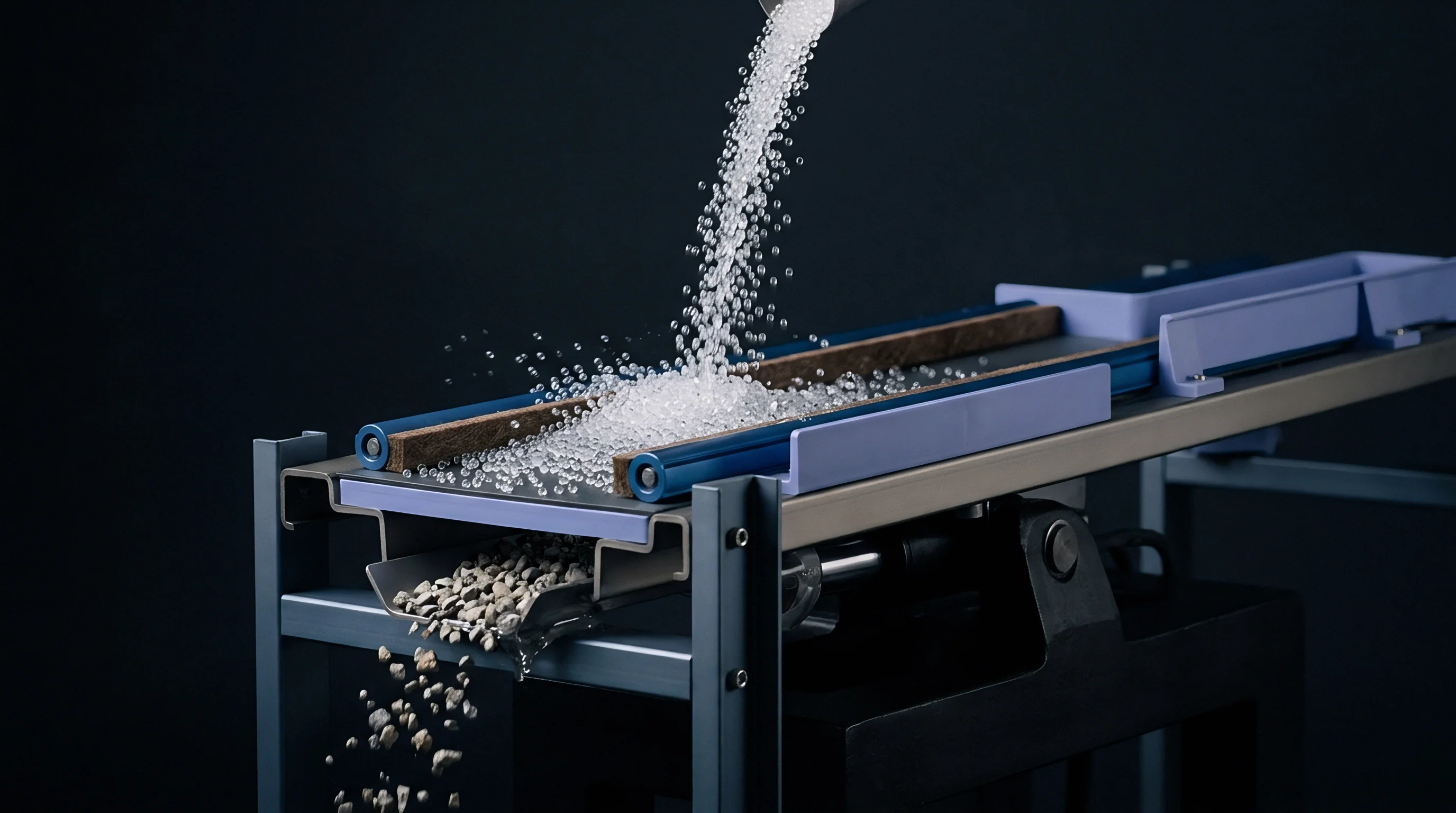
Linear feed velocity directly dictates sensor integration time and spatial resolution limits in high-speed optical sorters. Vibratory feeders spread pellets into continuous single-layer streams conveyed down inclined chutes or flat optical belts. High-resolution monochrome or three-channel RGB line-scan cameras capture imagery across the moving belt plane at line rates up to 80 kHz.
Camera resolution choices determine minimum detectable defect limits. A optical system configured with 50 microns per pixel spatial resolution identifies 100-micron black specks with sufficient pixel contrast for reliable software triggering. Increasing feed chute velocity elevates mass throughput but shortens camera exposure windows, requiring higher intensity illumination arrays to prevent image blur.
Illumination hardware utilizes targeted spectral bands to isolate specific defect categories. Backlighting configurations generate high contrast perimeter images for accurate pellet perimeter measuring and long tail detection. Frontlit diffuse LED arrays expose surface blemishes, char specks, and external color variations.
Polarized illumination reveals internal stress birefringence and encapsulated gel structures within transparent polycarbonate, acrylic, and amorphous polyester resins. Optical sorting isolates contaminated lots.
Cross-contamination with higher-melting polymers creates unmelted stress raisers in thin-wall injection moldings.
Near-infrared spectroscopic camera units extend visual screening capability by determining chemical polymer identity inline. Near-infrared arrays detect foreign resin types mixed into virgin polyolefin streams, identifying high-density polyethylene pellets intermixed with polypropylene lots based on characteristic absorption bands at specific wavelengths.
| Screening Technology | Detection Limit | Mass Throughput | Primary Defect Focus | Operational Limitation |
|---|---|---|---|---|
| Manual Light Box | 300 microns | 2 kg/h | Gross char and discolouration | Operator fatigue and subjectivity |
| Flatbed Scanner | 25 microns | 0.5 kg/h | Gel counts and micro-specks | Offline sample batch limits |
| Dynamic Chute Sorter | 100 microns | 1,500 kg/h | Surface char and cross-mixing | Pellet tumbling hides underside defects |
| Dynamic Belt Sorter | 50 microns | 3,000 kg/h | Geometry anomalies and specks | Higher capital investment footprint |
| Performance metrics based on standard polyolefin pellets running under optimal LED lighting configurations. | ||||
Dynamic sorters process high container volumes. Operating an optical sorter above its calibrated mass throughput conceals micro-contaminants that later cause melt filter clogging and costly production line halts.

Sampling
Representative lot evaluation depends on pulling uniform material from multiple container depths. Heterogeneous defect distribution makes single-point surface collection unreliable for determining overall lot quality. Sieve tests separate oversized pellet cuts.
Statistical acceptance protocols conform to ISO 2859-1 standards, defining sampling plans indexed by Acceptable Quality Limit levels. Critical visual defects including metal fragments or foreign resin contamination carry strict acceptance thresholds. Major defects including severe char and excessive long tails operate under higher acceptable quality percentages.
Minor geometric irregularities retain the widest acceptance bands.
Sampling gaylords, octabins, and bulk bags requires multi-zone core extraction. Slotted stainless steel sampling probes, known as thief samplers, isolate polymer from top, middle, and bottom depths. Thief samplers pull deep core specimens.
Pneumatic inline samplers divert full-stream cross-section cuts during silo loading or railcar unloading operations at designated time intervals.
- Verify container seals and document lot numbers against incoming transport bills of lading.
- Insert a stainless steel slotted thief probe diagonally to the bottom container corner.
- Rotate the probe handle to open sample slots and collect material across the entire depth column.
- Close slots, extract the tube, and discharge pellets into a clean stainless steel container.
- Repeat extraction across five designated points on the container surface grid.
- Blend point samples in a rotary sample divider to yield a homogeneous one-kilogram laboratory sample.
| Defect Category | Specific Visual Attribute | Inspection Level | Critical AQL Threshold | Action on Non-Conformance |
|---|---|---|---|---|
| Critical Defect | Metal shards or foreign polymer | Level II Normal | 0.01 percent | Immediate lot rejection |
| Major Defect | Black specks over 200 microns | Level II Normal | 0.10 percent | Quarantine and re-screening |
| Major Defect | Tails exceeding double nominal length | Level I Reduced | 0.65 percent | Vendor claim and price adjustment |
| Minor Defect | Color variation within Delta E 1.5 | Level I Reduced | 2.50 percent | Blend authorization for non-critical parts |
ISO 2859-1 sampling plans mandate lot rejection when black speck counts exceed five particles per hundred grams of transparent resin.
Collected primary samples pass through rotary mechanical splitters to generate representative sub-samples for laboratory image analysis. Sample reduction maintains exact proportions of fines and oversized cuts present in the original bulk shipment. Incorporating ISO 2859-1 Level II normal inspection limits directly into purchase agreements legally shifts the burden of return freight costs onto the vendor whenever visual reject thresholds are breached.
Degradation
Visual anomalies frequently mirror structural changes inside the polymer matrix. Thermal oxidation during compounding generates conjugated double bonds and carbonyl groups that absorb blue light, causing resin yellowing. Polymer chain scission lowers average molecular weight, increasing melt flow rate while impairing mechanical strength.
Solid conveying behavior in processing equipment depends on predictable friction coefficients and uniform pellet packing. Fine dust reduces melt stability. Excessive fine particles sift through larger pellets, accumulating along barrel walls in feed throat regions.
Unmelted gel cores fracture under load. Fine dust increases local bulk density unpredictable, altering mass transport through feed zones and inducing screw slip. Color drift signals thermal degradation.
Unsteady screw filling produces melt pressure spikes and thermal variation at die exits.
Calculate volumetric feed throat variation using a typical 25-tonne polypropylene shipment. Nominal pellets exhibit a 0.54 g/cm³ bulk density with zero fines. A sub-standard shipment contains 6 percent fines under 500 microns alongside 3 percent oversized stringers, shifting bulk density down to 0.49 g/cm³.
An extruder running at a fixed 450 kg/h volumetric rate experiences a intake drop down to 408.3 kg/h, incurring a 41.7 kg/h throughput loss and generating a 14 percent pressure variance at the die face.
- Critical contaminant isolation segregates lots exhibiting metal particles or foreign polymers to prevent machine damage.
- Fines concentration logging triggers immediate sieve cleaning when fine content surpasses one half percent by weight.
- Color deviation assessment requires yellowness index testing before approving thermoforming grade resin.
- Gelling threshold verification halts film-grade processing if gel counts exceed twenty particles per hundred grams.
Embedded black specks and degraded char particles act as localized stress concentration sites in molded products. Under mechanical load, micro-cracks initiate at char interfaces, converting ductile failure modes into premature brittle fractures during tensile or impact testing.
Fines accumulated at the bottom of gaylords indicate severe strand shattering during die-face pelletization.
- Nozzle orifice clogging stems from severe carbonized char particles blocking small runner channels.
- Tensile impact drop occurs when embedded black specks create localized mechanical stress raisers.
- Blown film bubble instability originates from unmelted high-density gels puncturing thin web membranes.
- Barrel feed throat bridging follows high concentrations of interlocking pellet stringers and tails.
Cross-linked gels fail to melt inside standard extruder barrels. Film blowing processes running gel-contaminated resin experience localized wall thinning, optical haze, and bubble blowouts. Whether inline dynamic visual inspection during compounding can completely eliminate off-spec visual lots before shipping remains an unresolved question for resin manufacturers.

Settlement
Financial recovery for non-conforming shipments requires documented photographic evidence and standardized defect counts. Visual inspection data generated during incoming quality audits forms the legal basis for commercial supplier claims and lot rejections.
Off-spec lots face quarantine upon arrival at processing facilities. Reject claims contain high-resolution optical sorter scans, sieve fraction mass balances, and certified lab analysis reports detailing defect counts per kilogram sample. Visual data drives lot disposition.
Discolored resin reduces part yield.
Re-screening allowances reimburse processors for running rejected material through third-party optical sorters to isolate clean pellets. Industrial re-screening costs range from 150 to 350 dollars per tonne based on defect severity and throughput limits. Resin downgraded from prime to utility grade incurs price reductions ranging from 200 to 500 dollars per tonne depending on market demand.
Commercial agreements resolve fastest when backed by high-resolution visual evidence, verified defect counts per kilogram, and clear contract re-screening price tiers.