Rubber Morphology Control across High Pressure Injection Molded Logistics Containers
Controlling elastomeric domain dispersion and shear-induced phase morphology prevents sub-zero impact failure in high-pressure injection molded logistics crates.


Droplet
Microstructural control over the elastomeric disperse phase determines whether a high-pressure injection molded logistics crate survives cold storage handling or shatters upon drop impact. In high-density polyethylene and impact copolymer polypropylene formulations, the dispersed rubber phase acts as a localized stress concentrator, initiating plastic shear banding and craze termination before brittle micro-cracks propagate through the semi-crystalline matrix.

Rubber Phase Dispersion Mechanics
Polyolefin impact copolymers rely on elastomeric particles dispersed throughout a semi-crystalline matrix to arrest propagating cracks during dynamic mechanical loads. Polymer chains uncoil under stress. The fundamental physical mechanism governing phase dispersion during compounding and high-pressure injection molding rests on the balance between hydrodynamic shear forces that break apart rubber domains and interfacial tension forces that promote droplet coalescence.
During melt processing inside the injection barrel, the droplet breakup process is defined by the capillary number, which measures the ratio of shear stress to interfacial stress. When shear stress exceeds a critical capillary value, spherical rubber droplets elongate into thread-like filaments that subsequently break into smaller sub-micron domains. High viscosity ratios impede breakup.
The equilibrium particle size distribution (d50) shifts according to the processing temperature and melt shear rate, directly altering low-temperature impact strength.
| Material Formulation | Matrix MFR (230 °C / 2.16 kg) | Viscosity Ratio (Rubber/Matrix) | Mean Rubber Domain Size d50 (µm) | Notched Charpy Impact at -30 °C (kJ/m²) | Flexural Modulus (MPa) |
|---|---|---|---|---|---|
| PP Impact Copolymer Standard Grade | 12.0 g/10 min | 1.45 | 1.85 | 6.2 | 1450 |
| PP Impact Copolymer Controlled Morphology | 25.0 g/10 min | 0.92 | 0.48 | 44.5 | 1280 |
| HDPE / EOC Elastomer Blend (85/15) | 8.0 g/10 min | 1.05 | 0.35 | 52.0 | 1050 |
| HDPE / EPDM Blend (80/20) | 4.5 g/10 min | 1.80 | 1.20 | 18.4 | 1120 |
High-pressure injection molding introduces extreme flow conditions where shear rates inside runner systems and tool cavities regularly exceed 10,000 reciprocal seconds. Temperature shifts alter melt flow. When rubber domain diameters drop below 0.2 micrometers, the particles become too small to effectively initiate shear banding in the surrounding matrix.
Conversely, rubber domains larger than 1.5 micrometers act as mechanical defect sites, reducing static load-bearing capacity and accelerating craze growth under tensile loading.
Ethylene-octene copolymer domains sized between 0.3 and 0.7 micrometers yield an ISO 179 1eA notched Charpy impact strength of 44.5 kJ/m² at -30 °C under a 25.0 g/10 min base polypropylene melt flow rate.
Achieving structural performance across heavy-duty logistics containers requires precise control over the compounding extrusion parameters and mold cavity pressure profiles. Mismatching the matrix viscosity with the elastomer phase results in non-uniform domain dispersion across large crate wall sections, leading to localized mechanical failure during racking operations.

Phase Degradation Modes in High-Shear Processing
Processing polyolefin blends at elevated melt temperatures alters the interfacial tension between phases, triggering rapid thermal coalescence during long hold cycles.
- Thermal Coalescence occurs when extended cavity residence times allow elongated rubber droplets to retract and merge into oversized spherical aggregates before solidifying.
- Shear-Induced Phase Inversion happens when excessive loading of elastomeric impact modifier turns the rubber component into the continuous matrix, causing flexural modulus collapse.
- Interfacial Stripping arises under extreme mold fill velocities where high shear stresses separate compatibilizer block chains from the phase boundaries.
- Viscosity Degradation stems from thermal chain scission in the host resin, shifting the phase viscosity ratio away from the optimal domain breakup regime.
Whether post-condenser thermal annealing in hot runner systems permanently alters sub-micron phase distributions before cavity entrance remains an active area of investigation.

Gate
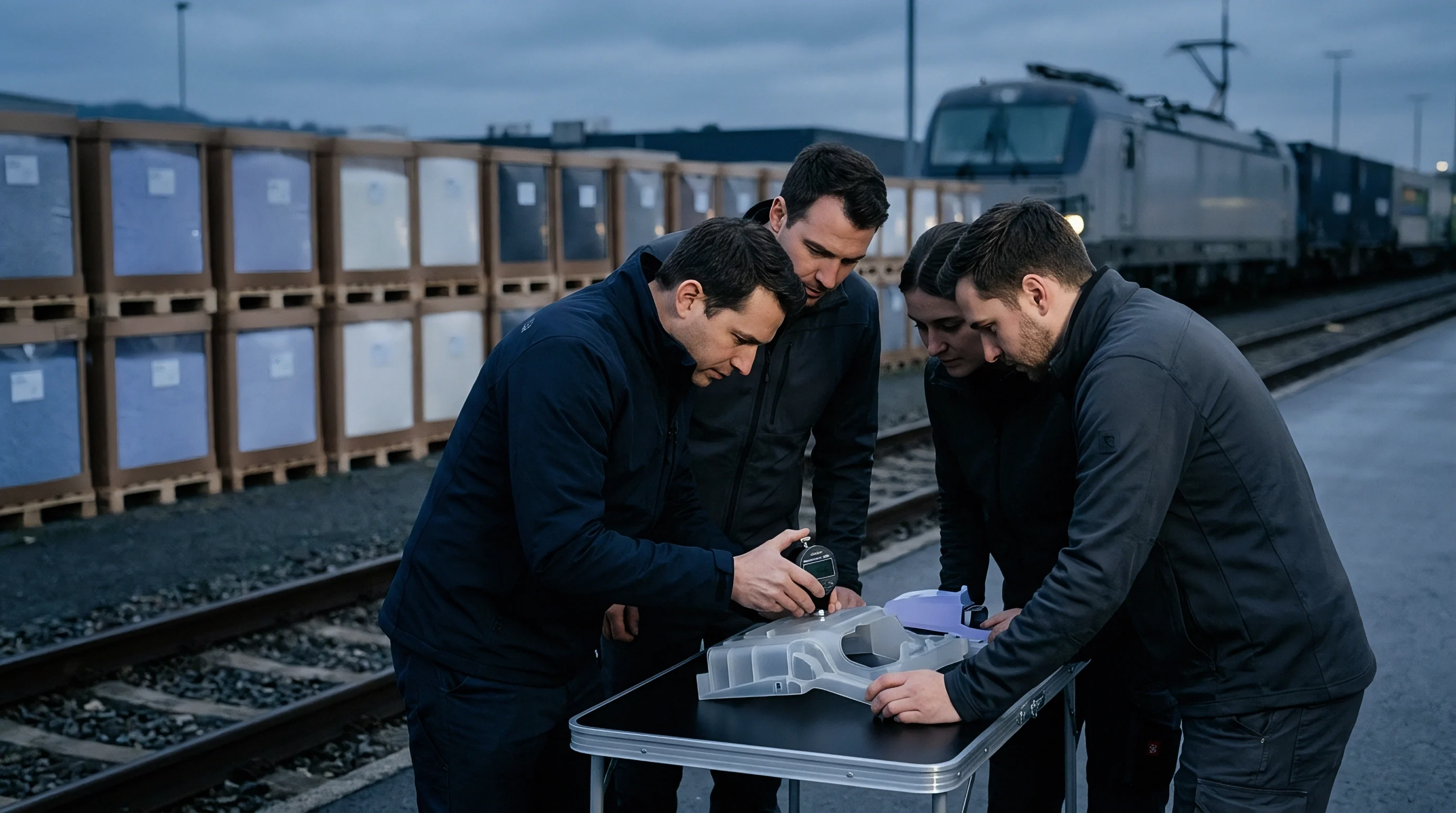
Melt velocity profiles passing through narrow cavity entry points subject rubber-modified polyolefins to shear rates exceeding 15,000 reciprocal seconds during high-speed injection phases. This intense mechanical deformation field reshapes the dispersed rubber morphology as material transitions from the delivery runner into the container wall tooling.

Shear Induced Elastomeric Deformation
High velocity flow produces immense velocity gradients near tool steel surfaces during cavity filling. Rubber particles near the frozen skin layer undergo extreme uniaxial extension, morphing from isotropic spheres into high-aspect-ratio ellipsoids oriented parallel to the primary flow direction. Wall friction deforms surface droplets.
This morphological anisotropy creates directional variations in impact resistance between the longitudinal flow path and the transverse axis of the molded logistics container.
Cooling rates fix final phase dimensions. In central core sections of thick container ribs, shear stresses remain near zero, allowing deformed rubber droplets sufficient thermal relaxation time to revert toward spherical geometries before solid-state crystallization locks the polymer matrix. Core zones cool slowly.
Consequently, container walls exhibit a distinct skin-core morphology gradient across their cross-section.
| Cross-Section Zone | Distance from Surface (mm) | Estimated Shear Rate (s⁻¹) | Cooling Rate (°C/s) | Aspect Ratio (Length/Diameter) | Dominant Deformation Mode |
|---|---|---|---|---|---|
| Frozen Skin | 0.00 ~ 0.20 | 12,000 | 150 | 4.5 ~ 8.0 | Extreme Fibrillation |
| Intermediate Shear Zone | 0.20 ~ 1.20 | 3,000 ~ 8,000 | 40 ~ 100 | 1.8 ~ 3.2 | Ellipsoidal Extension |
| Quiescent Core | 1.20 ~ 3.00 | 5 ~ 15 | 1.0 ~ 1.3 | Spherical Relaxation |
Managing this microstructural variation requires structured adjustment of entry geometry, melt temperature, and packing pressure timing. Molders track cavity pressure drop. Sharp entrances induce excessive extensional shear that tears elastomeric domains into irregular, sub-micron fragments, diminishing impact absorption capacity in structural container corners.
Thick-walled structural ribs maintain a higher internal core temperature during packing, accelerating rubber phase coarsening before solid-state freeze-out.

Cavity Entry Optimization Procedure
- Calculate the critical shear rate at the cavity entrance using maximum volumetric injection flow rates and runner geometry dimensions.
- Adjust entry lands to keep gate shear rates within 6,000 to 10,000 reciprocal seconds for polyolefin elastomer blends.
- Set tool coolant channels to provide uniform thermal extraction rates near entry regions, preventing localized heat build-up.
- Verify core-to-skin rubber aspect ratios using cross-sectional transmission electron microscopy on sliced wall samples.
Maintaining uniform cavity fill speeds preserves elastomeric dispersion across long flow paths without compromising structural rib density.
Matrix
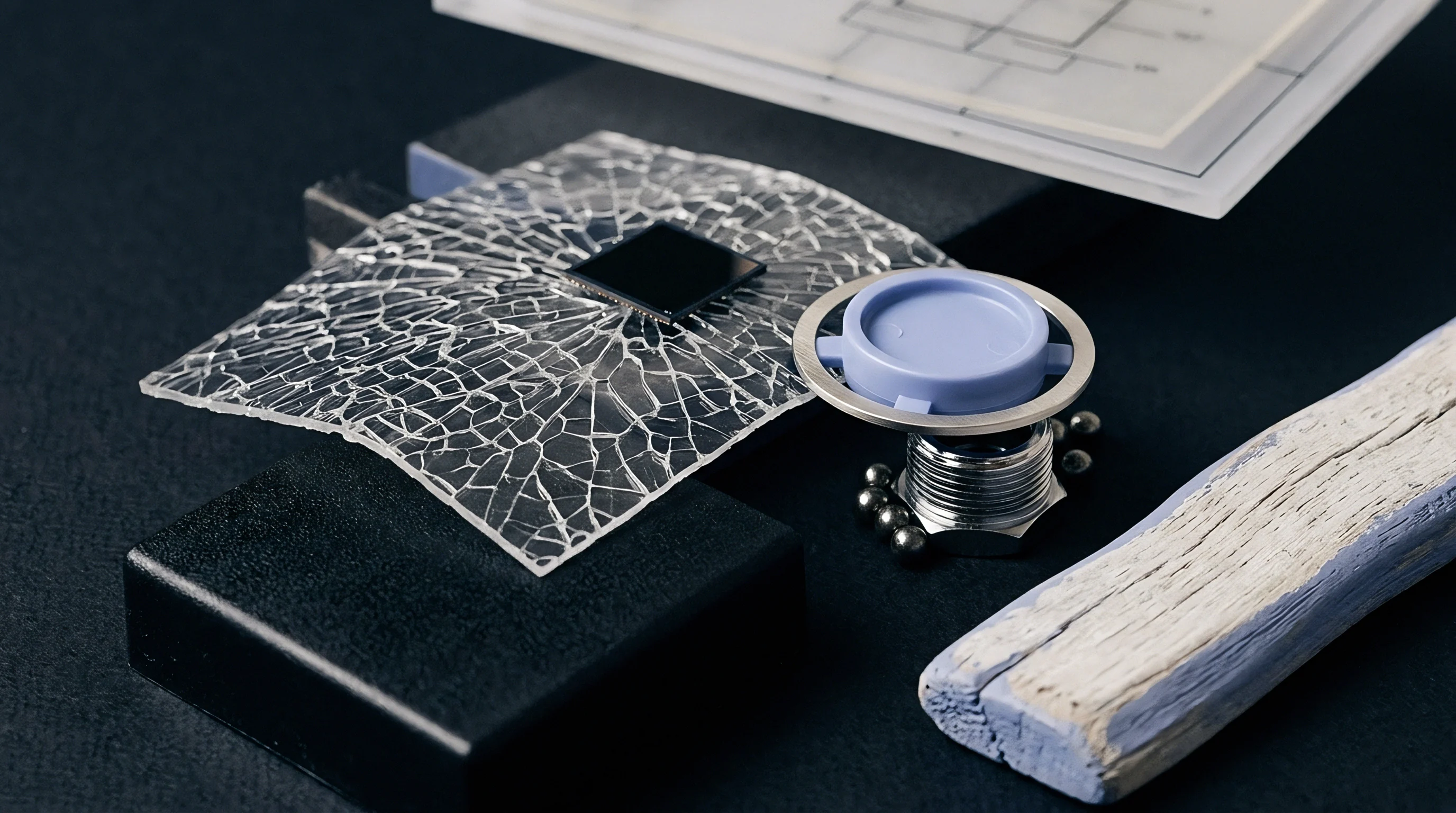
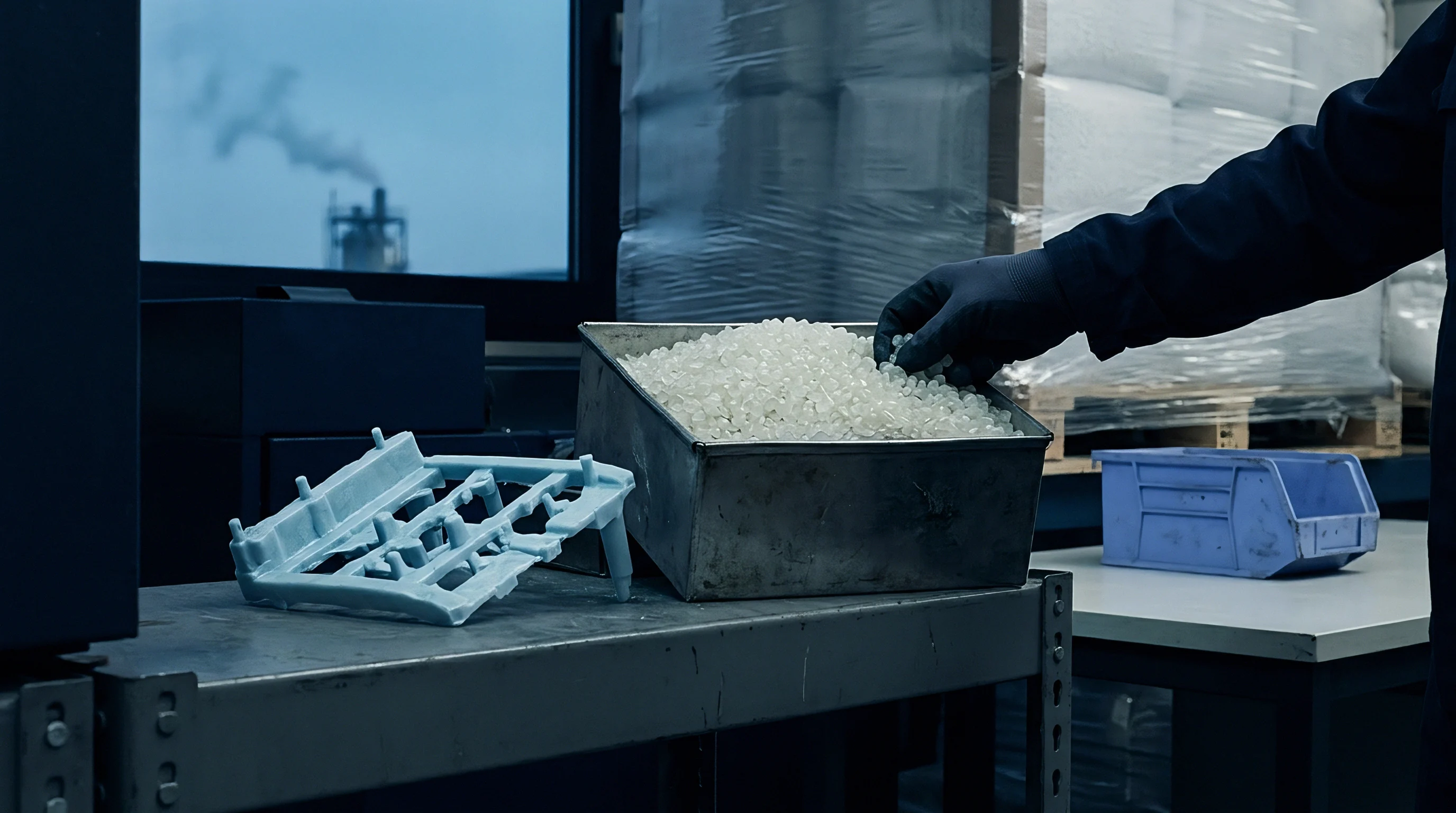
Base polymer molecular weight distribution and ethylene content govern the continuous phase stiffness while holding the dispersed elastomeric inclusions in stable mechanical suspension. Matching the zero-shear melt viscosity of the host resin to that of the rubber modifier prevents macro-phase separation during compounding and injection molding.
High viscosity ratios impede breakup. Incorporating functionalized compatibilizers such as maleic anhydride grafted polypropylene or diblock copolymers alters interfacial tension, stabilizing droplet morphology against shear-induced coalescence. Polymer chains uncoil under stress.
Does Viscosity Ratio Drift Alter Interfacial Rubber Coalescence?
Melt temperature variations inside the barrel shift the relative flow resistance of the polymer components, altering droplet breakup mechanics. When processing temperature increases by 20 °C, the host resin viscosity often drops faster than that of the elastomeric modifier, pushing the viscosity ratio (p) above the optimal window for droplet breakup. This shift leads to broader particle size distributions and reduced low-temperature ductility.
Lower temperatures reduce rubber elasticity. Maintaining a precise viscosity ratio requires monitoring melt indices across incoming lot shipments. When the matrix flow rate drifts from specification, compounders adjust barrel temperature profiles to realign phase viscosity ratios back to unity.
Higher melt viscosity ratios between the elastomeric modifier and the host resin prevent thermal coalescence during extended hold cycles.
Recyclate additions degrade phase stability. Incorporating post-consumer polypropylene into logistics container formulations introduces cross-contaminants that alter interfacial energy, forcing rubber inclusions to aggregate into large, brittle domains during mold cooling phases.
Resin suppliers frequently attribute lot-to-lot impact performance variations to minor ambient temperature fluctuations in the molding hall rather than shifting block copolymer composition.


Drop
Structural performance testing at sub-zero temperatures evaluates the energy absorption capacity of molded logistics containers under dynamic impact loads. Logistics containers operating in cold-chain transport must withstand drop impacts at -30 °C without experiencing catastrophic brittle shatter.

Fracture Mechanics and Craze Termination
Dynamic load dissipation occurs through localized yield zones initiated by sub-micron rubber inclusions. Clean fractures indicate brittle failure. When a container experiences dynamic impact, the stress field around dispersed rubber domain equators initiates localized matrix crazing.
These micro-crazes propagate through the continuous phase until they intersect adjacent rubber particles, which absorb kinetic energy and terminate craze growth.
ASTM D3763 multi-axial impact values below 35 Joules at sub-zero temperatures release the logistics operator from container batch acceptance.
If rubber particles sit too far apart or exhibit coarse domain geometries, crazes propagate uninhibited, coalescing into macro-cracks that split container floors and corner posts. Precision morphology control guarantees that craze initiation remains distributed uniformly throughout the stressed volume, maximizing total impact energy dissipation.

Impact Resistance Verification Protocols
Verification protocols validate microstructural stability and macro-mechanical performance prior to shipping commercial container lots.
- Instrumented Dart Impact Testing measures total puncture energy and peak force under multi-axial stress states according to ASTM D3763 standards at -30 °C.
- Notched Charpy Impact Evaluation quantifies energy absorbed per unit cross-sectional area per ISO 179-1/1eA at standardized sub-zero temperatures.
- Transmission Electron Microscopy provides direct measurement of rubber domain diameter distributions, aspect ratios, and interfacial boundary definition.
- Differential Scanning Calorimetry establishes total rubber phase content, crystallization kinetics, and glass transition temperatures (Tg) of the elastomer inclusions.
Incorporating ISO 179-1/1eA impact performance thresholds at -30 °C into purchase contracts transfers warranty liability to the compounder when elastomer dispersion fails minimum toughness specs.

Invoice
Landed compound pricing reflects both primary resin costs and the volumetric loading of specialized elastomeric modifiers needed to pass cold impact tests. Formulating high-performance container compounds involves balancing raw material cost premiums against scrap rates and field performance requirements.

Compounding Cost Structure and Scrap Rates
Elastomeric impact modifiers command a substantial cost premium over standard polypropylene base resins. Landed resin costs drive margin. Adding 15% by weight of an ethylene-octene copolymer increases raw material compounding cost per tonne significantly, requiring molding operations to optimize processing yield and eliminate cold-shot scrap.
| Elastomer Loading (wt%) | Resin Cost per Tonne (USD) | Unit Material Cost (USD/Part) | Cold Drop Test Pass Rate (%) | Process Scrap Rate (%) | Effective Landed Cost per Good Part (USD) |
|---|---|---|---|---|---|
| 5 % POE Modifier | 1,320 | 5.54 | 68.5 | 8.5 | 6.42 |
| 10 % POE Modifier | 1,480 | 6.22 | 94.0 | 2.8 | 6.71 |
| 15 % POE Modifier | 1,640 | 6.89 | 99.6 | 0.8 | 7.22 |
| 20 % POE Modifier | 1,800 | 7.56 | 99.9 | 0.5 | 7.89 |
Optimizing morphology control allows molders to minimize modifier loading while retaining high cold-impact pass rates. Achieving optimal rubber domain dispersion at 12% elastomer loading provides equivalent toughness to poorly dispersed systems containing 18% modifier, generating substantial material savings over large production runs.
Resin Sourcing Decision Checklist
- Melt Index Matching verifies that base resin and modifier viscosity ratios remain within 0.9 to 1.1 under target processing shear rates.
- Dispersed Phase Verification requires microscopic domain sizing certificates (d50 = 0.3 – 0.7 μm) for every production lot.
- Sub-Zero Performance Limits establishes contractually mandated Charpy notched impact minimums at -30 °C.
- Recyclate Limits caps post-industrial regrind content at 10% to prevent degradation of interfacial compatibilizer performance.
Molding large container fleets with un-compatibilized rubber blends leads to widespread field cracking under cold storage stacking loads, destroying project margins through warranty replacement costs.