Securing Property Rights for Production Tooling Assets in Contract Manufacturing
Securing tooling title demands explicit contractual bailment provisions, physical asset tagging prior to T1 trials, and unburdened lien waivers.

Title
Manufacturing contracts often blur the line between buyer-funded capital equipment and supplier-operated tooling. Production moulds, stamping dies, and extrusion tools sit on a supplier’s factory floor even when they legally belong to the brand owner. Securing clear ownership requires explicit contractual terms before steel cutting begins.
If a contract manufacturer runs into financial trouble, insolvency, or a commercial dispute, unsecured tooling can quickly be seized, tied up in mechanic’s liens, or attached by third-party creditors.
Contractual Ownership Markers
Purchase orders for injection moulds, stamping dies, and thermoforming tools serve as primary evidence in commercial disputes, with title typically transferring upon final payment. Ambiguous purchase orders that bundle tooling costs into part piece prices leave ownership open to legal challenge. Moulders frequently claim co-ownership or assert security interests over tools when development costs run over estimate or piece-price recovery mechanisms fail.
Establishing clear asset identity requires separating the tooling supply contract from the serial manufacturing agreement.
A legally sound tooling purchase order specifies exact tool construction parameters, cavity counts, target cycle times, steel grades, and hot runner configurations. Payment schedules tied to technical milestones protect capital allocation across tool build phases. Milestone payment structures typically distribute cash outflow across four distinct verification gates:
- Down Payment Release triggers tool steel ordering and preliminary mold flow analysis upon approval of 3D tool layout drawings.
- T0 Trial Execution validates basic mechanical movement, ejection systems, and core pulling mechanisms at the toolmaker’s facility.
- T1 Sample Approval verifies dimensional compliance against engineering drawings using full coordinate measuring machine inspection dossiers.
- SOP Sign Off transfers operational custody after achieving full statistical process capability across a continuous production run at the contract manufacturer.
Title retention clauses protect the buyer’s asset rights throughout construction and transit. Under the Uniform Commercial Code in North America and equivalent commercial codes across international jurisdictions, title passes according to express contract terms. If a contract remains silent on title timing, courts often rule that title passes upon physical delivery to the press floor.
This default rule exposes buyers to supplier lien claims before tools produce a single production part.
Contract clauses specifying that title to custom production tooling transfers immediately upon payment of the initial progress installment prevent supplier creditors from attaching liens during press bring-up.
Filing a UCC-1 financing statement in the jurisdiction where the contract manufacturer operates creates public notice of the buyer’s security interest. In international manufacturing hubs such as China, Vietnam, or Mexico, registering tools locally and executing bailment agreements with foreign subsidiaries establishes legal standing in local courts. Although invoices document the initial purchase, foreign courts often presume without local public registration that machinery installed inside a domestic facility belongs to the plant operator.
When a buyer funds tooling through direct capital expenditure, the contract manufacturer acts purely as a bailee holding physical custody for production. The contract must explicitly deny the moulder any right to pledge, mortgage, or encumber the tool, and must prohibit using buyer-owned tooling to produce components for third parties without written authorization.
Including an explicit reservation-of-ownership clause stating that all tooling assets funded under a designated purchase order remain the exclusive property of the buyer ~ regardless of physical possession ~ prevents supplier creditors from attaching liens during insolvency proceedings.


Steel
Physical metal modifications, cavity inserts, and cooling channel adjustments alter the asset throughout its operational life. High-volume injection moulding subjects P20 steel mold bases, H13 hardened cavities, and beryllium copper cooling inserts to cyclic thermal stress and mechanical wear. Over a five-hundred-thousand-shot tool life, contract moulders routinely perform maintenance, polish parting lines, replace ejector pins, and recut gate geometries.
Documenting steel alterations establishes whether modifications constitute routine upkeep or proprietary mold enhancements owned by the contract manufacturer.
Tooling Modification Records
Engineering changes executed during pilot production trials alter core geometries and insert hardness specifications. Moulders often implement unapproved gate changes, wall thickness modifications, or runner adjustments to widen narrow processing windows. Unrecorded physical modifications complicate tool transfers to secondary suppliers.
When a tool moves to a new facility, undocumented steel alterations cause severe dimensional drift, flash, or fill imbalance on initial press trials.
Tooling documentation files must record every physical alteration, cavity polish, and insert replacement. The tool drawing package remains the authoritative blueprint of asset identity. Software CAD models must mirror the physical steel in the press.
If a contract moulder modifies a core insert to resolve a sink mark without updating the 3D step file, the physical tool diverges from the intellectual property record.
| Stage | Physical Steel Condition | Title Status | Required Documentation |
|---|---|---|---|
| Unfinished P20/H13 blocks, rough cavity machining | Buyer holds title per milestone contract | Mill test certificates, heat treat logs, PO proof | |
| Polished cavities, fitted slides, runner installed | Title fully vested upon payment clearance | CMM dimensional report, T1 inspection dossier | |
| Hardened steel (52 HRC), texturing complete | Unencumbered buyer ownership | Bailment deed, fixed asset tag, asset registry entry | |
| Ejector replacement, gate refurbishment | Buyer ownership maintained | Maintenance logbook, recut steel CAD updates | |
| Note: Hardness testing per ASTM E18 verified prior to asset tag installation. | |||
Physical Identification Standards
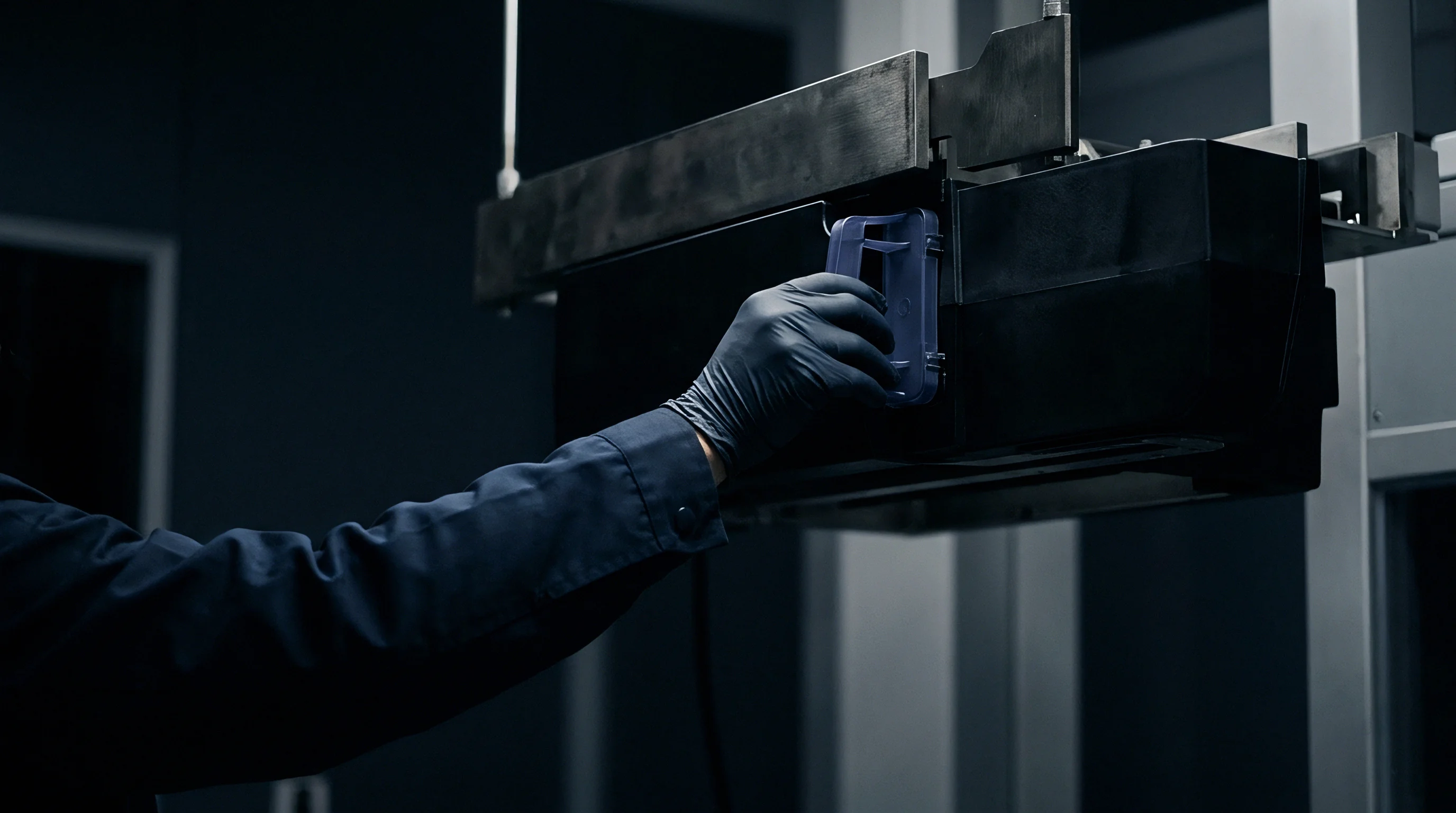
Deep-engraved asset tags and permanent exterior metal plates fix identity directly onto mold bases. Paint marks and adhesive labels fail under press-side operating temperatures and solvent exposure. An asset tag must survive ultrasonic cleaning tanks, mold storage environments, and high-temperature oil lines up to 180 degrees Celsius.
An effective tooling identification plate displays essential legal and technical parameters:
- Buyer Ownership Statement defines the legal entity holding property rights and includes unique asset tracking numbers.
- Tool Serial Identification matches the physical mold base to engineering drawings, CAD files, and purchase order records.
- Tooling Weight Specifications state dry weight and maximum clamp force requirements under DIN 16742 standards.
- Cavity Count Registry details total active cavities, runner volume, and original toolmaker identification codes.
During bankruptcy liquidations, court-appointed receivers audit physical plant inventory. Any mold lacking clear, riveted metal ownership plates indicating external corporate ownership is inventoried as supplier property, leaving the buyer with the burden of proving title through historical financial records and CAD matching.
Deep-engraved stainless steel tags riveted to both top and bottom mold plates at a depth of 0.5 millimeters ensure physical asset traceability during third-party insolvency audits.
Contract moulders frequently argue that unbilled engineering adjustments performed during tool tuning grant the shop a co-ownership equity share in the physical mould.

Custody
Physical possession of tooling assets by a third-party contract manufacturer creates a legal bailment relationship. Under bailment law, the contract moulder acts as bailee, accepting possession of property owned by the bailor buyer. This relationship imposes specific duties of care, maintenance, and protection upon the supplier.
Absent explicit contractual terms, general commercial law holds bailees only to standard ordinary care, leaving room for disputes when tools suffer premature wear, improper storage, or corrosion during production pauses.
Bailment Governance Provisions
Legal possession without ownership imposes a duty of reasonable care upon the contract moulder, which comprehensive bailment agreements convert into explicit operational obligations. These agreements define storage protocols, environmental controls, insurance requirements, and refurbishment duties. For example, molds stored in unheated warehouses can suffer atmospheric corrosion on polished cavity faces within weeks, while cleanroom and medical moulding tools require humidity-controlled storage below 40 percent relative humidity to prevent oxidation of S136 stainless steel surfaces.
Tooling bailment contracts must address six operational control areas:
- Verify physical presence of the tool base, core inserts, and spare parts inventory at the specified supplier manufacturing location quarterly.
- Inspect rust preventative coatings and water line flushing protocols executed prior to moving tools into long-term rack storage.
- Audit shot-counter data against maintenance logs to confirm adherence to prescribed preventive maintenance intervals every fifty thousand cycles.
- Validate third-party property insurance coverage levels against total replacement value including lead time loss compensation.
- Review storage conditions to ensure molds sit on elevated heavy-duty racking rather than raw concrete shop floors.
- Confirm that scrap tool disposal authorizations require dual signatures from both buyer and supplier engineering management.
If a factory fire, flood, or roof collapse destroys a production tool, contract moulders often discover their general liability policies exclude customer-supplied tooling. A bailment contract forces the supplier to carry all-risk property insurance covering customer-owned assets at full replacement cost. The policy must name the buyer as a loss payee so payouts go directly toward tool replacement at a designated toolroom.
Verification Logistics Protocol
Periodic physical audits verify asset location, operational condition, and cavitation integrity. Buyers must retain contractual rights to enter supplier facilities during normal operating hours to inspect tooling, verify asset tags, and audit maintenance records. Suppliers who restrict plant access create operational risk for the brand owner.
Bailment agreements specifying mandatory quarterly physical inspections and immediate tool release provisions prevent suppliers from holding molds hostage during commercial pricing disputes.
Under scientific moulding principles, maintenance logs track parting line shut-off force, guide pin lubrication, side-action wear plate clearance, and hot runner heater band resistance. When a moulder neglects maintenance, flash develops, forcing press operators to increase clamp tonnage ~ which crushes parting lines and deforms cavity vents. Assigning maintenance fault clearly in bailment agreements ensures the cost of recutting damaged parting lines falls entirely on the supplier.
Failing to maintain written bailment acknowledgments leaves the tooling vulnerable to immediate seizure by the supplier’s landlord upon factory lease default.


Taxonomy
Commercial tooling agreements categorize assets under distinct structural and financial models. Choosing between direct capital payment, piece-price amortisation, or shared equity models dictates asset title clarity and accounting treatment. Direct ownership provides total operational control but demands upfront capital expenditure.
Amortised tooling reduces initial cash requirements while introducing legal complexity surrounding asset title during mid-contract transfers.

Amortization Structure Mechanics
Piece-price amortization embeds tooling costs into per-unit moulding quotes over an agreed volume commitment. A typical agreement amortises a one-hundred-thousand-dollar injection tool across two hundred thousand production parts, adding fifty cents to each part price. Until full production volume is achieved and paid for, legal title remains split between buyer and moulder unless contractual protections intervene.
Amortisation schedules must define step-down pricing once the tooling charge is fully paid. If the amortisation period ends at unit two hundred thousand, the part piece price drops immediately by the fifty-cent tooling charge. Moulders routinely continue collecting amortisation fees past the agreed volume threshold unless automated invoice tracking systems trigger contract adjustments.
The buyer retains rights to audit production logs to verify amortisation completion.
Asset Classification Models
Direct capital acquisition isolates tooling expenditure from part production pricing. The buyer pays for the mold in full upon passing T1 or SOP inspection gates. Direct ownership establishes unambiguous legal title from inception, eliminating arguments over remaining tooling balances during supplier transitions.
The table below outlines accounting treatment and ownership boundaries across common commercial models.
| Financial Model | Initial Capital Source | Title Transfer Point | Early Exit Liability |
|---|---|---|---|
| Direct Buyer Purchase | Buyer capital budget | Immediate upon milestone payment | Zero balance owed to moulder |
| Full Amortisation | Supplier upfront cash | Upon full volume fulfillment | Unamortised capital balance buyout |
| Hybrid Milestone Amort | 50% Buyer / 50% Supplier | Proportional until final unit shot | Pro-rated remaining tool cost payoff |
| Supplier Funded Tooling | Supplier capital budget | Title stays with moulder | Tool remains supplier asset; IP risk high |
Early termination clauses protect both contracting parties under amortised tooling agreements. If product sales fail to reach forecasted volumes, the buyer holds contractual rights to buy out the unamortised tooling balance at any point. The buyout calculation must specify net book value without penalizing the buyer with speculative supplier profit margins.
Paying the unamortised balance immediately clears all liens, transferring full unencumbered title to the buyer.
The industry continues to debate whether software controls inside press controllers that restrict tool operation without a digital key constitute an unlawful interference with buyer property rights.


Repatriation
Extracting tooling assets from a contract manufacturer requires pre-planned logistics, tool drawing clearance, and physical access rights. When a manufacturing contract terminates due to performance failure, pricing disagreements, or strategic dual-sourcing, moving moulds between facilities exposes the asset to physical damage or supplier retention. A smooth tool transfer relies on executed contract covenants that mandate immediate tool surrender upon written demand.

Physical Relocation Protocols
Factory access provisions grant the buyer’s logistics agents legal right of entry to pull molds from presses. Moulders experiencing contract termination frequently assert mechanic’s liens, claiming unpaid invoices, storage fees, or unamortised setup costs. Establishing mandatory dispute escalation windows prevents suppliers from detaining tools while invoice disagreements undergo arbitration.
A structured repatriation protocol mandates specific physical export preparations before a mold leaves the supplier press floor:
- Cooling Circuit Drainage uses compressed air to blow out water channels, preventing internal corrosion and freeze damage during ocean transit.
- Cavity Protection Application coats core, cavity, and slide faces with heavy-duty wax-based rust preventatives suitable for multi-month transit.
- Mechanical Lock Installation bolts exterior steel lock straps across parting lines to keep mold halves securely closed during crane transport.
- Drawing Package Delivery transfers complete native 3D CAD step files, hot runner wiring schematics, and water layout drawings to the buyer.
Possessing physical steel without native tool drawings leaves the buyer unable to build spare inserts or modify gating at a secondary moulder. Contract clauses must declare that tool design drawings, mold flow simulations, and CNC machining files created for the tool constitute work-for-hire owned exclusively by the buyer.

Cross Border Transit Clearance
Customs documentation must classify exported molds under correct Harmonized System tariffs to avoid duplicate duty assessment. Tooling shipped cross-border for temporary production runs requires temporary import declarations or ATA Carnets to avoid duty charges. If a tool was originally exported from the buyer’s home country, re-importation requires proving original origin via export declarations and asset tags.
Customs entry declarations identifying customer-owned tooling under Harmonized System Code 8480.71 avoid double taxation during international factory relocations.
Dual-sourcing strategies require secondary tooling or rapid transfer mechanisms to protect supply chains. When primary production tools face legal detention, secondary backup tools ensure manufacturing continuity. Securing intellectual property rights alongside physical asset title ensures complete operational independence across contract manufacturing partners.