Establishing Analytical Evaluation Thresholds for Non Intentionally Added Substance Mass Spectrometry Screening
Analytical evaluation thresholds set mathematical peak cutoffs in mass spectrometry screening to trigger toxicity reviews for unknown migrants.

Matrix
Screening food contact polymers for non-intentionally added substances by mass spectrometry means turning chromatographic peak areas into estimated migrant concentrations. Unassigned compounds in these matrices stem from polymer breakdown, additive side-reactions, ink set-off, adhesive cleavage, or recycled feedstocks. Deciding whether an unknown peak poses a toxicological risk requires a clear concentration cutoff: the analytical evaluation threshold.
That threshold ensures any unidentified migrant above toxicological limits triggers formal structural identification and risk assessment.
Detector responses vary across several orders of magnitude depending on an analyte’s ionization, polarity, and molecular weight. Gas chromatography with electron ionization yields fairly consistent response factors for volatile and semi-volatile species. Liquid chromatography paired with electrospray or atmospheric pressure chemical ionization, however, produces vastly different signal intensities between polar and non-polar compounds.
Quantifying unknown peaks against a single surrogate standard can therefore introduce huge errors, which is why the analytical evaluation threshold formula incorporates an explicit uncertainty factor.
Targeted screening measures specific chemicals against authentic standards, whereas non-targeted screening profiles the entire set of extractable or migratable species without knowing what resides in the polymer network. Solvent extraction using aggressive swelling media like dichloromethane or hexane isolates all potential migrants; migration testing into regulated food simulants measures only the fraction that actually transfers into food under set time and temperature conditions. Analytical evaluation thresholds apply to both approaches, though converting between solvent volume, polymer surface area, and food mass involves different math in each setup.
The analytical evaluation threshold converts human daily exposure limits into chromatographic peak intensity cutoffs for unidentified chemical migrants.
The sensitivity needed for a screening run depends on the baseline exposure limit selected. Toxicological threshold of concern values from international safety bodies set acceptable exposure for compounds without specific toxicity data. For substances showing no structural alerts for genotoxicity, the default benchmark is a daily intake limit of 1.5 micrograms per person per day.
If a packaging material contacts one kilogram of food consumed daily by a 60-kilogram adult, that baseline equals a food concentration cutoff of 1.5 parts per billion. Suspected genotoxic motifs require lower intake limits, whereas known Cramer Class I structures allow higher cutoffs. In practice, the evaluation threshold must derive directly from the lowest conservative toxicological boundary for the target market.
Assays that set reporting limits purely on instrument signal-to-noise ratios routinely miss toxicologically relevant migrants. Signal-to-noise describes what the detector can pick up, while evaluation thresholds reflect safety requirements. If an instrument’s signal-to-noise limit lies above the calculated evaluation threshold, the method cannot guarantee regulatory compliance.
Compliance testing therefore requires adjusting sample concentration, injection volume, or mass spectrometer accumulation times until the limit of quantification drops below the threshold. When detector noise is high, laboratories must use larger sample equivalents rather than raising their reporting cutoffs.

Defining Extraction versus Migration Cutoffs
Solvent extraction tests immerse plastic samples in aggressive solvents at elevated temperatures, collapsing the polymer matrix and releasing internal additives, oligomers, and degradation products into solution. Assessing these extract samples requires back-calculating migrant concentration per unit mass of plastic. Migration tests, by contrast, measure transfer from the finished article across a set contact area into simulants like ten percent ethanol, three percent acetic acid, or vegetable oil.
Calculating the threshold for migration testing means factoring in the actual surface-to-volume ratio of the finished package.
The chosen simulant directly affects background noise and analyte recovery in the mass spectrometer. Aqueous simulants such as three percent acetic acid introduce volatile salts into liquid chromatography ion sources, suppressing signals for hydrophobic migrants. Fatty simulants like vegetable oil demand extensive cleanup ~ using solid-phase extraction or freeze-out steps ~ before gas chromatography, which causes analyte losses.
These interferences raise the detection limit, forcing laboratories to enrich samples further to remain compliant. A method validated for ten percent ethanol cannot simply be assumed valid for dry food simulants like modified polyphenylene oxide without re-checking baseline noise and recovery efficiency.
Screening protocols for non-intentionally added substances require matching the extraction medium to the analytical technique. Volatiles released during polymer processing are trapped by headspace solid-phase microextraction and run on gas chromatography-mass spectrometry. Semi-volatiles isolated by solvent reflux are analyzed via direct-injection gas chromatography.
Non-volatile, high-molecular-weight oligomers and synthetic side products require liquid chromatography paired with high-resolution accurate mass systems, like quadrupole time-of-flight or Orbitrap instruments. Each approach needs its own threshold based on its specific sample concentration factor and injection dynamics. Ultimately, the depth of screening hinges on choosing reference standards whose structures match how targets bind within the polymer matrix.


Formula
Deriving the evaluation threshold involves converting a human exposure limit into a concentration in the liquid or gas phase, adjusted for instrument variability. The core formula balances daily intake limits against packaging usage assumptions and laboratory concentration steps. For typical food contact packaging, calculating the threshold in micrograms per kilogram of food takes the toxicological benchmark, applies the packaging ratio, and divides by total daily food intake.
Standard European Union and United States regulatory models fix that daily food consumption at one kilogram per person.
Sample preparation concentrates or dilutes the original simulant or extract, changing the concentration in the autosampler vial. Accounting for this fold-concentration yields the required threshold in the actual test solution. The complete equation also includes an uncertainty factor to cover response variation between internal standards and unknown compounds:
AET = (TTC / Consumption) (V_simulant / A_article) (1 / UF)
Where TTC represents the toxicological threshold of concern in micrograms per person per day, Consumption represents daily food intake in kilograms, V_simulant represents the volume of simulant in liters, A_article represents the surface area or mass equivalent of the tested package, and UF represents the non-dimensional uncertainty factor.

Sequential Math Derivation Steps
- Baseline Selection establishes the toxicological daily intake limit based on the hazard class, defaulting to 1.5 micrograms per person per day for uncharacterized non-genotoxic profiles.
- Packaging Ratio Conversion converts daily human intake into an allowable food concentration using the standard ratio of six square decimeters of surface area per kilogram of food.
- Concentration Factor Adjustment accounts for solvent evaporation or solid-phase extraction, adjusting target concentrations by the ratio of initial simulant volume to final extract volume.
- Uncertainty Factor Division lowers the numerical threshold by an empirical factor between 2 and 10 to guard against under-quantifying weakly ionizing compounds.
Uncertainty factors adjust the threshold downward to avoid missing real migrants. In electron ionization gas chromatography, organic molecules fragment in predictable ways; relative response factors for diverse compounds rarely vary by more than a factor of two relative to a well-matched internal standard. An uncertainty factor of 2 is therefore standard for GC screening.
Electrospray ionization in liquid chromatography is much less predictable ~ protonation efficiencies across functional groups differ dramatically, causing response factors to vary by over an order of magnitude. LC screening consequently requires an uncertainty factor between 5 and 10 so weakly ionizing toxic compounds do not drop below the reporting window.
Adding internal standards before extraction anchors the quantitative scale. These standards must be absent from the polymer matrix and behave chromatographically like the anticipated migrants. Deuterated or carbon-13 labeled analogs track recovery best, though general screening often relies on compounds like d10-phenanthrene for gas chromatography and d5-benzoic acid or fluorinated species for liquid chromatography.
Spanning the entire retention window with multiple standards is necessary to capture gradient-dependent response shifts during the run.
| Packaging Context | Toxicological Basis | Contact Ratio | Uncertainty Factor | Derived Threshold |
|---|---|---|---|---|
| Genotoxic Default (1.5 ug/day) | 6 dm2 / 1 kg food | 2 (GC-MS) | 0.75 ug/kg food | |
| Genotoxic Default (1.5 ug/day) | 6 dm2 / 1 kg food | 10 (LC-MS) | 0.15 ug/kg food | |
| Specialized Intake (0.15 ug/day) | 10 dm2 / 1 kg food | 10 (LC-MS) | 0.015 ug/kg food | |
| Cramer Class I (1800 ug/day) | 1 dm2 / 10 kg food | 2 (GC-MS) | 90.0 ug/kg food | |
| Assumes standard human body mass of 60 kg and single-day exposure allocation without cumulative decay adjustments. | ||||
Using an incorrect packaging ratio invalidates the whole calculation. Small formats, like single-dose pharmaceutical blisters or condiment sachets, have high surface-area-to-volume ratios. A sachet exposing 20 square decimeters per kilogram of food transfers ten times more chemical mass per unit volume than a storage drum exposing two square decimeters per kilogram.
Laboratory reports need to state the exact geometric contact ratio used in the calculation so compliance officers can confirm whether the test reflects real-world use.
A supply contract clause defining chemical purity mandates that any unassigned peak exceeding 0.15 parts per billion in liquid simulant triggers mandatory identification and hazard assessment.
The choice of extraction solvent determines whether a threshold reflects real migration potential or a worst-case inventory of total substances. Iso-octane and ethanol mixtures simulate fatty food migration by swelling polyolefin matrices, speeding up diffusion by orders of magnitude. If screening calculations treat solvent extract values as direct migration numbers without diffusion modeling, compliant materials end up misclassified as non-compliant.
Quality agreements should clarify whether exceeding a threshold requires immediate rejection or triggers follow-up testing under realistic migration conditions.


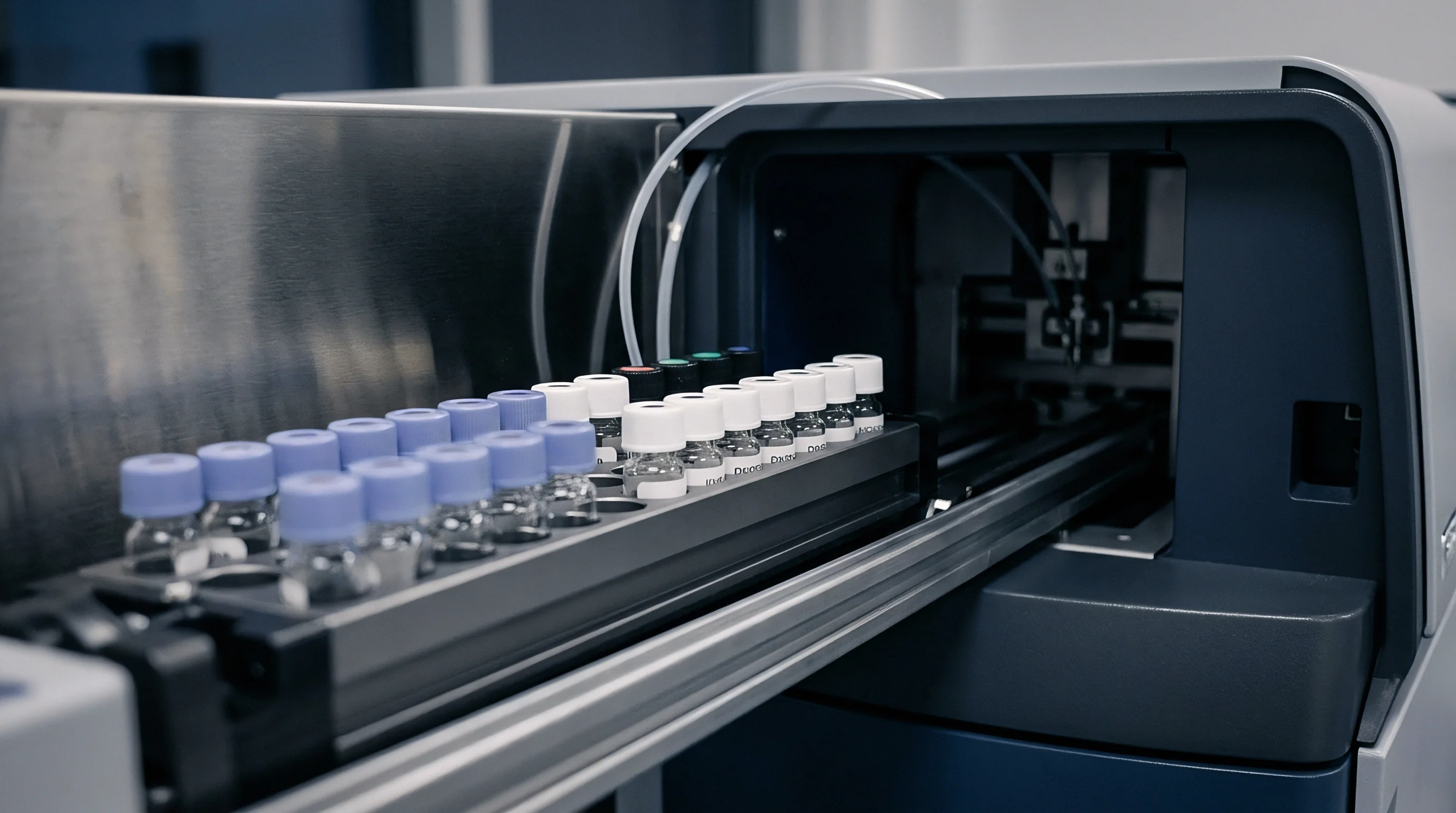
Vial
Chromatographic analysis converts chemical samples into electronic data through ionization and mass filtering. Inside the vial, volatile and non-volatile compounds exist alongside polymer additives, solvent impurities, and trace contaminants. Once injected, each molecule’s properties dictate how it travels through the column and ionizes in the source.
Gas chromatography separates volatile species along capillary columns coated with phases like five percent phenyl polysiloxane; liquid chromatography separates polar compounds on reverse-phase C18 columns using water-acetonitrile gradients.
Mass spectrometry detectors ionize incoming molecules through specific energy transfer mechanisms. High-energy electron ionization at 70 electronvolts breaks chemical bonds in a reproducible pattern, generating spectra that can be matched against libraries like NIST or Wiley. Soft techniques ~ such as electrospray or atmospheric pressure chemical ionization ~ preserve intact molecular ions as protonated or deprotonated species.
Measuring accurate mass on high-resolution instruments yields elemental formulas based on mass defects, providing the initial basis for identifying unknown migrants.

How Do Ionization Variance Factors Impact Peak Cutoffs?
Electrospray ionization efficiency depends heavily on proton affinity, gas-phase basicity, molecular size, and local mobile phase conditions. A strongly basic compound ionizes readily, producing a large peak at low concentrations. By contrast, a neutral or weakly polar molecule ionizes poorly, yielding a tiny peak even at high concentrations.
If an evaluation threshold uses a single internal standard to set a universal peak area cutoff, weakly ionizing compounds can slip under the integration limit despite being present at dangerous levels.
Relative response factors measure this ionization disparity by comparing target signals to an internal standard at equal concentrations. In liquid chromatography-mass spectrometry, response factors across different chemical classes frequently span four orders of magnitude. The uncertainty factor in the evaluation threshold formula lowers the reporting cutoff to accommodate that variation.
An uncertainty factor of 10 assumes the unknown compound ionizes at least ten percent as efficiently as the standard; if ionization efficiency falls to one percent, even that factor of 10 will miss the compound before its peak reaches the integration cutoff.
- Matrix Suppression Effects occur when co-eluting polymer oligomers compete for charge in electrospray sources, suppressing signals from real migrants.
- In-Source Fragmentation breaks fragile molecules into smaller fragments before mass analysis, splitting signal across several channels and dropping individual peaks below reporting limits.
- Adsorption Losses reduce hydrophobic analytes at low concentrations through binding to vial glass, transfer tubing, or column frits prior to ionization.
- Mass Analyzer Transmission Bias skews ion counts across broad mass ranges, leading quadrupole or time-of-flight instruments to undercount high-mass oligomers compared to small volatile fragments.
Managing ionization variance requires splitting chromatographic runs into discrete retention windows calibrated with dedicated structural standards. In gas chromatography, combining alkane series standards with aromatic, phenolic, and ester surrogates keeps response factors bounded across volatile and semi-volatile ranges. In liquid chromatography, using internal standards for acidic, basic, neutral, and amphoteric compounds improves signal normalization.
Modern screening protocols evaluate peak area cutoffs independently across each standard class.
High-resolution accurate mass instruments permit narrow mass extraction windows, improving signal-to-noise ratios by resolving target ions from overlapping background interferences. Time-of-flight and Orbitrap analyzers running at mass resolving powers above 30,000 separate signals that co-elute completely on unit-resolution triple quadrupole systems. That higher resolution lowers the noise floor, letting methods meet evaluation thresholds without aggressive sample concentration steps that dirty ion sources and cause sensitivity drift.
Minor unidentified chromatographic signals falling just below the derived threshold are sometimes described as harmless polymer fragments or standard processing aids. That assumption ignores that toxicological structural alerts operate independently of molecular weight or origin. A tiny peak below the threshold can represent a potent mutagen, while a massive peak may belong to an inert fatty acid slip agent.
Evaluating safety requires strictly adhering to derived cutoff rules rather than visually inspecting peaks.


Record
Proving compliance for non-intentionally added substances requires a conformity file linking testing protocols directly to toxicological evaluations. Authorities inspect these files to verify that packaging materials meet framework safety regulations. A complete file includes full analytical method details, raw chromatographic data, internal standard response factors, explicit threshold calculations, and identification logs for every peak exceeding the evaluation cutoff.
Data integrity requires keeping integration parameters fixed across screening runs. Automated integration software frequently clips small peaks or mistakes real signals for baseline drift in complex chromatograms. Analysts need to check baseline integration manually anywhere near the evaluation threshold level.
Re-integrating chromatograms to force minor peaks below the cutoff is a major audit finding.

Documentary Requirements for Threshold Compliance
- Raw Chromatographic Files containing full mass spectral scans, total ion chromatograms, and extracted ion chromatograms for all internal standards.
- Threshold Calculation Sheets documenting the toxicological baseline, packaging ratio, sample concentration factor, and uncertainty factor used.
- Library Search Records detailing database spectral matches along with mass defect and isotopic distribution calculations for tentative assignments.
- Toxicological Risk Assessments signed by qualified toxicologists evaluating all confirmed or tentative structures exceeding the calculated cutoff.
- Method Validation Dossiers demonstrating instrument precision, linear dynamic range, recovery efficiencies, and blank background levels under routine conditions.
A converter’s declaration of conformity must state the explicit scope of screening performed on the article. Generic statements claiming compliance with framework regulations carry no legal standing without supporting analytical evidence. The declaration needs to specify whether testing covered volatile, semi-volatile, and non-volatile fractions, give the exact evaluation threshold concentration applied, and confirm that all peaks above that cutoff were toxicologically cleared for the end use.
Omitting the uncertainty factor from an analytical evaluation threshold calculation invalidates the entire non-target screening dossier during a regulatory food contact audit.
Reviewing third-party laboratory reports requires checking how background blanks were subtracted. Solvents, thimbles, columns, and lab air lines all contribute trace organic background signals. Subtracting blank chromatograms cleans up presentation reports but can erase genuine migrants from the packaging itself.
If a background peak overlaps with a migrant peak, the laboratory must prove the source is strictly external before zeroing the signal. Blanket subtraction of shared peaks without quantitative threshold verification creates silent compliance risks.
Traceability requires linking test reports to specific production lots and resin masterbatches. Chemical compositions in plastic processing change with regrind usage, thermal breakdown in the barrel, purge residues, and cooling water additives. A screening report from a pristine resin trial does not cover commercial lots made under different thermal histories.
Any change in processing conditions, resin suppliers, or masterbatch ratios requires re-evaluating threshold compliance.
Failing to document the rationale behind an uncertainty factor leaves brand owners exposed during regulatory audits. If an inspector finds that an LC screening assay used an uncertainty factor of 2 instead of 10 without technical justification, the threshold is considered five times too high. Unidentified peaks ignored under that higher cutoff then have to be re-evaluated retroactively.
If one of those unassessed peaks turns out to be a restricted migrant or potent mutagen, the packaging lot faces recall at significant cost.

Triage
When screening detects a peak above the analytical evaluation threshold, the laboratory begins a structured identification and risk assessment workflow. The goal is converting an unassigned signal into a confirmed or tentative chemical structure so toxicologists can evaluate consumer risk. Peaks are prioritized by signal intensity, mass defects, structural alerts, and estimated concentrations.
Tentative identification starts with high-resolution mass spectra to derive empirical formulas. Measuring mass-to-charge ratios to four decimal places allows software to rule out candidate formulas using isotopic fine structure and the nitrogen rule. Collision-induced dissociation then breaks the molecule into diagnostic fragments.
Comparing these spectra against reference databases or in-silico tools narrows the candidates to a short list of likely structures.
- Confirm accurate mass molecular ion and derive elemental composition options within a five parts per million mass error window.
- Evaluate isotopic distribution patterns to confirm the presence of heteroatoms such as chlorine, bromine, sulfur, or silicon.
- Acquire collision-induced dissociation MS/MS spectra and match fragment patterns against spectral libraries and theoretical fragmentation models.
- Assign a tentative structural identity and evaluate the molecule for structural alerts associated with mutagenicity, carcinogenicity, or endocrine disruption using QSAR modeling software.
- Procure an authentic reference standard of the candidate compound, inject under identical chromatographic conditions, and verify retention time and spectral matching.
- Quantify the confirmed migrant against its authentic standard to obtain accurate migration concentrations, replacing the initial estimated threshold value.
Identification work scales with the required level of confidence. Standard confidence tiers run from unequivocal identification using an authentic standard, down to tentative assignment via spectral libraries, class assignment via functional groups, and remaining unidentified. Unidentified peaks above the threshold require immediate risk evaluation even without structural confirmation, using conservative mutagenic default limits to guide the decision.
Assigning an identity allows quantitative refinement, replacing estimated concentrations with measured values. Initial screening quantifies unknown peaks against an arbitrary internal standard assuming equal response. Analyzing an authentic standard reveals the true relative response factor, which often shifts calculated concentrations substantially in either direction.
If the refined concentration falls below regulatory limits or toxicity thresholds, the compound is cleared and archived in the safety file.
When an unknown peak above the evaluation threshold cannot be identified despite high-resolution MS and database searches, the converter has a few options. They can re-formulate the polymer to eliminate the responsible raw material or process step, add functional barrier layers to block migration, or run bioanalytical assays like Ames mutagenicity or reporter gene tests on the extract. Bioanalytical screening measures overall extract toxicity directly without identifying individual compounds, provided the assay’s sensitivity aligns with the evaluation threshold.
What analytical workflows should be deployed when an unidentified peak exceeding the evaluation threshold proves completely resistant to high-resolution mass spectral fragmentation and library matching?

Customs
Importing packaged goods or food contact materials subjects packaging declarations to inspection by customs and environmental health agencies. Officials check physical shipments against submitted compliance documents and send targeted high-risk samples to government laboratories. Non-target mass spectrometry screening is the standard tool enforcement labs use to flag unauthorized additives, banned chemicals, and unassessed non-intentionally added substances.
Border rejections for chemical non-compliance mean immediate container holds, mandatory re-export, or destruction at the importer’s expense. If an enforcement lab finds an unlisted migrant above safety thresholds, the manufacturer’s declaration of conformity becomes invalid. That renders the whole shipment an illegal entry under trade law, bringing fines, tariffs, and increased audit scrutiny on future shipments from that converter.
| Failure Severity Tier | Root Analytical Cause | Enforcement Action | Direct Landed Cost Impact |
|---|---|---|---|
| Uncertainty factor miscalculated; peak below threshold | Documentation notice; mandatory dossier update within 30 days | 5,000 EUR re-testing and legal drafting fees | |
| Genotoxic migrant detected above evaluation cutoff | Immediate shipment hold; mandatory product withdrawal from market | 85,000 EUR demurrage, destruction, and supply chain replacement costs | |
| Intentional omission of non-target screening data | Import ban; revocation of conformity status; criminal prosecution | 350,000 EUR regulatory penalties, legal fees, and brand damage |
Port-of-entry testing differs from routine quality control because enforcement laboratories prioritize rapid hazard detection over supplier dialogue. They run high-sensitivity screening methods backed by spectral libraries containing tens of thousands of contaminants, industrial chemicals, and additives. When screening finds unlisted compounds above evaluation thresholds, authorities issue non-compliance notices requiring the importer to prove safety within tight statutory deadlines without providing identification assistance.
Procurement teams structuring international packaging contracts need to include explicit terms covering non-target screening thresholds. Contracts should require suppliers and converters to provide screening dossiers from independent laboratories accredited to ISO/IEC 17025. They must also assign vendor liability for demurrage, re-testing, customs fines, and recall costs if unlisted migrants exceed calculated thresholds at import.
Analytical evaluation thresholds bridge the gap between mass spectrometry detection limits and food safety enforcement. Testing without sound threshold calculations leaves brand owners exposed to unassessed chemical liabilities, whereas arbitrary reporting cutoffs trigger unnecessary product rejections. Grounding thresholds in toxicological concern values, correcting for instrument ionization variance, and maintaining clear conformity records ensures packaging materials clear border scrutiny and comply with food contact regulations.