Component Article Threshold Determination in Complex Plastic Assemblies
Determining component article thresholds demands isolating discrete plastic subparts before calculating substance weight percentages against individual component mass.


Anatomy
Regulatory obligations under European chemical legislation depend on identifying the exact physical unit subjected to threshold limits. In complex plastic assemblies, determining whether an item constitutes a single article or an assembly of multiple discrete articles governs chemical threshold calculations. Article 3(3) of Regulation (EC) No 1907/2006 defines an article as an object given a specific shape, surface, or design during production that determines its function to a greater degree than does its chemical composition.
When plastic components are molded, stamped, or welded together, applying this definition demands isolating the point where individual constituent parts acquired their initial article status.
Plastics deform under mechanical force. In multi-component plastic manufacturing, structural elements often undergo intermediate processing steps before final joining. A rigid plastic clip molded in a stand-alone injection tool achieves article status the moment it cools and discharges from the mold cavity.
Subsequent assembly operations, such as snap-fitting that clip into a larger housing or ultrasonically welding it to a plastic chassis, do not erase its legal status as a distinct article.

European Legal Definitions and Structural Classification
Clause three of REACH Regulation nineteen hundred and thirty-five outlines how manufactured objects acquire functional properties during molding. The European Court of Justice ruling in Case C-106/14 clarified the application of threshold concentration limits within assembled products. Under this judgment, commonly referred to as Once an Article, Always an Article, obligations to notify and inform recipients regarding Substances of Very High Concern apply to each individual article present within a complex object.
Threshold determinations resting on total assembly mass mask high concentration additives contained in minor plastic subcomponents.
Consider a multi-material automotive plastic module. Density varies across polymer grades. An assembly containing structural nylon, elastomeric grommets, polyoxymethylene gears, and flame-retarded polypropylene outer covers represents a collection of independent articles.
Each plastic element that received a specific shape or surface design during an upstream molding step remains a distinct article throughout its life cycle. Evaluating chemical thresholds on whole subassemblies dilutes restricted substances below notification boundaries, creating immediate compliance default.

Judicial Ruling Effects on Component Mass Base
Judges sitting in Luxembourg established that individual parts retain independent identity after consolidation into larger trade goods. Mass determines the chemical threshold. For a Substance of Very High Concern listed under Article 59(1), the statutory threshold sits at 0.1 percent weight by weight.
The denominator for this calculation is the mass of the specific discrete article containing the substance, never the mass of the complete plastic assembly.
- Structural Subparts molded independently prior to secondary joinery remain distinct articles, requiring individual mass determination for all chemical threshold calculations.
- Co-molded Assemblies incorporating pre-inserted metal or plastic components treat inserted elements as discrete articles separate from the overmolded resin body.
- Mechanical Fasteners fabricated from engineering thermoplastics retain standalone article status, requiring dedicated material declarations from sub-tier molders.
- Surface Treatments applied as thin chemical films without independent geometric structure integrate directly into the substrate resin mass rather than forming separate articles.
Calculating substance concentration against total product weight violates statutory duties under European market access regulations. When an assembly incorporates dozens of distinct injection-molded parts, screening must occur at the subpart level. A two-gram plastic bracket containing 0.2 percent weight by weight of a restricted phthalate triggers mandatory disclosure obligations under REACH Article 33, even if that bracket sits inside a fifty-kilogram enclosure.
Importers carry the regulatory duty.
Failure to identify discrete articles during supply chain compliance audits leads directly to inaccurate documentation. Rejections hold cargo at customs. Classifying an assembly as a single article miscalculates chemical concentration, exposing the importer to market removal orders and financial penalties.


Stack
Multi-polymer items create complex structural boundaries when elastomeric soft grips, rigid housings, and co-extruded layers fuse. Overmolding and co-injection techniques obscure the physical boundaries between material phases. Determining article status across these physical interfaces requires analyzing the manufacturing sequence and structural independence of each polymer resin.
Custom tooling alters part geometry. In a standard two-shot injection molding process, the primary plastic core cools inside the mold tool before the secondary resin injects into the newly opened cavity. The primary core acquired its shape and surface design independently, establishing itself as an article prior to contact with the secondary resin.
Overmolding binds distinct plastic layers. The secondary resin forms its structure directly against the solid substrate of the primary core, creating an integrated interface through thermal fusion or mechanical interlocking.

What Criteria Separate Polymer Coatings from Discrete Component Articles?
Surface layers applied via liquid spray, dip processing, or vapor deposition lack independent structural stability prior to substrate application. A liquid coating applied onto a plastic housing cures into a thin film, deriving its geometry entirely from the underlying mold face. The cured film does not constitute a separate article under REACH definitions; it represents a substance or mixture applied to an article.
Polymer layers produced via multi-shot injection molding differ fundamentally because each resin charge occupies a predefined volume shaped by precision metal tooling.
| Joinery Method | Interface Type | Article Classification | Mass Basis for 0.1% Threshold | Analytical Separation Method |
|---|---|---|---|---|
Co-extruded plastic profiles present unique classification dynamics. When two molten resin streams merge inside an extrusion die and cool simultaneously, neither material phase exists as an independent geometric object prior to exit. The resulting co-extruded profile emerges from the extrusion die as a single, multi-material article.
In this specific structural configuration, chemical threshold percentages are calculated against the combined mass of the co-extruded profile rather than the isolated mass of an individual color layer or functional strip.

Interfacial Adhesion and Polymer Phase Boundary Dynamics
Direct chemical bonding occurring at a mold junction fuses two thermoplastic resins into a single continuous solid matrix. Interfacial chain entanglement creates a narrow transition zone where polymer chains interdiffuse. Despite this localized chemical mixing, the macro-scale geometric independence of the pre-molded substrate dictates its ongoing status as a separate article within the overall assembly.
Co-molded assemblies combining independent rigid cores and overmolded elastomers require separate mass evaluation for each distinct polymer phase.
Structural adhesion does not nullify historical article formation steps. When a glass-filled polyamide chassis enters a secondary mold cavity to receive a thermoplastic vulcanizate seal, the polyamide chassis remains an article. The overmolded vulcanizate seal, taking its form inside the secondary mold cavity, becomes a secondary article joined to the first.
Compliance testing proves component article boundaries.
Determining whether a multi-material plastic component comprises one or multiple articles requires step-by-step evaluation of the tooling sequence. Tooling vendors frequently claim that multi-shot molding merges distinct resins into an indivisible single substance, ignoring the pre-existing mechanical structure of the primary substrate.


Arithmetic
Compliance determination hinges on selecting the precise denominator value when evaluating chemical mass fractions. Substance of Very High Concern concentration calculations depend directly on the mass of the isolated article under evaluation. Mathematical errors occur when engineering practices default to whole-assembly mass figures recorded in enterprise resource planning software.
Data cascades through multi-tier supply chains. A mass fraction calculation divides the total mass of a specific chemical additive by the net dry mass of the discrete component article containing that additive. Expressed as a percentage, a value exceeding 0.1 percent weight by weight triggers mandatory statutory obligations under European chemicals regulation, including Article 33 supply chain declarations and SCIP database registration.

Mass Fraction Computation Protocols
Evaluating substance concentrations demands dividing the mass of a restricted chemical by the net dry mass of the single item containing it. When an additive distributes uniformly within a plastic compound, compound formulation data directly provides the percentage value. When an additive resides within a masterbatch added during injection molding, the calculation must adjust for the let-down ratio utilized during part fabrication.
- Determine the net mass in grams of the fully cured, isolated plastic component article.
- Identify the concentration of the target substance within the raw resin compound or masterbatch formulation.
- Calculate total target substance mass in milligrams by multiplying compound concentration by the component let-down ratio and component mass.
- Divide total substance mass in milligrams by total component article mass in milligrams.
- Multiply the resulting quotient by one hundred to obtain the final weight percent figure for regulatory threshold comparison.
Phthalates plasticize rigid polyvinyl chloride. Flame retardants safeguard electrical enclosures. When these additives mix into resin formulations, their final concentration within the finished plastic part must be calculated using exact component weights.
Recycled resins introduce unmapped impurities. Using estimated or averaged part weights distorts concentration figures and generates non-compliant documentation.

Worked Evaluation for a Dual Shot Injection Housing
Assume a fluid control subcomponent weighing two hundred and fifty grams contains an overmolded elastomeric seal weighing two point five grams. The elastomeric seal resin compound contains 2-(2H-benzotriazol-2-yl)-4,6-ditertpentylphenol (UV-328), a restricted Substance of Very High Concern, added as a UV stabilizer at a concentration of 0.48 percent weight by weight within the raw seal material formulation.
Calculating UV-328 concentration against the entire two hundred and fifty gram fluid control housing yields a misleading result:
Mass of UV-328 in seal = 2.5 grams 0.0048 = 0.012 grams (12 milligrams)
Whole Assembly Concentration = (0.012 grams / 250 grams) 100 = 0.0048 percent weight by weight (48 ppm)
Evaluating the assembly as a single article produces a calculated figure of 0.0048 percent, falling far below the 0.1 percent regulatory threshold. This calculation creates a false negative result, masking a regulatory breach.
Evaluating the seal as a discrete component article yields the legal concentration calculation:
Component Article Concentration = (0.012 grams / 2.5 grams) 100 = 0.48 percent weight by weight (4,800 ppm)
An additive concentration of 4,800 mg/kg within an isolated 2.5-gram seal exceeds the 0.1 percent weight threshold regardless of total housing mass.
The correct calculation yields 0.48 percent weight by weight, exceeding the 0.1 percent threshold by nearly five-fold. The placing entity must immediately submit a SCIP database notification and provide safe use instructions to downstream industrial buyers.
Submitting a declaration based on whole-assembly mass breaches Article 33 requirements under European Regulation 1935/2004 and REACH enforcement frameworks.
Declarations bind the placing entity. Selecting the correct mass denominator represents the difference between lawful market distribution and regulatory enforcement action. Inserting ISO 1043 polymer identification clauses into component purchasing terms forces sub-tier suppliers to disclose subpart mass figures alongside raw resin formulations.


Extraction
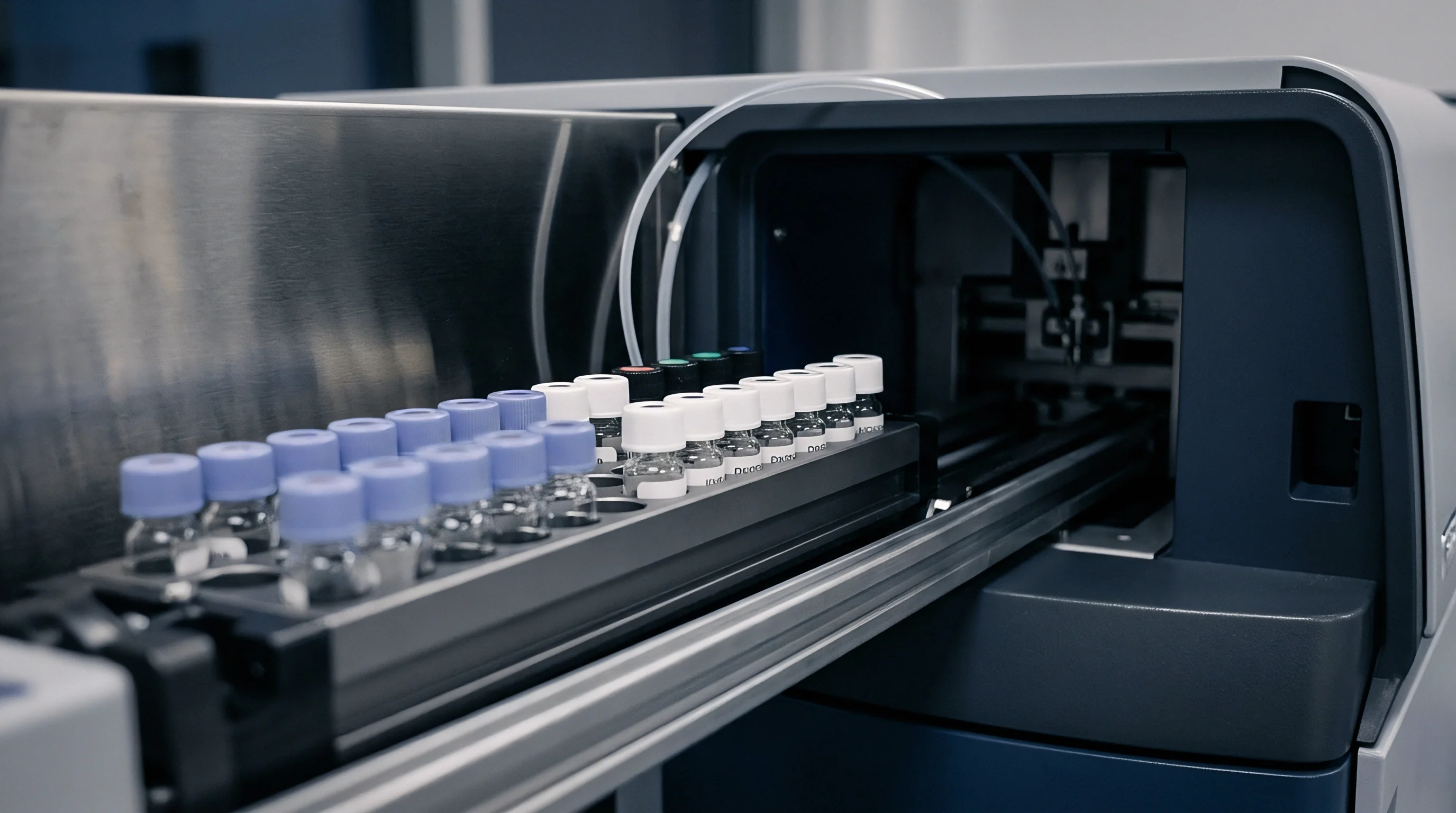
Laboratory analysis of composite plastics requires physical segregation of individual resin phases before chemical testing. Analytical instruments require homogeneous liquid extracts or uniform solid particles for accurate quantification. Testing whole, un-separated multi-material parts yields diluted analytical results that invalidate compliance assertions.
Solvents dissolve specific resin matrices. Subjecting an assembled plastic housing containing nylon, polybutylene terephthalate, and silicone to total solvent dissolution creates complex matrix interference. High-molecular-weight polymers precipitate during solvent extraction, clogging chromatographic injection ports and masking target substance peaks during mass spectrometry analysis.
Mechanical Segregation and Micro Precision Preparation
Technicians employ cryogenic milling, scalpel sectioning, and precision lathe turning to separate fused polymer layers. Mechanical separation isolates discrete resin phases down to sub-milligram sample quantities. Solid plastic components undergo cooling liquid nitrogen baths to increase brittleness, enabling precise fracture along thermal fusion lines between overmolded materials.
| Target Additive Class | Polymer Matrix | Sample Isolation Technique | Extraction Solvent System | Detection Limit (LOQ) |
|---|---|---|---|---|
Micro-dissection protocols require trained laboratory operators working under optical magnification. Technicians isolate plastic layers without cross-contaminating adjacent polymer phases. When overmolded interfaces demonstrate strong chemical bonding, razor sectioning cuts sample material precisely five micrometers clear of the mechanical transition zone to ensure sample purity.

Chromatographic Quantification and Method Sensitivity
Gas chromatography paired with mass spectrometry delivers accurate substance measurements down to trace concentrations. Liquid chromatography combined with tandem mass spectrometry quantifies high-boiling-point additives, hindered amine light stabilizers, and oligomeric flame retardants. Analytical sensitivity depends on achieving high extraction efficiency without thermal degradation of target analytes.
Analytical screening performed on composite melt samples obfuscates localized chemical thresholds and invalidates subpart compliance files.
- Cryogenic Fracture segregates rigid and flexible polymer phases cleanly along physical bond lines without thermal additive degradation.
- Solvent Selection must achieve complete swelling of the target polymer matrix while leaving adjacent insoluble substrates intact.
- Limit of Quantification thresholds for analytical equipment must sit at minimum one order of magnitude below the target statutory compliance limit.
- Procedural Blank Evaluation prevents laboratory cross-contamination during micro-dissection and trace solvent extraction sequences.
Screening multi-material plastic assemblies via whole-part melt homogenization creates severe dilution errors. A ten-milligram flame retardant additive contained within a one-gram plastic clip yields a true concentration of 1.0 percent (10,000 mg/kg). If that clip is ground together with ninety-nine grams of non-retarded enclosure housing prior to extraction, the analytical report will read 100 mg/kg, improperly clearing a non-compliant part.
It remains unclear how international laboratories will standardize cryogenic separation techniques for micro-injected thermoplastic vulcanizates bonded to glass-reinforced substrates.


Cascade
Information regarding restricted substances travels downstream through every tier of the manufacturing supply chain. Component manufacturers, assembly integrators, and brand owners must align data exchange formats to preserve subpart compliance records. Gaps in material disclosures erode liability protections and trigger customs delays at European borders.
Commercial suppliers often provide generic Declarations of Conformity that list compliance against whole finished product part numbers. These high-level declarations mask missing subpart data. When a regulatory authority requests supporting technical dossiers under Regulation (EC) No 1935/2004 or REACH Article 33, the placing entity must produce full analytical test reports or material disclosures for every individual article present in the assembly.

Supply Chain Information Disclosures
Bill of materials data structures record component mass values down to the discrete molded subpart level. Modern compliance software architecture demands mapping multi-level bills of materials to individual material composition files. Full Material Disclosures capture raw resin grade numbers, masterbatch additive formulations, and subpart dry weights.
SCIP database requirements under the Waste Framework Directive 2008/98/EC demand precise physical mapping of complex assemblies. A SCIP notification submission structures products hierarchically: top-level articles contain complex sub-assemblies, which in turn contain discrete primary articles. Each primary article containing a Substance of Very High Concern above 0.1 percent weight by weight requires independent registration, linking material details to specific geographic and structural locations inside the assembly.

Contractual Risk Allocation and Port Customs Surveillance
Commercial purchase agreements assign financial liability for non-compliant shipments held by border enforcement officers. Compliance clauses in supply contracts must require sub-tier molders to furnish subpart-level material composition declarations. Standard boilerplate assurances claiming general legal compliance fail to provide legal defense when customs authorities sample and test physical components.
Port enforcement authorities employ portable X-ray fluorescence analyzers and rapid laboratory extraction protocols during dockside import sweeps. When screening identifies restricted heavy metals, phthalates, or brominated additives in a specific plastic clip or bumper, inspectors seize the shipment. Importers who rely on whole-assembly concentration calculations cannot contest analytical seizures based on diluted subpart math.
Contract clauses must grant brand owners audit rights over sub-tier resin procurement records and mold configurations. Verifying that injection facilities do not introduce unapproved regrind or masterbatch formulations during production runs maintains the validity of original component article evaluations. A declaration resting on supplier assertions without physical sample segregation fails under regulatory scrutiny.