Analytical Verification of Non Intentionally Added Substances in Multi Layer Barrier Film Imports
Analytical verification of NIAS in multi-layer barrier films requires high-resolution mass spectrometry screening backed by toxicological threshold classification.


Bench
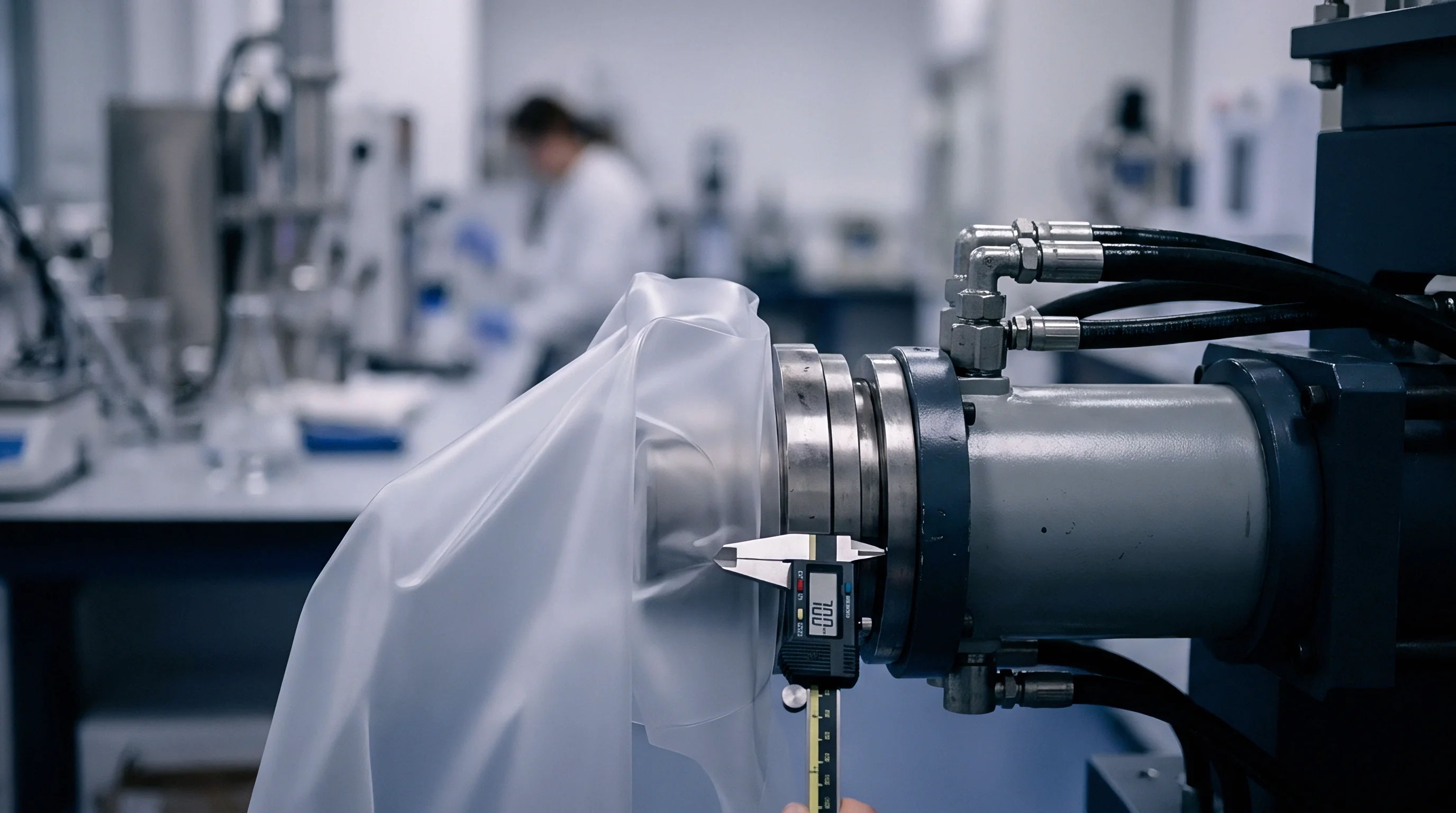
Analytical verification of non-intentionally added substances in imported multi-layer barrier films begins on the chromatograph bench. High-resolution mass spectrometry resolves compound matrices across polymers, adhesives, and functional coatings. Gas chromatography coupled with quadrupole time-of-flight mass spectrometry screens volatile and semi-volatile fractions up to five hundred Daltons.
Liquid chromatography high-resolution systems capture polar, non-volatile migrants between one hundred and one thousand two hundred Daltons. Laboratories execute extraction procedures using food simulants or solvent immersion under standardized contact conditions.
Extract concentration changes migrant recovery. Solvents like dichloromethane or ethyl acetate extract low-molecular-weight oligomers directly from polyethylene, ethylene vinyl alcohol, and polyurethane tie-layers. Evaporating these extracts risks stripping volatile reaction by-products.
Nitrogen blowdown requires thermal limits of thirty degrees Celsius to preserve trace volatiles. Authentic reference standards permit direct calibration for known migrants. Semi-quantification applies an internal standard such as deuterated benzophenone or diethyl phthalate when reference standards do not exist.
Response factors between target structures and internal markers vary by an order of magnitude. Quantification uncertainty expands accordingly.
Migrant recovery drops below sixty percent when solvent evaporation temperatures exceed thirty-five degrees Celsius.
Chromatographic peaks demand systematic deconvolution. Automated libraries match mass spectra against reference repositories with probabilistic scoring. Spectral similarities below eighty-five percent require tandem mass spectrometry fragmentation experiments to assign empirical formulas.
Accurate mass evaluation operates within a five parts per million mass error window. High resolution isolates isobaric contaminants that co-elute during rapid temperature programming.
Testing schedules dictate sampling depth. Retaining archive specimens protects against transit discrepancies.

Cleavage
Non-intentionally added substances emerge from chemical degradation during laminate conversion. Thermal degradation of polyolefins during high-temperature extrusion generates oxidized hydrocarbons, unsaturated aldehydes, and linear ketones. Ethylene vinyl alcohol barrier cores undergo chain scission and cross-linking at processing temperatures above two hundred twenty degrees Celsius.
Polyurethane adhesive formulations introduce cyclic reaction intermediates. Aromatic isocyanates reacting with polyester or polyether polyols form cyclic oligomers alongside intended linear polyurethane chains. Incomplete curing leaves free monomeric diisocyanates that hydrolyze into primary aromatic amines upon moisture contact.

Does Polyurethane Adhesive Cleavage Yield Primary Aromatic Amines?
Water molecules diffusing into unreacted aromatic isocyanate groups initiate spontaneous decarboxylation. Two distinct pathways govern this reaction: aromatic amine generation occurs through carbamic acid decomposition, followed by addition reactions with residual isocyanate to form asymmetric aromatic ureas. In laminate reels cured under low relative humidity, unreacted monomeric 4,4-diphenylmethane diisocyanate persists inside the adhesive bondline.
Subsequent contact with aqueous or acidic food simulants accelerates the extraction and hydrolysis of these monomers. Primary aromatic amines migrate directly into water-based food simulants, exceeding detection limits established under food contact regulations.
| Precursor Component | Cleavage Mechanism | Dominant Degradation Product | Retention Index Range |
|---|---|---|---|
| Polyurethane Adhesive | Hydrolytic scission of unreacted isocyanate | 4,4-Diaminodiphenylmethane | 1800 to 1950 |
| Solvent-Based Tie Layer | Esterification cyclization | Cyclic polyester oligomers | 2200 to 2800 |
| Polyethylene Sealant Layer | Thermo-oxidative radical scission | 2,4-Di-tert-butylphenol | 1400 to 1550 |
| Tris-phosphite Antioxidant | Oxidative hydrolysis | 1,3-Di-tert-butylbenzene | 1050 to 1180 |
| Erucamide Slip Additive | Atmospheric photo-oxidation | 13-Docosenamide breakdown amides | 2400 to 2600 |
Antioxidant breakdown represents another persistent contributor. Tris(2,4-di-tert-butylphenyl) phosphite sacrifices its phosphorus center to neutralize hydroperoxides, converting completely into its phosphate analogue. Severe processing conditions induce further hydrolytic fragmentation into 2,4-di-tert-butylphenol.
Secondary degradation products carry higher migration velocity through polyolefin skins than the parent additive molecule. Slip additives introduce equivalent complications. Erucamide undergoes oxidative cleavage along its central double bond, yielding pelargonic acid and shorter aliphatic chains that generate unpredicted peaks during headspace thermal desorption testing.
Converters frequently attribute elevated chromatographic peaks to unavoidable baseline noise from raw resin syntheses.

Reel
Physical roll geometry governs secondary contamination across imported film reels. High-speed flexographic or rotogravure printing applies inks and overprint varnishes to the outer substrate face. Printed films wind immediately into tight rolls under tension exceeding two hundred Newtons per linear meter.
Core compression forces the unprinted, food-contact sealant layer against the printed external surface. Photoinitiators, unreacted acrylate monomers, and residual printing solvents transfer across the physical boundary by mechanical contact. This set-off phenomenon deposits non-volatile compounds directly onto the contact layer without chemical migration through the barrier core.
Is Migration Modelling Accepted against Laboratory Screening?
Diffusion modeling relies on verified polymer partition coefficients and activation energies. Validated diffusion algorithms predict migration rates through polyolefin structures under European standard EN 13130 guidelines. Predictive calculations hit rigid operational limitations when applied to converted multi-layer laminates.
Unknown spatial distribution of adhesive reaction products invalidates one-dimensional Fickian diffusion equations. Set-off migration during winding bypasses the inner barrier layer entirely. Mathematical models treat multi-layer structures as ideal continuous sheets, missing boundary effects at inter-layer interfaces.
Article 16 of Regulation EC 1935/2004 binds the importer of record to absolute documentary traceability across every converting tier.
Testing must account for mechanical defects inside barrier cores. Biaxially oriented polyamide provides gas barrier attributes, yet mechanical flexing introduces micro-cracks that allow medium-weight volatiles to cross into the food contact zone. Aluminium foil layers below nine micrometers thickness contain pinholes from rolling operations.
Ethylene vinyl alcohol preserves gas impermeability only under controlled relative humidity. Water absorption plasticizes the polymer matrix, raising diffusion coefficients for polar non-intentionally added substances by two orders of magnitude.
- Core Tension Measurement evaluates reel winding forces to pinpoint mechanical set-off pressure zones across internal layers.
- Pinhole Density Quantitation measures microscopic voids in aluminium barrier plies below nine micrometers thickness under optical backlighting.
- Solvent Residue Trapping isolates volatile printing hydrocarbons via static headspace extraction at eighty degrees Celsius.
- Bondline Fluorimetry Screening maps unreacted adhesive monomer distributions across multi-ply interfaces before slitting.
Reel slitting introduces edge debris. Particulate matter settles between wound layers.
| Barrier Layer Chemistry | Layer Thickness | Test Molecule | Lag Time to Breakthrough |
|---|---|---|---|
| Ethylene Vinyl Alcohol (32 mol% ethylene) | 12 micrometers | Toluene | 720 hours |
| Ethylene Vinyl Alcohol (44 mol% ethylene) | 12 micrometers | Toluene | 210 hours |
| Biaxially Oriented Polyamide 6 | 15 micrometers | Benzophenone | 140 hours |
| Aluminium Foil (defect free) | 7 micrometers | Diisopropylnaphthalene | Exceeds 5000 hours |
| Aluminium Foil (5 pinholes/m2) | 7 micrometers | Diisopropylnaphthalene | 18 hours |
Purchasing agreements specify quality thresholds. Section 4.2 of supply agreement DIN-9831 requires converters to archive untouched production reel ends for twenty-four months to preserve analytical traceability.

Exposure
Toxicological qualification classifies unlisted substances by structural hazard. The threshold of toxicological concern system assigns unidentified or unlisted migrants to Cramer structural classes based on chemical functional groups. Cramer Class I covers simple chemical structures with low oral toxicity profiles, carrying an intake limit of one thousand eight hundred micrograms per person per day.
Cramer Class II covers intermediate chemical functional groups, permitting five hundred forty micrograms per person per day. Cramer Class III encompasses complex aromatic structures, heteroatoms, or reactive groups, reducing the intake ceiling to ninety micrograms per person per day. Carcinogenic or genotoxic alerts, such as free aromatic amines or alkylating agents, trigger an absolute limit of zero point zero ten micrograms per kilogram of food.
Translating analytical peaks into dietary exposure requires strict geometric conversion. European Union default conventions establish a packaging-to-food ratio of six square decimeters of film per one kilogram of packed foodstuff. Migration values reported in milligrams per square decimeter convert directly to food concentration values through this factor of six.
Testing with real foodstuffs presents extraction challenges due to fats and proteins interfering with chromatographic baselines. Regulation EU 10/2011 defines substitute food simulants to reproduce matrix interactions without matrix noise. Simulant D1 uses fifty percent ethanol in water for dairy emulsions.
Simulant D2 uses rectified olive oil, isooctane, or ninety-five percent ethanol for fatty food packaging.
A surface area to mass ratio of six square decimeters per kilogram converts analytical migrant limits into packaging compliance limits.
Simulant interactions alter polymer matrices. Ninety-five percent ethanol swells polyolefin sealant layers, swelling amorphous regions and artificially accelerating the diffusion of internal adhesive by-products. Modified polyphenylene oxide, marketed as Tenax, serves as Simulant E for dry food and elevated temperature contact.
Volatile and semi-volatile substances migrate into Tenax via gas-phase diffusion and contact adsorption. Thermal desorption followed by gas chromatography mass spectrometry quantifies migrants without liquid extraction steps.
- Declaration Verification matches raw polymer additive lists against finished film structure formulations.
- Simulant Selection maps intended end-use food categories against standardized solvent contacts.
- Thermal Exposure Calibration subjects test specimens to accelerated contact windows matching product shelf life.
- Chromatographic Profile Acquisition collects untargeted spectra across liquid and gas chromatography platforms.
- Toxicological Screening compares peak intensities against Cramer toxicity threshold tables.
Analytical quantification without authentic chemical standards introduces systematic measurement errors. Can toxicological thresholds be applied rigorously to substances identified solely through spectral library matching?
Dock
Customs officials examine declaration dossiers long before container seals break. Border rejection notifications across European Union entry ports show increasing interventions targeting food contact multi-layer films originating from overseas converters. Deficient documentation triggers immediate border detention.
Importers of record bear sole legal responsibility for verifying that imported films meet migration limits established under regional frameworks. Generic supplier certificates claiming compliance with Regulation EC 1935/2004 without supporting analytical reports are rejected during customs audits. Border laboratories draw representative specimens directly from landed shipping containers, submitting multi-layer films to ten-day overall and specific migration testing.
| Substance Category | Statutory Migration Limit | Designated Analytical Instrument | Simulant Matrix |
|---|---|---|---|
| Primary Aromatic Amines (individual) | 0.002 mg/kg food | LC-MS/MS (triple quadrupole) | 3% Acetic Acid |
| Primary Aromatic Amines (sum) | 0.010 mg/kg food | Photometric / LC-MS/MS | 3% Acetic Acid |
| Cyclic Polyurethane Oligomers | 0.050 mg/kg food | LC-QTOF-MS | 50% Ethanol |
| Benzophenone Photoinitiators | 0.600 mg/kg food | GC-MS (single quadrupole) | Tenax (MPPO) |
| Total Non-Volatile Extractables | 10.0 mg/dm2 film | Gravimetric residue analysis | Rectified Olive Oil |
Importers encounter extensive financial fallout when non-intentionally added substances exceed statutory limits. Demurrage charges accumulate daily while detained containers await laboratory confirmation. Port storage fees compound the primary testing costs.
Discoveries of genotoxic migrants inside converted films mandate full product recalls, inventory quarantine, and hazardous waste destruction at the importer of record expense.