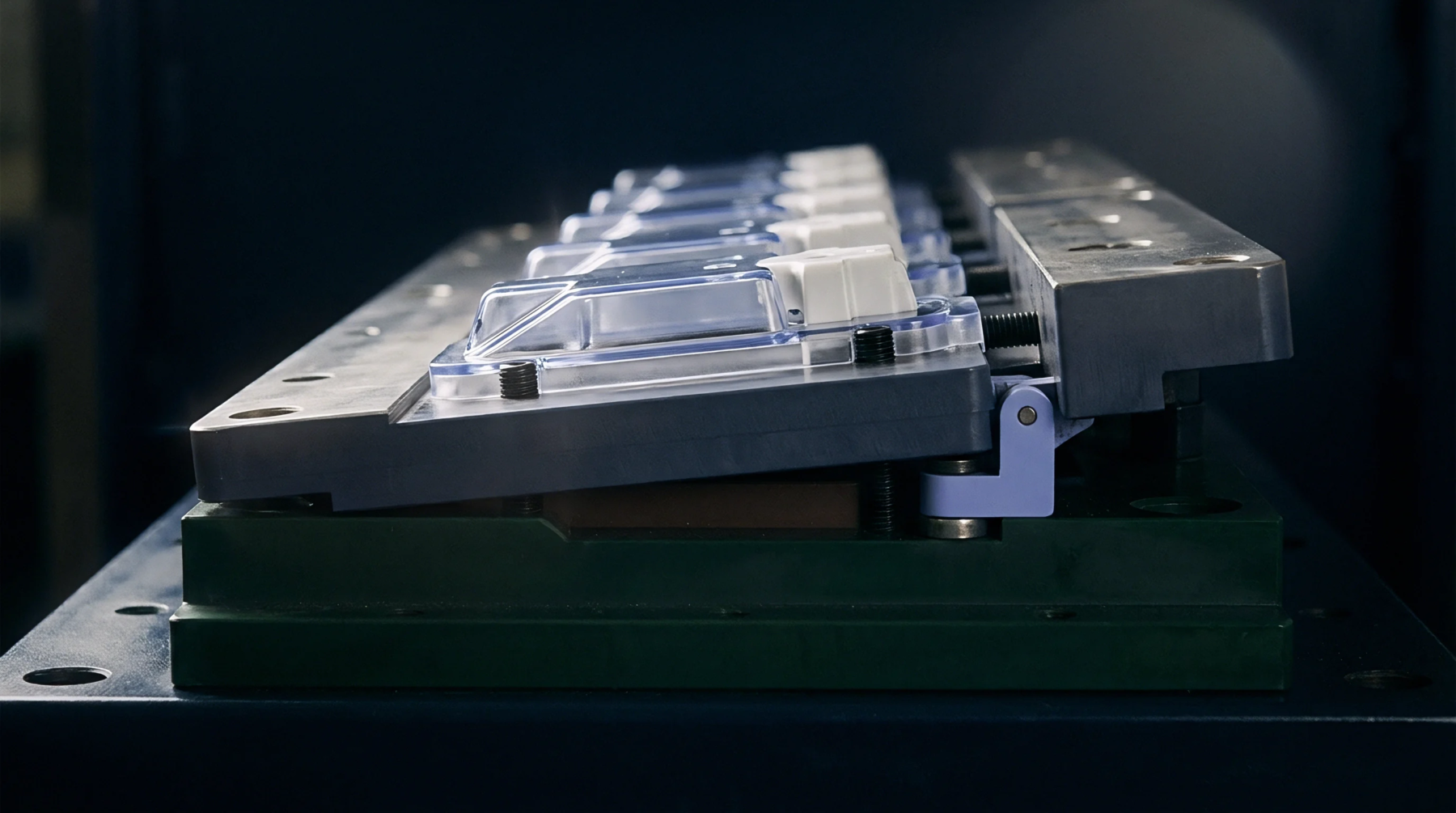
Interfacial Heat Transfer Coefficient Calibration under Injection Cavity Pressure Curves
Calibrating interfacial heat transfer against cavity pressure curves replaces guess-work with exact pressure-dependent thermal conductance functions.
Glass fiber thermal conductivity is a physical property that quantifies how rapidly heat transfers through a composite matrix reinforced with silicate filaments. Polyamide and polycarbonate compounds experience directional heat dissipation governed by this metric, which depends directly on filler loading fractions and polymer crystallinity. Tooling designers specify this property during the compounding phase to predict mold cooling rates and prevent localized hotspots inside injection cavities.
Excessive thermal transfer variance across a production batch creates differential volumetric shrinkage, which triggers warpage and dimensional rejection in finished housings. Material specifications define the baseline heat transfer coefficient of the raw pellet, whereas part specifications dictate the actual thermal gradient across a moulded geometry. Virgin polymer batches exhibit stable thermal propagation profiles, whereas repeated processing degrades the reinforcement structure and lowers the bulk conductivity measurement.
Moulders holding tight geometric tolerances must compensate for the discrepancy between laboratory datasheet values and the effective thermal conductivity achieved during high speed injection cycles.
Polymeric matrices possess inherently low phonon mobility, so introducing directional reinforcement channels thermal energy along the orientation axis of the injection flow. Crystallite orientation density dictates how efficiently phonons cross the interphase boundary between the thermoplastic resin and the embedded silicate strands. Extrusion temperatures set the initial dispersion quality of the reinforcement network, ensuring uniform thermal bridges throughout the structural cross section.
Processors monitor barrel thermal profiles to maintain adequate wetting of the sizing agent on the glass filaments, because poor interfacial adhesion creates micro voids that impede heat flux. Regrind material introduces broken filaments with reduced aspect ratios, lowering the bulk thermal conductivity and shifting the thermal equilibrium of the mold. Operators running regrind streams must adjust cooling channel fluid temperatures downward to match the heat extraction rate established during virgin material validation runs.
Mold designers calculate cycle times using thermal diffusivity equations derived from the specific heat capacity and density of the reinforced compound. Heat transfer through the steel tool wall controls the solidification rate of the skin layer, locking in the orientation of the subsurface fiber network. Thick walled sections trap thermal energy longer, promoting localized crystallization that alters mechanical performance relative to thin walled regions.
Injection speed variations alter shear forces within the runner system, causing local segregation of the filler material and uneven thermal conductivity across the part. Dimensional stability relies on uniform heat extraction from both the core and the cavity halves during the high pressure packing phase.
Differential cooling rates between the fiber rich core and the resin rich skin generate internal stresses that manifest as geometric distortion upon part ejection. Moulders mitigate thermal warping by balancing mold temperature controllers to eliminate temperature gradients between the stationary and moving tool halves. Part inspection protocols measure flatness deviations against CAD models to verify that the thermal conductivity of the compound produced the intended heat dissipation symmetry.
Excessive thermal insulation in thick ribs causes sink marks because the core remains molten after the gates freeze off. Structural housing failures occur when localized thermal variations reduce the impact strength of the composite below the threshold required for end use deployment.
Calibrating interfacial heat transfer against cavity pressure curves replaces guess-work with exact pressure-dependent thermal conductance functions.
Expertise is a utility, not a secret. sentiention™ publishes its working knowledge as open reference: intelligence layer covering the materials it sources, the markets it enters, and the reference that serves both.