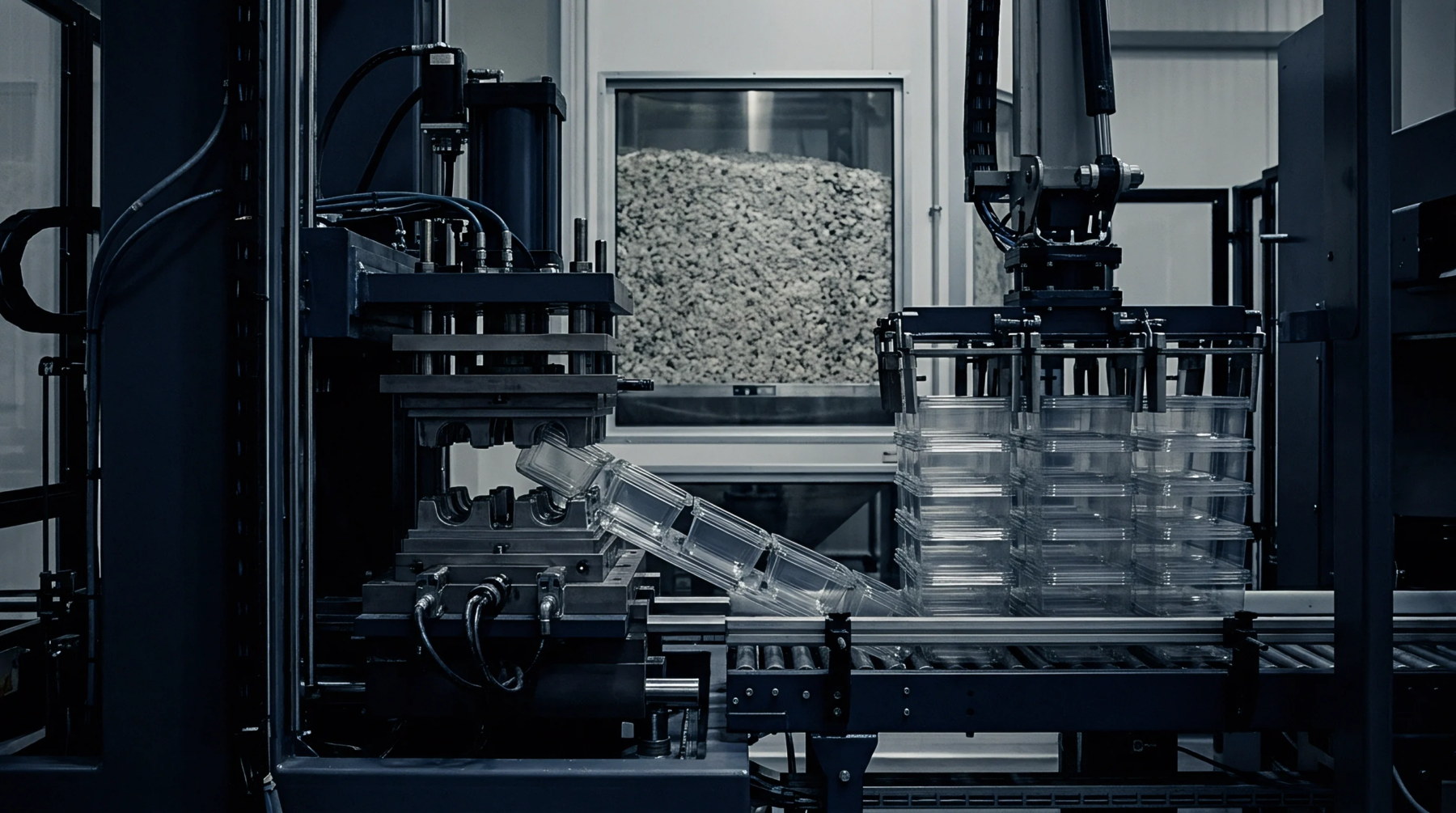
Thermoforming against Injection for Volumes below Fifty Thousand Units
Thermoforming delivers lower total landed cost below fifteen thousand units by saving upfront tooling capital, beyond which injection piece price efficiency dominates.
Computer-controlled mechanical removal of excess material from a plastic component follows a preprogrammed path to reach final dimensions. This cnc trimming process utilizes a rotating cutter or high-speed spindle to shape moulded parts by shedding unwanted flash or cured overflows. It applies to thermoset composites and structural thermoplastics where dimensional stability demands removal of rough edges left by the moulding tool.
Operation occurs after the primary shape sets but before the piece enters final inspection or assembly. Tooling geometry determines the quality of the finish and the speed of execution, while vacuum fixtures hold the lightweight part against the mechanical force exerted during the operation. Precise path control prevents thermal stress or structural compromise at the edge of the material.
A well-calibrated machine maintains tolerances that match the part design criteria without introducing micro-cracks or excessive heat buildup in the matrix of the resin.
Surface integrity depends on the interaction between spindle speed and feed rate. High rotational rates prevent chatter on rigid polymers, whereas lower speeds keep brittle materials from developing fractures during the machining cycle. Correct tool selection offsets the risk of delamination in glass-reinforced resins, as sharp cutters shear fibers rather than pulling them from the polymer binder.
Excessive heat from a dull bit creates a localized melt zone, which leaves a rough texture and increases the post-trim cleanup cost for the production line. Consistent pressure ensures the part remains seated in the fixture throughout the movement, preventing deviations that lead to thin walls or sharp burrs along the trim line. Engineers set these variables to balance production throughput with the requirement for a clean finish.
Virgin material cost dictates that manufacturers recover as much functional geometry as possible during the initial moulding phase. Excess trim scrap generated by loose tolerances adds to the overhead of every produced unit, especially when regrind is incompatible with the final application. Moulders maintain tight control over the location of the gate and parting line to minimize the amount of material that requires subsequent removal.
Large volumes of waste necessitate additional logistics for disposal or reclamation, which adds to the total unit cost. Skilled technicians align the software paths with the actual position of the part in the jig to avoid removing useful sections of the component. Reducing the amount of offcut material improves the yield per unit of raw resin consumed during the fabrication stage.
Deviations from the programmed coordinate system cause the tool to bite too deep or miss the target edge. Vibration within the machine frame creates a wavy surface finish that requires secondary sanding to correct. Poor vacuum grip permits the part to shift, resulting in dimensional failure where the finished edge sits outside the permitted range for assembly.
Proper maintenance of the guide rails and spindle bearings keeps the head stable during high-speed travel. A rigid fixture prevents resonant frequencies from developing in large, thin-walled moulded parts. Final results reflect the interplay between machine precision and tool sharpness.
Thermoforming delivers lower total landed cost below fifteen thousand units by saving upfront tooling capital, beyond which injection piece price efficiency dominates.
Expertise is a utility, not a secret. sentiention™ publishes its working knowledge as open reference: intelligence layer covering the materials it sources, the markets it enters, and the reference that serves both.