Calculating Masterbatch Addition Rates for Post Consumer Polyethylene Compounds
Masterbatch let-down rates for post-consumer polyethylene compounds require mass-balance adjustments offsetting baseline additives, ash, and carrier viscosity.


Formulation
Incoming certificates of analysis for post-consumer recycled polyethylene regularly omit the residual functional additives already circulating within the polymer chains. When a compounding extruder takes in recycled high-density polyethylene pellet lots bearing an unknown heat stabilizer history and a melt flow rate of 0.85 g/10 min at 190 °C under a 2.16 kg load per ISO 1133, calculating masterbatch let-down rates strictly from virgin resin equations guarantees off-spec mechanical values. The primary mathematical relationship calculates masterbatch addition percentage by dividing the target active ingredient concentration in the final compound by the nominal active concentration supplied within the carrier pellet.
Recycled feedstocks corrupt this direct arithmetic. The incoming flakes or pellets frequently contain degraded phenolic antioxidants, carbon black residues from prior conversion cycles, and inorganic particulate burdens that dilute or actively consume the newly introduced functional concentrates.
Determining the actual addition rate demands a mass balance calculation separating the virgin carrier contribution from the contaminated polymer mass. Active loadings differ. Let the target active stabilization level in the finished compound be denoted as Ct, expressed as a weight fraction.
Let the concentration of active additive in the commercial masterbatch be Cmb, and let the pre-existing background concentration of that active chemistry within the post-consumer feedstock be Cpcr. The required mass fraction of masterbatch, denoted as M, derives from the balance equation where the total delivered active mass equals the sum of the components:
Ct = (M × Cmb) + ((1 – M) × Cpcr)
Solving for the masterbatch fraction M yields the governing relationship:
M = (Ct – Cpcr) / (Cmb – Cpcr)
When compounding virgin polymer, Cpcr equals zero, reducing the calculation to the baseline ratio Ct / Cmb. If a post-consumer film blend of linear low-density and low-density polyethylene contains a known residual primary antioxidant fraction of 0.04 weight percent (400 ppm) determined via high-performance liquid chromatography, and the compounding target requires 0.15 weight percent (1500 ppm) active hindered phenol stabilizer utilizing a 10.0 weight percent active masterbatch, the calculation shifts noticeably:
M = (0.0015 – 0.0004) / (0.1000 – 0.0004) = 0.0011 / 0.0996 = 0.01104
The required addition rate equals 1.104 weight percent. Running the calculation without measuring the background residue dictates a 1.500 weight percent addition rate. That error adds 3.96 kilograms of unneeded concentrate per metric tonne of compound.
At typical functional additive concentrate prices, that delta expands compounding costs without technical gain, and risks surface blooming during downstream blown film extrusion.
DIN EN 15344 Annex B mandates documentation of batch melt flow rates and inorganic ash thresholds before compounders calculate additive replenishment volumes.
Color masterbatch calculations demand equal scrutiny. When tinting post-consumer natural high-density polyethylene, the base polymer possesses a baseline yellowness index (ASTM E313) ranging between 8.0 and 22.0, alongside variable opacity from cross-contamination with polypropylene caps or pigmented shreds. The masterbatch addition rate calculation cannot rely solely on the target pigment loading percentage.
It must incorporate an opacity compensation coefficient. Pigment let-down calculations that ignore base grey-shift force operators to over-dose colorants at the throat of the extruder, depressing tensile yield performance and elevating compound density above specification limits.
Standard purchase specifications governed by DIN EN 15344 clause 4.2 enforce strict batch acceptance ranges for melt mass-flow rate and density, allowing converters to reject lots that deviate by more than 20 percent from the agreed nominal value.
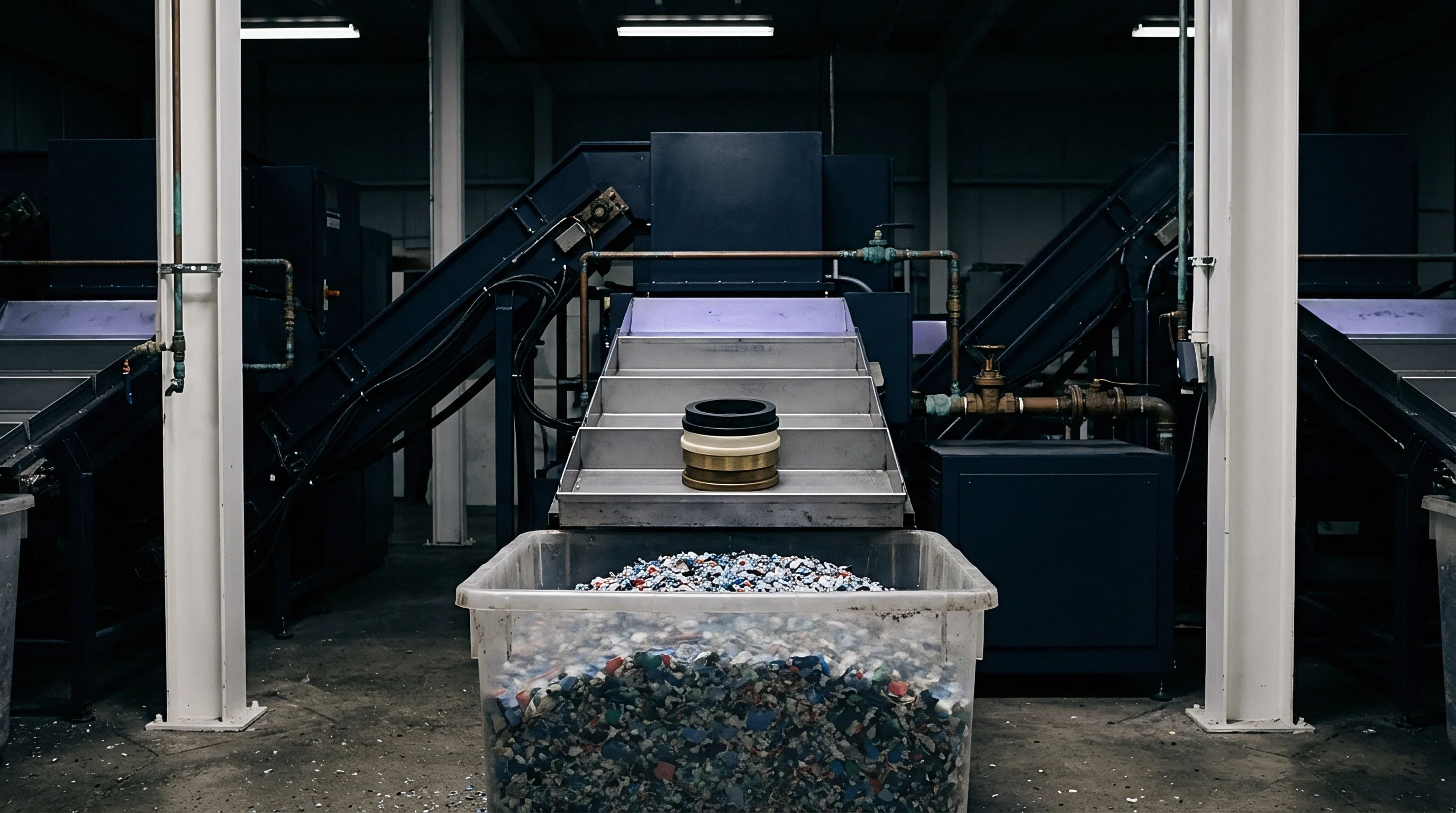
Feed
Gravimetric dosing units deliver additive concentrates based on loss-in-weight measurements calibrated against standard virgin pellet bulk geometries. Post-consumer polymer streams present severe physical morphology disparities. While a standard spherical or cylindrical polyethylene masterbatch pellet maintains a poured bulk density between 0.52 and 0.58 g/cm³, recycled polyethylene regrind flakes fluctuate between 0.28 and 0.42 g/cm³, and re-pelletized post-consumer materials vary from 0.46 to 0.54 g/cm³ depending on degassing efficiency and die-face cutting geometry.
Density differences dictate volume.
Volumetric dosing augers encounter erratic screw-flight filling when metering masterbatch into uncompacted flake. If the screw flight fills incompletely, the physical addition rate drops below the calculated setpoint, starving the melt of stabilizer or pigment. Conversely, when gravimetric feeders manage both streams, the rapid cyclic corrections induced by flake bridging in the main hopper cause the masterbatch feeder to over-compensate during momentary loss of main polymer flow.
Pellet mass varies widely.
| Material Stream | Physical Geometry | Bulk Density (g/cm³) | Feeder Screw Type | Mass Delivery Variance (%) |
|---|---|---|---|---|
| Virgin Carrier Masterbatch | Uniform cylindrical pellet | 0.56 | Twin-screw concave | ± 0.25 |
| Post-Consumer rHDPE Repelletized | Strand-cut lens pellet | 0.50 | Single-screw open flight | ± 1.10 |
| Post-Consumer rLDPE/LLDPE Flake | Shredded film flake ( | 0.31 | Large-pitch twin auger with agitator | ± 4.80 |
| High-Load Mineral Filler Masterbatch | Dense micro-pellet (70% CaCO3) | 1.25 | Twin-screw fine pitch | ± 0.40 |
| Post-Consumer rHDPE Bottle Regrind | Rigid flake fraction ( | 0.38 | Single-screw with bridge-breaker | ± 3.20 |
Compounding operations managing recycled feeds compensate for bulk density differences by establishing specific mass metering ratios rather than relying on volumetric cylinder speed percentages. Gravimetric blenders positioned directly above the extruder throat must sample and adjust feed rates at intervals under two seconds. Flake stratification in intermediate hoppers causes natural classification, where heavier masterbatch pellets migrate downward through looser recycled flakes during mechanical vibration.
The result is an initial surge of additive followed by additive starvation across the remainder of the gaylord or silo transfer cycle.
Downstream converters running blown film or blow molding lines suffer continuous bubble instability, localized parison sagging, and persistent gauge variation when feed throat stratification enters the melting zone unchecked.


Variance
Residual contaminants inside post-consumer polyethylene compounds distort the target chemistry by interacting directly with the masterbatch components. Mineral fillers like calcium carbonate and talc arrive from prior converting lives where they functioned as antiblock agents or structural stiffeners. Ash testing conducted per ISO 3451-1 method A (calcination at 600 °C) uncovers inorganic filler levels ranging from 0.5 to 8.0 weight percent in post-consumer blow molding grades.
Talc stiffens the wall. Calcium carbonate acts as an abrasive sink, adsorbing polar additives such as light stabilizers (hindered amine light stabilizers, or HALS) and primary phenolic antioxidants, stripping them from the amorphous polymer phase.

What Adjustments Offset Recyclate Ash Content?
Baseline ash measurements dictate an immediate upward adjustment in the stabilizer masterbatch let-down calculation to neutralize physical adsorption losses. Basic steric hindrance calculations show that surface adsorption on sub-micron mineral particulates deactivates up to 25 percent of typical monomeric HALS molecules. When compounding rPE containing 3.0 percent residual calcium carbonate, the addition rate of a tertiary amine light stabilizer concentrate must climb proportionally above the original clean-polymer design.
Active loadings must account for the following critical adjustments during rate derivation:
- Mineral Adsorption Factor balances the polar attraction between high-surface-area calcium carbonate or talc particles and hydroxyl groups on primary antioxidants. Compounding engineers apply an empirical multiplier between 1.15 and 1.30 to the active antioxidant dosing rate when ash content exceeds 2.5 weight percent.
- Carbon Black Tint Masking compensates for background grey or dark-green hues in mixed-color post-consumer streams. Calculating white masterbatch (titanium dioxide) addition requires spectrophotometric evaluation per ASTM E1331, increasing TiO2 loading from a standard 2.0 percent up to 5.5 percent to achieve acceptable L-values above 85.
- Polypropylene Cross-Contamination Ratio offsets the rheological imbalance introduced by commingled polypropylene caps in fractional-melt rHDPE bales. Differential scanning calorimetry per ISO 11357-3 identifies the PP fraction via its 160 °C to 165 °C melting endotherm, triggering an adjustment in elastomeric compatibilizer masterbatch addition rates.
- Acid Neutralization Over-Dose counteracts acidic decomposition products formed during prior re-extrusion cycles. Halogen scavengers, such as synthetic hydrotalcite or calcium stearate, are dosed at 0.10 to 0.25 weight percent above baseline values to protect process tooling from pitting corrosion.
Extrusion pressure spikes. The presence of baseline carbon black inside grey post-consumer agricultural film pellets ruins attempts to calculate standard colorant let-downs. Carbon black masks undertones.
A baseline level of merely 0.2 weight percent carbon black completely dominates the spectral absorption spectrum, rendering organic pigment additions useless for pastel or translucent targets.
A residual ash content of four percent by mass consumes over one-fifth of active phosphite stabilizers through surface adsorption during twin-screw processing.
Compounders frequently discover that suppliers report nominal masterbatch active contents based on chemical synthesis feed weights rather than final pellet assays, asserting that thermal processing losses within their own compounding facility fall within allowable commercial trade tolerances.


Matrix
Polymer carriers within masterbatch pellets control how efficiently active additives disperse throughout the host post-consumer polyethylene melt. Virgin masterbatches typically use high melt flow rate carrier resins, often an injection-grade LLDPE or LDPE with an MFR between 15 and 30 g/10 min (190 °C / 2.16 kg), ensuring rapid melting and distributive blending into lower-flow matrices. Post-consumer HDPE compounding streams, however, frequently run fractional melt indices between 0.20 and 0.80 g/10 min (190 °C / 2.16 kg) to maintain parison strength or environmental stress crack resistance (ESCR).
A carrier with an excessively high melt flow creates an extreme viscosity mismatch. The low-viscosity masterbatch carrier melts prematurely in the feed zone, coating the screw flights and causing severe slip against the barrel wall.

Where Does Carrier Incompatibility Induce Delamination?
Melt viscosity divergence between the carrier resin and the post-consumer matrix generates uneven shear distribution along the screw profile. If the shear stress fails to reach the critical threshold needed to break pigment agglomerates, uncolored or unstabilized domains persist throughout the compound. Carrier selection must align with the post-consumer host morphology per the data compiled below:
| Carrier Polymer Type | Carrier MFR (190 °C / 2.16 kg) | Target Recycled Host | Viscosity Ratio (Carrier / Host) | Dispersion Efficiency |
|---|---|---|---|---|
| LLDPE (Butene copolymer) | 20.0 g/10 min | rHDPE Blow Molding (0.35 g/10 min) | 0.018 | Poor; prone to screw slip and gel clusters |
| LLDPE (Octene copolymer) | 4.5 g/10 min | rLLDPE Blown Film (0.90 g/10 min) | 0.200 | Excellent; uniform film bubble distribution |
| HDPE (Homopolymer) | 8.0 g/10 min | rHDPE Pipe Grade (0.25 g/5.0 kg) | 0.095 | Good; preserves stiffness and hoop strength |
| Homo-Polypropylene | 12.0 g/10 min (230 °C) | rPE Mixed Fraction (1.20 g/10 min) | — | Fails; forms distinct immiscible lamellar phases |
| Ethylene Vinyl Acetate (18% VA) | 3.0 g/10 min | rLDPE Extrusion (0.75 g/10 min) | 0.250 | Superior; lower melting point aids early release |
The melt fracture persists. Beyond viscosity matching, additive carriers dilute the physical properties of the post-consumer matrix if added at high percentages. Adding 5.0 weight percent of an LDPE-based black masterbatch to a pipe-grade rHDPE compound drops the flexural modulus (ISO 178) by approximately 60 to 90 MPa, and lowers the tensile strength at yield (ISO 527-2) by up to 4.0 percent.
The let-down rate calculation must therefore account for the carrier polymer as an active mechanical contaminant.
To preserve environmental stress crack resistance tested under ASTM D1693 Condition B (10% Igepal CO-630 at 50 °C), the compounding formulation must minimize low-molecular-weight carrier fractions. Volatiles vent through ports. High-molecular-weight carriers, or direct additive injection utilizing liquid dosing systems, avoid carrier-induced stress cracking failures entirely.
Gels trigger bubble blowouts.
Masterbatch carrier resins comprising more than three percent of the total finished blend weight must be reported as distinct polymer components under international recyclability design standards.
Whether secondary crystallization phenomena between high-density post-consumer fractions and branched low-density carrier resins can be fully stabilized across multiple thermal re-processing generations remains an unresolved engineering question.

Yield
Financial calculations for post-consumer polyethylene compounds ultimately link active masterbatch dosing accuracy directly to operating profit margins and conversion yield rates. In post-consumer plastics sourcing, raw material accounts for 55 to 70 percent of total compound manufacturing cost. Masterbatch concentrates, particularly performance packages containing secondary phosphite process stabilizers, hindered amine light stabilizers, and sub-micron slip agents, command prices five to twelve times higher per kilogram than the base post-consumer polymer.
Over-dosing by a fraction of a percent erodes conversion margins across metric tonnage runs.
Consider a continuous compounding line producing 12,000 metric tonnes annually of certified post-consumer rHDPE compound for blow-molded industrial containers. The engineering specification mandates an active long-term heat stabilization package consisting of a 1:1 blend of Tris(2,4-di-tert-butylphenyl)phosphite and Octadecyl-3-(3,5-di-tert-butyl-4-hydroxyphenyl)propionate at a net concentration of 2,000 ppm (0.20 weight percent) in the final pellets. The masterbatch purchased carries a 20.0 weight percent active loading in an HDPE carrier, commanding a delivered price of 6.20 EUR per kilogram, while the incoming washed rHDPE flake prices at 0.95 EUR per kilogram.
- Baseline Formulation Run operates assuming zero background stabilizer in the flake. Masterbatch addition rate sits at 1.00 weight percent (10.0 kg masterbatch per metric tonne of compound). The masterbatch cost contribution equals 62.00 EUR per tonne of finished compound.
- Assayed Formulation Run detects 450 ppm of active residual hindered phenol stabilizer inside the incoming flake lots via solvent extraction and gas chromatography-mass spectrometry. Recalculating the required let-down rate reduces masterbatch addition to 0.776 weight percent (7.76 kg masterbatch per metric tonne). Masterbatch cost drops to 48.11 EUR per tonne.
- Annual Operational Variance across the 12,000-tonne production run realizes a direct raw material cost reduction of 166,680 EUR. Processing energy, screw wear, and inventory holding costs remain completely identical between the two calculation models.
Moisture creates visual splay. Regrind bulk density collapses. Screen packs plug early.
Beyond direct formulation costs, imprecise let-down rates degrade compounding line throughput. If an antioxidant package is under-dosed due to inaccurate flake density compensation, the post-consumer polyethylene undergoes rapid thermo-oxidative crosslinking within the compression zones of the extruder screw. Gel counts escalate exponentially.
Screen pack differential pressure increases rapidly, forcing premature line shutdowns for breaker plate maintenance.
| Addition Precision Profile | Screen Pack Life (Hours to 180 Bar Delta) | Extruder Throughput (kg/h) | Finished Pellet Gel Count (per m² Film) | Scrap Rate on Downstream Film Lines (%) |
|---|---|---|---|---|
| Uncorrected Volumetric Dosing (± 15%) | 4.5 | 1,420 | 450 | 6.8 |
| Standard Gravimetric Dosing (± 5%) | 12.0 | 1,650 | 120 – 180 | 2.4 |
| Assay-Adjusted Gravimetric Dosing (± 1%) | 28.5 | 1,780 | 0.8 |
Higher masterbatch dosing accuracy stabilizes head pressure and prevents screen pack blinding. The compounding line maintains maximum design screw speeds without generating excessive shear heat that degrades vulnerable recycled molecules. Downstream converters avoid costly warranty claims tied to premature environmental stress cracking or pinhole formation in thin-gauge linings.
Stable let-down calculations protect plant margins.
High carrier loading degrades melt stability when shear energy rises uncontrollably.