Verifying Monomer Compliance and Non Intentionally Added Substances in Polymer Import Supply Chains
Verifying monomer compliance and non-intentionally added substances requires batch-level analytical screening paired with complete upstream declarations.
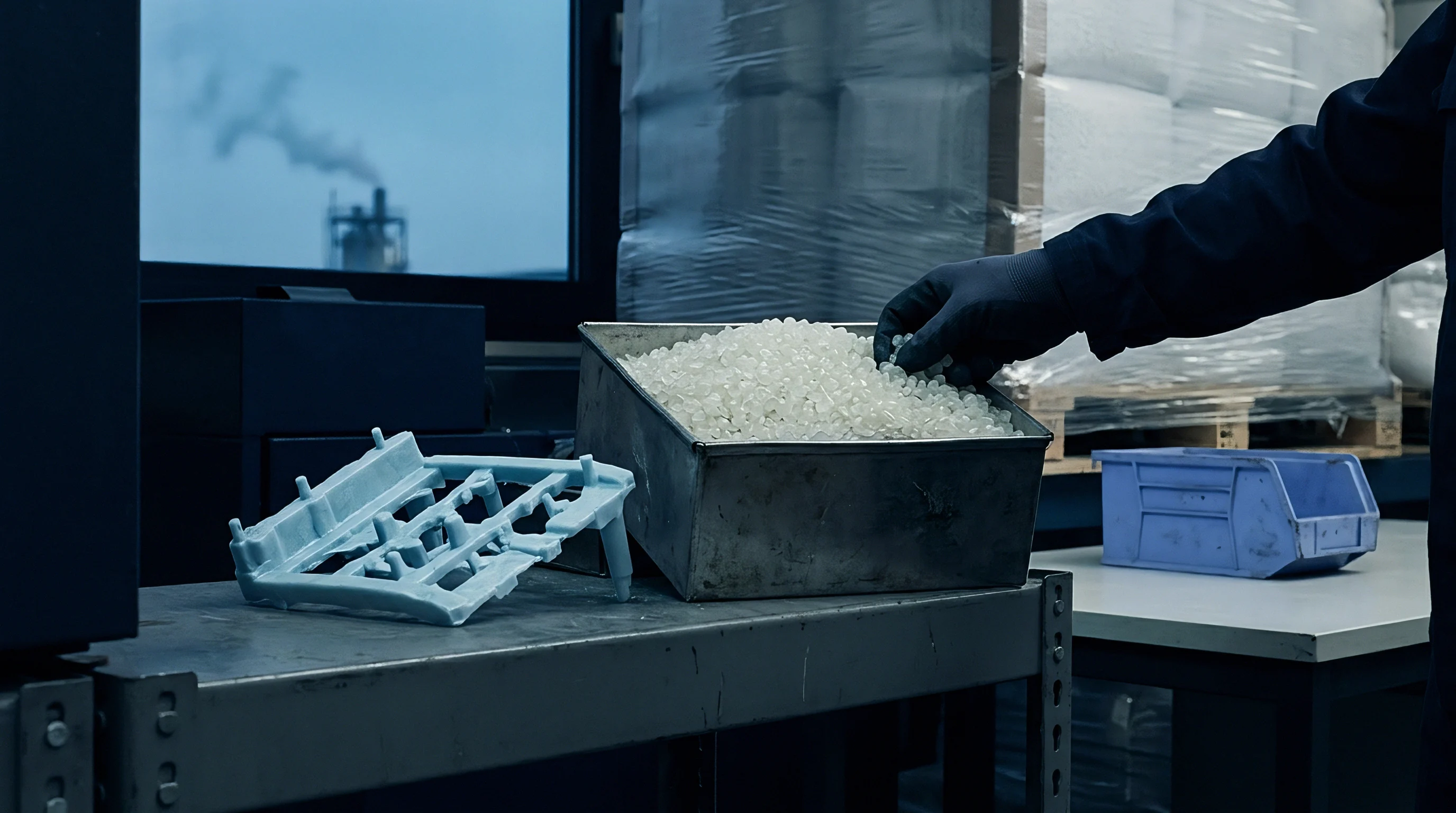

Melt
Unreacted chemical precursors remaining inside virgin polymer pellets migrate into food products when processing conditions fail to drive reactions to complete conversion. Industrial synthesis of food-grade packaging resins operates within precise thermodynamic boundaries, yet equilibrium dynamics leave measurable fractions of unpolymerized monomer distributed throughout the solid polymer matrix.

Thermal Conversion and Residual Monomer Kinetics
High-density polyethylene and polypropylene production relies on organometallic catalysts operating under controlled pressure to link olefin units into extended polymer backbones. Polymerization rarely reaches complete conversion. Kinetic limitations, steric hindrance, and localized catalyst deactivation leave unreacted ethylene or propylene dissolved inside the molten polymer stream.
In polycondensation reactions producing polyethylene terephthalate, the reversible nature of esterification generates residual terephthalic acid, isophthalic acid, and ethylene glycol. Polystyrene production exhibits an equilibrium limit where unreacted styrene monomer remains trapped at levels between two hundred and one thousand parts per million within the glassy polymer matrix prior to devolatilization.
Thermal history during processing determines whether secondary reaction products outnumber primary chemical residues in the final article.
Unreacted monomers remain inside. Temperature accelerates mass transfer. When virgin resin pellets enter the converter extrusion barrel, elevated thermal energy increases the thermodynamic activity of these residual molecules.
High processing temperatures increase the diffusion coefficient of small molecules through the amorphous regions of the polymer network, accelerating their movement toward the packaging surface.

Degradation Pathways Forming Volatile Side Products
Exposing thermoplastic resins to shear forces inside processing extruders breaks polymer chains through homolytic bond cleavage. Polymer melt temperatures exceeding two hundred and forty degrees Celsius induce thermo-oxidative degradation in polyolefins. Alkyl radicals formed during mechanical shearing react with oxygen dissolved in the polymer feed, initiating free-radical cascade reactions.
This degradation pathway generates short-chain alkanes, alkenes, ketones, and aldehydes, including hexanal and acrolein.
Process stabilisers added to protect the polymer melt undergo degradation themselves. Hindered phenol antioxidants like Irganox 1010 scavenge peroxy radicals, formingquinoid transformation products. Organophosphite secondary antioxidants, such as Irgafos 168, reduce hydroperoxides to alcohols while oxidizing to tris(2,4-di-tert-butylphenyl)phosphate.
Shear stress breaks polymer chains. Thermal breakdown of these secondary additives yields 2,4-di-tert-butylphenol, a low-molecular-weight aromatic compound capable of migrating into aqueous and fatty food simulants. In polyamides, caprolactam residues re-equilibrate at extrusion temperatures, forming cyclic dimers and trimers that persist in the finished film.
Resin exporters frequently state that vacuum degassing during pelletization removes all unreacted volatile precursors, ignoring the subsequent thermal generation of decomposition products inside the converter injection molding barrel.


Probe
Identifying unknown chemical migratants requires advanced chromatographic isolation paired with high-resolution detector systems. Analytical evaluation must separate intentionally added additives from reaction side-products, breakdown compounds, and structural impurities present in imported polymer goods.

Targeted Specific Migration Analysis by Chromatography
Quantifying known residual monomers uses calibrated gas or liquid separation systems coupled to single-quadrupole or triple-quadrupole mass spectrometers. Specific migration limits set by regulatory authorities reflect substance-specific toxicological thresholds. Bisphenol A, used in polycarbonate synthesis and epoxy canister linings, carries a specific migration limit of 0.05 milligrams per kilogram in food contact materials.
Measuring bisphenol A migration requires exposing packaging specimens to food simulant B, three percent acetic acid, or simulant D2, ninety-five percent ethanol, for ten days at forty degrees Celsius, followed by reverse-phase liquid chromatography with tandem mass spectrometry detection.
Gas chromatography separates volatiles. Volatile monomers such as vinyl chloride monomer and acrylonitrile demand headspace gas chromatography coupled to flame ionization or mass selective detection. Vinyl chloride monomer carries a strict limit of non-detection, defined by an analytical detection limit of 0.01 milligrams per kilogram in the packaging material or food simulant.
Caprolactam migration from nylon films is evaluated using gas chromatography with nitrogen-phosphorus detection following migration testing into ten percent ethanol for ten days at sixty degrees Celsius, against a specific migration limit of 15 milligrams per kilogram.

Untargeted High Resolution Mass Spectrometry Workflows
Non-intentionally added substances comprise oligomers, additive degradation products, internal lubricants, reaction side products, and environmental contaminants. Discovering these unknown migratants demands untargeted screening workflows utilizing high-resolution mass spectrometry platforms, such as quadrupole time-of-flight or Orbitrap mass spectrometers.
Gas chromatography QTOF evaluates volatile and semi-volatile substances below five hundred Daltons. Liquid chromatography QTOF with electrospray ionization captures polar, non-volatile compounds, including polyethylene terephthalate cyclic oligomers. Cyclic PET trimers, tetramers, and pentamers migrate from hot-fill containers into aqueous and fatty food simulants.
Matrix effects obscure minor peaks. Quantifying untargeted peaks relies on semi-quantification, where peak areas of unidentified signals are calculated against deuterated internal standards, such as deuterated toluene or deuterated dicyclohexyl phthalate.
A semi-quantitative screening limit of 0.01 mg/kg in 10 percent ethanol after 10 days at 60 °C establishes the minimum sensitivity needed for untargeted NIAS evaluation.
- Peak Coelution Hazards Interferences from broad polymer additive peaks obscure minor non-target substance signals in standard gas chromatograms.
- Matrix Ion Suppression Liquid chromatography electrospray ionization sources suffer reduced response factors when co-extracted oligomers enter the mass spectrometer ionization chamber.
- Simulant Evaporation Loss High-temperature exposure during extraction with volatile simulants alters solute concentrations and yields artificially inflated concentration readings.
- Response Factor Variance Quantifying unknown substances using an arbitrary internal standard introduces quantitative uncertainty spanning an order of magnitude.
| Method | Target Volatility | Representative Analytes | Limit of Detection | Primary Application |
|---|---|---|---|---|
| Headspace GC-MS | Volatile under 150 °C | Vinyl chloride, Acrylonitrile, Styrene | 0.005 mg/kg | Residual monomer quantification |
| GC-QTOF | Semi-volatile 150 to 400 °C | Antioxidant breakdown, Phthalates | 0.010 mg/kg | Non-target NIAS screening |
| LC-QTOF (ESI+) | Non-volatile over 300 Da | PET cyclic oligomers, Photoinitiators | 0.010 mg/kg | Polar oligomer identification |
| ICP-MS | Elemental / Inorganic | Antimony, Titanium, Zinc catalysts | 0.001 mg/kg | Catalyst residue determination |
Unidentified chromatographic peaks exceeding an equivalent concentration of 0.01 milligrams per kilogram require toxicological evaluation under the Threshold of Toxicological Concern approach. Compounds categorized as Cramer Class I present low oral toxicity, carrying a human exposure threshold of 1.8 milligrams per kilogram body weight per day. Cramer Class III compounds, containing complex functional groups or aromatic structures, trigger a lower threshold of 0.09 milligrams per kilogram body weight per day.
Potential genotoxic structural alerts demand a target threshold of 0.0025 milligrams per kilogram body weight per day.
Analytical laboratories continue to evaluate whether low-intensity chromatogram peaks below the conventional toxicological threshold demand exhaustive structure identification when computational toxicology algorithms flag potential DNA-reactive structural alerts.


Batch
Laboratory test reports certifying a single hand-selected resin sample fail to guarantee legal compliance across full-scale container shipments. Manufacturing variability across compounding runs, colorant masterbatch additions, and regrind usage creates chemical divergence between pristine test specimens and commercial import lots.

Statistical Sampling for Import Lot Qualification
Verifying chemical consistency across twenty-tonne ocean freight containers requires structured sampling schemes based on international acceptance quality limits. Sampling errors invalidate lab reports. Batch variation introduces hidden risk.
A single analytical report submitted by an overseas converter often reflects resin produced under ideal laboratory conditions rather than continuous manufacturing shifts.
Consider an import shipment of 40,000 thermoformed polypropylene food containers weighing 20 tonnes. The nominal container mass is 50 grams, presenting an internal contact surface area of 1.8 square decimetres for a food volume of 0.25 kilograms. The actual surface-to-volume ratio of this package equals 7.2 square decimetres per kilogram of food.
European compliance framework conventions assume a standardized ratio of six square decimetres per kilogram of food.
Laboratory testing of a submitted sample measures specific migration of an Irgafos 168 degradation product in simulant D2 at 0.80 milligrams per square decimetre. Calculated using the conventional standard assumption of six square decimetres per kilogram, the predicted food concentration equals 4.80 milligrams per kilogram, falling within the specific migration limit of 5.0 milligrams per kilogram. Calculated using the actual container packaging geometry of 7.2 square decimetres per kilogram, the true migration reaches 5.76 milligrams per kilogram.
Package geometry alters contact density. Small contact areas elevate migration. Migration depends on concentration.
The actual packaging exceeds the legal restriction despite passing the conventional prototype evaluation.
Testing conducted solely under the EU conventional surface-to-volume ratio of six square decimetres per kilogram fails to protect buyers when actual packaging geometry imposes a higher contact density.
| Lot Size Range (Units) | Sample Code Letter | Sample Size (Units) | Acceptance Number (Ac) | Rejection Number (Re) |
|---|---|---|---|---|
| 3,201 to 10,000 | K | 125 | 3 | 4 |
| 10,001 to 35,000 | L | 200 | 5 | 6 |
| 35,001 to 150,000 | M | 315 | 7 | 8 |
| 150,001 to 500,000 | N | 500 | 10 | 11 |
| Methods Note: Acceptance numbers reflect Acceptable Quality Limit (AQL) 1.0 for major analytical non-conformities under single normal sampling. | ||||
- Inspect outer shipping container seals and record container identification numbers against the bill of lading.
- Select palleted cartons across top, middle, bottom, front, and rear stack positions using random number generation.
- Extract individual packaging specimens using clean cotton gloves to avoid cross-contamination from handling oils.
- Place extracted specimens inside airtight fluoropolymer bags and seal immediately with argon purge.
- Affix chain-of-custody tracking labels detailing lot number, timestamp, sampling depth, and inspector identity.
Accepting a supplier test report generated from a pristine resin prototype rather than the landed commercial shipment exposes the importer to customs impoundment, mandatory cargo re-export, and immediate forfeiture of port clearance privileges.


Dossier
Documentary evidence verifying food contact compliance flows through every intermediate tier of the polymer converting chain before product entry. Importers carry full legal liability for placing plastic packaging on target markets, making complete conformity files essential for defending import declarations against customs audits.

Mandatory Components of Food Contact Declarations
Regulation (EU) 10/2011 Annex IV sets rigid explicit requirements for information contained within written compliance statements. Intermediate suppliers omit key details. Formal declarations require signed documentation.
Declarations must track resin composition from base polymer synthesis down to masterbatch additions and barrier adhesives.
A declaration of conformity that conceals substance identities behind generic commercial trade names shifts the entire burden of verification onto the entity importing the finished article.
- Issuer Legal Identity The full corporate name, registered office address, and authorized signature of the entity manufacturing or importing the intermediate resin.
- Substance Restriction Disclosure Explicit lists of monomers, additives, and reaction products subject to specific migration limits in Annex I or Annex II.
- Dual Use Additive Declarations Identifiers for direct food additives present in the polymer matrix to prevent cumulative concentration limit breaches in final food products.
- Contact Boundary Specifications Definitive operating limits defining allowable food types, contact duration, temperature ranges, and surface-to-volume scaling ratios.
- Functional Barrier Validation Analytical verification proving that non-authorized substances located behind a functional barrier remain below 0.01 mg/kg migration.

When Does a Declaration Fail to Protect the Importer?
Upstream suppliers frequently issue generic compliance certificates that omit specific usage limitations, simulant restrictions, or dual-use additive disclosures. A declaration covering intermediate polymer granules does not automatically validate a thin-walled thermoformed tray processed under high heat. Converting processes change chemical structure.
Colorant carriers, slip additives like erucamide, and printing ink photoinitiators introduced during final converting introduce unlisted migratants. When a certificate of conformity references obsolete testing standards or fails to name the specific manufacturing lot loaded into the ocean container, regulatory authorities deem the compliance file incomplete.
Incorporating Annex IV compliance language into purchase contract specifications converts ambiguous quality promises into an enforceable legal warranty requiring upstream resin compounders to disclose all restricted monomers and dual-use additives.


Recourse
Financial losses resulting from non-compliant imported polymers extend far beyond the direct purchase price of the raw resin. Port authorities hold non-compliant freight. Unverified resins cause costly rejections.
Importers bear primary financial responsibility for customs holds, storage penalties, product recalls, and cargo destruction charges when imported polymer articles breach statutory migration limits.

Financial Exposure in Import Regulatory Enforcement
Customs authorities conducting port health screening seize non-compliant containers, placing full financial responsibility onto the importer of record. Demurrage charges at commercial sea ports accumulate rapidly, ranging from two hundred to five hundred Euros per container for every day cargo remains held under customs quarantine. Re-exporting rejected shipments to overseas ports of origin requires secondary freight booking and customs clearance fees.
Mandatory destruction of hazardous or non-compliant plastic waste at licensed incinerators adds five thousand to fifteen thousand Euros per container in disposal fees.
Commercial contracts that lack specific compliance testing conditions leave buyers unable to recover recall expenses from overseas resin converters.

Contractual Mechanisms for Supplier Indemnification
Structuring international supply agreements requires linking letter-of-credit disbursements to accredited independent analytical testing certificates. Payment holds enforce analytical quality. Overseas converters operating outside domestic judicial jurisdictions frequently ignore post-clearance damage claims once funds clear international banking channels.
Standard supply contracts must stipulate that batch sampling occurs at port of arrival prior to final invoice settlement.
Contracts should define explicit reimbursement mechanisms covering demurrage costs, third-party laboratory fees, and commercial product recall liability if analytical screening detects unauthorized non-intentionally added substances or monomer migration exceeding statutory specific migration limits.
Sourcing polymer articles across international borders demands linking final payment releases directly to accredited laboratory test results rather than relying on supplier indemnification promises after goods pass customs.