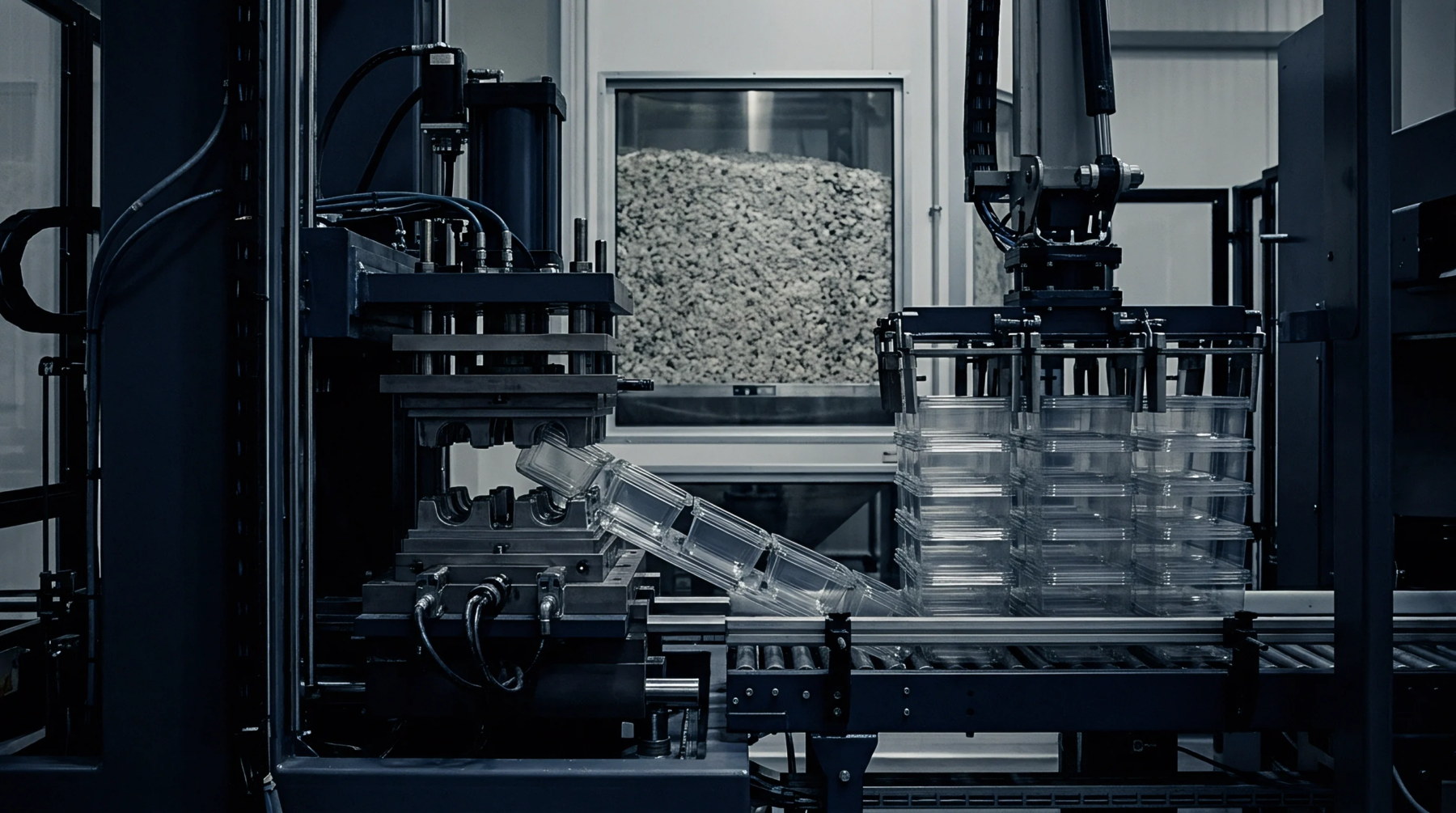
Thermoforming against Injection for Volumes below Fifty Thousand Units
Thermoforming delivers lower total landed cost below fifteen thousand units by saving upfront tooling capital, beyond which injection piece price efficiency dominates.
Virgin polymer economics anchor the baseline calculation for raw resin pricing, which defines the financial terms governing the purchase of base petrochemical pellets before compounding additives or masterbatch colorants enter the supply chain. This commercial benchmark determines the cost structure for injection moulding and extrusion operations by establishing the baseline value of polyethylene, polypropylene, and engineering thermoplastics. The boundary of the metric stops at the hopper throat, excluding freight surcharges, warehouse holding expenses, and downstream processing overhead.
Market volatility alters feedstock availability, forcing compounders and converters to adjust purchasing schedules continuously.
Material standards dictate the mechanical properties expected from a specific polymer batch, separating base resin characteristics from the dimensional tolerances of a finished moulded component. Technical datasheets provide melt flow index values and tensile strengths measured under laboratory conditions, but production environments rarely duplicate those ideal parameters across a multi-cavity tool run. Operators experience short shots, flash, and warpage when melt temperature or injection pressure drifts outside the narrow operating window established during initial sampling.
Virgin polymer streams command premium valuations because molecular weight distribution remains uniform, whereas regrind introduces chain degradation that compromises impact resistance and tensile yield strength. Strict quality control protocols prevent contaminated scrap from entering high-stress automotive or medical assemblies, preserving structural integrity under load.
Supplier contracts shift risk between resin producers and moulding facilities through indexed pricing formulas tied to upstream monomer costs and regional supply balances. Converters absorb raw material inflation unless supply agreements contain cost adjustment clauses that pass rising expenses down to the end customer. Large-scale buyers secure volume discounts by committing to annual tonnage minimums, leaving smaller processors vulnerable to spot market spikes and allocation limits.
Processing scrap offsets virgin resin expenditure when regrinding operations remain internal, though thermal history degrades polymer chains and limits the permissible percentage of recycled material in structural parts. Equipment wear accelerates when abrasive fillers enter the compound, adding maintenance overhead that offsets initial material savings.
Injection pressure stability depends heavily on batch-to-batch viscosity consistency, requiring toolmakers and processors to adjust machine parameters when raw material properties fluctuate. Excessive moisture content in hygroscopic resins causes polymer hydrolysis inside the barrel, generating surface blisters and silver streaks that ruin part aesthetics. Dimensional repeatability suffers when melt density varies across shipments, forcing technicians to recalibrate cooling times and packing profiles to maintain strict part tolerances.
Scrap rates climb immediately when variable resin behaviour forces frequent mould adjustments, turning marginal material savings into expensive production downtime. Supplier reliability ultimately determines whether a processing facility maintains profitable cycle times without constant operator intervention.
Thermoforming delivers lower total landed cost below fifteen thousand units by saving upfront tooling capital, beyond which injection piece price efficiency dominates.
Expertise is a utility, not a secret. sentiention™ publishes its working knowledge as open reference: intelligence layer covering the materials it sources, the markets it enters, and the reference that serves both.