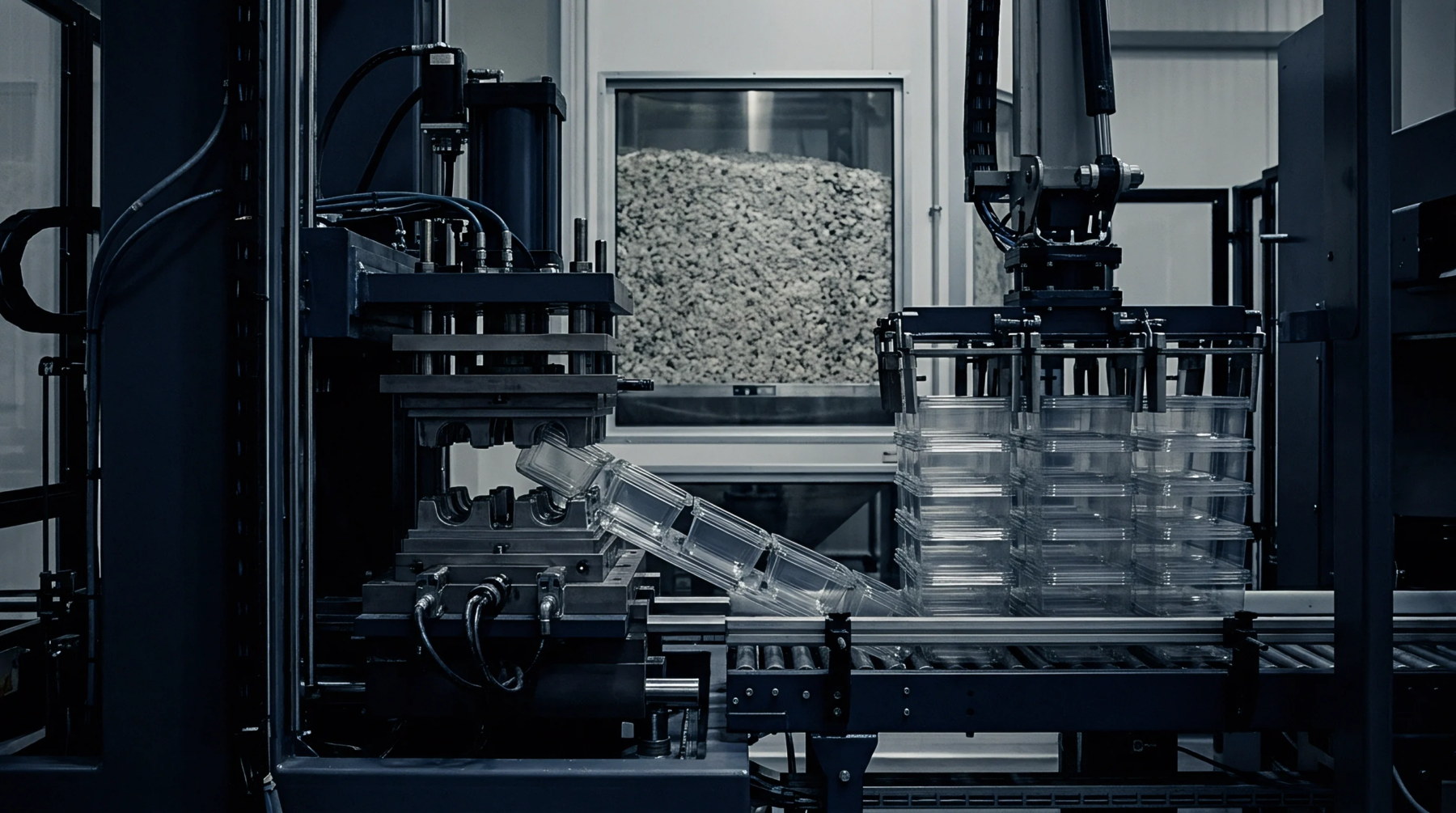
Thermoforming against Injection for Volumes below Fifty Thousand Units
Thermoforming delivers lower total landed cost below fifteen thousand units by saving upfront tooling capital, beyond which injection piece price efficiency dominates.
A male core functions as the stationary or protruding segment of an injection mould assembly that occupies the interior cavity to shape the hollow geometry of a thermoplastic part. Engineers designate this component to define the inner wall thickness, internal draft angles, and negative features that do not release from the primary parting line of the moulding machine. Precise alignment between the male core and the corresponding female cavity prevents uneven wall distribution during the high pressure injection phase.
When production cycles initiate, the molten resin flows around this geometry before cooling into a solid shell. The physical dimension of the component dictates the internal volume of the finished item while ensuring the part slides off the tool without mechanical interference. The functional boundary of the assembly ends where the stripper plate or ejector pins interface with the hardened steel surface of the mould segment.
The stability of a male core determines the perpendicularity and circularity of the produced polymer vessel throughout the manufacturing life of the tool. Manufacturers select specific tool steels such as hardened stainless or pre-hardened alloys to resist the constant thermal contraction forces exerted by the shrinking plastic resin during every cycle. Soft materials deform under the repeated impact of high velocity polymer streams, leading to ovality in parts that should possess a perfect radius.
If the geometry shifts by even a few microns, the wall thickness variation induces internal stress concentrations that eventually result in premature cracking. Operators verify these clearances using coordinate measuring machines to ensure the central position remains absolute from the first shot to the end of the production run.
Regrind ratios directly impact the wear characteristics of a male core, particularly when the recycled material contains abrasive flame retardants or glass fibre reinforcements. Virgin resin provides a predictable melt viscosity that allows the tool to fill evenly without forcing the steel components out of their locked alignment. High concentrations of regrind change the flow front behaviour, causing the pressure against the mould surfaces to fluctuate during the packing stage.
Excessive pressure leads to metal fatigue at the base of the core where the cross section narrows to accommodate complex interior geometries. Moulders must account for the density variations of secondary feedstocks to prevent the tool from experiencing mechanical binding during the high heat cycles.
Maintenance intervals for a male core rely on the surface finish requirements of the final component and the chemical properties of the processed resin. Acidic byproducts from polyacetal or certain flame retardant additives trigger pitting on the polished surface of the metal insert. Pitting increases the friction between the solidified plastic and the steel, which causes the part to stick during the ejection sequence.
Regular cleaning removes the microscopic layers of degraded plastic that accumulate in the textures of the tool. A well maintained surface ensures that the release forces remain within the rated limits of the machine hydraulic system. This component provides the absolute structural baseline for the mass production of hollow polymer parts.
Thermoforming delivers lower total landed cost below fifteen thousand units by saving upfront tooling capital, beyond which injection piece price efficiency dominates.
Expertise is a utility, not a secret. sentiention™ publishes its working knowledge as open reference: intelligence layer covering the materials it sources, the markets it enters, and the reference that serves both.