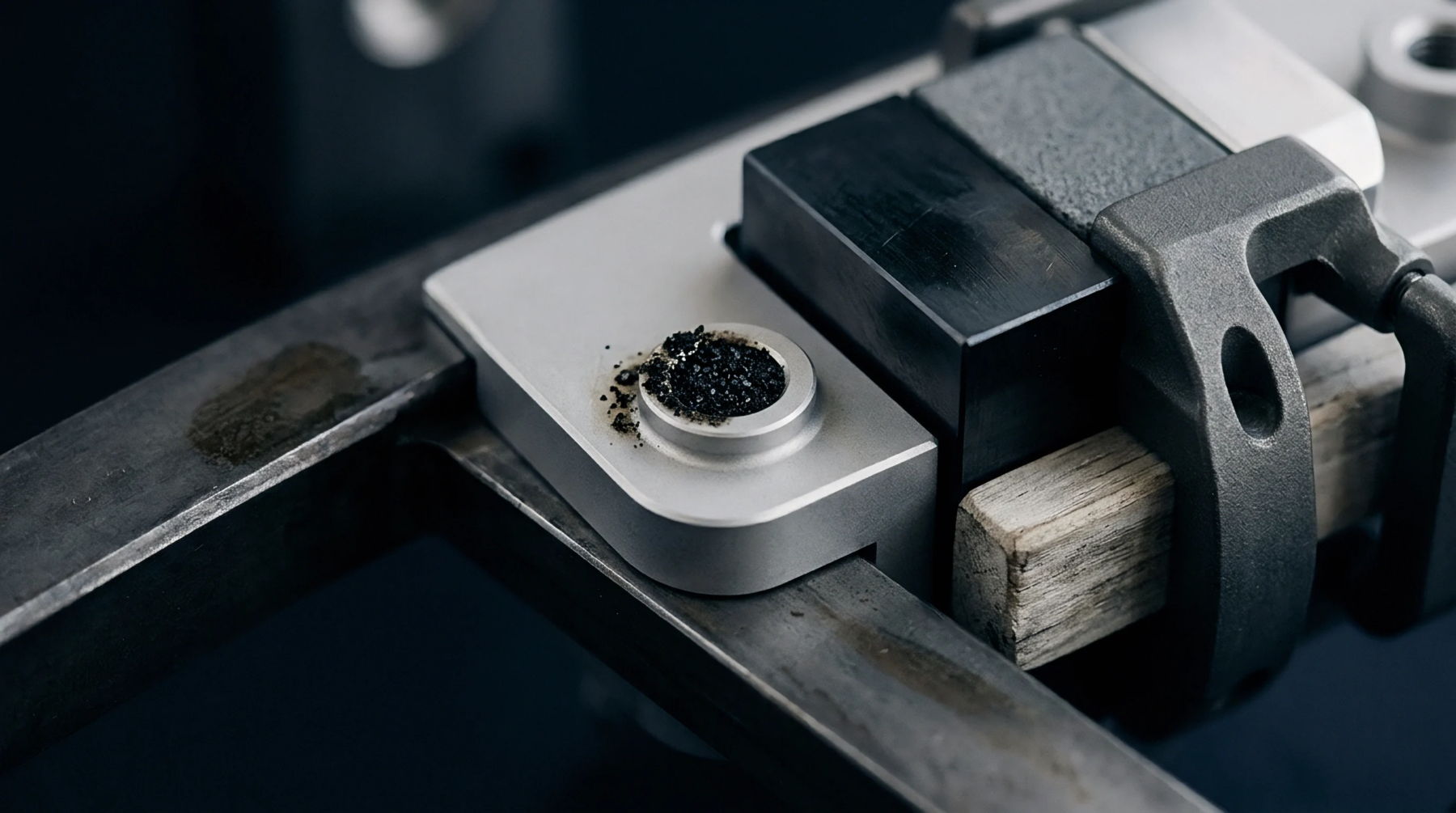
Injection Mold Parting Line Wear Inspection Basics
Inspect parting line wear using optical blueing and depth micrometer checks to catch shutoff hobbing before flash exceeds 0.03 mm.
Polypropylene part trimming relies upon kiss off recutting to excise excess flash from enclosed apertures without shifting the remaining wall geometry. This secondary tooling operation presses a sharpened steel rule or matched shear edge against a designated land on the underside of the component while the injection moulded article remains clamped in a dedicated fixture. Excess material separates cleanly along the established shear line because the die travel stops precisely at the parting plane defined by the mould maker.
Thermoplastic parts with deep draws and complex internal ribs require this mechanical shearing method to prevent the structural distortion that occurs during manual knife trimming. Tooling engineers establish the shear depth during prototype trials by adjusting shim stacks beneath the cutting rule until clean separation happens without crushing the underlying polymer structure.
Steel rule dies lose their primary edge sharpness rapidly when processing mineral filled polypropylene compounds because abrasive calcium carbonate particles accelerate abrasive wear along the bevel. Toolmakers specify through hardened tool steel or laser hardened cutting edges to extend the service life of the die before sharpening becomes necessary. Moulders track the frequency of edge maintenance by monitoring the appearance of white stress whitening around the cut perimeter, a visual indicator that dull steel is tearing the matrix rather than shearing it cleanly.
Production lines running unfilled homopolymer polypropylene experience lower frictional heating during the cut, which reduces thermal softening at the sheared boundary and preserves dimensional tolerances across large production batches.
Dimensional variations between individual injection moulded parts create alignment challenges when automated presses execute kiss off recutting on high shrinkage crystalline polymers. Ambient shop floor temperature fluctuations alter the dimensions of the thermoplastic article after demoulding, causing the peripheral shear edge to land slightly off centre from the designated land. Tooling designers compensate for this thermal movement by incorporating spring loaded locating pins that register on the interior datum features of the part before the cutting stroke engages.
Part specifications tolerate a maximum edge burr height of zero point two millimetres along the cut perimeter, and any deviation beyond this threshold indicates that the locating nest has worn beyond its acceptable service limit.
Automated trimming systems recover economic efficiency by converting continuous post mould scrap into high density regrind suitable for blending with virgin polymer streams. Operators collect the excised polymer slugs immediately beneath the cutting die and route them through a granulator equipped with a fine screen to produce consistent flake geometry. Virgin polypropylene costs more per kilogram than regrind material, so maintaining a steady scrap recovery loop lowers the total material expense for high volume packaging components.
Quality control protocols limit the incorporation rate of reground scrap to twenty percent by weight in structural grades to prevent molecular chain degradation from reducing the tensile strength of the finished article.
Inspect parting line wear using optical blueing and depth micrometer checks to catch shutoff hobbing before flash exceeds 0.03 mm.
Expertise is a utility, not a secret. sentiention™ publishes its working knowledge as open reference: intelligence layer covering the materials it sources, the markets it enters, and the reference that serves both.