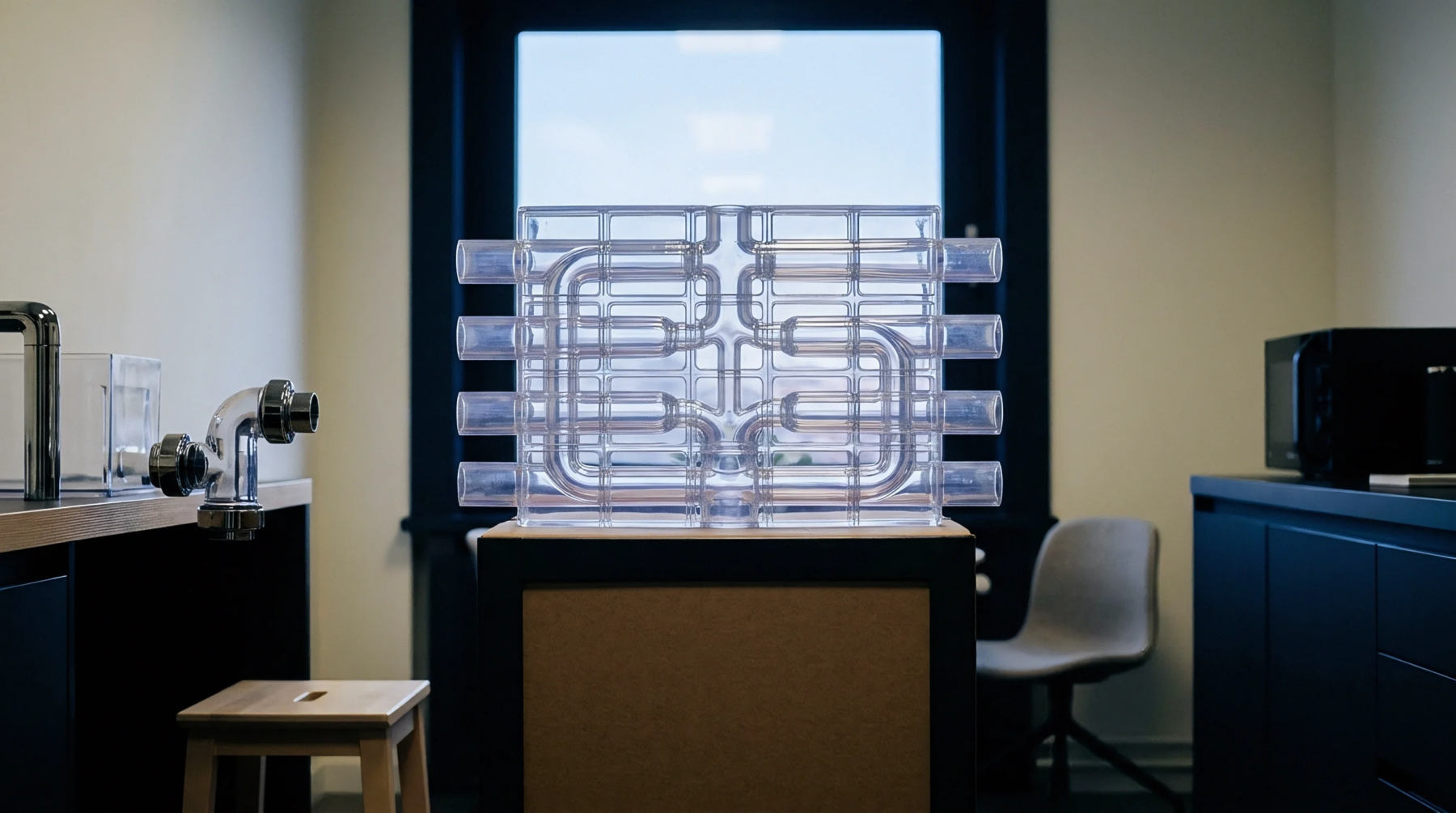
Meaning
Structural reinforcement features in thin-walled plastic parts provide stiffness without adding excessive wall thickness. A high-aspect rib achieves this stiffening by extending deep into the mould cavity with a height-to-width ratio often exceeding four to one. This design maintains part rigidity while minimizing material usage.
It prevents the formation of heavy sections that would otherwise slow down the cooling phase.
Flow Pattern
Filling deep, narrow channels requires high melt temperatures and sufficient injection pressure. As the polymer melt enters a high-aspect rib, the increased surface-to-volume ratio causes rapid freeze-off if the velocity is too low. Rapid fill rates prevent hesitation lines and incomplete packing.
Defect Prevention
Moulded parts frequently suffer from surface depressions when internal projections shrink more than the outer skin. Incorporating a high-aspect rib requires a very thin root thickness to prevent sink marks on the cosmetic surface opposite the projection. This dimension is typically restricted to sixty percent of the nominal wall thickness to balance stiffness and cosmetics.
Careful drafting ensures the feature remains functional without causing cosmetic flaws or localized stress concentrations that weaken the assembly.
Ejection Dynamic
Extracted parts are vulnerable to distortion when they cling to deep steel pockets. During the cooling cycle, the high-aspect rib shrinks onto the male core, generating significant frictional resistance. Incorporating a generous draft angle along the rib face is necessary to facilitate clean release.
Adequate ejector pin surface area prevents the pins from punching through the warm plastic.