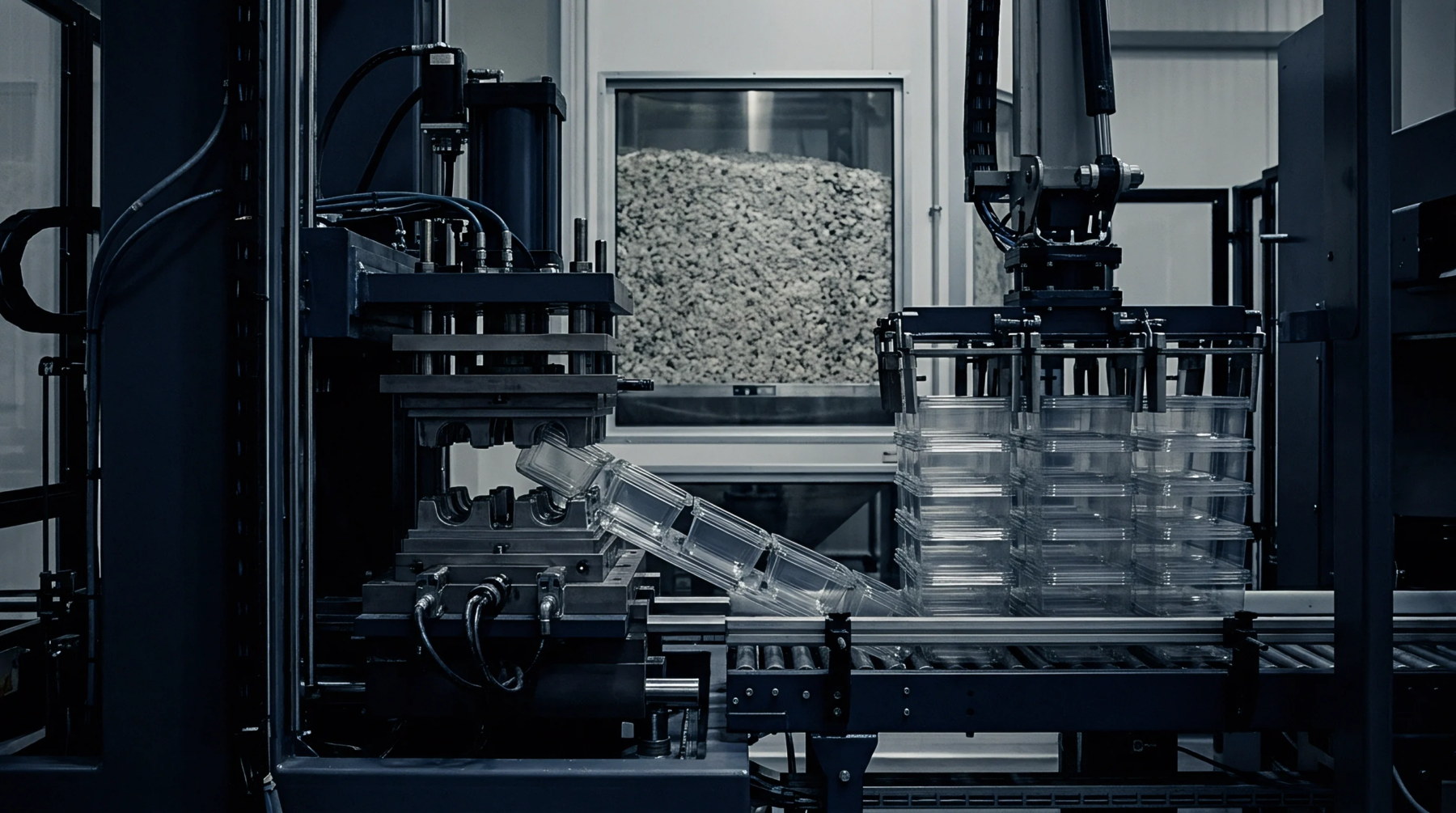
Thermoforming against Injection for Volumes below Fifty Thousand Units
Thermoforming delivers lower total landed cost below fifteen thousand units by saving upfront tooling capital, beyond which injection piece price efficiency dominates.
Solid thermoplastics characterized by a highly ordered molecular arrangement that forms distinct geometric structures during the cooling phase of the injection moulding cycle. While amorphous resins soften gradually, a crystalline polymer exhibits a sharp and well-defined melting point where the secondary bonds holding the lattice together break. This transition requires higher energy input during the plasticization stage within the barrel.
Cooling these materials necessitates precise temperature control to ensure that the lattice forms consistently across every cycle. Inconsistent cooling rates cause variations in the degree of crystallinity, leading to dimensional instability in the finished part. The process of crystallization releases latent heat, which the cooling system of the tool must effectively remove to maintain a stable cycle time.
Effective thermal management is critical because a fluctuation of only a few degrees can alter the physical properties of the plastic. The melt also flows more easily once the melting point is reached, necessitating precise gate designs to prevent flash.
The shrinkage rate of these materials is typically much higher than that of their non-crystalline counterparts because the molecules pack more tightly as they solidify. Designers must account for this volumetric change when calculating the dimensions of the tool cavity. If the mould temperature remains too low, the molecules are frozen in place before they can organize into their preferred structure.
This results in post-moulding shrinkage as the part continues to crystallize over time at room temperature. High mould temperatures promote a more complete crystalline structure, which stabilizes the part dimensions before ejection. This thermal management determines the final properties of the component, including its density and its resistance to creep under long-term load.
A moulder often uses insulated plates to maintain these high temperatures without heating the entire press. Volumetric shrinkage can reach as high as three percent in some grades, which requires the use of specialized holding pressure profiles to pack the cavity.
Mechanical strength and chemical resistance are generally superior in this category due to the dense packing of the polymer chains. Opaque or translucent appearances are common because the crystal structures scatter light rather than allowing it to pass through. Parts made from these resins often resist solvents that would easily degrade an amorphous material.
Proper drying and melt temperature maintenance are necessary to prevent thermal degradation which destroys the chain length and reduces the eventual strength of the moulded component. The density of a crystalline polymer is always higher than its amorphous equivalent because the organized chains occupy less volume. This density change is a primary driver of the high mould shrinkage seen during production.
Because the material is so rigid, it is prone to brittleness if the cooling process is too rapid or if the material contains excessive moisture.
The degree of crystallinity in a finished part is often measured using differential scanning calorimetry to ensure the process remains within the specified window. Moulders must balance the improved mechanical properties of high crystallinity against the longer cycle times required to achieve them. If a part is cooled too quickly in the tool, it may appear stable but will eventually warp as internal stresses relax over time.
This makes the selection of cooling channel layouts a vital part of the mould design process for these specific materials.
Thermoforming delivers lower total landed cost below fifteen thousand units by saving upfront tooling capital, beyond which injection piece price efficiency dominates.
Expertise is a utility, not a secret. sentiention™ publishes its working knowledge as open reference: intelligence layer covering the materials it sources, the markets it enters, and the reference that serves both.