Polyolefin Phase Identification in Mixed Recyclate Streams
Verify polyolefin phase boundaries using differential scanning calorimetry and infrared spectroscopy before compounding to prevent brittle field failures and price deductions.
Domain
Adding zero-point-five weight percent polypropylene to high-density polyethylene blow-molding resin drops environmental stress crack resistance by sixty percent under ASTM D1693 Condition B, driven by phase separation. Between 190 °C and 230 °C, high-density polyethylene and isotactic polypropylene form an immiscible blend with a positive Flory-Huggins interaction parameter. As the melt cools, thermodynamic forces drive phase separation, causing the minor phase to form discrete spherical droplets in the continuous matrix when concentration stays below fifteen weight percent.
Driven by interfacial tension, these droplets coalesce, while repulsive chemical forces between linear ethylene sequences and methyl-branched propylene units prevent polymer chains from entangling across the phase boundary.
Under shear or impact loading, morphological boundaries serve as weak points. Uncompatibilized polyolefin blends debond cleanly at interfaces under tensile deformation, since adhesion energy between virgin polyethylene and polypropylene phases sits below two Joules per square meter. Microscopic voids develop around the minor-phase polypropylene domains during initial elastic deformation as they concentrate stress, allowing cracks to propagate rapidly through matrix boundaries without plastic deformation when external loads strike parts molded from contaminated recyclate streams.
Linear low-density polyethylene behaves differently when blended with high-density polyethylene, where melt miscibility depends on short-chain branching distribution and molecular weight distribution. High-density polyethylene with a density of 0.958 grams per cubic centimeter co-crystallizes with linear low-density polyethylene containing hexene comonomer units up to twelve branches per thousand carbon atoms. Beyond that branching concentration, liquid-liquid phase separation occurs prior to crystallization, producing domains that alter solid-state optical clarity, impact performance, and tear resistance in blown film applications.
- Interfacial Debonding Voids develop at domain boundaries under tensile strain when surface energy mismatch prevents chain entanglement between immiscible phases.
- Coalescence-Induced Agglomerations form large droplet morphology during slow cooling cycles, concentrating mechanical stresses inside injection molded walls.
- Spherulitic Boundary Cleavage occurs when polypropylene crystallization excludes polyethylene chains into inter-spherulitic spaces during solid-state phase conversion.
- Crystallization Retardation alters solidification timing when one polyolefin component supercools relative to the adjacent matrix polymer phase.
Identifying component phase architecture requires understanding how shear history during compounding modifies domain size. High-shear twin-screw compounding reduces minor-phase polypropylene droplet diameters down to zero-point-eight micrometers, whereas low-shear single-screw processing leaves macro-domains exceeding twelve micrometers. These larger domains accelerate mechanical delamination in thermoforming and blow molding operations.
Distinguishing fine phase dispersion from true chemical miscibility calls for analytical tools capable of resolving sub-micron physical transitions.
Whether low-frequency dynamic oscillatory shear can reliably isolate sub-micron polypropylene inclusions below zero-point-two weight percent without analytical calibration curves remains an active engineering dispute.

Enthalpy
Differential scanning calorimetry measures endothermic and exothermic phase transitions to establish polyolefin identity under ISO 11357-3. Because polymer melt enthalpy correlates directly with crystalline fraction, standard specific heat of fusion values provide the reference baseline: 293 Joules per gram for one hundred percent crystalline polyethylene and 207 Joules per gram for one hundred percent crystalline isotactic polypropylene. Sample preparation alters measured values significantly, making controlled cooling essential.
Heating rates of 10 °C per minute under a nitrogen atmosphere isolate peak melting temperatures while erasing prior processing stress.
Peak melting points identify dominant structural phases in complex recyclate streams. High-density polyethylene displays a peak melting endotherm between 131 °C and 137 °C, while linear low-density polyethylene melts between 120 °C and 126 °C depending on comonomer type and content. Low-density polyethylene exhibits a broad melting envelope between 108 °C and 115 °C because of long-chain branching.
Isotactic polypropylene shows a distinct melting transition between 160 °C and 166 °C, whereas random ethylene-propylene copolymers melt lower, between 135 °C and 150 °C, overlapping thermally with high-density polyethylene endotherms.
| Polymer Phase Type | Peak Melting Window (°C) | Reference Heat of Fusion (J/g) | Thermal Overlap Sensitivity | Primary Standard Method |
|---|---|---|---|---|
| High-Density Polyethylene | 131 to 137 | 293 | High overlap with random EP copolymers | ISO 11357-3 |
| Linear Low-Density Polyethylene | 120 to 126 | 293 | Moderate overlap with medium-density PE | ASTM D3418 |
| Low-Density Polyethylene | 108 to 115 | 293 | Low overlap; broad melting envelope | ISO 11357-3 |
| Isotactic Polypropylene Homopolymer | 160 to 166 | 207 | Low overlap with polyethylene species | ISO 11357-3 |
| Polypropylene Block Copolymer | 140 to 163 | 207 | Bimodal peak matches PE and PP melting | ASTM D3418 |
Deconvolution of overlapping thermal peaks requires mathematical fitting functions when random copolymers or medium-density polyethylene fractions pollute high-density polyethylene streams. Because baselines shift during thermal scans, the choice of baseline method can introduce up to eight percent variance in calculated phase mass fractions. A straight linear baseline connecting signal onset to thermal return undercounts low-temperature melting tails, whereas sigmoidal baselines track heat capacity changes across the transition zone more accurately.
At cooling rates exceeding 10°C per minute, polypropylene crystallization kinetics alter heat of fusion values by up to 14 percent.
Successive Annealing Fractionation enhances thermal phase resolution by segregating polymer chains according to crystallizable sequence length. The procedure subjects the recyclate sample to stepwise isothermal crystallization from 130 °C down to 90 °C in 5 °C increments, allowing specific lamellar thicknesses to form discrete crystal structures at each step. Subsequent heating scans resolve individual melting peaks corresponding to narrow comonomer distribution fractions, isolating linear low-density polyethylene from high-density polyethylene inclusions that standard differential scanning calorimetry scans register as a single merged peak.
Quantifying total polyethylene content within a polypropylene matrix involves integrating the enthalpy of the melting peak between 110 °C and 138 °C. Dividing the calculated heat of fusion by 293 Joules per gram yields the mass fraction of crystalline polyethylene, though correcting for amorphous content requires density determination via ISO 1183 gradient column testing. In mixed recyclate streams, mineral fillers like talc or calcium carbonate distort thermal mass calculations unless thermogravimetric analysis first quantifies inorganic residue levels under ISO 11358-1.
Baselines drawn through overlapping melting peaks yield accurate phase proportions only when thermal history gets fully erased during the initial heat cycle.

Fractionation
Temperature Rising Elution Fractionation separates polyolefin components by crystallizability rather than molecular mass. The system dissolves the polymer blend in 1,2,4-trichlorobenzene at 150 °C inside a packed column, then cools it at 1.5 °C per hour onto an inert support so polymer chains crystallize in layers defined by chain stereoregularity and short-chain branching density. Highly branched or amorphous fractions remain in solution at ambient temperatures, after which stepwise or continuous heating under solvent flow elutes fractions into an infrared detector at specific thermal thresholds.
Linear, unbranched chain architecture causes high-density polyethylene fractions to elute between 94 °C and 102 °C, whereas linear low-density polyethylene elutes between 75 °C and 90 °C depending on comonomer level. Isotactic polypropylene elutes above 98 °C, overlapping high-density polyethylene thermal windows at standard solvent flow rates. Coupling Temperature Rising Elution Fractionation with Gel Permeation Chromatography produces a two-dimensional map of molecular weight as a function of elution temperature, exposing cross-phase contamination with high specificity.
- Dissolve zero-point-five grams of mixed polyolefin recyclate in fifty milliliters of xylene at 135 °C under reflux for two hours.
- Cool the solution to 25 °C over four hours to induce selective precipitation of crystalline polyethylene and polypropylene phases.
- Filter the ambient precipitate through a zero-point-four-five micrometer polytetrafluoroethylene membrane to separate soluble ethylene-propylene rubber fractions.
- Extract the dried precipitate residue with boiling n-heptane for six hours inside a Soxhlet apparatus to dissolve tactic polypropylene fractions.
- Isolate insoluble residue containing pure high-density polyethylene for gravimetric balance verification and infrared verification.
Crystallization Analysis Fractionation speeds separation by monitoring polymer precipitation during active cooling cycles. Dissolved polymers precipitate at specific temperatures depending on crystallizable sequence length, while infrared detectors measure liquid-phase concentration continuously. The resulting crystallization curve mirrors the derivative heating curve from Temperature Rising Elution Fractionation, cutting analytical run times from twenty-four hours down to two hundred minutes per sample.
Compliance with ISO 11357-3 mandates twin-baseline deconvolution when polyethylene and polypropylene melting transitions overlap within a fifteen-degree thermal window.

How Does Phase Drift Alter Recycling Margins?
Cross-contamination in polyolefin streams destabilizes compounding economics by forcing additive adjustments. Buying sorted high-density polyethylene flake containing three percent polypropylene causes unpredictable shifts in processing viscosity, since polypropylene has a higher melting temperature and different shear rate dependence. Un-melted polypropylene fragments reaching the screen pack at lower processing temperatures cause pressure spikes, blinding the screen pack and raising operational downtime and maintenance costs per metric tonne processed.
Solvent choice determines elution temperature; using xylene instead of 1,2,4-trichlorobenzene drops elution temperatures by approximately 15 °C across all polyolefin species. These lower dissolution temperatures help prevent thermal degradation of recycled polymer chains during long fractionation cycles, though oxidation stabilizers like dibutylhydroxytoluene must still be present at zero-point-one weight percent to prevent chain scission during extended high-temperature protocols.
Failing to account for co-elution in solvent extraction leads compounders to miscalculate impact modifier dosages, resulting in cracked automotive bumper fascia during cold drop testing.
Spectroscopy
Fourier Transform Infrared Spectroscopy resolves polyolefin phase chemistry by identifying functional group vibrational modes under ASTM E1252. Polyethylene spectra feature prominent absorption doublets from methylene rocking modes at 720 cm⁻¹ and 730 cm⁻¹, alongside C-H stretching bands at 2848 cm⁻¹ and 2915 cm⁻¹. Polypropylene spectra show distinctive methyl group bending modes at 1376 cm⁻¹ and 1456 cm⁻¹, combined with skeletal stretching vibrations at 973 cm⁻¹, 998 cm⁻¹, and 1167 cm⁻¹.
Peak area ratios then quantify relative phase concentrations in unknown recyclate samples.
Determining low levels of polypropylene contamination in a polyethylene matrix relies on the absorption ratio between the 1376 cm⁻¹ methyl peak and the 720 cm⁻¹ methylene peak. Transmission mode analysis requires hot pressing films at 180 °C under twenty bar pressure to achieve a thickness between fifty and one hundred micrometers. Attenuated Total Reflectance eliminates sample preparation but probes only the top one to two micrometers of the pellet surface, where surface oxidation or additive migration can skew readings relative to true bulk composition.
| Wavenumber Range (cm⁻¹) | Vibrational Mode Assignment | Target Polymer Phase | Interference Factors | Detection Limit (wt%) |
|---|---|---|---|---|
| 720 to 730 (Doublet) | Methylene (-CH₂-) Rocking | High Density Polyethylene | Paraffinic waxes, long alkyl chains | 0.10 |
| 1376 (Singlet) | Methyl (-CH₃) Symmetric Def. | Isotactic Polypropylene | Propylene comonomers in LLDPE | 0.05 |
| 998 (Singlet) | Isotactic Helical Chain Stretch | Crystalline Polypropylene | Atactic PP phase suppresses peak | 0.25 |
| 1167 (Singlet) | C-C Backbone / C-H Bending | Polypropylene Matrix | Ester-based processing aids | 0.20 |
| 1715 to 1740 | Carbonyl (C=O) Stretching | Oxidized Recyclate Phase | Polyesters, vinyl acetate copolymers | 0.02 |
Micro-Raman spectroscopy provides spatial phase mapping across cross-sectioned recyclate pellets at one-micrometer resolution. Carbon-hydrogen stretching modes yield clear phase separation patterns: polyethylene shows strong scattering at 1130 cm⁻¹ and 1296 cm⁻¹, while polypropylene scatters intensely at 809 cm⁻¹ and 841 cm⁻¹. This mapping reveals whether minor polyolefin phases exist as discrete encapsulated droplets or continuous interpenetrating networks, though carbon black pigments absorb Raman laser energy and cause severe fluorescence that obscures spectra in dark recyclate streams.
Infrared absorption bands resolve matrix ratios only when sample thickness matches the optical penetration depth of the bench instrument.
Solid-state Carbon-13 Nuclear Magnetic Resonance spectroscopy measures phase composition without calibration standards. High-resolution cross-polarization magic-angle spinning yields distinct chemical shifts for each carbon environment: resonance signals at 21.8 ppm correspond to methyl carbons in polypropylene, while signals at 30.0 ppm belong to backbone methylene carbons in linear polyethylene sequences. Integrating signal intensities yields molar phase ratios directly, though high instrument costs restrict Nuclear Magnetic Resonance to reference validation rather than routine lot acceptance testing.
Infrared transmission variances can stem from carbon black filler agglomeration rather than underlying polyolefin matrix cross-contamination.
Strain
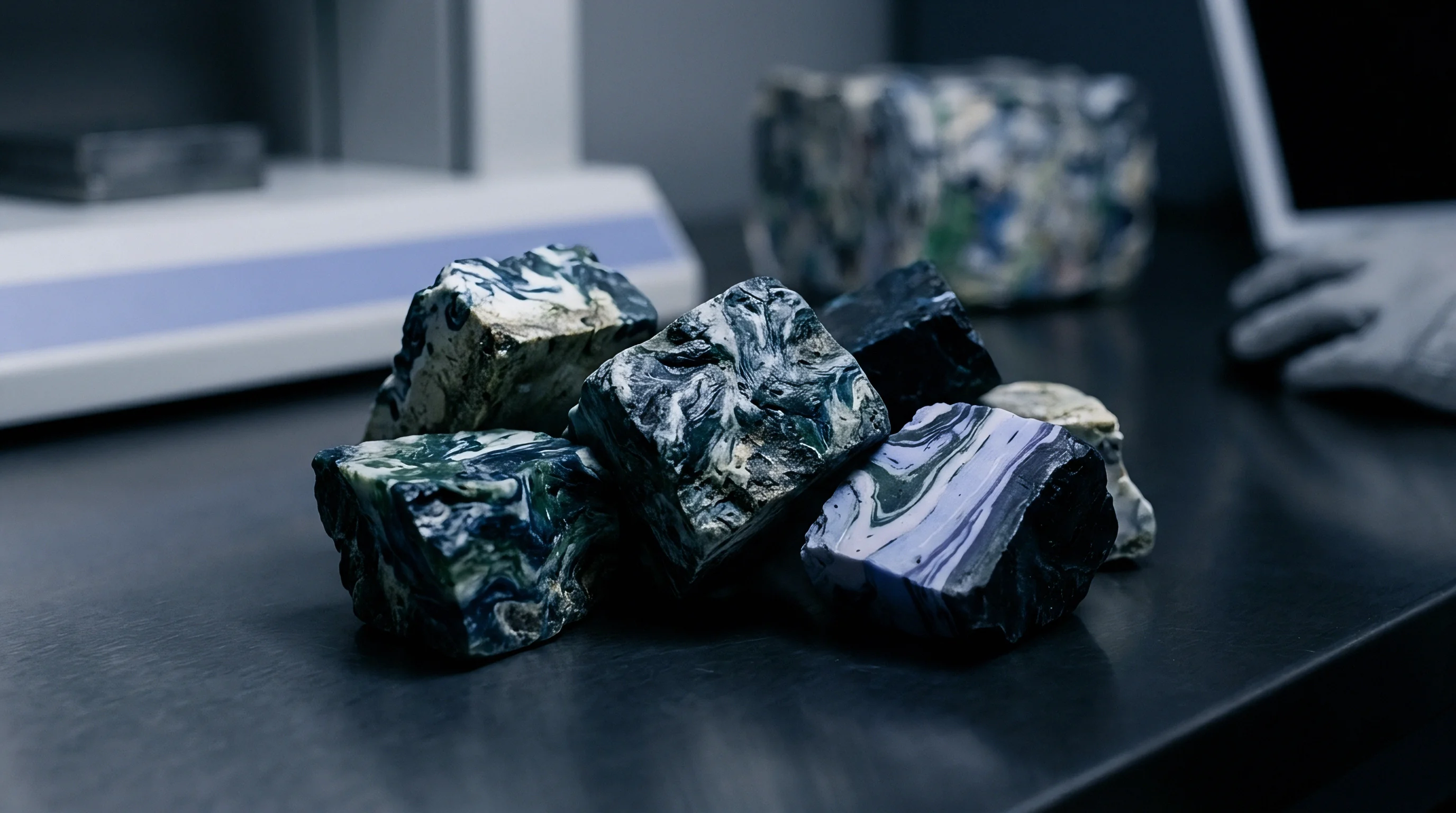
Phase separation dictates the mechanical response of polyolefin recyclates subjected to high strain rates. Uncompatibilized polypropylene inclusions within a high-density polyethylene continuous matrix create stress concentration sites during impact loading under ISO 179. When shear strain exceeds elastic limits, minor-phase domains detach from the matrix and micro-voids coalesce into brittle crack fronts.
Instrumented Izod impact testing under ISO 180 shows energy absorption dropping from forty kilojoules per square meter down to four kilojoules per square meter when polypropylene contamination reaches two weight percent in high-density polyethylene resin.
Interfacial modification restores ductile energy dissipation across phase boundaries. Block copolymers containing distinct polyethylene and polypropylene segments migrate to domain interfaces during melt compounding; ethylene-propylene rubber or hydrogenated styrene-butadiene-styrene block copolymers drop interfacial tension from five millinewtons per meter down to zero-point-five millinewtons per meter. This lower interfacial tension allows minor-phase domain sizes to drop below five hundred nanometers during extrusion, converting catastrophic crack propagation into diffuse micro-yielding.
Interfacial failure across uncompatibilized phase boundaries lowers instrumented impact resistance long before tensile yield stress changes.
Tensile property evaluations under ISO 527 show that yield strength remains largely insensitive to minor phase contamination below five weight percent, whereas tensile elongation at break serves as a far more sensitive indicator. Virgin high-density polyethylene exhibits elongation at break exceeding six hundred percent at a crosshead speed of fifty millimeters per minute, but adding one percent immiscible polypropylene drops elongation at break below fifty percent as chain slippage gives way to micro-cleavage at matrix interfaces.
- Styrene-Ethylene-Butylene-Styrene Block Copolymers provide high interfacial adhesion when bridging isotactic polypropylene domains inside low-density polyethylene continuous phases.
- Ethylene Octene Elastomers lower glass transition temperatures of mixed polyolefin phases, improving sub-zero impact resistance down to minus forty degrees Celsius.
- Reactive Maleic Anhydride Grafted Polyolefins react with polar surface contaminants while compatibilizing residual polyethylene droplets inside polypropylene matrixes.
- Ethylene-Propylene-Diene Terpolymers match phase viscosity ratios during compounding, reducing domain coalescence under low-shear injection molding conditions.
Selecting compatibilizers requires matching the modifier’s melt flow rate to that of the continuous matrix phase under ISO 1133 at 190 °C with a 2.16 kg load. Viscosity mismatch prevents the elastomer from encapsulating minor-phase droplets efficiently; if modifier melt viscosity exceeds matrix melt viscosity, the modifier forms independent dispersed domains rather than accumulating at phase boundaries. Optimizing this viscosity ratio balances dispersion energy requirements against finished-part stiffness penalties.
Section 4.2 of ISO 19069-2 invalidates lot acceptance when phase-separated polyolefin domains exceed five micrometers in average equivalent spherical diameter.
Discount
Cross-contamination in commodity polyolefin recyclate bales triggers commercial price deductions on landed shipments. Reclaimers pricing post-consumer high-density polyethylene regrind adjust invoice valuations based on measured polypropylene contamination. Bales with polypropylene content under zero-point-five weight percent command full market value, while contamination exceeding three weight percent incurs price penalties reaching three hundred US dollars per metric tonne.
At those levels, compounders must add expensive compatibilizing elastomers at dosage rates of three to five percent by weight, erasing processing margins.
Recyclate discounts reflect sorting purity. Near-infrared sorting equipment on high-speed lines fails to distinguish black-pigmented high-density polyethylene from black polypropylene containers, leaving dark recyclate streams at high risk of cross-contamination. Automated optical sorting achieves ninety-eight percent purity on clear bottle streams, but drops to eighty-two percent purity on mixed-color post-consumer rigid packaging.
As a result, commercial contracts specify phase purity limits backed by mandatory certificates of analysis for each delivered lot.
| Target Stream Type | Contaminant Phase | Contamination Threshold (wt%) | Required Remediation Strategy | Landed Cost Deduction (USD/MT) |
|---|---|---|---|---|
| High-Density PE Regrind | Polypropylene | 0.5 to 1.5 | Low-level impact modification | 50 to 100 |
| High-Density PE Regrind | Polypropylene | 1.5 to 3.0 | Compatibilizer let-down at 3% | 150 to 250 |
| High-Density PE Regrind | Polypropylene | Above 3.0 | Rejection or re-granulation downgrading | 300 to 450 |
| Polypropylene Flake | Polyethylene (LDPE/HDPE) | 1.0 to 3.0 | Viscosity modification via peroxide | 80 to 140 |
| Polypropylene Flake | Polyethylene (LDPE/HDPE) | Above 3.0 | Blending with virgin homopolymer | 200 to 350 |
Verification protocols depend heavily on sample sizing accuracy. Sampling sixty-tonne railcars requires withdrawing increment samples from top, middle, and bottom discharge ports under ASTM D1898 guidelines. Simple density measurements fail across blends, as gradient column testing cannot distinguish a fifty-fifty blend of high-density polyethylene and polypropylene from medium-density polyethylene grades.
Differential scanning calorimetry remains the standard rapid verification method for lot clearance prior to silo discharge.
- Differential Scanning Calorimetry Thermograms proving total phase purity limits, run per ISO 11357-3 with second-heat integration curves attached.
- Melt Flow Index Reports recorded under dual load conditions (2.16 kg and 5.0 kg at 190 °C) verifying shear sensitivity and potential cross-phase degradation.
- Ash Content Certificates detailing inorganic filler fractions determined under ISO 11358-1 via thermogravimetric thermal decomposition.
- Fourier Transform Infrared Spectral Profiles confirming baseline absorption boundaries and verifying the absence of un-compatibilized minor phases.
Because contamination triggers severe price deductions or immediate lot rejection, processing off-spec recyclate through injection tools risks short shots, delamination gate defects, and structural failure in finished components. Standard purchase agreements include clause options allowing buyers to debit sellers for purge compound costs, tool cleanup downtime, and third-party laboratory verification testing when delivered resin fails specified phase purity thresholds.
Reclaiming financial value from off-spec polyolefin recyclate depends on identifying cross-contamination thresholds before the material enters compounding extruders.