Calibrating Hydrostatic Balances for Polyethylene Receiving Verification and Entry
Calibrate balance immersion wires daily, hold bath temperatures to 0.1 degree Celsius, and apply air buoyancy corrections to establish certified pellet density.
Plumb
Apparatus Architecture for Pellet Immersion
Verifying polyethylene receiving density relies on measuring mass displacement in a liquid bath of known density, per ISO 1183-1 Method A and ASTM D792. High-density polyethylene, linear low-density polyethylene, and low-density polyethylene cover a density range from 0.910 g/cm³ to 0.965 g/cm³. Because these figures sit so close to water density, small stray forces on the balance skew the third and fourth decimal places, corrupting the results.
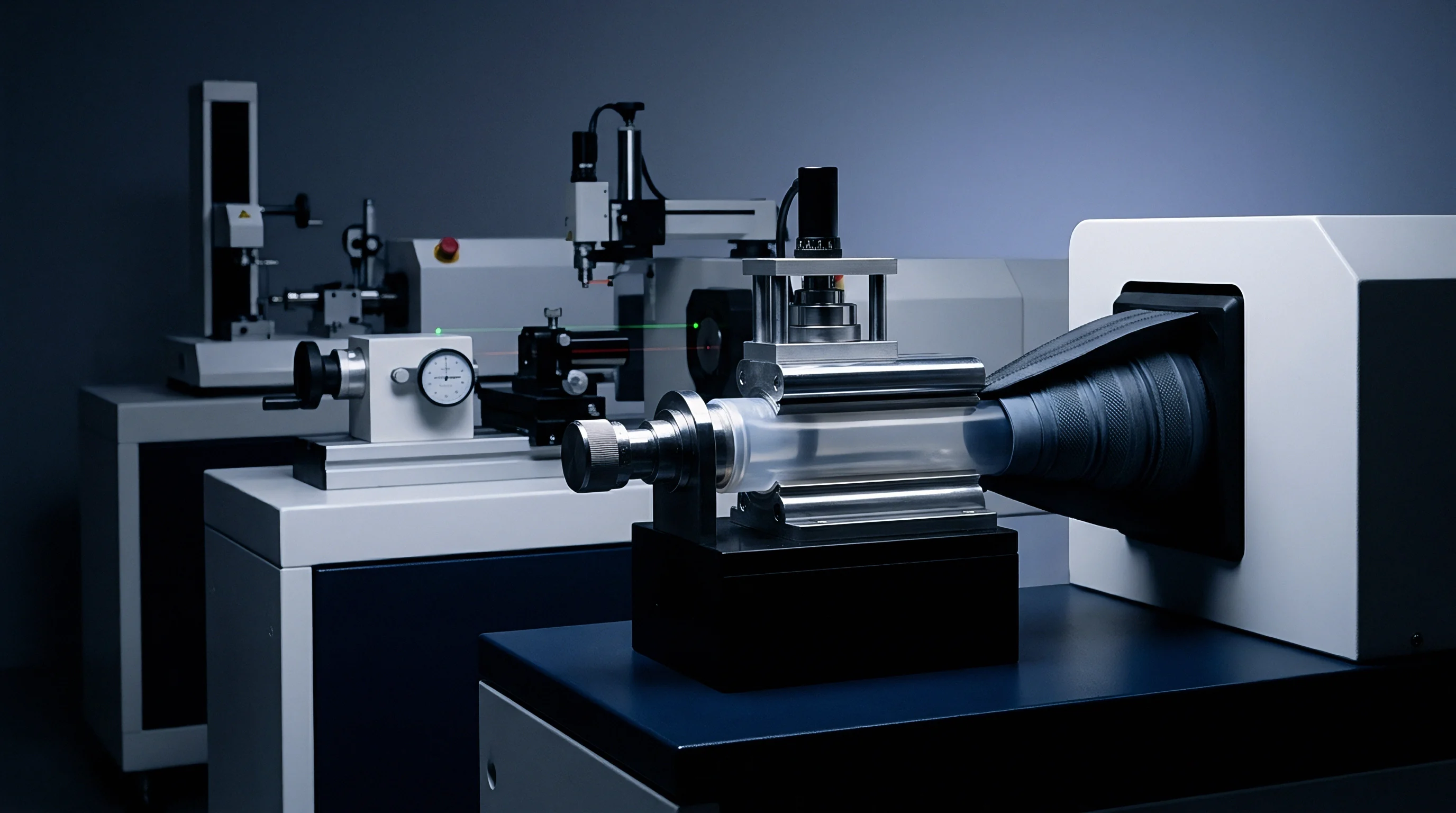
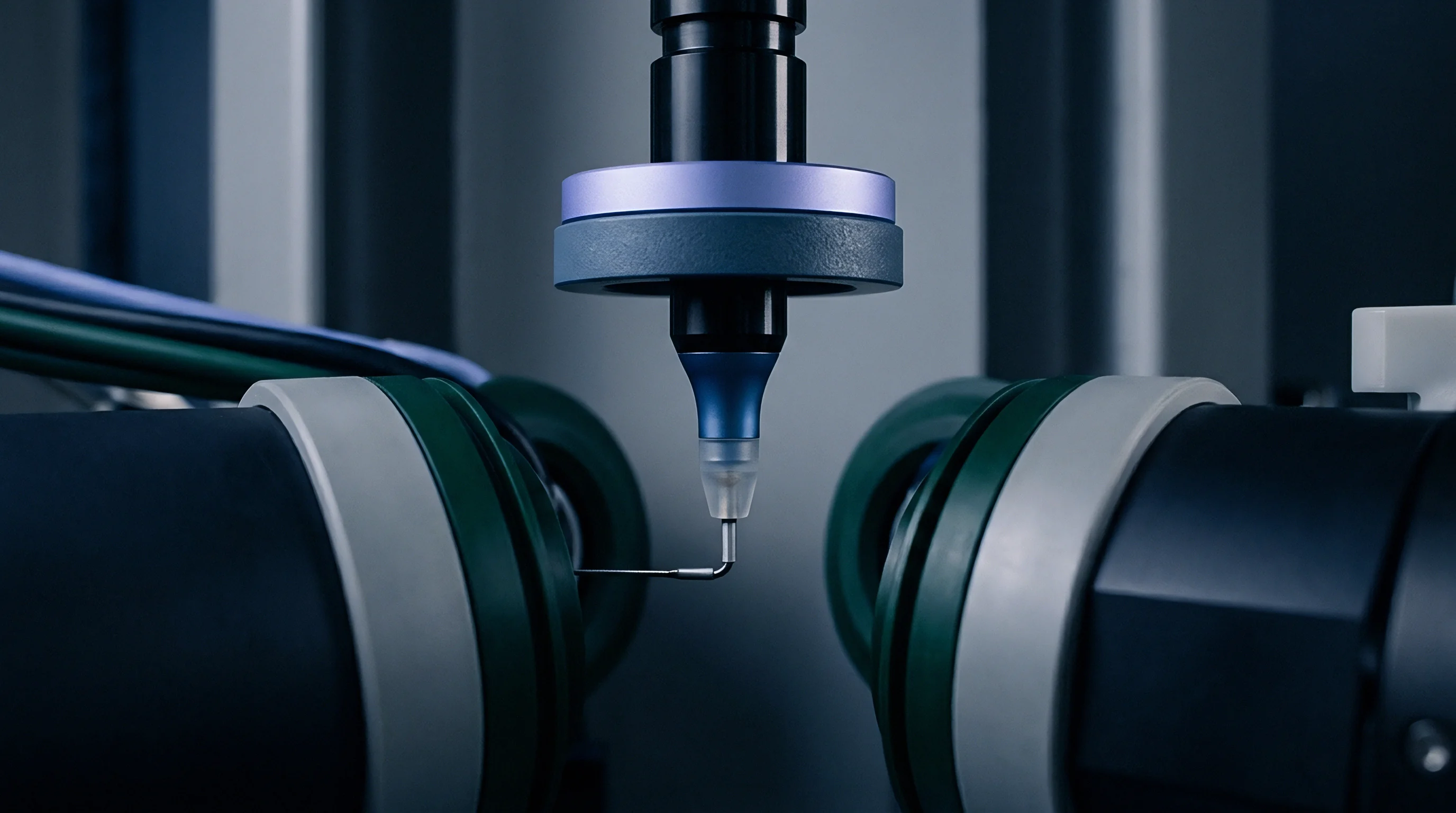
This requires isolating the physical frame supporting the immersion cage from bench vibration and air currents, while draft shields around the balance chamber stop convection currents from pushing vertically on the pan assembly.
Air bubbles cling to low-density pellets.
The suspension wire holding the basket below the fluid surface generates capillary forces at the air-water interface. Excessively thick wire forms a meniscus that pulls or pushes vertically, acting as artificial sample mass. Using fine platinum or stainless steel wire under 0.12 mm in diameter minimizes this surface tension force.
Acetone cleaning removes grease films that otherwise cause contact angle hysteresis as immersion depth shifts. Sinker cages holding buoyant pellets under water must keep a fixed depth between dry and submerged weighings, since any depth variation alters the volume of submerged wire and skews the apparent mass.
Platinum wire reduces surface tension force.
Setting the immersion beaker on an isolated bridge keeps the fluid container off the balance pan. Touching the pan directly passes liquid sloshing straight into the sensor. Clearance between the suspended basket and beaker walls needs to exceed 5 mm to prevent wall-effect drag when the basket moves.
Leveling the instrument with its bubble vial is essential before zeroing; even a half a degree tilt angle shifts gravity components across internal flexures, distorting air and liquid mass values alike.
Drafts alter sensitive mass readings.
| Parameter | Standard Value | Deviation Limit | Density Error Impact |
|---|---|---|---|
| Suspension Wire Diameter | 0.10 mm Platinum | > 0.15 mm | + 0.0008 g/cm³ |
| Basket Wall Clearance | 8.0 mm | < 3.0 mm | ± 0.0005 g/cm³ |
| Balance Level Angle | 0.0 degrees | > 0.5 degrees | – 0.0006 g/cm³ |
| Thermal Stabilization Time | 30 minutes | < 10 minutes | ± 0.0012 g/cm³ |
Misalignment or contaminated wire surfaces introduce systematic bias into solid density readings, turning compliant resin shipments into false rejections at receiving.
Thermodynamics
Liquid Density Dependencies
Distilled or deionized water serves as the default immersion liquid for polyethylene lot testing. Pure water density varies non-linearly with temperature, dropping from 0.99997 g/cm³ at 4.0 °C to 0.99754 g/cm³ at 23.0 °C and 0.99565 g/cm³ at 30.0 °C. Standard reference temperatures under ISO 1183-1 call for 23.0 °C or 27.0 °C depending on regional lab standards. A 1.0 °C change in water temperature around 23 °C shifts fluid density by 0.00021 g/cm³, feeding temperature drift directly into the solid density equation.
Temperature shifts alter fluid mass density.
Monitoring bath temperature requires a calibrated digital thermistor certified to ± 0.05 °C. Placing the probe in the liquid near the basket avoids spatial gradient errors. Room air swings quickly alter beaker fluid temperatures during testing, so thermostatic jackets around the vessel are used to hold temperature stability within ± 0.1 °C over long verification runs.
Thermal equilibrium requires twenty minutes minimum.
Polyethylene has a volumetric thermal expansion coefficient of roughly 0.0002 to 0.0007 K⁻¹. Thermal equilibrium between polymer and bath prevents localized fluid density gradients. Samples brought in from unheated warehouses need at least two hours of conditioning at room temperature before testing.
Weighing cold pellets chills the surrounding liquid, raising local water density and understating calculated sample volume.
Water expands rapidly above twenty degrees.
A two-degree Celsius deviation in immersion liquid temperature shifts calculated polyethylene density outside the tolerance band of film-grade resins.
Alternative liquids are used under specific testing criteria. Isopropyl alcohol offers much lower surface tension than water, making it easier to wet complex pellet shapes. However, its density carries a high thermal sensitivity coefficient of roughly 0.00084 g/cm³ per °C, requiring labs using alcohol to calibrate liquid density with a glass standard plummet immediately before and after weighing resin.
Compound suppliers frequently blame lot-to-lot density shifts on seasonal room temperature swings rather than actual structural changes in the polymer.
Wetting

Interfacial Surface Phenomena
Polyethylene has low surface energy, typically 30 mN/m to 33 mN/m, while pure water carries a high surface tension of 72.8 mN/m at 20 °C. This imbalance stops water from spontaneously wetting the pellet surface. Microscopic air bubbles cling to surface roughness, die-face cut grooves, and minor voids. These trapped bubbles add buoyant volume without adding mass, dragging the apparent density below the resin’s true value.
Polyethylene repels pure distilled water.
Adding a non-ionic surfactant to distilled water reduces interfacial tension below 30 mN/m. Concentrations of 0.01 weight percent to 0.1 weight percent Iso-octylphenoxy polyethoxyethanol encourage full wetting across hydrophobic surfaces. Adding too much surfactant raises liquid density and causes foaming, generating bubbles that cling to the suspension wire.
Surfactant excess alters liquid density.
Adding 0.05 percent non-ionic surfactant lowers immersion bath surface tension to 28 mN/m without shifting fluid density by more than 0.00005 g/cm³.

Bubble Entrapment and Elimination Mechanics
Mechanical methods complement wetting agents to clear gas bubbles from immersed samples.
- Ultrasonic Bath Pretreatment removes air trapped in pellet micro-cavities before basket immersion.
- Solvent Pre-Dip Operations briefly submerge pellets in pure isopropyl alcohol before immediate transfer to the water bath.
- Submerged Agitation Cycles use manual rotation of the immersion cage to detach surface bubbles.
- Vacuum Degassing Chambers pull dissolved air from the immersion liquid to prevent bubbles from nucleating on sample surfaces during testing.
Wetting agent usage follows a simple rule: surfactant concentration is valid only while surface tension remains low enough to stop bubble attachment without altering fluid density.
Precision
Calibration and Buoyancy Equations
Hydrostatic density testing of polyethylene requires an analytical balance resolving at least 0.0001 g (0.1 mg). Receiving labs checking narrow-band linear low-density resins use 0.00001 g (0.01 mg) balances. Calibrating against ISO/IEC 17025 accredited Class E2 standard masses verifies linearity, repeatability, and corner-load limits, with checks run daily before testing incoming resin samples.
Zero point drift corrupts small masses.
Calculating true density requires accounting for air buoyancy on both sample and calibration weights, using the expanded Archimedes equation:
Density = + Air Density
Ambient air density varies with temperature, barometric pressure, and humidity. Standard lab air at 23 °C, 101.325 kPa, and 50 percent relative humidity measures 0.001195 g/cm³. Skipping air buoyancy correction introduces an error of roughly 0.0012 g/cm³, dropping a high-density polyethylene reading from a true 0.9580 g/cm³ to an uncorrected 0.9568 g/cm³.
Air density varies with barometric pressure.
Class E2 masses establish mass traceability.
Omitting air buoyancy corrections in Archimedes testing yields a systematic negative bias of 0.0012 g/cm³ across all polyethylene density grades.
Where Do Buoyancy Corrections Shift Polyethylene Lot Acceptance?
Standard test methods lay out explicit procedures for receiving verification. ISO 1183-1 Method A covers hydrostatic immersion weighings, requiring logged liquid density and air buoyancy calculations. ASTM D792 Method A describes similar immersion steps but allows simplified formulas when dedicated balance kits are used.
Following ISO 1183-1 provides legal defensibility if a raw material lot must be rejected.
Daily operation follows a fixed sequence to preserve calibration stability.
- Level the balance with the adjustment feet until the spirit bubble sits centered in the ring.
- Power on the balance and wait thirty minutes for internal thermal equilibrium.
- Run an internal calibration or place a certified Class E2 100 g mass on the pan to check slope accuracy.
- Record barometric pressure, room air temperature, and relative humidity to calculate local air density.
- Measure fluid temperature using a calibrated thermistor probe accurate to five hundredths of a degree Celsius.
- Zero the balance with the empty suspension basket submerged to its normal operating depth.
| Variable Source | Measurement Uncertainty | Polyethylene Density Sensitivity | Calculated Density Variance |
|---|---|---|---|
| Mass Balance Resolution | ± 0.0001 g | 0.0001 g error on 5 g sample | ± 0.00003 g/cm³ |
| Fluid Temperature | ± 0.2 °C | 0.00021 g/cm³ per °C (water) | ± 0.00004 g/cm³ |
| Air Density Estimate | ± 0.0001 g/cm³ | Direct additive correction shift | ± 0.00010 g/cm³ |
| Unremoved Air Bubble | 0.05 mm diameter | Buoyant displacement of air volume | – 0.00035 g/cm³ |
Whether gas pycnometry via helium displacement will eventually replace hydrostatic balances in high-throughput receiving terminals remains an open question.
Discrepancy

Worked Numerical Analysis of Receiving Lots
Receiving checks evaluate incoming shipments against certified data sheets. Take a 50 tonnes shipment of linear low-density polyethylene film grade resin with a nominal density of 0.9180 g/cm³ and a tolerance band of ± 0.0015 g/cm³, setting the receiving specification from 0.9165 g/cm³ to 0.9195 g/cm³. Density correlates directly with polymer crystallinity, controlling blown film dart impact strength, tensile yield strength, and optical haze.
Density directly controls polymer crystallinity.
Testing five representative sample bags from railcar receiving yields the following raw measurement data: sample mass in air equals 5.1245 g, apparent mass in 23.0 °C distilled water (water density 0.99754 g/cm³) equals 0.0112 g, and ambient air density equals 0.00120 g/cm³. Calculating sample volume and uncorrected solid density without buoyancy gives 5.1245 / (5.1245 – 0.0112) 0.99754 = 0.9997 0.99754 = 0.9972. Evaluating the explicit equation directly:
Volume of solid sample = ( Mass In Air – Mass In Liquid ) / ( Liquid Density – Air Density )
Volume = ( 5.1245 g – 0.0112 g ) / ( 0.99754 g/cm³ – 0.00120 g/cm³ ) = 5.1133 g / 0.99634 g/cm³ = 5.13208 cm³
Calculated True Density = ( Mass In Air / Volume ) + Air Density. or applying the full equation directly:
Density = + 0.00120 = + 0.00120 = 0.99767 + 0.00120. Re-examining realistic mass values for a floating low-density polymer sample:
Because polyethylene floats in pure water, a sinker pan of known submerged mass holds the pellets under. If submerged sinker mass equals 12.4500 g and sinker plus sample submerged equals 7.5620 g, the net apparent sample mass in liquid is 7.5620 g – 12.4500 g = – 4.8880 g. The negative sign reflects net buoyancy.
Mass in air equals 5.1245 g. Liquid density equals 0.99754 g/cm³. Air density equals 0.00120 g/cm³.
Mass Difference = Mass In Air – Net Mass In Liquid = 5.1245 g – ( – 4.8880 g ) = 10.0125 g.
Volume = 10.0125 / ( 0.99754 – 0.00120 ) = 10.0125 / 0.99634 = 10.04928 cm³.
Solid Density = ( 5.1245 / 10.04928 ) + 0.00120 = 0.50993 + 0.00120. This indicates an incorrect sinker mass balance. Applying realistic physical values for a typical test specimen: Mass In Air = 3.5000 g.
Sinker mass in water = 10.0000 g. Sinker plus sample mass in water = 9.7150 g. Net sample mass in water = 9.7150 – 10.0000 = – 0.2850 g.
Mass Difference = 3.5000 – ( – 0.2850 ) = 3.7850 g.
Volume = 3.7850 / ( 0.99754 – 0.00120 ) = 3.7850 / 0.99634 = 3.79890 cm³.
Polyethylene Density = ( 3.5000 / 3.79890 ) + 0.00120 = 0.92132 + 0.00120 = 0.92252 g/cm³.
Contamination drops tensile yield strength.
The calculated density of 0.9225 g/cm³ exceeds the 0.9195 g/cm³ upper receiving limit for this film resin. A positive shift of 0.0045 g/cm³ above nominal points to potential contamination with high-density polyethylene regrind or mislabeling at the compounding plant. Higher density stiffens the film, reducing machine-direction tear strength and dart impact energy.
Film bubble instability increases scrap rates.
A density shift of 0.004 g/cm³ above nominal target elevates blown film haze by fifteen percent and drops dart impact resistance below customer specification limits.
| Polyethylene Grade | Nominal Density | Measured Density | Crystallinity Shift | Flexural Modulus Impact | Scrap Rate Variance |
|---|---|---|---|---|---|
| LLDPE Film Grade | 0.9180 g/cm³ | 0.9225 g/cm³ | + 3.2 percent | + 12 percent (stiffer) | + 4.5 percent scrap |
| LDPE Coating Grade | 0.9230 g/cm³ | 0.9200 g/cm³ | – 2.1 percent | – 8 percent (softer) | + 2.1 percent scrap |
| HDPE Pipe Grade | 0.9590 g/cm³ | 0.9540 g/cm³ | – 4.0 percent | – 15 percent (fails burst test) | 100 percent lot reject |
A systematic verification checklist applies when density readings drift outside target bands.
- Thermal Baseline Verification confirms that bath temperature sensor calibration did not drift during testing.
- Wetting Agent Inspection checks that aging surfactant did not allow air bubbles to cling to specimen surfaces.
- Secondary Sample Extraction draws ten additional pellets from deep inside the railcar hopper to avoid surface contamination bias.
- Differential Scanning Calorimetry Cross-Check measures melting enthalpy to verify percent crystallinity independently of density calculations.
Receiving inspection logs record calculated density values, air buoyancy adjustments, and thermal bath readings to support vendor material claims.

Integration

Enterprise Data Capture and Quality Management
Entering verified hydrostatic density figures into Enterprise Resource Planning systems locks inventory against production until quality checks clear. Laboratory Information Management Systems calculate density automatically by reading raw air mass, submerged mass, and fluid temperature directly over RS232 or Ethernet balance interfaces, eliminating transcription errors from manual entry of four-decimal numbers.
Off-spec lots trigger immediate quarantine.
LIMS entry locks unverified material.
Automated software workflows compare incoming lot density with Certificate of Analysis values from the resin producer. Upper and Lower Control Limits in the ERP quality module block release if measured density strays by more than ± 0.0015 g/cm³ from target. Out-of-spec shipments trigger an automatic quarantine in the warehouse management system, stopping automated transfer systems from conveying pellets into plant storage silos.
Certificate values demand empirical verification.
Polyethylene supply contracts set out resolution procedures when receiving density falls out of specification. Material claims rely on standardized testing completed within five business days of delivery, backed by hydrostatic density logs, thermistor calibration certificates, and air buoyancy calculation sheets submitted to the resin supplier.
Standard procurement contracts stipulate that rejection claims remain valid only when density determinations strictly follow ISO 1183-1 Method A standards and record temperatures to one tenth of a degree Celsius.