Tool Steel Yield Strength Selection for High Speed Cyclic Clamping Loads
Select tool steel with cyclic compressive yield strength triple the nominal lockup pressure to prevent parting line coining under dynamic toggle clamp spikes.
Land
Parting line shut-offs on high-speed thin-wall packaging moulds endure continuous cycles of localized compression that exceed the nominal ratings of standard toolroom steels. On a 300-tonne electric toggle press running at thirty-five cycles per minute, the mold closes every 1.7 seconds, transferring kinetic energy directly into the primary shut-off faces before hydraulic or mechanical decelerators damp the stroke. Standard design practice assigns clamping tonnage across the projected area of the molded parts plus a narrow perimeter land.
When that land area drops below fifteen percent of the total platen coverage, local contact pressures exceed 350 megapascals during initial lockup. Steels specified purely on bulk tensile yield numbers compress, work-harden, and permanently deform across the first half-million shots.
Tool designers regularly select pre-hardened DIN 1.2738 or standard AISI P20 tempered to 32 Rockwell C for production cavities, relying on standard catalogue tables that quote nominal yield figures between 850 and 980 megapascals. Those values reflect monotonic tensile test specimens pulled at room temperature under static loading rates. Under dynamic compression repeated two million times per month, micro-yielding initiates at stresses far below the standard 0.2 percent offset yield mark.
Localized plastic deformation develops at sharp corners, shut-off steps, and vent breaks, altering nominal cavity depth and triggering flash across critical sealing boundaries.
Clamping pressures exceeding 320 megapascals cause measurable shut-off sinkage on DIN 1.2311 steels within four hundred thousand continuous cycles at two-hertz operation.
Dynamic clamping generates load spikes during the final five hundred micrometers of tool closure. Kinematic toggle links accelerate through their mechanical advantage curve, peaking in force immediately prior to mechanical dead-center lock. Unless the parting line lands are dimensioned to preserve an operational safety factor of three against the cyclic micro-yield strength of the chosen steel, the tool experiences progressive coining.
Vent lands collapse from twenty-five micrometers down to eight micrometers, strangling gas egress and producing localized burn marks on injection shots.
- Dynamic shut-off area calculation incorporates platen deflection curves and toggle overshoot margins rather than dividing gross press tonnage evenly across flat tool surfaces.
- Step-joint engagement clearance preserves a minimum horizontal relief of 0.05 millimeters per side to prevent galling during high-speed thermal expansion cycles.
- Perimeter crush ring relief recesses non-critical tool faces by 0.30 millimeters to isolate mechanical clamping forces exclusively onto replaceable hardened wear blocks.
- Vent pocket geometry maintains forty millimeters of supported land steel behind the shut-off edge to resist bending moments induced by localized parting line pressure.
Permanent displacement of parting line lands changes the clamped part geometry, shifts critical wall thicknesses, and forces press technicians to increase clamp tonnage to suppress parting-line flash, accelerating mold destruction.
Matrix
Alloy composition and heat treatment dictate how tool steel behaves under repeated mechanical shock. High-speed cyclic clamping demands a microstructure capable of absorbing cyclic compressive stress without plastic flow or micro-cleavage. Hot-work tool steels such as DIN 1.2343 (AISI H11) and DIN 1.2344 (AISI H13) tempered to 48 to 52 Rockwell C provide the requisite yield performance, reaching monotonic yield strengths between 1,450 and 1,680 megapascals.
The presence of secondary carbide precipitation within a fully tempered martensitic matrix resists cyclic dislocation movement, preserving shut-off dimensions over multi-million-cycle production runs.
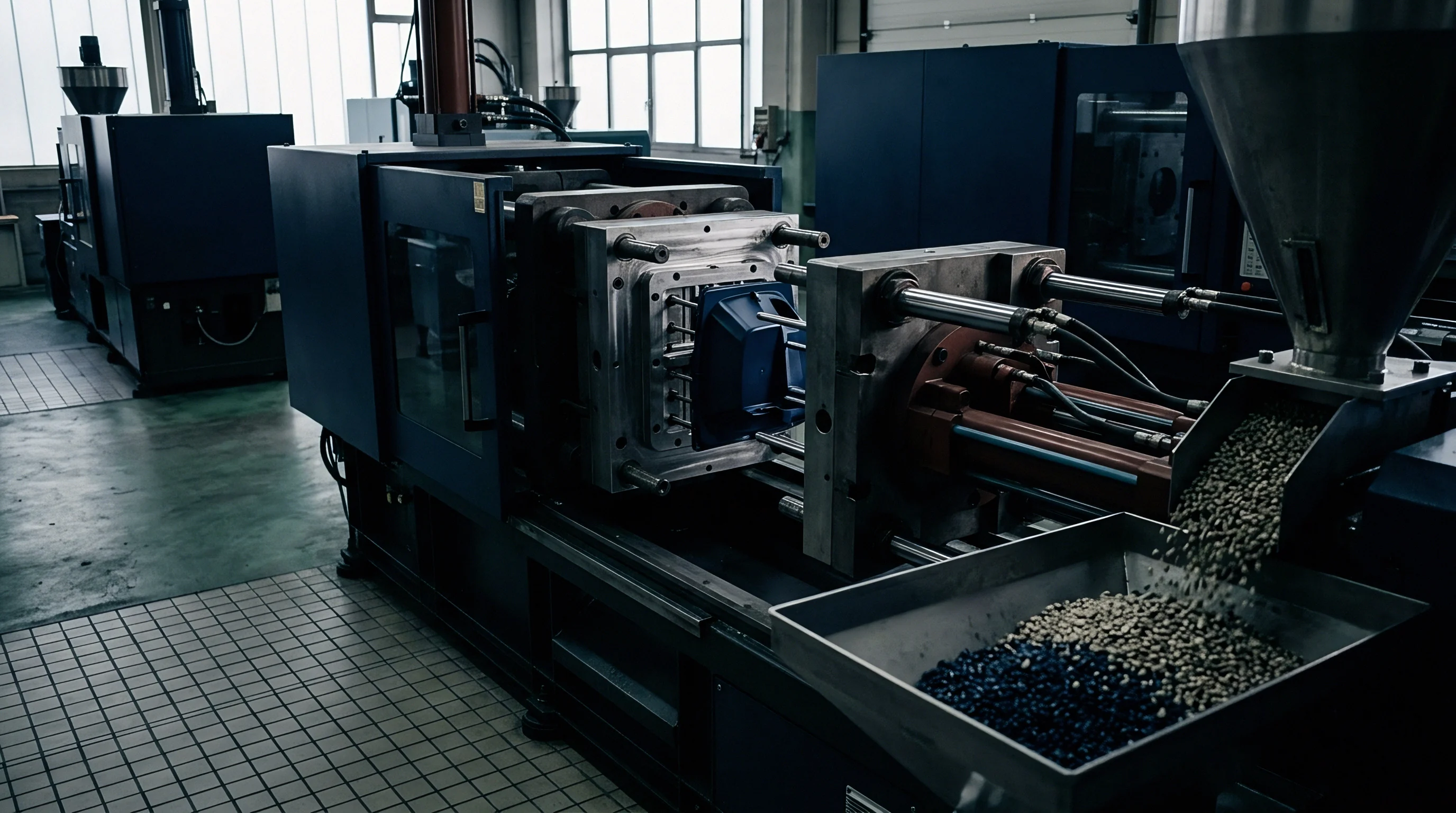
Does Core Tempering Outweigh Carbon Content?
Retaining elevated cyclic yield performance requires balanced carbon levels rather than maximum attainable hardness. Steels with carbon fractions exceeding 0.60 percent, such as standard AISI D2, achieve hardness ratings above 60 Rockwell C yet fail catastrophically through edge chipping when subjected to high-speed clamping impact. The coarse primary chromium carbides present in ledeburitic D2 tool steel function as stress raisers under dynamic compressive fatigue.
Premium hot-work formulations keep carbon between 0.36 and 0.42 percent, precipitating fine molybdenum and vanadium carbides during secondary hardening that stabilize the matrix against micro-yield while maintaining impact toughness above twenty-five joules.
| Steel Grade | Hardness (HRC) | 0.2 Percent Yield (MPa) | Cyclic Compressive Limit (MPa) | Charpy V-Notch (J) |
|---|---|---|---|---|
| DIN 1.2738 (AISI P20+Ni) | 32 | 870 | 410 | 35 |
| DIN 1.2083 (AISI 420 ESR) | 50 | 1,420 | 720 | 18 |
| DIN 1.2344 (AISI H13 ESR) | 52 | 1,650 | 910 | 24 |
| Bohler M390 (Powder Metal) | 58 | 1,820 | 1,150 | 12 |
| Uddeholm Vanadis 4 Extra | 60 | 2,100 | 1,380 | 28 |
Cleanliness in the steelmelt governs fatigue life under high cyclic pressures. Standard electric arc furnace steels carry non-metallic inclusions, primarily aluminum oxides and manganese sulfides, that act as internal stress concentrators. Electroslag remelting (ESR) refines the ingot by passing molten metal through an active slag bath, reducing sulfur below 0.003 percent and distributing trace inclusions into sub-micrometer globular forms.
Specifying ESR processing extends cyclic compressive fatigue life by a factor of three over conventional melt qualities operating under equivalent 900-megapascal cyclic loads.
Tools manufactured from conventional melt stock exhibit localized micro-fissuring around oxide inclusions under ISO 4957 cleanliness testing limits.
Powder metallurgy cold-work steels expand performance envelopes when cycle rates exceed forty shots per minute and parting line lands undergo localized pressures past 1,000 megapascals. Grades like Uddeholm Vanadis 4 Extra combine high vanadium content with gas atomization, yielding an isotropic grain structure free of carbide banding. The resulting steel delivers a compressive yield strength exceeding 2,000 megapascals alongside exceptional crack propagation resistance, preventing premature shut-off fatigue in high-speed cap, closure, and medical syringe tooling.
- Inclusion density bands produce localized shear bands under repeated toggle clamp impact, degrading the land surface.
- Retained austenite instability converts to un-tempered martensite under cyclic compressive strain, causing dimensional growth and localized embrittlement.
- Carbide network segregation creates planar paths for fatigue crack propagation along the direction of primary mill rolling.
- Decarburization zones reduce surface yield strength across EDM-machined areas, leaving soft layers that coin during initial mold qualification.
Heat treatment vendors often claim that their standard single-temper cycle achieves full target hardness, yet omitting secondary and tertiary tempering leaves excessive retained austenite that shifts dimensions under dynamic production pressures.
Pulse
High-speed injection cycles transform clamp actuation from a static force balance into a dynamic mechanical shock event. Five-point double toggle mechanisms deliver non-linear kinematics: platen acceleration starts smoothly, reaches peak velocity during traverse, and decelerates rapidly as the linkage pins approach horizontal alignment. Mechanical overshoot occurs when moving platen inertia drives the mold halves into contact before the press controller executes velocity deceleration.
The resulting dynamic impact generates a force pulse forty to seventy percent higher than the nominal machine setpoint.
Is Toggle Linkage Overshoot Quantifiable Press Side?
Placing strain gauge tie-bar monitors on a 400-tonne packaging press running thin-wall polypropylene food containers reveals the real magnitude of these clamping shocks. A press programmed for 2,800 kilonewtons of clamp force routinely records transient peaks of 4,200 kilonewtons lasting eighteen to forty milliseconds during rapid toggle extension. The tool steel matrix absorbs this mechanical kinetic pulse entirely across the parting line shut-off faces.
Platen kinematic overshoot spikes transient shut-off stress by sixty percent during the final forty milliseconds of high-speed toggle lockup.
Thermal gradients further intensify local clamping stresses. During continuous operation, mold cores running warm water circuits expand axially toward the stationary platen. A core extending 150 millimeters into the cavity expands by 0.035 millimeters at steady-state operating temperatures of seventy degrees Celsius.
If the press setup technician locks the clamp cold without compensating for thermal expansion, the actual parting line land compression increases beyond calculated elastic limits once the tool reaches thermal equilibrium. Core bases deform plastically, introducing cyclic stress reversals that promote low-cycle thermal-mechanical fatigue.
Platen breathing alters the distribution of clamping force across multi-cavity layouts. Center-point deflection on standard cast platens reaches 0.08 millimeters under full tonnage. Cavities positioned near the center take lower initial mechanical load, while outboard parting lands bear excessive compression.
The tool designer compensates for this bow by introducing micro-relief steps or pre-cambering the mold backplates, ensuring uniform land engagement when the platens flex under maximum operating load.
Calculating the true required yield strength demands modeling the clamping pulse as a fatigue endurance problem rather than a static load equation. Monotonic yield calculations assume infinite time for stress distribution across the steel grain boundaries. Dynamic pulses under twenty milliseconds restrict dislocation movement, forcing localized stress concentrations to elevate rapidly.
Micro-strain accumulates cycle by cycle until a fatigue fissure forms at the parting line perimeter.
The exact threshold where transient dynamic impact transitions from purely elastic deformation to cumulative sub-surface crystal slip remains subject to ongoing debate among toolroom metallurgists.

Fatigue
Failure of tool steel under repetitive clamping loads presents distinct morphological signatures. Coining represents the most prevalent failure mode, characterized by a visible indentation of the shut-off land accompanied by a raised metal ridge along the cavity boundary. This displacement occurs when cyclic contact stress exceeds the compressive elastic limit of the mold core or cavity insert.
Once coining begins, plastic melt migrates into the resulting gap, creating flash defects that require immediate press stoppage and costly toolroom benching.
Micro-cracking along electro-discharge machined (EDM) surfaces represents an equally destructive failure mechanism. Wire EDM and sinker EDM operations leave a recast white layer composed of un-tempered, brittle martensite saturated with micro-fissures. When exposed to cyclic clamping pulses, these micro-fissures propagate downward into the base tool steel matrix.
Without rigorous post-EDM chemical etching, stone polishing, and stress-relief tempering, catastrophic land spalling occurs within the first hundred thousand press cycles.
A surface hardness mismatch between moving and stationary shut-off blocks prevents reciprocal adhesive metal pickup during high-speed closure.
Surface modification technologies extend the cyclic fatigue life of hardened tool steels when applied properly. Plasma nitriding forms a diffusion layer up to 0.15 millimeters deep, raising surface hardness to 65 Rockwell C while maintaining core ductility. Physical vapor deposition (PVD) coatings like titanium aluminum nitride (TiAlN) provide an ultra-hard four-micrometer barrier that resists adhesive wear and sliding friction on interlocks and side-action guide heels.
Thin coating layers cannot support dynamic clamping loads if the substrate steel yields beneath them, causing the brittle coating to crack like ice over soft mud.
- Clean shut-off faces thoroughly with solvent to remove degraded grease and polymer vapor deposits.
- Apply high-resolution blue contact dye evenly across the primary parting line lands of the ejector half.
- Close the mold in the press under twenty percent manual clamp tonnage without melt injection.
- Open the mold to verify a continuous contact pattern spanning at least eighty-five percent of the shut-off area.
Steel hardness must step down progressively from the shut-off surface to the ejector base plate to maintain uniform load absorption without shattering brittle components under high-speed mechanical clamp deceleration.
Ledger
Selecting premium tool steels with elevated cyclic yield strength carries a direct procurement cost premium that is recovered through reduced press downtime and extended maintenance intervals. A four-cavity hot runner tool built from conventional pre-hardened DIN 1.2738 demands a raw steel expenditure of 4,200 dollars. Upgrading the core and cavity inserts to ESR-grade DIN 1.2344 increases raw material and heat treatment costs to 8,800 dollars.
Powder metallurgical grades like Uddeholm Vanadis 4 Extra push insert expenditures to 14,500 dollars. These upfront material figures represent a minor fraction of the total tooling capital commitment, typically under eight percent of the delivered mold cost.
| Evaluation Metric | DIN 1.2738 Pre-hard | DIN 1.2344 ESR | Vanadis 4 Extra PM |
|---|---|---|---|
| Initial Insert Steel Cost | $4,200 | $8,800 | $14,500 |
| Toolroom Machining Cost | $32,000 | $38,000 | $44,000 |
| Cycles to First Land Repair | 450,000 | 2,800,000 | 8,500,000 |
| Refurbishment Events (10M Cycles) | 18 | 3 | 1 |
| Total Maintenance Expense | $63,000 | $13,500 | $4,800 |
| Unplanned Press Downtime Hours | 288 | 48 | 16 |
| Net Tooling Cost Per 1k Parts | $9.92 | $6.03 | $6.33 |
Financial recovery accelerates rapidly when factoring press downtime rates. Operating a high-speed packaging cell incurs an average hourly machine rate of 160 dollars. Every unpredicted mold removal for parting line laser welding and bench re-fitting consumes sixteen hours of technician labor, press teardown, and recalibration time.
A tool built from standard pre-hardened plate that requires welding every four hundred thousand cycles bleeds capital continuously through lost production availability, easily generating forty thousand dollars in unbudgeted maintenance over its operating life.
Supply agreements governing production tooling must define steel provenance and verification standards explicitly before purchase orders are signed. Raw material certificates must specify vacuum degassing, electroslag refining verification, and ultrasonic testing to SEP 1921 Group 3 Class D standards. Toolmakers frequently substitute local commercial-grade equivalents to protect margins on fixed-price builds unless the contract demands full mill test reports and hardness mapping dossiers prior to final tool signoff.
Part drawings must designate critical shut-off tolerance envelopes and maximum permissible land coining thresholds directly on the title block, legally establishing that cavity flashing exceeding 0.03 millimeters constitutes tool steel structural failure subject to supplier warranty remedy.