Extrusion Conversion Minimums and Start up Scrap Realities
Extrusion conversion minimums exist to dilute non-negotiable startup purge and calibration scrap across enough linear footage to stabilize part piece price.


Bleed
Continuous thermoplastic extrusion operates on a thermodynamic equilibrium that batch moulders rarely encounter. An extruder barrel does not stop cleanly; the melt pump, screen pack, and profile die hold thermal mass that requires dynamic stabilization before any single foot of profile matches drawing dimensions. Line operators run dozens of kilograms of virgin compound through cold calibrators to balance head pressures, purge degraded resin from prior heats, and achieve a steady viscous state.
This material loss occurs on every single startup, resin lot change, and die servicing interval.
Buyers approaching custom profile extrusion from the injection moulding sector frequently misunderstand this baseline mass penalty. Injection tools achieve thermal balance within five to ten shots, losing grams of material across runner systems that drop into regrind bins for immediate reintroduction. An extrusion line operating a 90 mm single-screw barrel at 180 kg per hour consumes between 45 and 120 kg of prime polymer during thermal stabilization alone, generating purging scrap that cannot enter closed-loop reclaim without altering base molecular weight distributions.
The monetary toll of this initial purging falls on the production order regardless of run length.
Extrusion conversion minimums exist to dilute this non-negotiable startup bleed across sufficient linear footage. A converter quoting a custom thermoplastic elastomer or rigid PVC profile calculates a threshold where machine startup waste, off-spec calibration lengths, and down-spec transition profiles drop below a tolerable fraction of total resin weight. When an engineering drawing calls for 500 meters of a specialized co-extruded profile, the startup mass can equal thirty percent of the total bill of materials.
The economics force converters to enforce minimum order lengths or levy flat setup fees that absorb the raw compound consumed before the puller reaches line speed.
Startup scrap on custom profiles represents a fixed thermodynamic toll rather than machine inefficiency.
A supplier quoting a 1,500-meter minimum run length is protecting the enterprise from absorbing five hours of changeover labor, calibration waste, and thermal loss on an order that generates zero machine contribution. The tooling charge covers the EDM wire-cutting of profile plates, the vacuum calibrator housings, and water bath tanks, yet the conversion fee remains hostage to the startup cycle. Sourcing teams that negotiate down order lengths without addressing setup scrap invariably discover compensatory margins buried in linear meter surcharges.
This dynamic creates commercial friction when qualification trials require short prototype runs. Sourcing specialists attempting to purchase 100 meters of profile for dimensional verification find that machine setup costs match the total price of a 2,000-meter production cycle. The machine consumes identical purge masses, line attendants spend identical hours setting vacuum levels, and laboratory technicians cut identical cross-sections whether the order calls for a single spool or full trailer loads.

Purge
Thermal Mass and Screw Displacement Volumes
Extrusion barrels retain significant polymer volumes within their flights, feed throats, and adapter sections. Calculating startup mass begins with the displacement volume of the screw geometry across the feed, compression, and metering zones. A standard 60 mm diameter screw with a 24:1 length-to-diameter ratio contains approximately 2.5 to 3.2 liters of molten resin under steady pressure.
At melt densities common to rigid polyolefins or polyamides, this resident pool represents several kilograms of polymer subjected to prolonged heat history during idle states.
Resin degradation during thermal transitions mandates systematic clearing procedures. High-molecular-weight purge compounds, often acrylic-based or surfactant-loaded polyethylenes, enter the feed throat to scour carbonized residues, cross-linked gels, and obsolete color concentrates off the barrel wall and flight faces. This purge compound does not leave the die cleanly; it creates an extended interface zone of blended materials that lacks physical integrity for profile calibration.
Operators cut and discard every meter of extruded shape until optical inspection confirms total elimination of foreign polymer chains.

Contamination Thresholds and Purging Ratios
Cross-contamination limits dictate the total volume of purging compound and prime material run to waste. Highly sensitive engineering polymers such as polyetheretherketone or fluoropolymers display severe drop-offs in mechanical properties when exposed to parts-per-million levels of residual polyolefin purge. The clearing ratio regularly exceeds five barrel volumes to push traces of cleaning polymers past dead spots in adapter rings and breaker plates.
This displacement phase generates vast piles of heavy, distorted profile chunks that collect in water-cooling troughs.
| Barrel Diameter (mm) | Screw L/D Ratio | Resident Mass HDPE (kg) | Standard Purge Mass (kg) | Stabilization Scrap (kg) | Total Lost Mass (kg) |
|---|---|---|---|---|---|
| 35 | 24:1 | 1.2 | 4.5 | 6.0 | 11.7 |
| 45 | 28:1 | 2.4 | 8.0 | 12.5 | 22.9 |
| 60 | 30:1 | 5.8 | 18.0 | 28.0 | 51.8 |
| 90 | 30:1 | 19.5 | 55.0 | 85.0 | 159.5 |
| 120 | 32:1 | 44.0 | 120.0 | 180.0 | 344.0 |
Color changes between contrasting pigments multiply purge requirements. Transitioning an extrusion line from carbon-black masterbatch to a natural or signal-white formulation forces the line operator to run the extruder at elevated backpressures for hours. Carbon pigments embed inside microscopic tooling fissures and dead zones behind the screen pack.
Operators frequently remove the die, soak it in solvent or burn off residues in fluidized bed ovens, and reinstall the assembly, adding substantial thermal ramp cycles to the startup ledger.
The purge phase ends only when the resin exits the die lips free of optical defects, black specks, and internal voiding. Sourcing engineers auditing factory floors evaluate startup discipline by the condition of the purge station. Piles of unsegregated purging patties indicate poor inventory control, as clean single-polymer purges can be diverted into commercial re-pelletizing streams rather than landfills.

Draft
Calibrator Pulling and Line Tension Equilibrium
Exiting the die lips, the molten profile possesses almost zero tensile strength. The extrudate must bridge the open-air gap between the die face and the entry bushing of a vacuum calibrator tank without sagging, tearing, or ballooning. Line operators perform a manual threading maneuver: grabbing the hot, gelatinous extrudate with insulated gloves, stretching it into a leading neck, and walking it through multiple consecutive cooling tanks, sizing plates, and drying air knives before feeding the tapered tail into caterpillar puller belts.
This string-up process generates immediate, non-recoverable startup scrap. The initial pulled profile exhibits stretched walls, collapsed hollow sections, and inconsistent dimensions while line tension matches melt exit velocity. Caterpillars squeeze the hollow sections flat to achieve tractive grip, destroying hundreds of feet of profile before the haul-off rate locks into sync with screw RPM.
Until haul-off speed, screw feed rate, and vacuum water tank pressures reach steady equilibrium, every running foot is cut away and tossed into the bin.
Profile geometry remains out of tolerance until vacuum sizing forces counter the radial shrinkage forces of the cooling melt.
Vacuum sizing tanks introduce hydrostatic drag that opposes line pull. Sizing sleeves inside the tank pull the outer perimeter of the molten profile against chilled bronze or stainless steel surfaces using vacuum levels between negative 50 and negative 400 millibar. Insufficient vacuum causes wall collapse; excessive vacuum causes stick-slip friction inside the sleeve, resulting in profile chatter marks, surface tearing, and cyclic dimensional variations.
Balancing these forces takes twenty to forty minutes of fine adjustment per trial run.
Differential wall thicknesses complicate this draft equilibrium. Thicker structural legs retain heat longer than thin decorative fins, cooling slower and shrinking toward their thermal center. This uneven contraction bows the entire profile along its longitudinal axis, an anomaly termed camber.
Compensating for camber requires the line setter to alter water spray nozzles inside vacuum tanks, angling cooling streams to freeze thick sections earlier or reheating thin sections to equalize internal stress states.
The line operator cuts dimensional coupons at the saw table every three minutes during this phase, cross-referencing outer boundaries using optical shadowgraphs. Setup pieces cannot ship to customers, as cooling stress locked into unbalanced profiles causes excessive warpage once parts enter storage warehouses or field installation.


Gauge

Wall Thickness Tolerances and Thermal Shrinkage Stack
Holding dimensional tolerance on an extruded shape differs fundamentally from holding tolerance in a rigid steel cavity. Under DIN 16742 or ISO 20753 considerations adapted for continuous profiles, dimensional stability depends on polymer thermal contraction, draw-down ratios, and haul-off precision. Polymers do not freeze against rigid walls in profile extrusion; they cool dynamically from the outer perimeter inward, pulling cross-sectional walls away from nominal drawing targets.
Semi-crystalline thermoplastics display high volumetric shrinkage rates that strain profile consistency. Unfilled polypropylene shrinks between 1.5 and 2.2 percent, whereas high-density polyethylene shrinks between 2.0 and 3.5 percent during cooling from melt temperatures of 210 degrees Celsius to ambient room conditions. An engineer specifying a profile wall thickness of 2.00 mm with a tight tolerance of plus or minus 0.05 mm demands a level of continuous line capability that standard single-screw systems struggle to deliver across shifts without closed-loop laser gauge control.
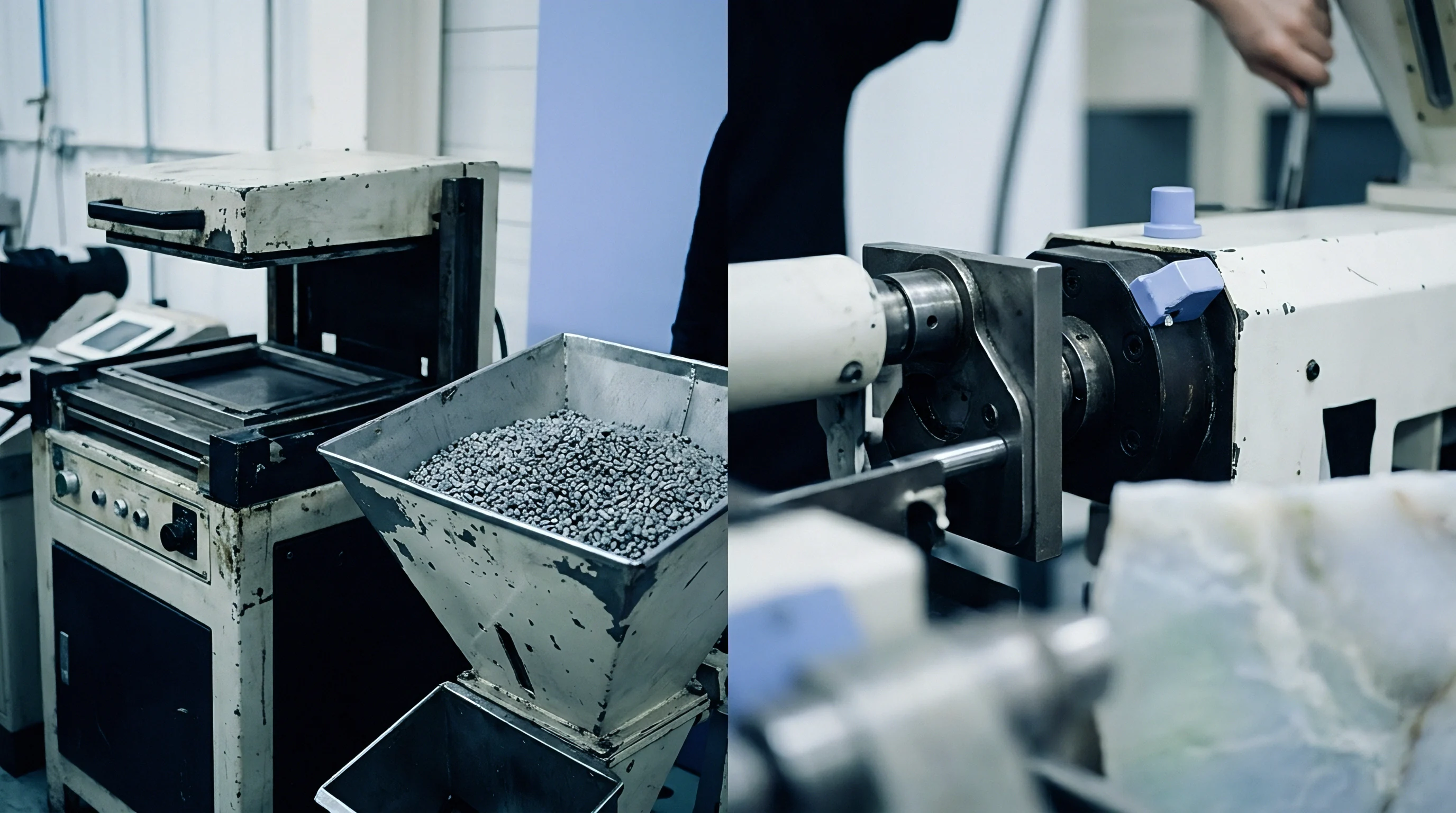
Do Calibration Tanks Hold Tight Drawing Callouts across Shifts?
Maintaining micro-tolerances over a multi-kilometer extrusion campaign requires active compensation for melt temperature drift and ambient water tank warming. Chilled water loops running through calibration tanks fluctuate by several degrees as factory ambient temperatures swing between afternoon highs and night shifts. A 3-degree shift in cooling bath temperature moves the freeze line inside the sizing sleeve, altering the outside diameter of a round tube or the leg gap of an asymmetric structural channel.
- Outer profile dimensions wander outside target envelopes when vacuum pump water rings experience cavitation from elevated bath temperatures, reducing calibrator suction forces against the sizing tooling.
- Internal web thicknesses swell or neck down without warning because internal profile hollows cool solely via ambient air conduction, escaping the direct contact chilling that freezes exterior perimeter skins.
- Hinge flexure gaps on co-extruded assemblies pinch tight when low-durometer elastomer segments contract at rates divergent from the rigid base substrate during secondary water bath quenching.
- Linear cut lengths skew off specification at the traveling saw table if caterpillar puller pads pick up cooling water spray, causing micro-slip events against the profile outer jacket.
The scrap generated while correcting these dimensional drifts is a routine cost of high-precision profile operations. Line setters run test lengths, measure cross-sections across eight distinct coordinate axes, adjust puller speed trims by fractions of a meter per minute, and check again. Every minute consumed by this metrology loop produces twenty meters of unclassifiable, sub-tolerance profile that cannot be packaged for sale.
Quality departments verify capability by establishing process capability indexes on critical dimensions. Achieving a Cp index above 1.33 demands a steady-state run lasting several consecutive hours without raw material variation. Orders cut short by low conversion volumes simply terminate before the line setter establishes true statistical process control, leaving the buyer holding profiles produced entirely within the wide variance window of line startup.
Reclaim
Granulating startup scrap and re-extruding it into prime profiles appears to solve the economic penalty of short run lengths, yet material science limits this practice. Thermoplastics run through an extruder barrel experience thermal degradation, chain scission, and shear-induced stress that lowers average molecular weight. When processing high-performance polymers, running regrind alters melt flow rates, rendering precise profile calibration nearly impossible across tight-tolerance die lips.
A plant floor operating a closed-loop regrind system feeds ground scrap back into virgin material streams via proportional blenders at ratios typically between 5 and 20 percent. However, startup purge lumps and contaminated string-up profiles cannot safely enter this stream. Purge chunks contain oxidized black specks, degradation byproducts from heater-band soak times, and embedded brass wire residues from manual die scraping tools.
Feeding these contaminants into a granulator produces regrind flakes that lodge directly behind extruder breaker plates or foul the fine exit gaps of narrow profile dies.
Repeated thermal cycles reduce polymer intrinsic viscosity, increasing melt flow index and inducing wall sag in open calibration gaps.
The economic ledger for reprocessing scrap contains significant hidden energy and labor charges. The scrap must be manually collected, sorted by resin grade, chopped in coarse shredders, moved through secondary knife granulators, de-dusted to remove fines, and stored in desiccant drying hoppers. If a processing plant handles multiple polymer colors, cross-contamination risks multiply exponentially.
One stray pellet of dark polyamide 6 inside a clear polycarbonate run chars inside the barrel and ruins an entire production shift.
Automotive and medical specifications flatly prohibit the inclusion of post-industrial regrind in primary extrusion profiles. ISO 13485 environments demand traceable raw materials possessing certified lot histories, forcing converters to write off startup scrap as hazardous or non-recoverable waste. The entire mass of startup purge, calibration off-cuts, and end-of-run tailing profiles becomes an absolute financial loss that must be absorbed directly by the production contract.
Converters processing rigid PVC face unique chemical hurdles regarding scrap reclaim. Rigid vinyl compounds undergo dehydrochlorination when exposed to excessive residence times, releasing hydrochloric acid gas that corrodes chrome-plated tooling surfaces and barrel walls. Burned PVC scrap cannot be re-extruded; it chars into brittle, carbonaceous flakes that must be rejected and hauled off-site for disposal, imposing landfill fees that add directly to conversion overhead.
Converters often declare that regrind inclusion rates up to fifteen percent do not alter part performance, yet they will not honor dimensional warranties on asymmetric shapes unless virgin resin comprises one hundred percent of the hopper mix.
Ledger
Worked Conversion Economics for an Engineering Profile
Consider the production economics of an asymmetric rigid acrylonitrile butadiene styrene (ABS) profile with a nominal linear mass of 0.45 kg per meter. The procurement specification calls for a high-impact extrusion grade ABS at a virgin material cost of 3.20 dollars per kilogram. Tooling comprises an extrusion die plate, a dual-stage vacuum calibrator, and sizing shoes costing 7,500 dollars.
The production line operates a 65 mm single-screw extruder with a machine conversion rate of 145 dollars per hour, capable of a steady-state throughput of 90 kg per hour (200 linear meters per hour).
The thermal stabilization, color purge, and line threading procedures consume 65 kg of virgin ABS and take 1.2 hours of non-productive machine setup time. During initial calibrator balancing and puller synchronization, another 40 kg of material becomes uncalibrated draft scrap across 0.5 hours before the optical shadowgraph confirms drawing compliance. Total startup waste equals 105 kg of compound and 1.7 hours of machine time before a single good meter enters the collection bin.
The job ends with a run-out purge and line clear that takes 0.5 hours and generates 15 kg of tail-out waste.
| Run Length (Meters) | Theoretical Part Mass (kg) | Total Resin Mass Charged (kg) | Total Machine Hours Charged | Resin Cost per Meter (USD) | Machine Cost per Meter (USD) | Effective Net Cost per Meter (USD) |
|---|---|---|---|---|---|---|
| Data based on 105 kg startup scrap, 15 kg tail scrap, 2.2 h total setup and clearing time, and 145 USD/h press rate. Tooling amortisation excluded. | ||||||
| 250 | 112.5 | 232.5 | 3.45 | 2.98 | 2.00 | 4.98 |
| 500 | 225.0 | 345.0 | 4.70 | 2.21 | 1.36 | 3.57 |
| 1,000 | 450.0 | 570.0 | 7.20 | 1.82 | 1.04 | 2.86 |
| 2,500 | 1,125.0 | 1,245.0 | 14.70 | 1.59 | 0.85 | 2.44 |
| 5,000 | 2,250.0 | 2,370.0 | 27.20 | 1.52 | 0.79 | 2.31 |
| 10,000 | 4,500.0 | 4,620.0 | 52.20 | 1.48 | 0.76 | 2.24 |
The worked ledger demonstrates the steep economic penalty of sub-minimum run lengths. At 250 meters, startup and tail-out scrap represent more than fifty percent of the total resin bill, elevating the raw material cost component to 2.98 dollars per meter compared to the theoretical net profile baseline of 1.44 dollars. Adding setup machine hours drives the unit piece price to 4.98 dollars per meter.
When the order expands to 5,000 meters, scrap dilution lowers the unit price to 2.31 dollars per meter, a reduction of over fifty-three percent.
Sourcing programs that ignore these conversion thresholds force extruders to deploy defensive quoting structures. A converter will rarely outline the individual line items for startup scrap, machine stabilization, and threading losses. Instead, they present a high minimum order quantity (MOQ) of 2,500 meters or apply a flat lot-charge penalty of 1,200 dollars on any release below their threshold.
Sourcing teams seeking lower inventory carry costs must understand that cutting PO volume does not eliminate the physical 120 kg waste mass; it merely concentrates that cost over fewer deliverable units.
Tool amortisation compounds this financial exposure. Dividing a 7,500-dollar tooling invoice over an exploratory run of 500 meters adds an extra 15.00 dollars per meter to the bill, rendering the component commercially unviable. The tool cost must amortise over annual volumes running in the tens of thousands of meters to fall below fifty cents per unit length.
Sourcing engineers evaluating profile extrusions must negotiate contracts that balance warehouse holding costs against the fixed, physical laws of extruder startup dynamics.
Terms
Commercial contracts for custom extrusion profiles require contractual mechanisms that clearly assign scrap liabilities. Purchase orders lacking specific scrap riders leave the buyer vulnerable to hidden yield shortages or unexpected mass surcharges. Converters protect margins by inserting production overrun and underrun tolerances, standardizing on plus or minus ten percent variations on finished footage.
Sourcing managers must define whether scrap is billed as a separate pass-through line item or baked entirely into the piece price per linear foot.
A rigorous Master Services Agreement incorporates explicit yield calculations linked to run length. The contract specifies baseline startup scrap allowances for standard setups, color transitions, and material changes. If a converter runs a standard resin, the agreement must declare whether startup scrap generated during stabilization becomes the property of the buyer for third-party reclaim or stays with the converter without credit.
- Production overrun bounds govern the exact linear footage a customer must accept, legally obligating payment on finished extrudate up to ten percent above purchase order releases while preventing unauthorized disposal charges.
- Scrap mass transparency clauses define standard baseline startup resin weights per die cross-section, ensuring raw material price escalations apply strictly to finished product weights rather than unoptimized press-side waste.
- Setup amortisation schedules establish fixed setup fees for low-volume production releases, preventing hidden unit-rate markups when inventory requirements force runs beneath calculated conversion minimums.
- Regrind prohibition warranties document acceptable usage percentages in secondary structural regions, defining financial damages and batch rejection parameters if uncertified regrind appears in primary functional surfaces.
Buyers operating in cross-border manufacturing environments must scrutinize raw material indexing clauses. Resins priced on index tables (such as ICIS or ChemOrbis) shift monthly; when converters quote long lead-time custom profiles, a sudden resin cost increase between order placement and extrusion run exacerbates the scrap penalty. Contracts must fix scrap allocation baselines to prevent converters from inflating startup waste estimates during market pricing upswings.
The standard procurement rider provides that all startup scrap generated as a consequence of tooling dimensional failure or converter machine downtime falls exclusively on the converter ledger, leaving the customer responsible only for standard thermal stabilization allowances established during initial tool qualification.

Bounds
Process boundaries dictate the minimum viable run length for any profile profile. An operations team cannot bypass the physical limits of barrel melt volumes, thermal inertia, and calibrator stabilization times through contractual negotiations. When total projected product demand cannot absorb baseline startup waste over an extended amortization period, product designers must evaluate whether extrusion remains the appropriate manufacturing path.
Low-volume applications requiring less than 500 meters over the product lifecycle frequently incur landed costs that outstrip additive manufacturing or CNC-machined bar stock. Machining custom shapes from extruded standard rectangular profiles or continuous cast rods eliminates the 7,500-dollar profile die cost and sidesteps line startup waste entirely. The scrap generated during CNC milling remains localized, dry, and instantly salable as high-value, unburnt swarf.
Alternatively, aluminum extrusion offers an informative point of comparison for low-volume programs. While aluminum billet extruders generate butt scrap and puller stretch allowances, billet changeovers do not require the multi-hour thermal and viscous purging sequences inherent to continuous polymer screws. The tooling costs for aluminum dies sit substantially lower than complex vacuum calibrators, making aluminum a viable alternative for structural tracks requiring short production lots.
Injection moulding also shifts the scrap equation when profile lengths remain short and discrete. If an extruded assembly consists of straight, cut-to-length profiles under 300 mm, a multi-cavity injection mould running cold runner regrind or hot runner systems often delivers lower piece-part costs at volumes beneath 5,000 units. The upfront tooling investment increases, yet the elimination of ongoing 120-kilogram line startup scrap penalties balances the investment across early assembly releases.
Can the process window for custom profiles ever contract to the point where 100-meter production runs become commercially viable without setup subsidies?