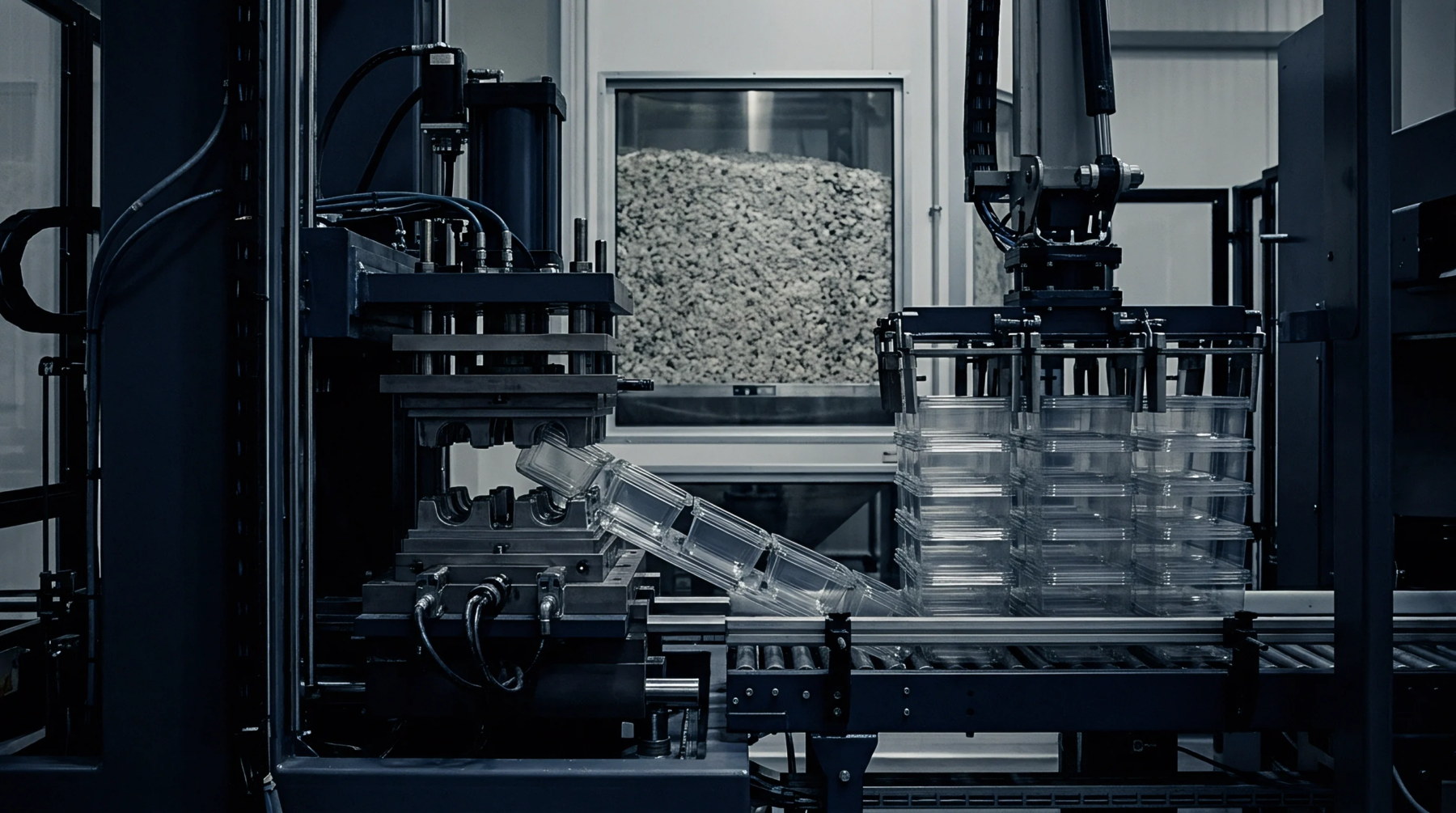
Thermoforming against Injection for Volumes below Fifty Thousand Units
Thermoforming delivers lower total landed cost below fifteen thousand units by saving upfront tooling capital, beyond which injection piece price efficiency dominates.
This process describes the physical quantity of web material remaining after high precision die stamping or punch operations on flat resin sheets. A skeleton scrap consists of the outer margins and the internal bridges left within the perimeter of the original workpiece. Moulders define this variable by subtracting the total weight of finished parts from the mass of the initial input sheet.
It operates as an efficiency metric for estimating material loss during the conversion of thermoplastic slabs into discrete shapes. Accurate quantification prevents skewed cost accounting because the ratio of usable resin to waste shifts depending on the geometry of the part. Such data informs the logistics of recycling, as the physical consistency of the leftover web determines whether the regrind remains viable for future feed streams.
Proper management of skeleton scrap ensures that production costs remain aligned with raw material expenditures. The volume of waste follows the density of the part nesting pattern on the sheet. When layouts optimize the spacing between voids, the mass of the leftover web decreases.
Conversely, complex contours that require significant buffer zones between components generate higher levels of surplus. Operators calculate this metric by weighing the discarded matrix after the extraction of the finished units. High ratios of waste indicate a need for improved tooling, as excessive trimming adds to the energy costs of grinding and reprocessing.
Virgin resin costs exceed those of reclaimed content, so maintaining a low waste ratio preserves the margin of the product. The matrix itself requires segregation from dust or contaminants to prevent degradation during the subsequent extrusion steps.
The purity of skeleton scrap determines the suitability of the material for reintegration into the production line. Clean loops allow the manufacturer to mix reclaimed flakes with virgin pellets in controlled percentages. This practice reduces total resin consumption without compromising the mechanical integrity of the molded parts.
Technicians monitor the thermal history of the web to avoid molecular degradation, since repeated heating cycles reduce the viscosity of the polymer. If the scrap displays signs of oxidation or contamination, blending it into the primary stream introduces defects into the final component. Parts molded from degraded regrind exhibit reduced impact strength and lower tensile performance.
Consistent identification of the waste stream allows the team to isolate batches that maintain the target material specifications, thereby ensuring that physical properties remain stable across entire production runs.
Financial performance relies upon the accurate tracking of skeleton scrap as a non-productive asset. Every unit of mass diverted to the trash bin represents a direct loss of income. Procurement departments value the ability to distinguish between unavoidable matrix waste and excessive trim.
By adjusting the feed rate to match the optimal web consumption, the manufacturer minimizes the volume of discarded material. Variations in the thickness of the initial sheet change the total tonnage of the leftover material, which affects the storage requirements for recycling. Systems that track these quantities enable precise predictions of the yield for each manufacturing cycle.
Detailed monitoring of the internal waste cycle proves that rigorous control of the web geometry provides the most effective mechanism for reducing the cost per part.
Thermoforming delivers lower total landed cost below fifteen thousand units by saving upfront tooling capital, beyond which injection piece price efficiency dominates.
Expertise is a utility, not a secret. sentiention™ publishes its working knowledge as open reference: intelligence layer covering the materials it sources, the markets it enters, and the reference that serves both.