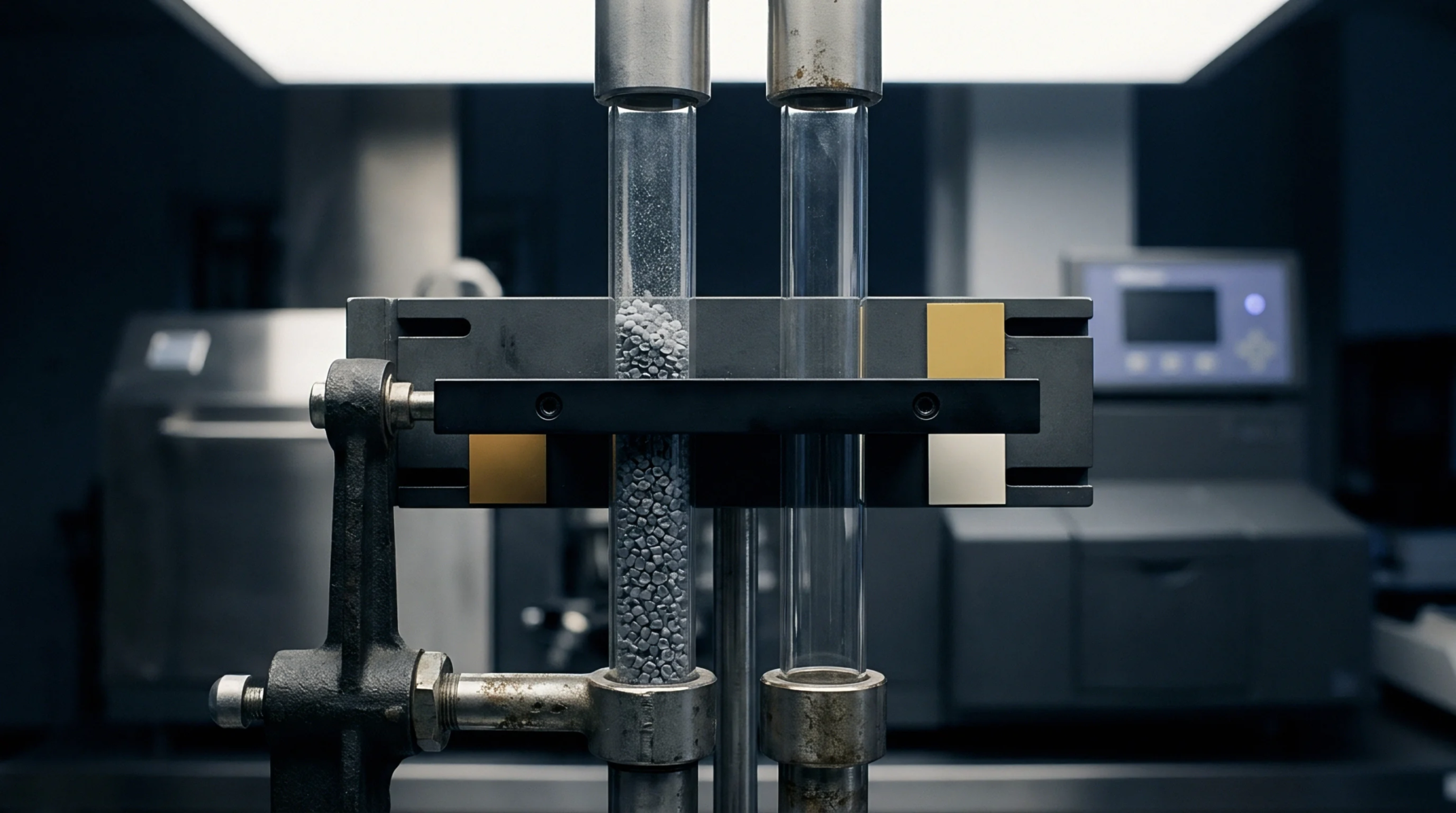
Optical Coherence Scanning Measurement Limit Boundaries on Vertical Tooling Cavity Sidewalls
Side-viewing prisms and polarized optical coherence gating extend sidewall slope scanning limits beyond eighty-five degrees in deep tooling cavities.
Optical deflection optics mounted at cavity periphery govern internal cavity wall inspection during injection molding runs. Side viewing deflection prisms direct peripheral rays toward the main objective axis, enabling operators to check barrel bore geometry and gate seating without extraction. Tooling engineers set these components during optical alignment phases to detect parting line flash and microcracking in cylindrical polymer preforms.
Unintended thermal shift causes prism housing expansion, leading to distortion at the extreme fields of view. Melt temperature anomalies create localized birefringence within the optical path, obscuring wall thickness irregularities in transparent polycarbonate components. Polymer sourcing requires high purity cyclic olefin copolymers to prevent internal scatter across the reflective surface.
Part specifications govern the final geometry of the molded article, whereas material specifications dictate the melt flow index and refractive index of the base resin. Virgin polymer stocks maintain consistent optical clarity throughout prolonged production cycles, while regrind additions introduce volatile inclusions that degrade image fidelity. Datasheet values assume ideal laboratory conditions, whereas molders must account for shear-induced orientation when verifying tolerance stacks across multi-cavity production runs.
Refractive index shifts across the glass substrate generate geometric aberration within molded preforms. Barrel temperature fluctuations alter the mounting pocket dimensions, inducing mechanical stress on the optical element. Production runs suffer from barrel wear when abrasive glass-filled polybutylene terephthalate melts pass the perimeter of the assembly.
Optical distortion manifests as barrel distortion on the inspection monitor, masking micro-voids near the base radius. Moulders struggle to maintain consistent focal length when cooling channel scale buildup elevates local mold wall temperatures. Process technicians compensate for thermal expansion by adjusting clamping tonnage and injection velocity profiles during warm-up sequences.
Injection pressure peaks dictate the mechanical loading transferred through the optical housing to the internal prism face. Melt viscosity variations alter packing efficiency around the housing perimeter, creating residual stress concentrations in the surrounding polymer matrix. Cavity pressure transducers provide feedback for closed-loop machine control, preventing flash intrusion into the optical interface.
Operators verify holding pressure settings against component shrinkage rates to maintain dimensional stability across high-volume production runs. Tooling maintenance schedules mandate periodic cleaning of the deflection face to remove volatile organic compounds condensed from outgassing engineering thermoplastics.
Dimensional tolerance allocation separates acceptable optical assemblies from rejected hardware destined for scrap bins. Coordinate measuring machines verify the angular orientation of the reflective face against the primary locating datum. Toolmakers check alignment using specialized laser interferometers to quantify wavefront error before final press-fitting into the core plate.
Production engineers monitor scrap rates closely during initial sampling phases to isolate assembly drift from raw material batch variability. Final inspection procedures confirm that optical clarity remains within specification after exposure to sustained thermal cycling.
Side-viewing prisms and polarized optical coherence gating extend sidewall slope scanning limits beyond eighty-five degrees in deep tooling cavities.
Expertise is a utility, not a secret. sentiention™ publishes its working knowledge as open reference: intelligence layer covering the materials it sources, the markets it enters, and the reference that serves both.