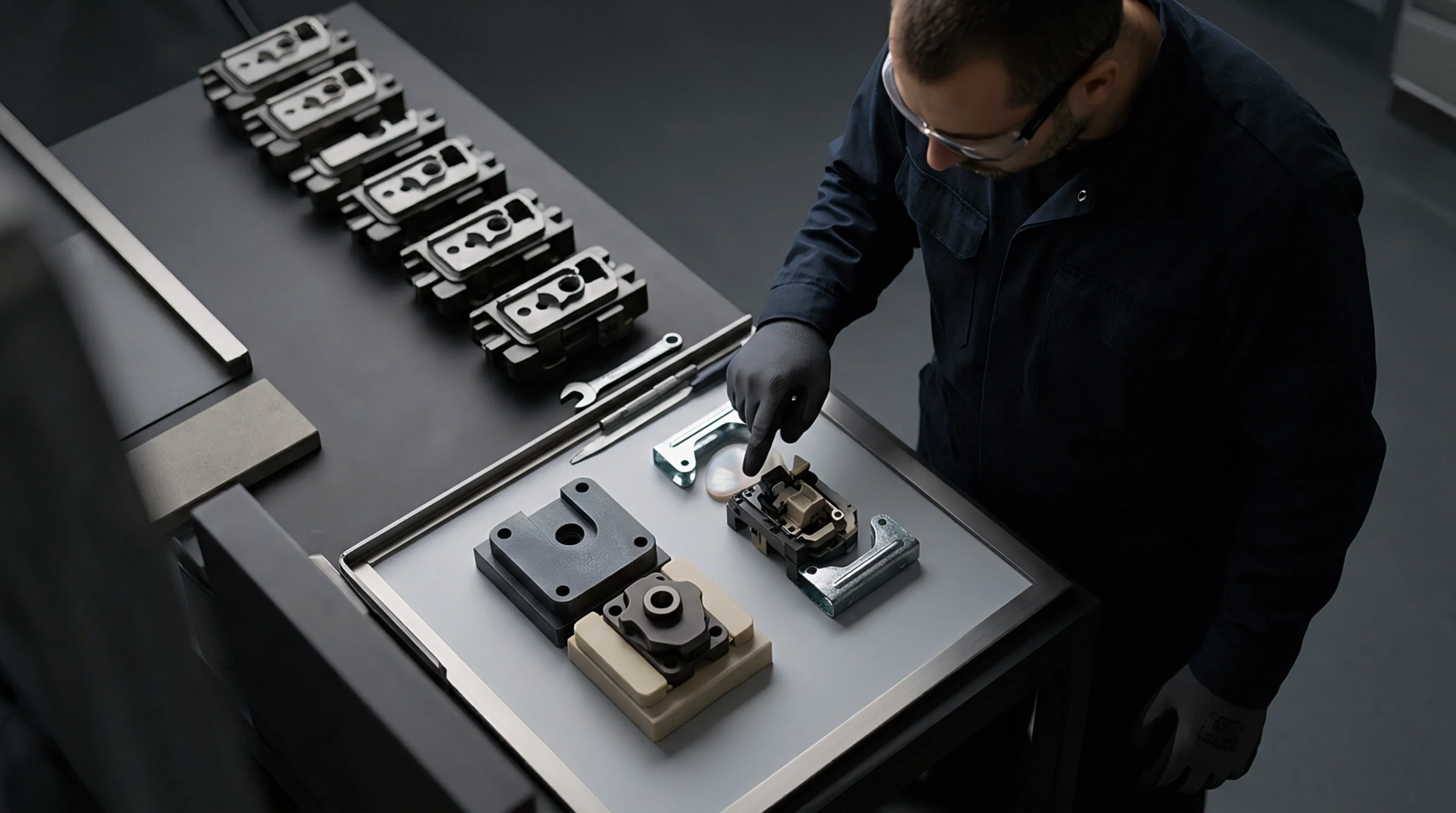
Parting Line Shutoff Inspection in Plastic Injection Molds
Verifying parting line shutoff lands under true press tonnage with bluing or foil prevents flash and stops premature tool crush.
Polymeric component compression represents the initial mechanical interference established between a valve seat and its elastomeric insert within injection-moulded fluid handling assemblies. Shutoff seal preload governs the minimum seating stress required to prevent fluid bypass across high-pressure melt channels and hydraulic shutoff nozzles during high-tonnage clamping phases. This specific seating force prevents drool and material degradation inside the hot runner tip during thermal soak cycles.
Material specifications for these elastomeric seals differ fundamentally from part specifications, because the seal compound requires specific durometer ratings and compression set resistance rather than mere tensile strength. Virgin polymers maintain predictable recovery rates under repeated mechanical deflection, whereas regrind additions degrade resilience and cause premature sealing failure.
Toolmakers establish this mechanical interference during bench assembly by measuring bolt elongation or applying calibrated rotational force to the retainer flange. Hot runner manufacturers specify cold-clearance dimensions that account for thermal expansion differentials between the surrounding steel manifold and the internal polymer components. Processing temperature fluctuations alter the dimensional state of the assembly, which directly changes the effective seating pressure on the elastomeric barrier.
A datasheet value for hardness provides a baseline property, but the actual value a moulder can hold across a production run depends heavily on consistent torque application during mould maintenance. Insufficient mechanical force leads to immediate melt leakage along the parting line, while excessive compression deforms the elastomer beyond its elastic recovery limit.
Continuous cycling at elevated melt temperatures softens the elastomeric insert and induces permanent deformation known as compression set. Material degradation accelerates when barrel temperatures exceed the thermal index of the specific fluoropolymer or thermoplastic elastomer selected for the application. Process engineers monitor cycle times closely because prolonged dwelling under high clamping loads increases stress relaxation within the seal matrix.
Regrind material integration further worsens this instability by lowering the overall molecular weight distribution, which reduces recovery memory after repeated valve closures.
Inadequate mechanical interference allows viscous polymer to escape into valve actuator chambers, contaminating pneumatic cylinders and causing catastrophic production downtime. Maintenance technicians incur substantial labour costs when clearing carbonized polymer blockages resulting from chronic seal bypass. Scrap rates multiply rapidly during start up sequences when cold polymer forces past unseated barriers before thermal expansion reaches equilibrium.
Precise mechanical adjustment of the assembly prevents costly mould teardowns and eliminates raw material waste associated with intermittent valve failure.
Verifying parting line shutoff lands under true press tonnage with bluing or foil prevents flash and stops premature tool crush.
Expertise is a utility, not a secret. sentiention™ publishes its working knowledge as open reference: intelligence layer covering the materials it sources, the markets it enters, and the reference that serves both.