Managing Thermal History and Annealing Variables in Polyethylene Density Standards
Polyethylene density measurements shift by up to 0.008 g/cm3 across cooling methods, requiring ASTM D4703 Procedure C to ensure contractual compliance.

Melt
Polyethylene density reported on a resin certificate of analysis reflects the cooling rate of the test plaque rather than an intrinsic polymer constant. A resin cooled at 15 degrees Celsius per minute under ASTM D4703 Procedure C yields an apparent density roughly 0.004 g/cm3 higher than identical material cooled at ambient rates on an open laboratory bench. High-density blow molding grades specified at 0.954 g/cm3 easily slip into the 0.950 g/cm3 bracket when compression molds cool without controlled thermal loops.
Solid-state morphology freezes early under rapid heat extraction, trapping disordered amorphous chains that would otherwise pack into lamellar crystals.
Polymer chains in a molten state above 190 degrees Celsius remain completely entangled and amorphous. Thermodynamic equilibrium favors crystal formation below the melting point of 130 to 137 degrees Celsius for linear high-density polymers, yet chain kinetics restrict crystal growth when cooling passes rapidly through the crystallization window between 125 and 110 degrees Celsius. Fast quenching arrests polymer chain folding.
The material locks into a lower-density metastable solid containing thinner lamellae, larger amorphous fractions, and reduced crystal thickness.
Polyethylene density shifts across a range of 0.005 g/cm3 purely through thermal manipulation without altering chemical composition.
Standardized measurement protocols isolate resin chemistry by enforcing specific thermal histories. ISO 17855-2 and ASTM D4703 define rigorous plaque preparation parameters to ensure reproducibility across laboratories. When compounding lines draw samples straight from an extruder die and drop them into chilled water, the measured density drops significantly below the datasheet nominal value.
Incoming inspection protocols encounter disputes when receiving facilities prepare test specimens under differing cooling cycles.
Molding conditions alter crystal formation rate directly. Slower thermal dissipation extends the time polymer chains spend in the high-mobility crystallization regime, fostering thicker lamellar stacks and higher bulk density. Shortening this crystallization window via forced convective cooling produces compliant part dimensions at the expense of nominal material density.
Ignoring thermal history during incoming pellet checks causes incorrect grade rejections and costly production interruptions.

Kinetics
Lamellar crystal growth in polyethylenes follows secondary nucleation kinetics described by the Hoffman-Lauritzen theory. Linear polyethylene homopolymers crystallize rapidly due to uniform backbone structure, whereas short-chain branched copolymers encounter steric hindrances. Ethyl and butyl branches along linear low-density polymer backbones cannot integrate into the unit crystal cell, forcing branched segments into the interlamellar amorphous regions.
The rate of cooling directly dictates whether marginally mobile chain segments segregate into crystal growth fronts or freeze into amorphous entanglements.
Annealing solid plaques below their peak melting temperature supplies thermal energy to reinitiate chain mobility. Isothermal conditioning at 100 degrees Celsius for linear low-density resin or 120 degrees Celsius for high-density resin allows chain segments within thin lamellae to reorganize into thicker, thermodynamically stable crystals. Density increases systematically with annealing duration until lamellar thickening reaches a thermodynamic plateau.
| Polyethylene Grade Class | Nominal Density Range (g/cm3) | Annealing Temp (deg C) | Quench Density (g/cm3) | Annealed Density (g/cm3) |
|---|---|---|---|---|
| VLDPE (0.900-0.914) | 0.908 | 85 | 0.903 | 0.910 |
| LLDPE (0.915-0.925) | 0.920 | 95 | 0.915 | 0.922 |
| MDPE (0.926-0.940) | 0.935 | 105 | 0.930 | 0.937 |
| HDPE Copolymer (0.941-0.958) | 0.952 | 115 | 0.946 | 0.954 |
| HDPE Homopolymer (0.959-0.968) | 0.962 | 120 | 0.956 | 0.965 |
Crystal perfection occurs during sustained thermal exposure. Secondary crystallization processes proceed over logarithmic time scales, causing measurable density creep even at room temperature over extended storage periods. Standardized testing dictates tight time frames between thermal preparation and density determination to minimize ambient drift.
Cooling rate variations induce significant mechanical property differences. Yield strength, tensile modulus, and environmental stress crack resistance shift alongside density changes. Slower cooling elevates yield strength while reducing stress crack resistance because larger spherulites create localized inter-spherulitic stress concentrations.
Thicker lamellar crystals yield higher density and stiffer finished parts.
Controlled cooling balances morphology. Slower rates expand crystalline fraction.

Specimen
Plaque preparation demands strict adherence to international mechanical pressing standards. ASTM D4703 specifies four cooling procedures, each imposing distinct cooling rates from the melt at 190 degrees Celsius. Procedure A enforces an uncontrolled cooling cycle where the mold cools between platens with water turned off, producing cooling rates between 10 and 15 degrees Celsius per minute.
Procedure C mandates a constant cooling rate of 15.0 plus or minus 0.5 degrees Celsius per minute, utilizing automated cooling water loops. Procedure C serves as the referee standard for commercial transactions because it minimizes intra-laboratory variance.
Where Does Annealing Shift Density Classifications?
Density grade boundaries in ASTM D1248 and ISO 17855-1 carry narrow spans. An intermediate-density resin transitioning to high-density at 0.941 g/cm3 can shift across classification lines purely through annealing variables. Conditioning test specimens in a boiling water bath at 100 degrees Celsius for one hour elevates apparent density by 0.002 to 0.005 g/cm3 depending on branch frequency.
Sourcing specifications that fail to state the specimen conditioning standard leave the door open to grade disputes.
Preparing compliant plaques involves several sequential steps:
- Preheating cycles ensure complete pellet melting at 190 degrees Celsius under contact pressure for five minutes to erase prior shear history.
- High-pressure consolidation applies 10 MPa of platen pressure for two minutes to expel entrapped air bubbles from the mold cavity.
- Regulated platen cooling lowers plaque temperature at exactly 15 degrees Celsius per minute until the assembly drops below 40 degrees Celsius.
- Conditioning holds stabilize molded plaques at 23 degrees Celsius and 50 percent relative humidity for 40 hours prior to immersion testing.
Density gradient column testing per ASTM D1505 or ISO 1183-2 requires pristine specimen cutouts. Gas bubbles, sink marks, or rough flash introduce buoyancy errors that invalidate test column calibration. Specimens cut from compression plaques must have clean edges free of mechanical shear deformation, since cold working induces localized strain crystallization that artificially elevates buoyancy readings.
ASTM D4703 Procedure C cooling at 15 degrees Celsius per minute establishes the contractual benchmark for resin density certification.
Purchase contracts enforcing ASTM D4703 Procedure C eliminate ambiguity by penalizing supplier shipments that fail density thresholds under standardized cooling cycles.

Gradient
Liquid column testing determines density with high analytical precision. A vertical glass column filled with a degassed isopropanol-water or ethanol-water mixture creates a linear density gradient. Calibrated glass floats of known density establish a vertical reference scale across the column height.
Technicians introduce small polymer specimens into the column, allowing them to settle at equilibrium levels where specimen density matches the surrounding liquid mixture. Column temperature must remain stable within 0.1 degrees Celsius via an automated water jacket.
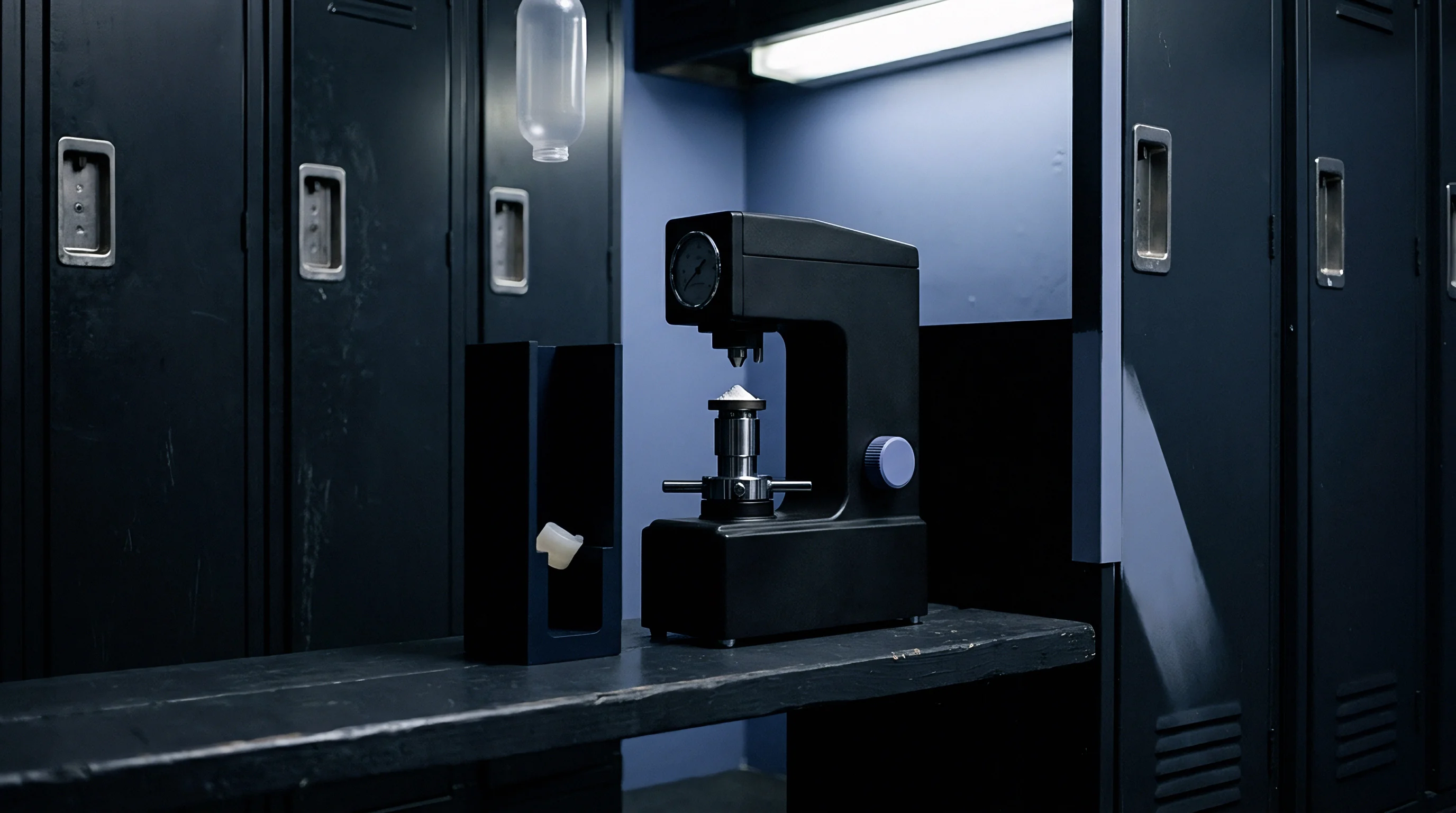
Is Rapid Quenching Permissible under ASTM D4703?
Rapid ice-water quenching is permitted under ASTM D4703 Procedure B, but it produces the lowest crystalline fractions. Quenched specimens exhibit substantial density drift over time as amorphous fractions relax toward equilibrium. Laboratories testing quenched plaques obtain readings up to 0.008 g/cm3 lower than laboratories using Procedure C on identical resin lots.
| ASTM D4703 Procedure | Cooling Rate Specification | Mean Density (g/cm3) | Crystallinity Level (%) | Gradient Accuracy (+/- g/cm3) |
|---|---|---|---|---|
| Procedure A | Natural cooling (10-15 deg C/min) | 0.9525 | 68.4 | 0.0003 |
| Procedure B | Quench in ice water (>100 deg C/min) | 0.9460 | 62.1 | 0.0005 |
| Procedure C | Controlled (15.0 +/- 0.5 deg C/min) | 0.9538 | 69.8 | 0.0002 |
| Procedure D | Slow cooling (5.0 deg C/hour) | 0.9582 | 74.2 | 0.0002 |
Sourcing engineers face systematic discrepancies when inspecting resin data. Resin producers typically quote density based on Procedure C or fully annealed specimens. Processors running injection molding tools or blown film lines experience cooling rates exceeding 300 degrees Celsius per minute, yielding parts with density values significantly lower than the incoming resin certificate indicates.
Specimen preparation variables that distort gradient column readings include:
- Microscopic void inclusion causes buoyant upward forces that register as lower resin density during column immersion.
- Specimen surface wetting failures trap air bubbles against the polymer skin, displacing liquid and corrupting equilibrium float depth.
- Liquid absorption into low-density copolymer matrices shifts specimen mass upward during extended column settling times.
- Thermal jacket drift alters fluid density profiles across the column height, creating non-linear calibration distortions.
A buoyant bubble on a polymer edge corrupts column precision instantly.
Resin suppliers frequently claim their production lots met catalog specifications when tested under internal laboratory conditions.
Arbitration
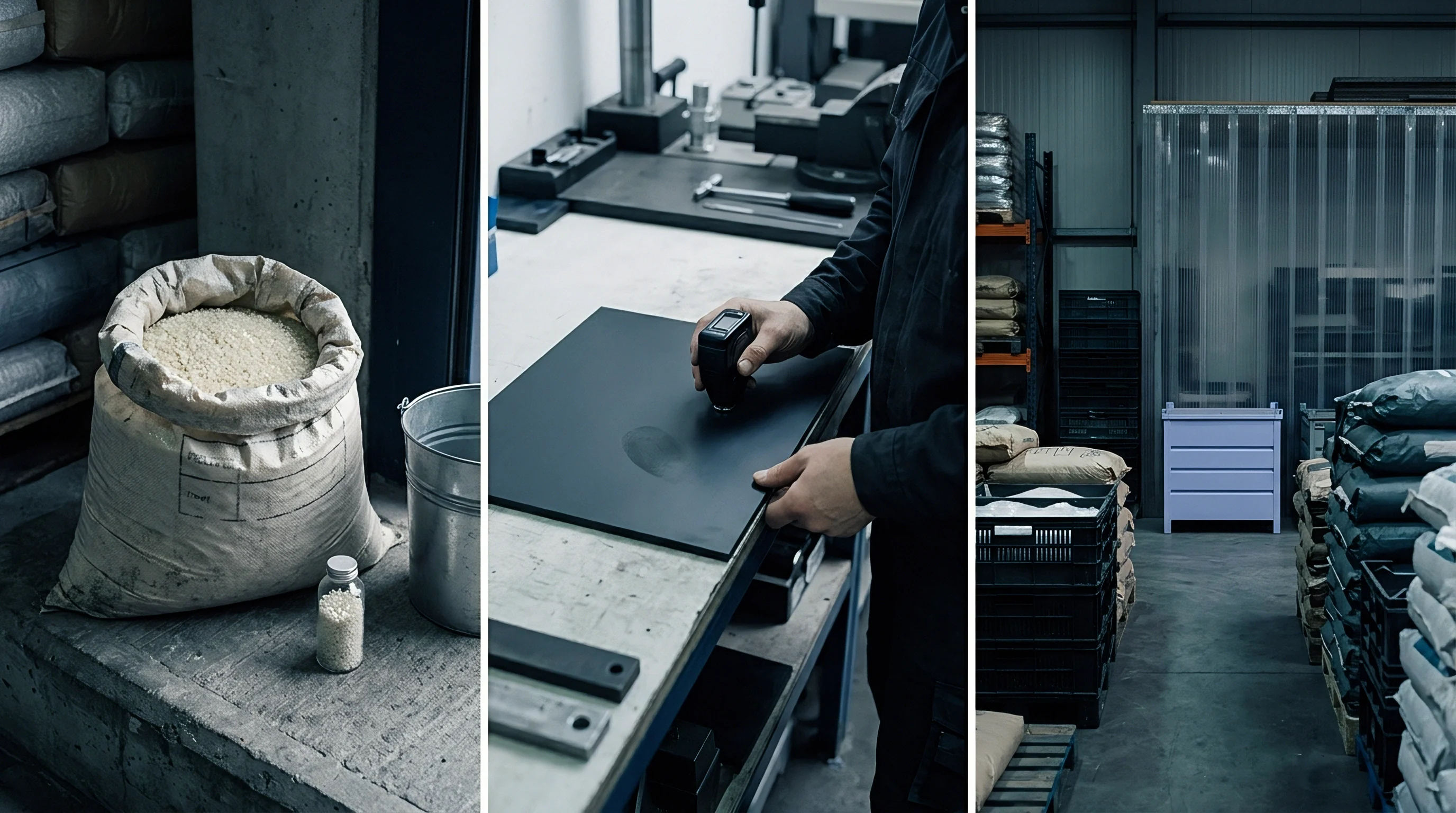
Commercial lot disputes over delivered resin density require strict test method alignment. Sourcing agreements that specify raw density without defining sample preparation, cooling procedure, and conditioning intervals expose buyers to unrecoverable material rejections. When a shipment of film-grade linear low-density polyethylene arrives with an apparent density of 0.916 g/cm3 against an invoice specification of 0.920 g/cm3, resolving the claim depends entirely on specimen thermal history.
A buyer evaluating a 50-tonne railcar lot assumes a baseline purchase price of 1,300 USD per tonne for prime fractional-melt copolymer. An apparent density shortfall of 0.004 g/cm3 shifts the resin from the specified 0.920 g/cm3 film bracket into a lower-modulus class, jeopardizing film dart impact performance and line productivity. Retesting without standardized Procedure C annealing creates false claims that collapse during technical dispute hearings.
Dispute settlements require testing three distinct specimen sets:
- As-received pellet buoyancy provides immediate screening data but carries variable thermal history from compounding underwater pelletizers.
- Standardized compression plaques prepared under ASTM D4703 Procedure C establish the baseline for resin specification compliance.
- Oven-annealed plaques conditioned at 100 degrees Celsius for one hour isolate chemical branch distribution from kinetic freezing artifacts.
Differential scanning calorimetry complements gradient column data during grade arbitration. Melting enthalpy measurements per ISO 11357-3 calculate absolute weight-fraction crystallinity based on a reference heat of fusion of 293 J/g for 100 percent crystalline polyethylene. Combining column density with thermal enthalpy data identifies whether a deficient density reading stems from resin branching or hasty cooling during sample preparation.
Precision testing protects purchasing margins across commercial polyolefin contracts. Clarifying plaque cooling rates in procurement dossiers aligns supplier certificates with incoming verification data.