Calculating Unit Amortization Rates for Cross Border Machining Cell Investments
Unit amortization rates divide landed cell capital including tariffs and rigging by realistic spindle hours multiplied by verified part cycle times.
Bench
Machining cell amortization converts discrete capital outlays into a predictable per-part expenditure. When establishing a dedicated manufacturing cell across sovereign borders, calculating this rate demands direct inclusion of landed infrastructure expenditure alongside physical cycle constraints. The unit amortization rate equals total capitalized cell investment divided by the net contract production volume adjusted for overall equipment effectiveness.
Calculating this rate without accounting for landed freight, import duties, and initial scrap yields understates the true capital cost per component.
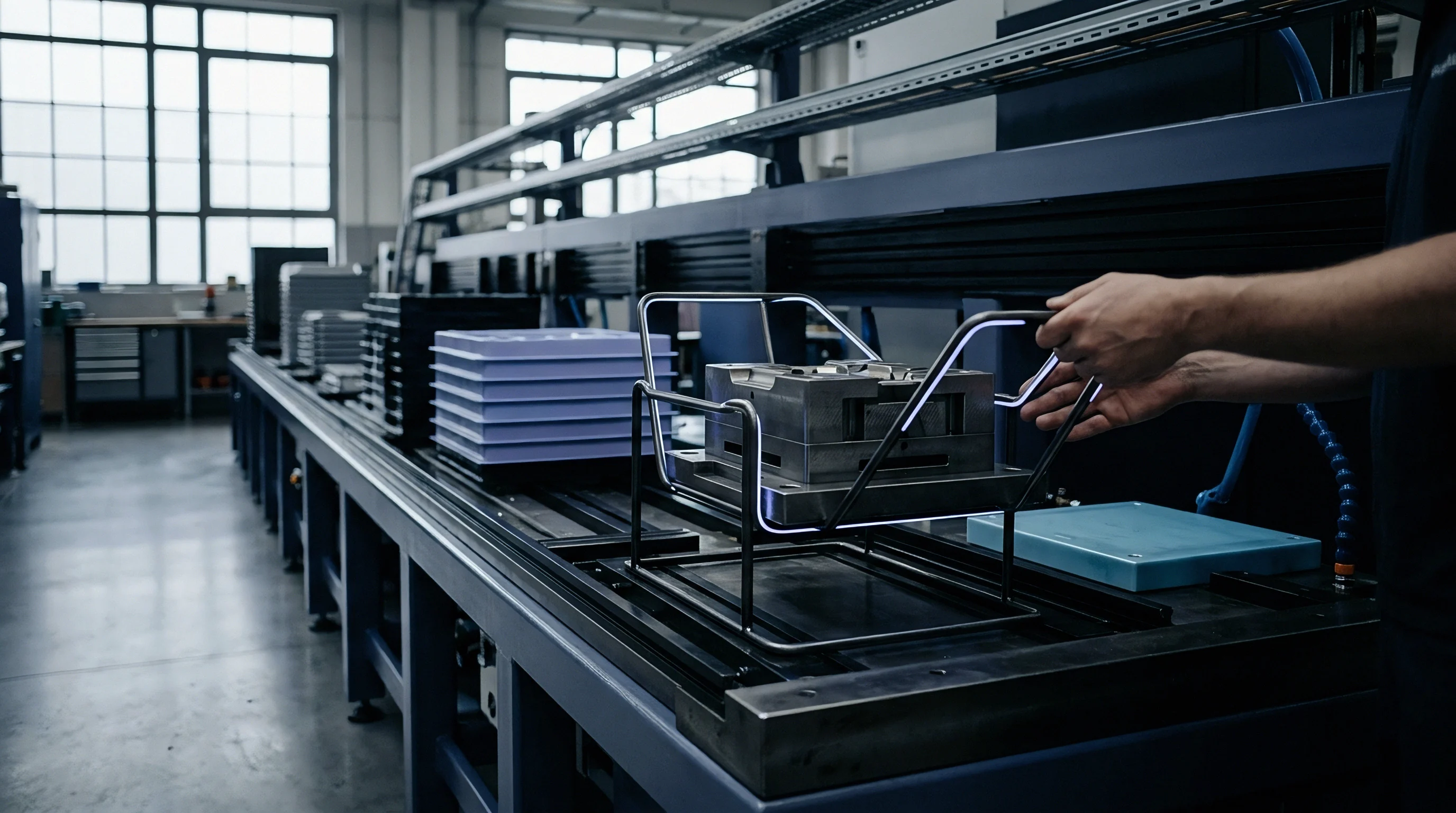
A multi-axis automated milling unit represents a integrated production ecosystem rather than a standalone machine tool. The capital base includes the core CNC machining centers, automated pallet changers, zero-point clamping receivers, tombstone fixtures, end-of-arm robotic tooling, laser tool setters, and co-located coordinate measuring machines. Pre-production software integration, post-processor development, and cell-level programmable logic controller engineering form part of this original capital sum.
Assigning a generic machine-hour rate across diverse part geometries obscures the dynamic cost profile of complex multi-part runs.
Capital recovery rates collapse when target production volumes are set against rated machine capacity rather than audited spindle hours.
Cell capacity calculations depend on actual cutting hours rather than total available clock hours. Standard operational planning assumes 8,760 available hours annually in a continuous three-shift environment. Machine maintenance, tool changeovers, chip removal, and workpiece inspection reduce effective spindle run time.
High-precision aluminum structural aerospace components or titanium medical implants often demand process windows where spindle availability stabilizes between sixty-two and seventy-eight percent. Tooling wear impacts unit cost. Dividing capital costs across unadjusted rated machine hours guarantees an unrecovered debt balance at program termination.
Physical setup configuration sets the baseline unit volume baseline. Dual-spindle 5-axis cells equipped with a linear pallet pool allow continuous raw material loading without halting active cutting cycles. Single-table configurations compel the operator to pause spindle motion during workpiece unloading, driving down cell availability.
Calculating amortization on a part-by-part basis requires mapping part geometry directly to table index seconds and spindle cutting seconds. The geometric complexity of the part defines the required axes of motion, which directly dictates the capital scale of the cell selected for the line.
Cell integration spending scales non-linearly when production moves to offshore facilities. Power infrastructure stability, foundation reinforcement, compressed air drying systems, and environmental climate control units add significant capital costs to the primary equipment bill. Failure to add these facility prep expenses into the amortization pool inflates the apparent profitability of the cross-border allocation during initial board approvals.
Operational capital allocation models achieve balance when peripheral automation expenditures match the useful economic lifespan of the primary machine beds.

Border
Cross-border asset movement introduces tariff structures, international logistics fees, and non-refundable tax assessments that alter the capital base. Machinery classified under Harmonized System Code 8457.10 for machining centers carrying automatic tool changers incurs import duty rates ranging from zero to twelve percent depending on the destination country and bilateral trade agreements. Freight forwarders add heavy-lift transport surcharges, ocean transit insurance, and port handling fees that expand the asset acquisition expense beyond the ex-works machine quotation.
Landed Capital Factor Components
Capitalizing cross-border cell installations requires tracking four distinct expenditure channels that merge into the fixed asset ledger prior to asset depreciation:
- Hardware Acquisition covers the core machining centers, sub-spindles, rotary tables, high-pressure coolant units, and primary machine options delivered at the vendor factory floor.
- Logistics and Transfer incorporates intermodal container transport, specialized export crating, ocean freight, port terminal handling, and air-suspension trucking from port to site.
- Fiscal Clearance includes non-recoverable customs duties, import tariffs, administrative customs broker fees, and non-creditable portions of value-added import taxes.
- Integration and Rigging accounts for millwright rigging services, floor anchoring, laser alignment, transformer installation, local electrical certification, and vendor commissioning fees.
Incoterms DDP destination clauses transfer import duty liability and customs clearance delays back to the equipment integration vendor.
Tariffs shift landed values. When importing high-speed machining cells into jurisdictions enforcing localized content policies, machinery imported without localized ancillary equipment often faces penalty tariffs. Importing a cell with pre-installed robotic loading arms may reclassify the shipment under HS Code 8479.50, changing the applicable baseline duty rate.
Sourcing managers determine exact tariff classifications prior to signing purchase orders to avoid unexpected tax assessments upon port arrival.
| Cost Component | Direct Import Model | In-Bond / Free Trade Zone Model | Impact on Amortization Base |
|---|---|---|---|
| Primary Machine Duty (HS 8457) | 4.2% to 8.5% paid at entry | Deferred until domestic market entry | Adds directly to depreciable asset value |
| Import Value Added Tax | Fully creditable within 60 days | Exempt while inside zone | Excluded from capitalized base if refunded |
| Export Crating & Transport Insurance | 1.5% to 3.0% of FOB value | 1.5% to 3.0% of FOB value | Capitalized into primary machine cost |
| Local Installation & Millwright Rigging | Direct local service payment | Direct local service payment | Capitalized as site installation expense |
Value-added taxes paid at entry present distinct accounting choices depending on regional tax law. In jurisdictions where import value-added tax is fully creditable against domestic sales tax liabilities, the tax amount remains outside the amortized capital base. In territories where cross-border services or imported capital equipment carry non-refundable turnover taxes, those taxes form a permanent component of the localized asset base.
Sourcing practices model both scenarios to establish true landed unit costs.
Under standard equipment sales agreements, the delivery terms clause reading Equipment risk of loss and title transfer upon physical arrival at the buyer plant, with import duties and customs clearance executed under Incoterms 2020 DDP terms transfers all import compliance costs and customs variance risks into the seller landed invoice price.
Arithmetic
Calculating the unit amortization rate requires combining capital acquisition costs, useful asset lifespan, expected operational efficiency, and anticipated component volume. The standard linear unit amortization formula distributes the landed capital investment across total expected good parts. Yield losses escalate expenses.
Unit Amortization Rate Equation Structure
The mathematical formulation for the Unit Amortization Rate (UAR) expresses capital recovery per part as a function of landed cell cost, net asset residual value, program volume, and operational yield factors:
UAR = ( C_total – V_residual ) / ( V_contract Y_first OEE )
Where C_total represents the total landed capital cost including freight, duty, and installation. V_residual reflects the forecasted net resale value of the cell at the conclusion of the production contract. V_contract indicates the total target production volume agreed upon in the supply contract.
Y_first represents the first-pass structural machining yield percentage. OEE expresses the overall equipment effectiveness factor combining availability, performance rate, and quality output.
Consider a practical scenario involving a dedicated two-machine 5-axis horizontal machining cell producing structural aluminum transmission housings. The total ex-works quote for the cell hardware equals 1,250,000 USD. Shipping, export crating, ocean transit, and port fees total 85,000 USD.
Import duties sit at 4.5 percent on hardware, adding 56,250 USD. Rigging, foundation isolation pads, local electrical hookup, and vendor commissioning total 110,000 USD. The total capitalized cost C_total reaches 1,501,250 USD.
Assume the contract specifies a volume of 450,000 units over a five-year lifecycle. At program conclusion, the cell carries an estimated residual value V_residual of 250,000 USD based on secondary market machinery valuations. The net capital to recover equals 1,251,250 USD.
If the cell operates at a theoretical one hundred percent efficiency with zero scrap, the raw unit amortization rate equals 2.78 USD per part.
Spindle availability drops below sixty-eight percent when automated pallet changers lack vibration telemetry on secondary index pins.
Real-world process dynamics ruin raw theoretical assumptions. Machining aluminum structural castings involves first-pass scrap rates due to casting porosity, tool breakages, and dimensional drift caused by thermal expansion. Assume an audited first-pass yield Y_first of 96.5 percent.
Further assume an operational OEE factor of 78.0 percent across the multi-shift lifecycle, accounting for planned maintenance, operator delays, and tool offset adjustments. The effective production volume drops from 450,000 planned parts to 338,715 accepted parts. Re-calculating the equation yields a true Unit Amortization Rate of 3.69 USD per part, representing a 32.7 percent increase over the raw theoretical figure.
How Far Does Spindle Utilization Shift Unit Amortization?
Spindle utilization shifts unit amortization exponentially as runtime hours diverge from planned targets. Machine tools incur fixed capital depreciation regardless of whether the spindle turns. When cell utilization falls due to erratic order releases or poor material staging, the fixed capital recovery burden per operating hour rises instantly.
Sourcing teams calculate sensitivity models across multiple utilization bands to set clear contract volume floors.
| Annual Spindle Hours | OEE Factor | First-Pass Yield | 5-Year Good Yield (Units) | Effective Unit Amortization Rate |
|---|---|---|---|---|
| 6,000 (3-Shift Full Run) | 85.0% | 98.0% | 425,340 | 2.94 USD |
| 4,800 (3-Shift Standard) | 78.0% | 96.5% | 338,715 | 3.69 USD |
| 3,600 (2-Shift Standard) | 72.0% | 95.0% | 246,240 | 5.08 USD |
| 2,400 (Low Demand Run) | 65.0% | 92.0% | 143,520 | 8.72 USD |
Ignoring operational scrap and cell downtime when fixing unit amortization rates forces the machine shop to absorb unrecovered machine costs within their operating margins, leading to eventual supplier insolvency or mid-program price renegotiation requests.
Degradation
Machining cells undergo physical degradation that directly alters capital amortization math over multi-year cycles. Mechanical wear degrades spindle bearing concentricity, ball screw lead accuracy, way cover seals, and rotary table index repeatability. As mechanical backlash increases, machining tolerances widen, requiring slower cutting feed rates or secondary manual finishing operations.
This degradation reduces effective cell output capacity over time, pushing unit amortization rates higher in the later stages of the machine life cycle.
High-speed milling spindles operating continuously above 18,000 RPM require complete rebuilds every 6,000 to 10,000 operating hours. Ball screw assemblies and linear guideway trucks require replacement after roughly 20,000 hours under heavy roughing loads. Coolant systems suffer particulate build-up that wears internal high-pressure pump impellers, reducing coolant pressure through the spindle tool tip.
Sourcing teams build these scheduled capital rebuild reserves into the overall asset amortization structure from day one.
Cell Mechanical Subsystem Failure Modes
Tracking physical subsystem wear allows predictive inclusion of capital maintenance events within the amortization schedule:
- Spindle Bearing Runout Escalation degrades dynamic tool concentricity, producing micro-chatter marks that demand reduced feed rates and lower part throughput.
- Ball Screw Backlash Acceleration causes pitch errors during high-speed contouring, requiring structural component rework and increasing scrap rates.
- Linear Guide Carriage Wear permits table tilting under heavy end-milling cuts, breaking dimensional tolerances on long structural aerospace components.
- Pallet Receiver Alignment Decay leads to unrepeatable zero-point datum locations during pallet transfers, causing misaligned pocket features.
Maintenance reserves directly modify hourly machine rates. Setting aside dedicated funds for major mechanical overhauls prevents sudden cash flow shocks during mid-life cycle refurbishments. A machining cell operating without a mechanical maintenance reserve eventually suffers extended unplanned outages.
Unplanned outages stop cashflow.
- Establish baseline machine tool accuracy standards using ISO 230-2 laser interferometry measurement protocols during initial factory acceptance testing.
- Calculate required annual maintenance reserves by taking six percent of original hardware capital value for light-alloy cutting cells or ten percent for hard-metal titanium cutting cells.
- Divide the annual maintenance reserve figure by target planned spindle operating hours to yield the hourly maintenance reserve rate.
- Multiply the hourly maintenance reserve rate by the part cycle time in hours to establish the per-unit maintenance cost component.
- Add the per-unit maintenance cost component directly into the total unit amortization formula alongside primary hardware depreciation.
When requesting coverage for secondary spindle overhauls after tool crash events, tooling vendors typically state that machine tool geometric alignments and spindle bearing lifetimes published in sales catalogs apply exclusively to continuous cuts under ideal laboratory vibration conditions.
Ledger
Cross-border financial reconciliation requires managing currency risks, residual asset value transfers, and taxation rules across both exporting and importing entities. Capitalizing a machining cell in foreign currency exposes the buyer to exchange rate fluctuations between the equipment purchase date and the final payment milestone. If a cell is purchased in Euros but amortized against a component supply contract paid in US Dollars, exchange shifts alter the underlying capital recovery rate instantly.
Currency swings distort balances. Sourcing organizations utilize dual-currency amortization tracking models to maintain visibility over real capital recovery rates. Forward exchange contracts or currency hedging options lock in the foreign exchange rate for capital equipment purchases, eliminating currency variation from the baseline unit amortization equation.
Unamortized asset balances ought to transfer to foreign production subsidiaries at Net Book Value to avoid triggering local stamp duties.
Early contract termination presents significant financial risk when machining cells are dedicated to a single customer product line. If a buyer cancels a manufacturing contract three years into a five-year agreement, unamortized asset balances must be settled. Contract clauses define whether the buyer purchases the remaining asset balance at net book value, pays an early termination fee equal to unrecovered capital, or allows the supplier to repurpose the equipment while paying a liquidated damages fee based on remaining targeted volumes.
Asset title ownership defines cross-border legal remedies. When the buying firm funds the machining cell directly, title remains with the buyer while the physical equipment resides in the foreign supplier facility. This structure requires clear international bailment agreements, explicit machinery tagging, and public asset registry filings within the host country.
Foreign tax authorities may view buyer-owned equipment located at a supplier site as a permanent establishment, potentially exposing the buying entity to local corporate tax liabilities. Sourcing practices draft equipment lease and bailment contracts to mitigate cross-border tax exposure while protecting capital investments.
How balance sheet asset values reconcile when cell relocations occur across international tax jurisdictions remains an open structural question for finance teams managing global manufacturing footprints.