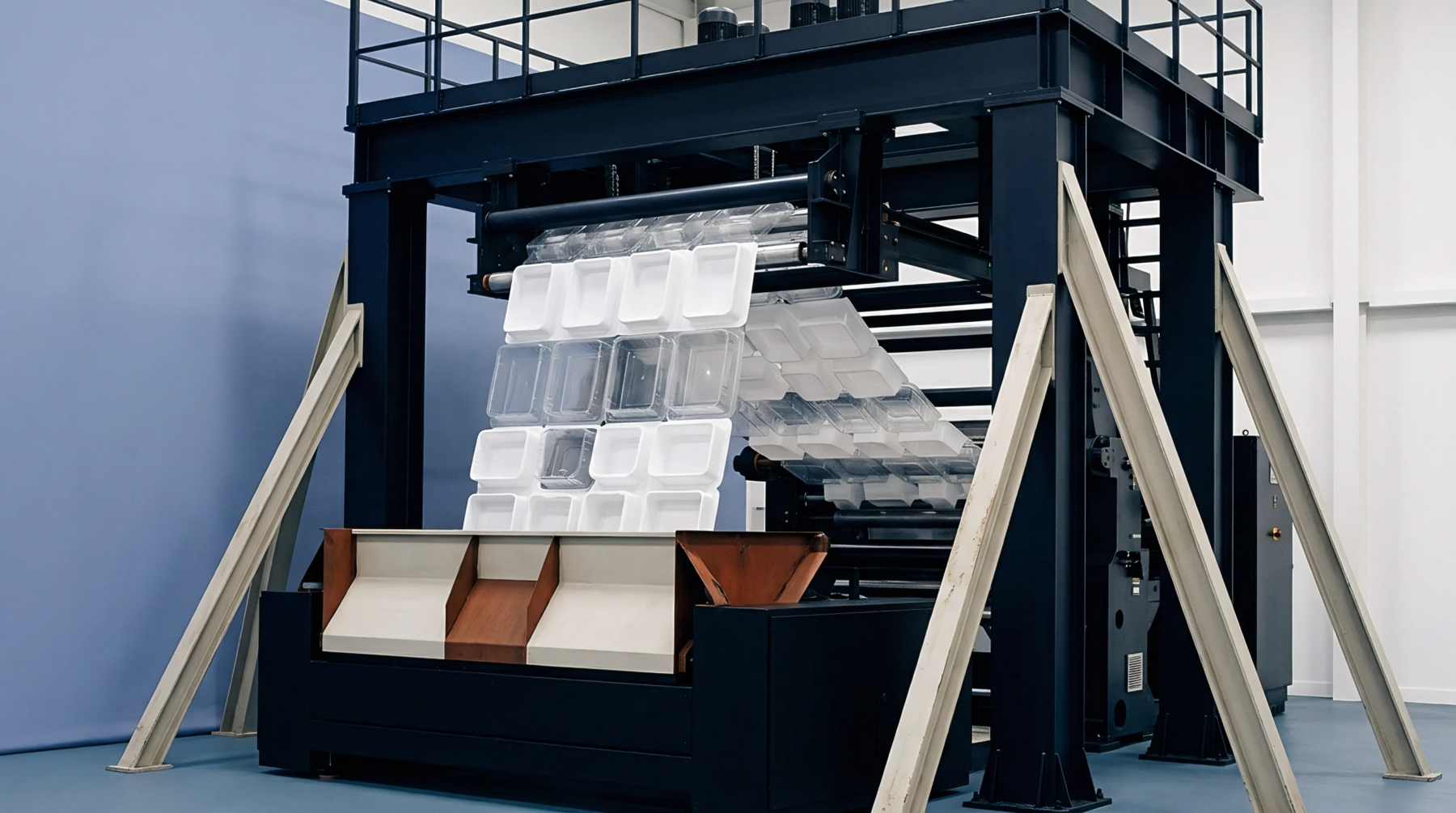
Food Contact Declarations for Custom Molded Plastic Components
Food contact declarations for custom molded plastics require finished part migration testing to cover processing degradation and additive changes beyond raw resin certificates.
Polymeric component fabrication requires custom injection molding when standard catalogue geometries fail to satisfy strict assembly requirements or functional demands. This manufacturing method forces softened thermoplastic or thermoset pellets under high pressure into a matched steel cavity where the material solidifies into a net shape part. Tooling boundaries, melt temperature, and packing pressure dictate whether the resulting geometry matches the mathematical CAD model or suffers from warp, sink marks, and dimensional drift.
Process engineers must establish cavity pressure curves during initial sampling trials to separate the material specification of the raw resin from the actual mechanical performance of the moulded component. Virgin polymer behaves predictably under shear stress during plastication, whereas regrind introduces viscosity variations that alter volumetric shrinkage rates across the tool. A laboratory datasheet provides baseline melt flow indices under ideal testing conditions, but the processor on the shop floor must compensate for pressure drops within the hot runner manifold to hold tight tolerances across a multi cavity production run.
Steel selection dictates the longevity and thermal conductivity of the mould base used in custom injection molding operations. P20 tool steel suits prototype runs or moderate production volumes, whereas hardened H13 or stainless steel alloys withstand abrasive glass filled resins over millions of cycles without gate wear. Cooling channel placement determines cycle time by extracting thermal energy evenly from the core and cavity halves.
Poor thermal management creates localized hot spots, which generate differential shrinkage and force the part out of tolerance upon ejection. Toolmakers must balance runner balance with gate size to prevent shear degradation of heat sensitive polymers during the filling phase.
Volumetric contraction occurs as the molten polymer transitions from a liquid state to a solid crystal or amorphous matrix inside the closed mould. Semi crystalline polymers exhibit higher shrinkage rates than amorphous alternatives because molecular chains pack tightly into ordered domains during cooling. Process technicians manipulate holding pressure to pack additional material into the cavity as cooling progresses, which compensates for initial volume reduction and prevents voids from forming at thick wall intersections.
Variations in barrel temperature profile alter the molecular weight distribution of the melt, changing the viscosity and ultimately shifting the final dimensions of the part away from nominal specifications.
Operating limits define the narrow band of temperatures, pressures, and speeds where custom injection molding yields defect free components. Injection velocity must remain high enough to prevent premature freeze off in thin wall sections, yet low enough to avoid molecular orientation and high internal stress concentrations. Clamp tonnage prevents the parting line from flashing under the extreme hydraulic forces generated during the packing phase.
Operators monitor machine feedback logs continuously to detect viscosity shifts caused by moisture absorption in hygroscopic resins or barrel degradation during prolonged production pauses.
Food contact declarations for custom molded plastics require finished part migration testing to cover processing degradation and additive changes beyond raw resin certificates.
Expertise is a utility, not a secret. sentiention™ publishes its working knowledge as open reference: intelligence layer covering the materials it sources, the markets it enters, and the reference that serves both.