Meaning
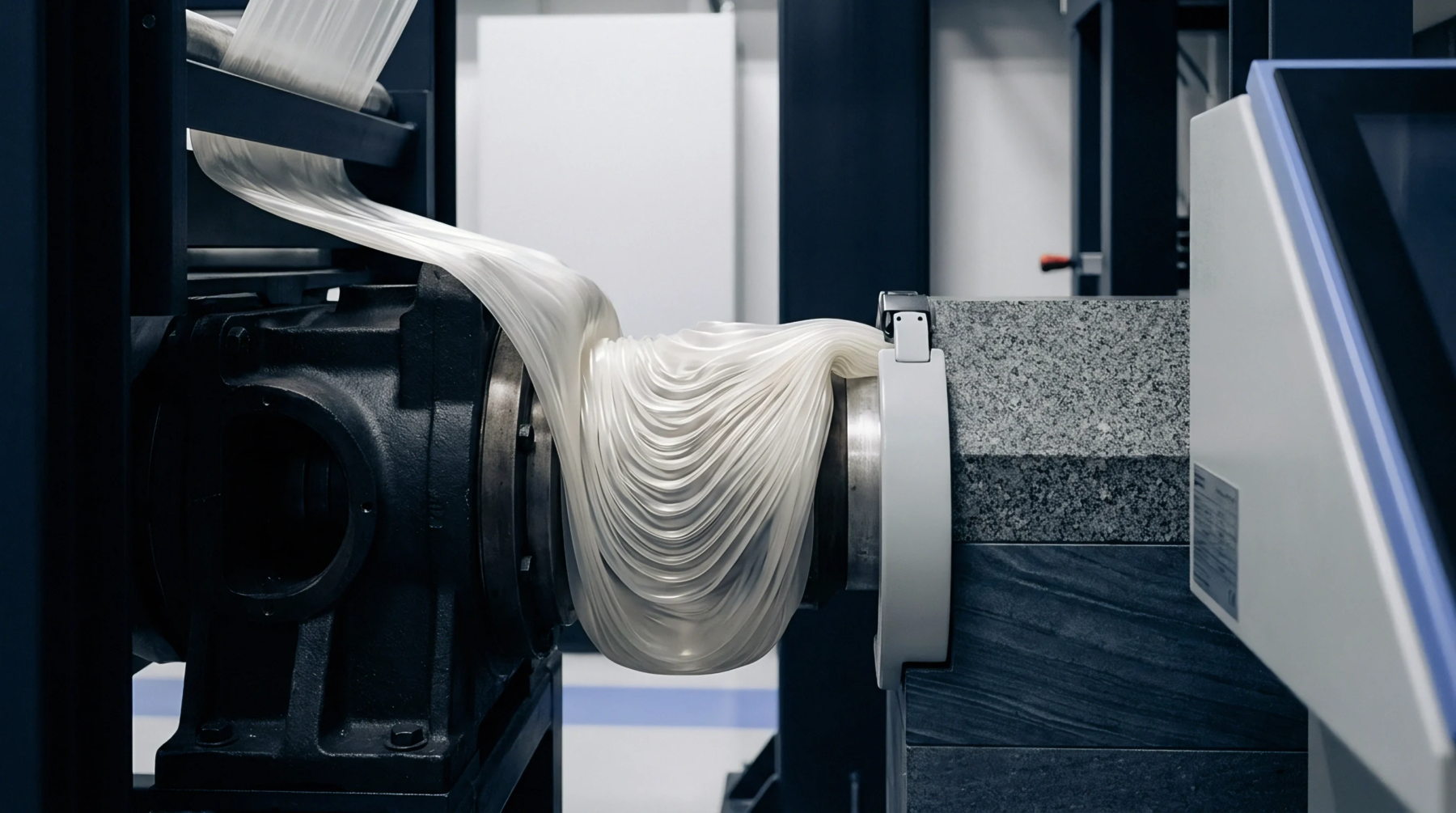
Non-Newtonian flow behavior defines the change in viscosity of a molten polymer as the speed of deformation increases. Shear rate dependence describes how internal friction between molecular chains drops under high flow velocities within a nozzle or runner system. This physical property prevents a single viscosity measurement from representing material performance across different processing stages.
Melt flow index tests provide only a single point of data at a fixed load, failing to predict how a resin behaves when forced through narrow gates at high velocities.
Rheological Profile
Polymers behave like complex liquids where viscosity responds inversely to the applied velocity gradient. Low flow speeds allow molecular entanglements to reform constantly, maintaining a higher resistance to movement. High velocity gradients stretch and align the polymer chains along the direction of flow, reducing resistance to movement.
This reduction in viscosity permits lower injection pressures during mold filling even when working with high molecular weight resins.
Process Efficiency
Injection molding machinery converts electrical energy into hydraulic pressure to overcome the resistance of moving polymer melt. Engineers adjust injection speed profiles to align with the flow behavior of a specific resin grade. High speeds lower the viscosity, assisting the filling of thin walls and intricate features without exceeding the clamp force of the press.
Regrind material often displays different flow properties compared to virgin resin because the initial processing cycle breaks down polymer chain lengths. A mismatch between the speed profile and the viscosity change of the material leads to inconsistent part dimensions or burnt edges from excessive shear heating.
Molding Economics
Pressure drop calculations require an accurate understanding of how the resin responds to flow acceleration during the injection phase. Production runs fail when the machine cannot reach target cavity pressures due to an unexpected spike in viscosity at lower flow rates. Precise control over velocity profiles minimizes energy consumption and prevents premature freeze-off in cold runners.
Stable performance relies on holding a consistent shear profile throughout the cavity fill to ensure uniformity between different batches of raw material.