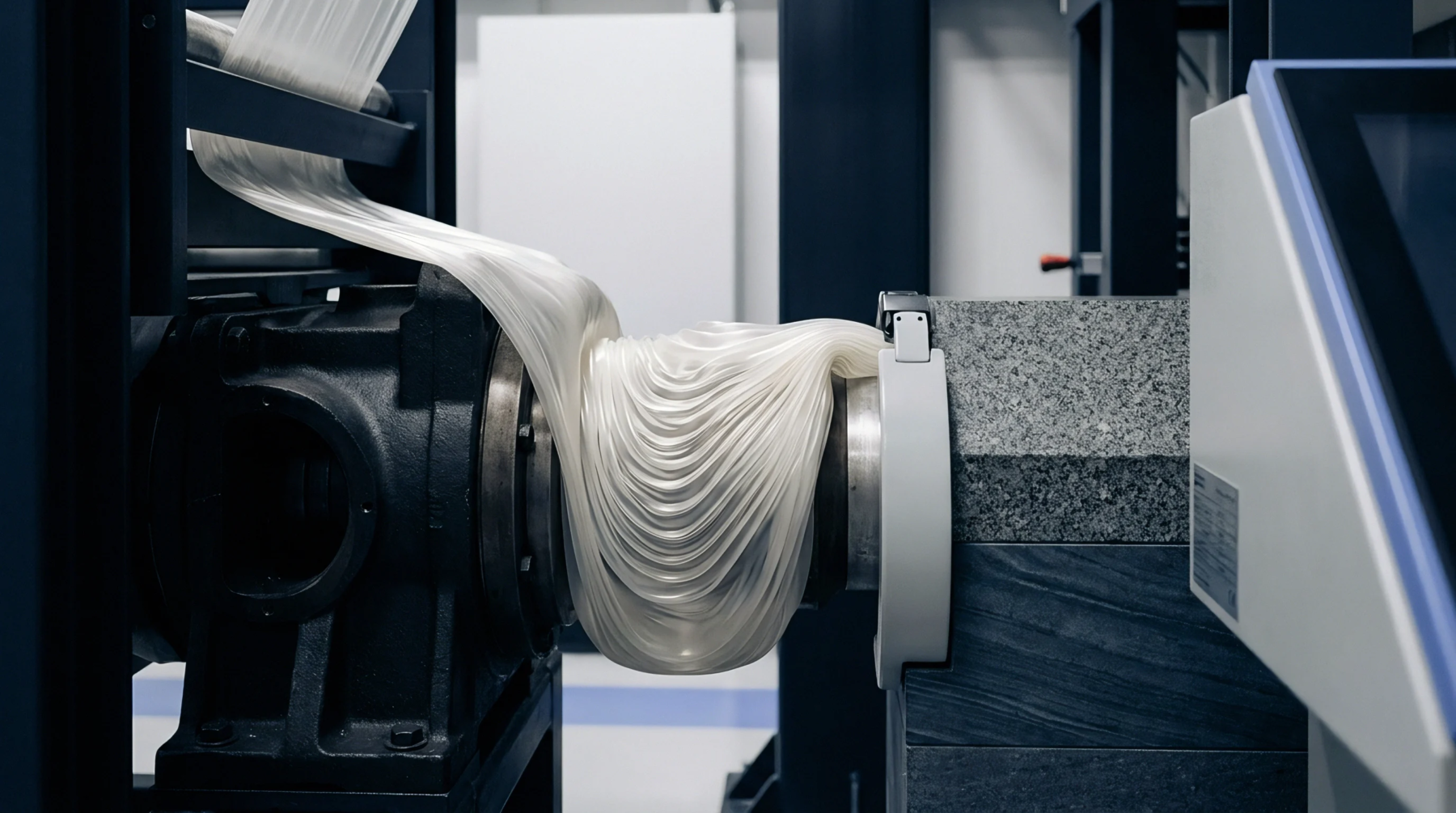
Optimizing Melt Channel Bifurcations to Eliminate Shear Heating Viscosity Gradients
Optimizing melt channel bifurcations with melt rotation geometry and stepped hydraulic diameters eliminates shear-induced viscosity gradients across cavities.
Dimensionless hydrodynamic values quantifying the ratio between viscous heat generation and thermal conduction across flowing polymer melts characterize non-isothermal processing states. Polymer flow through narrow channels dissipates significant mechanical energy as heat while channel walls conduct thermal energy away into mould steel. The Nahme number predicts whether viscous dissipation will alter the fluid velocity profile by significantly reducing local melt viscosity.
Molders and tool designers apply this formulation to analyze high-speed injection operations, extrusion dies, and runner systems where shear stress peaks. Its operational boundary sits within viscous, non-Newtonian flow regimes, losing analytical relevance where inertia dominates viscosity or within stationary, quiescent melt states.
Calculation of the index requires multiplying the temperature sensitivity of viscosity by wall shear stress, mean flow velocity, and characteristic channel thickness, divided by thermal conductivity. A value below unity indicates that thermal conduction into tool walls outpaces viscous heat generation, maintaining a relatively uniform thermal field across the melt stream. When the Nahme number surpasses unity, viscous dissipation outstrips thermal conduction, driving localized temperature spikes near channel walls.
These thermal spikes induce steep viscosity drops along bounding surfaces, altering expected laminar velocity profiles into flattened plug-flow regimes. Injection pressures required to sustain delivery drop unpredictably as local shearing overheats boundary layers. Accurate rheological calculations require accounting for these localized temperature rises rather than assuming isothermal flow conditions across mould cavities.
High values indicate severe internal shear heating within delivery channels, runners, and thin-wall mould cavities. Viscosity drops along channel edges channel the bulk of polymer flow into high-temperature outer shear layers. Core layers remain colder and sluggish, generating deep thermal stratification across the flowing cross-sectional profile.
Downstream gate entries split this heterogeneous melt into separate cavities, inducing severe cavity filling imbalances in multi-cavity injection moulds. Semicrystalline polymers like polyamide and polybutylene terephthalate experience localized variations in crystalline growth rates due to shear-induced temperature variations. Residual stresses freeze into finished parts along these shear boundaries, generating premature mechanical failure points or post-moulding warpage.
Tool engineers leverage calculated indices to optimize injection speeds, runner diameters, and gate dimensions for shear-sensitive resin grades. Processing engineers operating high-speed injection machines adjust injection velocities to constrain the Nahme number within acceptable operational boundaries. Sourcing teams handle polymers with narrow thermal degradation windows, selecting grades with lower temperature coefficients of viscosity to prevent burn defects.
Regrind additions often shift molecular weight distributions, elevating zero-shear viscosities and pushing operational indices into unpredicted dissipation regimes. Lowering injection rates or enlarging gate lands suppresses viscous overheating, preserving polymer chain integrity and stabilizing colour consistency. Controlling viscous dissipation ensures that datasheet mechanical properties match real part performance in serial moulding runs.
Optimizing melt channel bifurcations with melt rotation geometry and stepped hydraulic diameters eliminates shear-induced viscosity gradients across cavities.
Expertise is a utility, not a secret. sentiention™ publishes its working knowledge as open reference: intelligence layer covering the materials it sources, the markets it enters, and the reference that serves both.