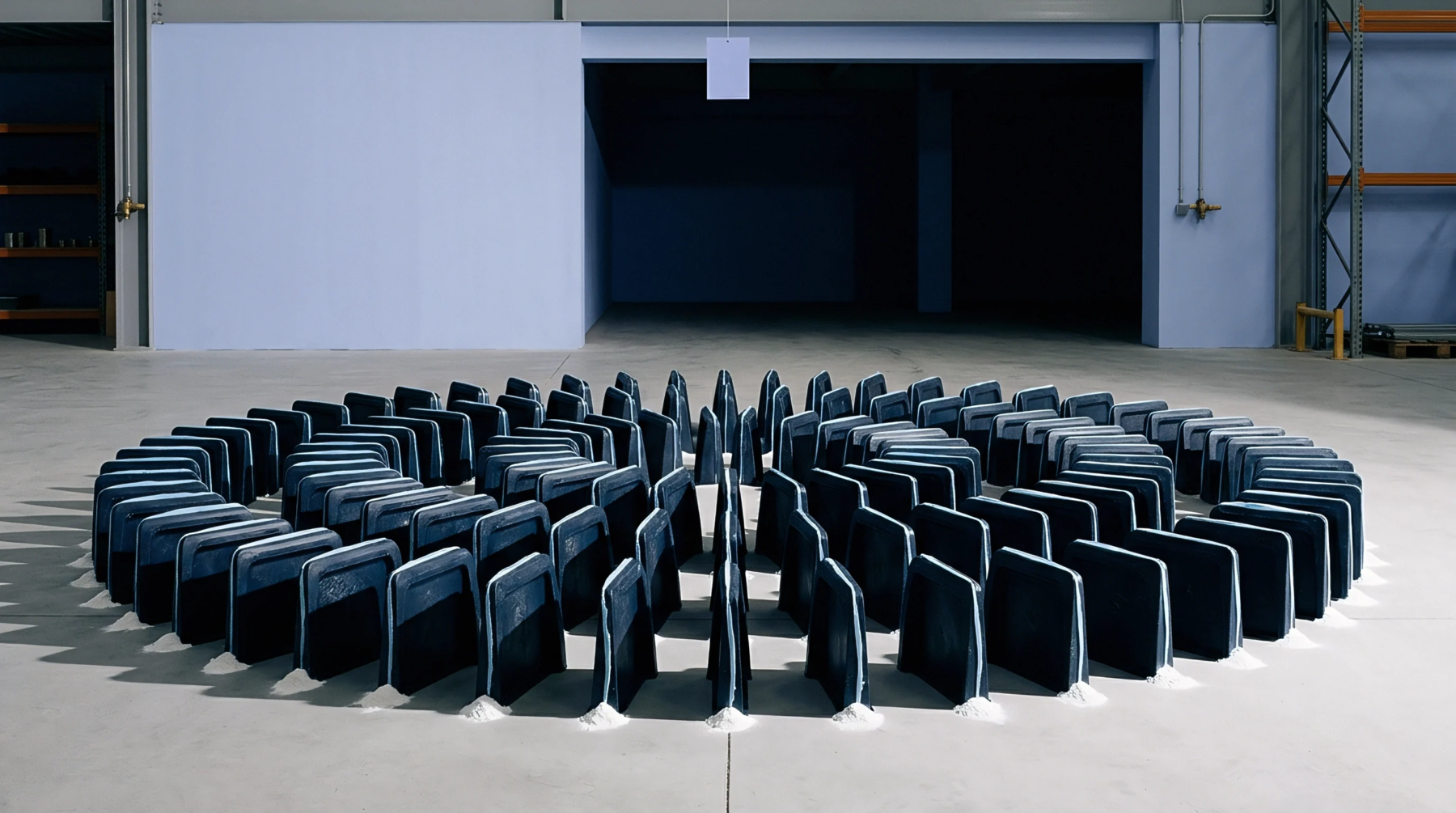
Interfacial Air Entrapment Dynamics Governing Semi Crystalline Resin Shrinkage Variations
Interfacial air entrapment slashes local heat flux by eighty percent, triggering localized spherulitic expansion that drives severe dimensional warpage.
Thermal degradation caused by rapid compressive heating of trapped air pockets within an injection mould cavity during the filling phase produces irreversible polymer scorching and local steel erosion. Under high injection velocities, the advancing polymer melt front seals vents or isolates blind pockets, preventing air and volatile off-gases from exhausting. When compressed instantaneously from atmospheric levels up to melt pressures exceeding one thousand bar without adequate heat dissipation, the trapped volume ignites through adiabatic compression.
This phenomenon, known in tool operations as adiabatic dieseling, leads to carbonised black deposits on the moulded part surface and micro-pitting on hardened cavity surfaces. The mechanism stops occurring when melt-front velocity is reduced before cavity fill completes or when dedicated venting paths relieve the pressure buildup ahead of the advancing melt.
Compressive work performed on captive cavity air converts directly into internal thermal energy when cycle times afford no opportunity for convective heat transfer into the surrounding tool steel. The instantaneous temperature rise follows the Poisson relation for ideal gas compression under adiabatic conditions, driving the pocket temperature beyond the thermal decomposition threshold of the surrounding polymer matrix. Trapped air pockets can reach temperatures exceeding eight hundred degrees Celsius within fractions of a millisecond.
Under these conditions, hydrocarbon bonds in technical resins such as polyamide, polyoxymethylene or polycarbonate rupture instantly, leaving brittle carbonaceous char at the flow convergence point. Volatiles released by the degrading resin further feed the localized combustion process, raising pressures high enough to alter the microstructural temper of the adjoining mould substrate.
Localized combustion releases corrosive chemical fractions that chemically etch and physically cavitate adjacent tool steel inserts. When adiabatic dieseling recurs over thousands of automatic production cycles, the repeated thermal cycling strips away protective passivation films and causes micro-fissuring of cavity surfaces. Hardened tool steels such as AISI H13 or premium stainless grades experience surface tempering and localized pitting, which quickly destroys polished surface finishes.
Pitted vent lands and cavity pockets subsequently seize parts during ejection, necessitating expensive tool room maintenance and EDM re-machining. Component dimensional tolerances fail because the damaged steel geometry alters part boundaries, while carbon buildup insulates subsequent shots from making proper contact with the chilled mould wall.
Vent land geometry along parting surfaces provides the primary mechanical barrier against compressive ignition within the cavity. Steel fabricators machine continuous venting channels around the cavity perimeter, maintaining depths calibrated between 0.010 millimetres and 0.035 millimetres depending on the base polymer viscosity, which allows air to discharge while freezing the incoming melt front. Porous sintered steel inserts placed at final filling points offer a secondary method to exhaust trapped air through permeable metallurgical structures.
Dynamic venting mechanisms that retract ejector pins or slide cores by a fraction of a millimetre during the injection stroke also alleviate air trapping in deep ribs. Balancing runner gates equalizes fill times across all cavities, preventing one cavity from over-pressurizing while neighbouring impressions remain unfilled.
Interfacial air entrapment slashes local heat flux by eighty percent, triggering localized spherulitic expansion that drives severe dimensional warpage.
Expertise is a utility, not a secret. sentiention™ publishes its working knowledge as open reference: intelligence layer covering the materials it sources, the markets it enters, and the reference that serves both.